
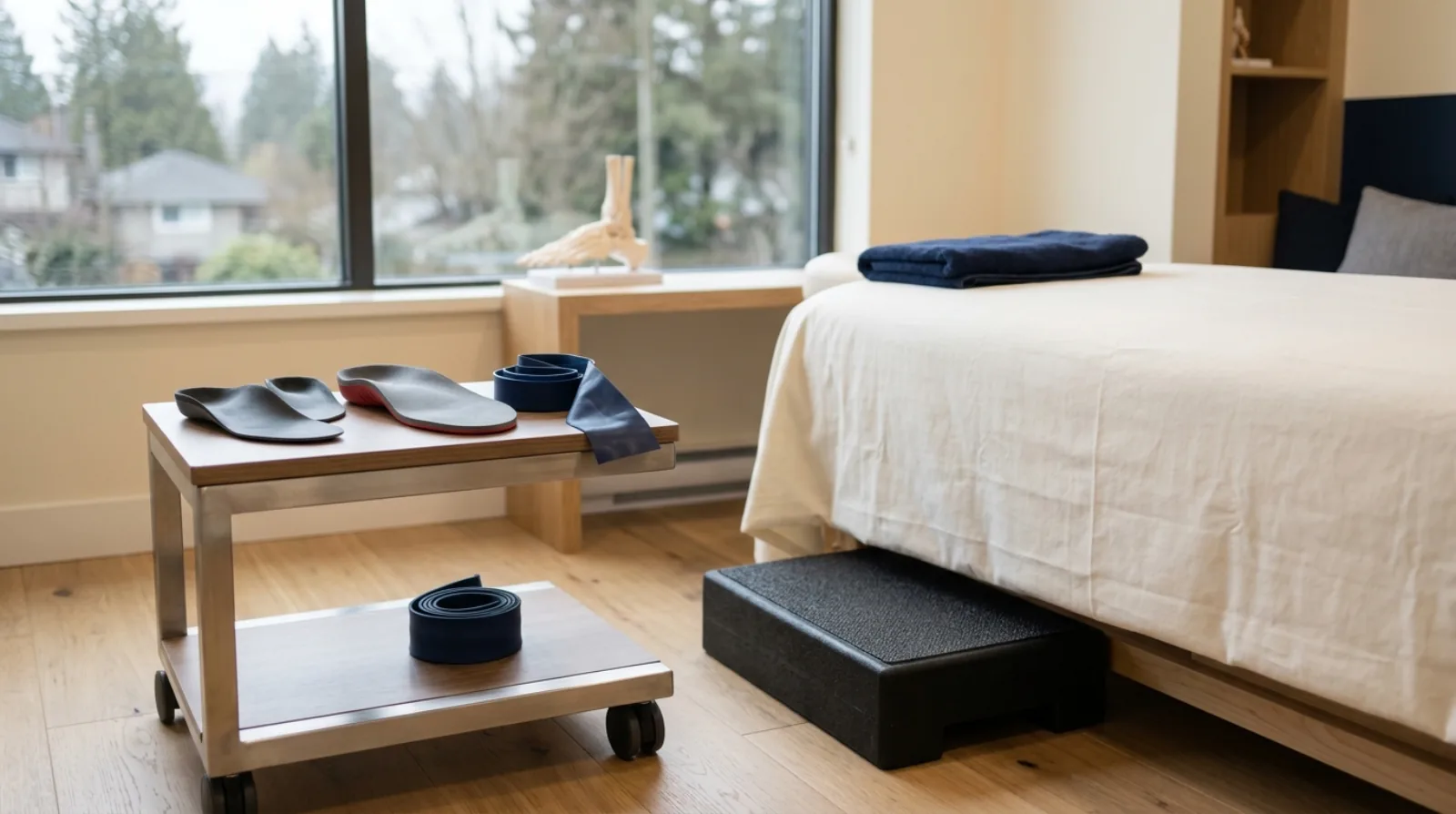
The Arch That Slowly Flattens: Tibialis Posterior Tendinopathy
Pain on the inside of the ankle that comes with an arch quietly dropping is one of the few foot problems where waiting genuinely costs you something.
BY MEDSTAR SPORT PHYSIO TEAM
An arch that is lower than it used to be, paired with an ache along the inside of the ankle, is a specific pattern rather than general foot fatigue.
At Medstar Sport Physio in North Vancouver, pain along the inside of the ankle and arch that comes with a gradually flattening arch usually points to the tibialis posterior tendon, the tendon that helps hold the arch up. The single-leg heel raise is the most useful early test, since it becomes difficult on the affected side well before the foot shape visibly changes. Research on conservative care consistently finds that foot orthoses combined with an exercise programme work better than orthoses alone, and that hip strength is often reduced alongside the local foot impairments. The condition is described in progressive stages, and the earlier ones have more options available, which is why an arch that is changing shape is worth assessing rather than waiting out.
Here is what the tendon does, how this differs from the foot problems it gets confused with, and what a rehabilitation plan actually needs to include.
What the tibialis posterior does all day
The tibialis posterior muscle sits deep in the calf. Its tendon runs down behind the bony bump on the inside of the ankle and fans out to attach underneath the arch of the foot.
Its job is unglamorous and constant. Every time you take a step, it helps control how much the foot rolls inward and helps hold the arch up as your weight passes over it. It also does most of the work of lifting the heel when you rise onto your toes.
When that tendon degenerates and lengthens, the structure it was supporting starts to give. The arch drops, the heel drifts outward, and the front of the foot turns out slightly. This is why the condition is often described in terms of the foot shape rather than the tendon itself.
The pattern that distinguishes it
The pain sits along the inside of the ankle, behind that bony bump, and often continues under the arch. It builds with time on your feet, so it is typically worse at the end of a long day, after a long walk, or after standing at work.
That timing is what separates it from plantar fasciitis, where the classic complaint is a sharp pain under the heel in the first few steps out of bed that eases as you move. Different location, different daily rhythm.
A systematic review published in the Journal of Foot and Ankle Research found that people with this condition showed poor heel-rise endurance, reduced strength turning the forefoot inward, a lowered arch height, and impaired single-leg balance compared with healthy controls. That first one is the useful clinical clue.
The single-leg heel raise tells you early
Stand on the affected leg and lift your heel off the ground. Then do it repeatedly.
On a foot with a healthy tibialis posterior, the heel comes up cleanly and the arch rises with it. On an affected foot, the movement is difficult, the height is reduced, the arch does not lift the same way, or you simply cannot get off the ground on that side. Often the person had no idea until they tried it side by side.
This matters because the test picks up trouble well before the foot shape has visibly changed, and the earlier stages of this condition are where conservative management has the most to work with.
The stages describe a foot that changes shape over time
Clinicians describe this condition in progressive stages, most commonly using the Johnson and Strom or Myerson classification. The early stage involves an inflamed, painful tendon with a foot that still moves normally and no deformity. The next stage involves tendon degeneration and lengthening, with an arch that has flattened but a hindfoot that is still flexible. Later stages involve a hindfoot that has become rigid, and eventually changes at the ankle joint itself.
The practical meaning of that progression is simple. A flexible foot has options a stiff one does not. That is the argument for having ankle-and-arch pain assessed while it is still an ache rather than waiting until the shape has set.
Orthotics and exercise work together, not separately
This is the part where the evidence is unusually clear and unusually often ignored.
Reviews of conservative management for this condition consistently find that foot orthoses combined with an exercise programme produce better outcomes than orthoses alone. Orthoses with a personalised arch support outperform flat insoles. The exercise component varies across the studies, typically including calf stretching and progressive strengthening for the tibialis posterior, but the groups adding exercise to orthoses did better than the groups using orthoses on their own.
That fits how the two things actually work. An orthotic changes the load passing through the tendon on every step, which is genuinely useful for an irritable tendon. It does not make the muscle stronger, and a tendon that stays weak stays vulnerable when you eventually take the insert out or ask more of the foot.
If you are weighing up the insert side of that equation, our guide to custom orthotics versus off-the-shelf inserts covers when the extra cost is justified.
The hip belongs in the plan
The same systematic review found something people find surprising: alongside the local foot impairments, participants also showed reduced hip extensor and hip abductor strength, with a medium effect size.
That fits what we see clinically. The leg works as a chain, and how the hip controls the thigh influences how the foot meets the ground. A rehabilitation plan that treats only the tendon and ignores what is happening further up often plateaus.
This is the same reasoning behind treating shin splints as a load-management problem rather than a local one. The painful tissue tells you where the load landed, not always why.
What rehab tends to involve
The first job is settling an irritable tendon, which usually means reducing the specific activities that spike it, adjusting footwear, and often adding arch support to change the load on every step.
Strengthening then builds progressively. Heel raises are central, first on two legs, then on one, then with added load and more range, because heel-rise endurance is the specific deficit the research identifies. Work strengthening the movement that turns the forefoot inward targets the tendon's own action more directly. Calf flexibility and balance work address the other measured impairments, and hip strengthening addresses the chain above.
Timelines vary with which stage the foot is in, how long it has been going on, and how much time you spend on your feet. In our clinic, the people who progress most reliably are the ones who keep the loading consistent rather than doing a burst of work and then stopping when the ache settles.
When to get it looked at
Pain along the inside of the ankle that has lasted more than a few weeks, an arch that looks lower than it used to, or difficulty rising onto the toes on one side are all worth an assessment, particularly together.
Sudden severe pain, an inability to bear weight, or a foot that changed shape abruptly rather than gradually points somewhere else and needs prompt medical assessment rather than a rehabilitation plan.
Book a 30-minute assessment and we will test the heel raise, look at what the arch is doing under load, and work out whether this needs offloading, strengthening, or both. You can see what we treat or reach the clinic here.
This article is general information, not personal medical advice. A regulated practitioner can confirm whether the patterns described apply to you.
Sources
- Self-reported social and activity restrictions accompany local impairments in posterior tibial tendon dysfunction: a systematic review, Journal of Foot and Ankle Research (2018)
- Orthotic treatment for stage I and II posterior tibial tendon dysfunction: a systematic review, Clinical Rehabilitation (2021)
- Reported selection criteria for adult acquired flatfoot deformity and posterior tibial tendon dysfunction: a systematic review
- College of Health and Care Professionals of BC public registry
Common questions
Frequently asked questions.
How do I know if my arch pain is the tibialis posterior tendon?
The typical pattern is pain and tenderness along the inside of the ankle and under the arch, worse with walking or standing, often with an arch that looks lower than it used to. A physiotherapist checks it with a single-leg heel raise, which is usually difficult or impossible on the affected side well before anything shows up on the other.
Will orthotics fix it on their own?+
Usually not on their own. Reviews of conservative management for tibialis posterior tendinopathy find that foot orthoses combined with an exercise programme produce better outcomes than orthoses alone, and that orthoses with a personalised arch support outperform flat insoles. An insert changes the load passing through the tendon on every step. It does not build strength, and the same research found hip extensor and abductor strength is often reduced too.
Is this the same as plantar fasciitis?+
No. Plantar fasciitis usually presents as sharp pain under the heel, worst in the first steps of the morning. Tibialis posterior pain sits along the inside of the ankle and arch and tends to build with time on your feet rather than peaking first thing.
Can it get worse if I ignore it?+
It can. The condition is described in stages, and the early stages involve a tendon that is painful but a foot that still moves normally, while later stages involve a foot shape that has changed and become stiff. Early stages have more conservative options available, which is why this one is worth assessing sooner rather than later.
Why is my hip involved in a foot problem?+
A systematic review found that people with this condition also showed reduced hip extensor and abductor strength, not just local foot impairments. The leg works as a chain, so a rehab plan that only addresses the ankle often leaves part of the problem in place.
What happens at a first physiotherapy visit for suspected tibialis posterior tendinopathy?+
The physiotherapist tests a single-leg heel raise on both sides, checks tenderness along the inside of the ankle and under the arch, and looks at hip extensor and abductor strength since the two are often linked. The findings are matched against the staging system to work out whether the foot still moves normally or whether shape changes have begun, which shapes what the plan focuses on first.
How long does tibialis posterior tendinopathy take to improve?+
Timelines vary with which stage the foot is in, how long the pain has been present, and how much time you spend on your feet. People who keep the loading consistent, rather than doing a burst of exercise and stopping once the ache settles, tend to progress more reliably. Your physiotherapist sets specific expectations once your stage is clear.
Can I keep walking or exercising with tibialis posterior tendinopathy?+
Often yes, at a modified level, since complete rest does not build the strength the tendon needs and the condition responds to a structured loading programme. Activities that spike pain along the inside of the ankle are usually reduced rather than stopped completely, while heel raises and other targeted strengthening progress in the background. A physiotherapist sets the right activity level for your stage.
Share this post
Copies a ready-to-publish LinkedIn post to your clipboard and opens the LinkedIn share dialog. Paste the text into the composer and publish.
Written by
Medstar Sport Physio Team
Registered clinician at Medstar Sport Physio & Health, North Vancouver.
This article is for general information only and does not constitute medical advice, diagnosis, or treatment. Individual presentations vary, and assessment findings and treatment plans differ from person to person. If you are experiencing severe symptoms, neurological changes (numbness, weakness, bowel or bladder changes), or a significant trauma, contact your physician or emergency services. Care at Medstar Sport Physio & Health is provided by practitioners registered with their respective British Columbia regulatory colleges.
Filed under
- tibialis-posterior
- tendinopathy
- foot-and-ankle
- orthotics
- north-vancouver


