RMT massage
Registered Massage Therapy (RMT) in North Vancouver
Therapeutic and sport massage from a College-registered RMT. Direct-billed to most extended-health plans, ICBC, and WorkSafeBC.
What it is
Registered Massage Therapy (RMT) in North Vancouver at Medstar.
Registered Massage Therapy at Medstar is delivered by a College of Massage Therapists of British Columbia (CMTBC) registrant. RMTs are health-care professionals with a 3,000-hour training program covering anatomy, pathology, clinical assessment, and treatment planning, plus a regulated scope of practice and direct-billing relationships with all major extended-health insurers, ICBC, and WorkSafeBC.
Practically, that means the massage you get here is goal-directed: relieving a specific pain, improving a specific range of motion, or supporting recovery from a specific sport or training load. Sessions are documented like any other clinical visit, and we coordinate care directly with your physiotherapist or osteopath when you're seeing both, so the work stays consistent across appointments.
Most patients book RMT for one of three reasons: persistent muscular tension that's bleeding into headaches, sleep, or work; sport recovery (after a hard training week, or as part of a rehab plan); or as direct-billed treatment for an active ICBC or WorkSafeBC claim, where massage is a covered modality.
How it works
Inside a session.
First visit starts with a structured intake: what's bothering you, what you've tried, what you're trying to get back to, plus any medical history relevant to massage scope (recent surgeries, blood thinners, skin conditions, pregnancy, cardiovascular status). Then a brief physical assessment of the body region you've come for.
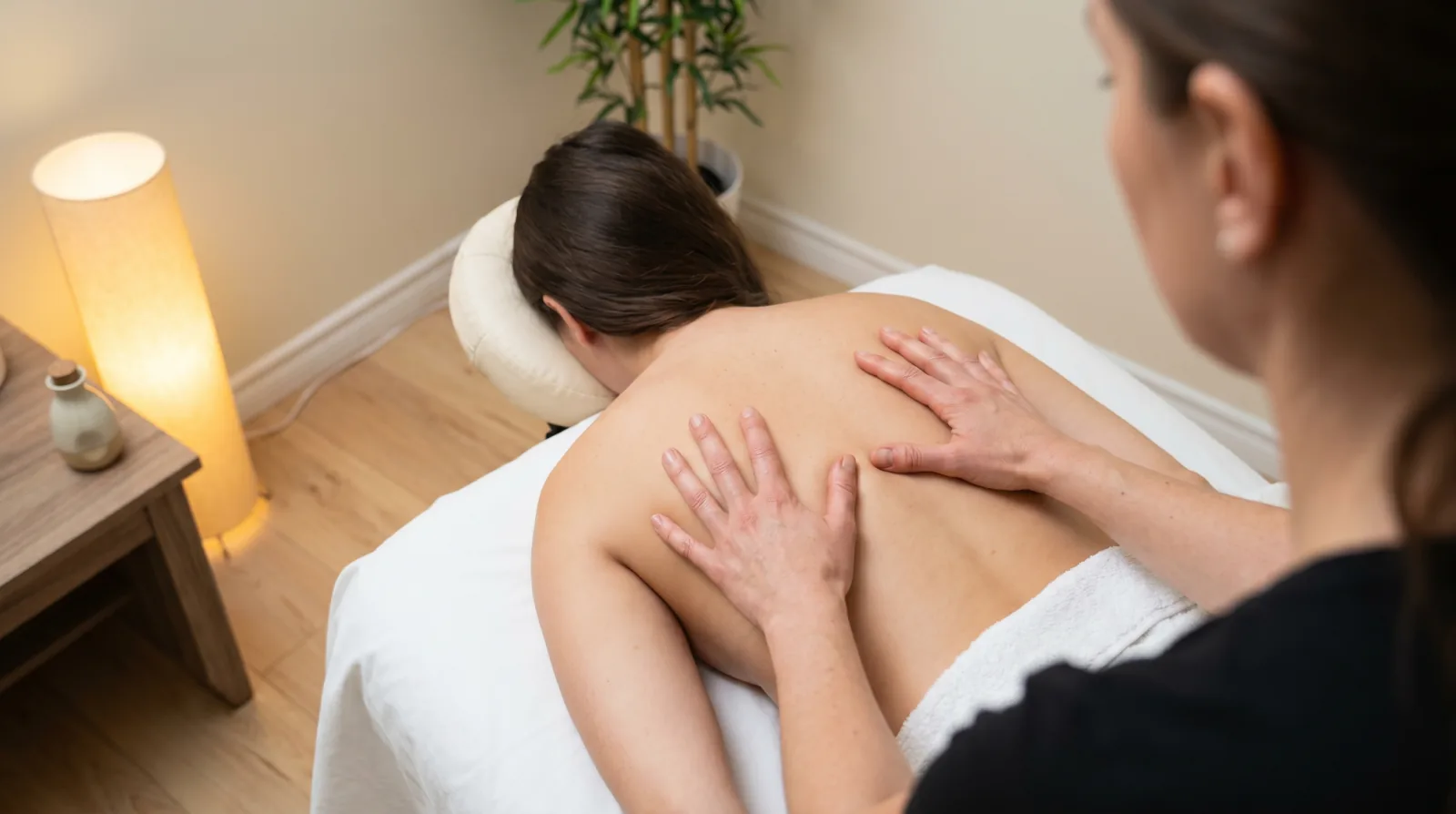
Treatment is 30, 45, or 60 minutes depending on what you've booked and what the case needs. You disrobe to your comfort level in a private treatment room, with full draping at all times, so only the body region actively being worked is uncovered. The RMT will check in on pressure depth and tolerance throughout; deep tissue work should feel like a strong-but-tolerable ache, never sharp pain.
Sessions typically end with a short home recommendation, usually a couple of mobility movements or a stretch sequence to reinforce the change between visits. The RMT may also flag patterns they think your physiotherapist should know about, and we share notes internally when you're seeing both.
Conditions we treat with this
See how registered massage therapy fits into specific recovery plans.
- Low back pain & sciatica: chronic muscular component
- Headaches: tension-type and cervicogenic patterns
- Whiplash & ICBC injuries: direct-billed massage rehab
- Shoulder & rotator cuff: chronic upper trap and posterior cuff tension
- Hip pain: gluteal and lateral hip soft-tissue work
- Runner's knee & IT band: quad, IT band, glute med tension
What to expect
Most patients notice meaningful relief during and immediately after the first session, with cumulative benefit over 3 to 6 sessions for chronic patterns. Acute injury cases often book weekly through the active phase, then taper to bi-weekly or monthly maintenance. We tell you honestly when ongoing massage adds value vs. when the case has graduated to self-care.
Talk to us
Not sure if it's the right fit?
Send a quick note about what's going on. A physiotherapist will read it and tell you honestly whether registered massage therapy is the right tool, or whether something else makes more sense first.
Common questions
About registered massage therapy.
What's the difference between a Registered Massage Therapist and a spa massage?
A Registered Massage Therapist (RMT) is a CMTBC-regulated health professional with a 3,000-hour clinical training program, regulated scope of practice, and direct-billing relationships with extended-health insurers, ICBC, and WorkSafeBC. Spa massage typically involves shorter training, no clinical assessment, and is not billable to insurance. RMT sessions are documented like any other healthcare visit and can be coordinated with your physiotherapist, doctor, or specialist.
Do I need a doctor's referral for RMT?+
No. Massage therapy is direct-access in BC, so you can book without a referral. Some extended-health plans require a physician note for reimbursement; check your specific policy wording. ICBC does not require a referral. WorkSafeBC claims may require referral and pre-approval depending on claim status.
How long is a session and what does it cost?+
Massage is booked in 30, 45, or 60-minute appointments. Current rates and direct-billing options are on the Jane booking page. We direct-bill most major extended-health insurers, ICBC, and WorkSafeBC, so most patients pay nothing or only the co-pay portion at the visit. Which length makes sense depends on the case: a focused follow-up on one area often fits a 30-minute slot, while a first visit or a full-body session usually needs 45 to 60 minutes.
How much pressure will be used?+
Pressure is matched to your tolerance and goals, from light Swedish through firm deep-tissue work. Deep-tissue work should feel like a strong, tolerable ache, never sharp or burning pain. The RMT checks in throughout the session, and you can adjust pressure at any time. Bruising or significant soreness after treatment usually means the pressure was too deep for that day and we recalibrate next session.
Will I be sore the next day?+
Mild post-treatment tenderness is normal, similar to the day-after sensation from a workout. It typically resolves within 24 hours. Drink water, move gently, and let your RMT know at the next visit how you responded so they can adjust technique and depth. If soreness lasts longer than a day or feels sharp rather than achy, tell your therapist before the next session so the pressure and technique can be recalibrated for your tissue.
Are there reasons I shouldn't have a massage?+
Absolute contraindications are rare, and typically include active deep-vein thrombosis, certain cancer treatments, severe uncontrolled cardiovascular disease, and certain infectious skin conditions. Relative contraindications (which the RMT will work around) include pregnancy, blood-thinning medications, recent surgery, severe varicose veins, and acute injury within the first 24 to 48 hours. Disclose all medications and medical history at the intake.
Can I see both an RMT and a physiotherapist at Medstar?+
Yes, and many patients do, particularly during active rehab from a sport injury or motor-vehicle claim. We coordinate care across disciplines so the work is additive rather than redundant. If you're using ICBC pre-approved coverage, the system tracks visits across both modalities, and we keep an eye on the count so you don't run out unexpectedly.
What should I expect at a first RMT visit?+
A clinical intake first: your injury or complaint history, relevant medications, and treatment goals, the same documentation standard as a physiotherapy visit. The RMT then assesses the area before treating, so the session is built around your specific presentation rather than a generic full-body routine.
Does ICBC cover registered massage therapy after a crash?+
Massage therapy delivered by a CMTBC-regulated RMT can be billed to ICBC as part of a motor-vehicle claim, alongside physiotherapy and other pre-approved services. We direct-bill ICBC so there is nothing to pay upfront for covered visits, and we track your combined visit count across modalities so you don't run out unexpectedly.

Reviewed by Amir Ahmadi, PhD, MSc PT, Registered Physiotherapist, Certified IMS Therapist, College of Physical Therapists of British Columbia (CPTBC). Last reviewed May 2026.
This page is for general information only and does not constitute medical advice, diagnosis, or treatment. Treatment suitability is determined case-by-case during assessment; not every service is appropriate for every presentation. If you have a medical implant, are pregnant, take blood thinners, or have an active infection, tell your physiotherapist before treatment. Physiotherapy at Medstar Sport Physio & Health is provided by physiotherapists registered with the College of Physical Therapists of British Columbia (CPTBC).
Ready to book?