High Intensity Laser Therapy (Class IV HILT)
High Intensity Laser Therapy (HILT, Class IV) in North Vancouver
Deep tissue photobiomodulation that calms acute inflammation, accelerates post-surgical healing, and quiets chronic joint pain. The first Class IV high intensity laser on the North Shore.
What it is
High Intensity Laser Therapy (HILT, Class IV) in North Vancouver at Medstar.
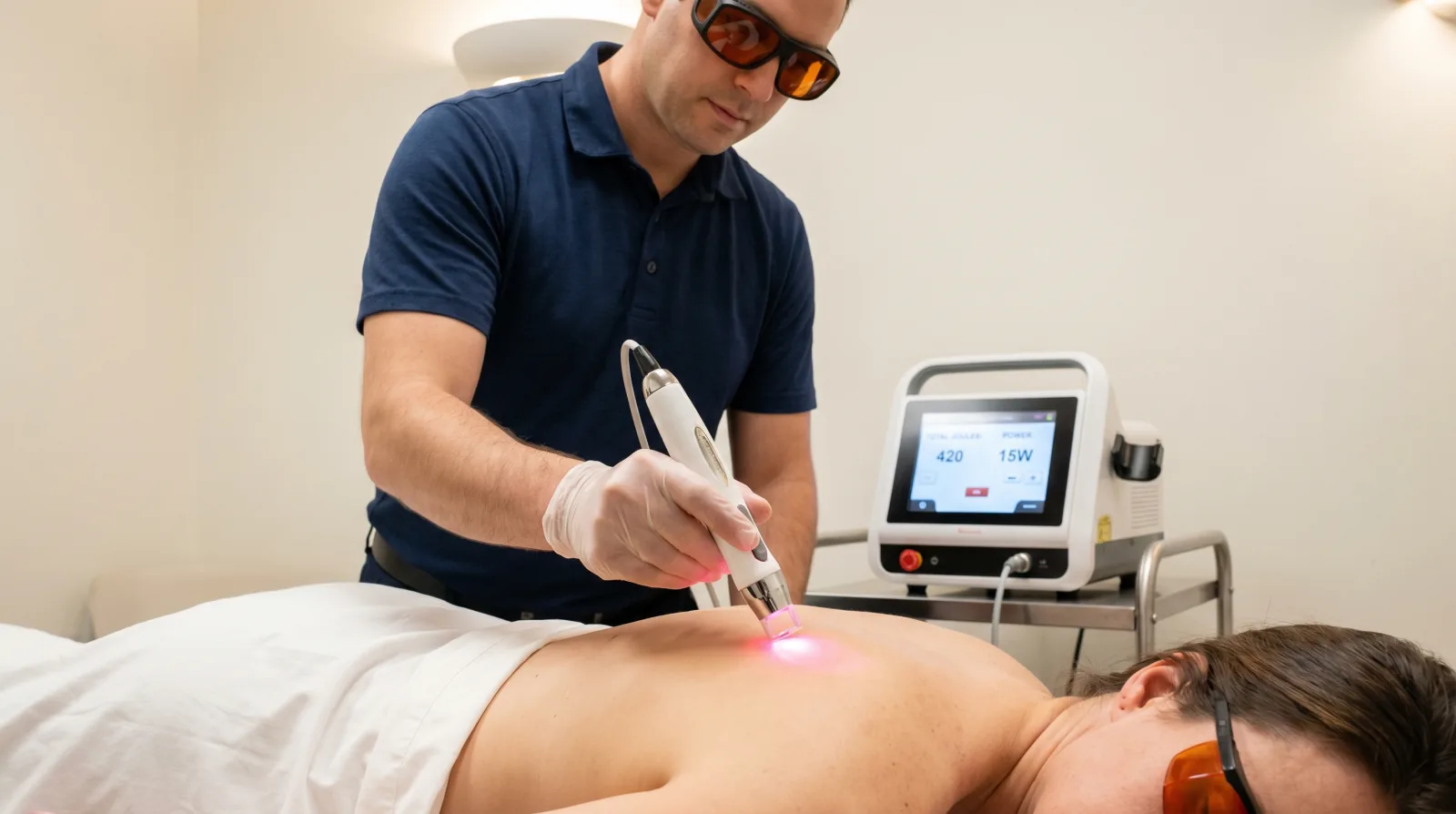
At Medstar Sport Physio in North Vancouver, high intensity laser therapy (HILT, also called high-power laser or Class IV photobiomodulation) uses a concentrated beam of red and near-infrared light delivered at therapeutic power densities (15W on our device) to drive biological effects deep into tissue. Lower-power Class IIIB lasers (the ones sold for home use) only reach the surface; a Class IV device delivers enough energy to influence joints, deep muscle, and the post-surgical tissue under skin and fat.
Medstar was the first physiotherapy clinic on the North Shore to install Class IV laser. A mild warmth is felt during treatment, but the therapeutic effect comes from photons being absorbed by mitochondrial cytochrome c oxidase, which up-regulates ATP production and modulates the inflammatory cascade at the cellular level. The cumulative effect across a 6 to 10 session course is faster resolution of pain and inflammation, and accelerated tissue regeneration.
It is not a magic bullet. Laser pairs best with manual therapy and progressive loading. It is a tool that helps the tissue accept more rehab work, sooner, with less pain. We use it most often in three settings: acute sport injuries (the first 2 to 4 weeks after a sprain or strain), post-operative recovery (rotator cuff repair, ACL reconstruction, meniscal surgery), and chronic joint pain (knee osteoarthritis, frozen shoulder) where inflammation is the limiting factor.
How it works
Inside a session.
A laser-inclusive session runs 10 to 20 minutes for the laser portion, on top of any manual therapy or exercise. Both patient and operator put on protective laser-safety glasses, because Class IV light can damage the retina if viewed directly, so eyewear is non-negotiable for everyone in the room.
The treatment area is exposed; the handpiece is moved in slow, continuous passes (never held stationary, to spread the energy and avoid hot spots). Most patients report a deep, pleasant warmth and occasionally a mild tingling. The sensation is never sharp or burning. If a hot spot develops, the operator immediately speeds up the pass or repositions the cooling head; comfort during treatment is the rule, not the exception.
A typical Class IV laser course is 6 to 10 sessions, often 2 to 3 times per week initially and then tapering. The cellular response builds across the course, so most patients notice a clear shift after the third or fourth session, with peak benefit typically felt during the second half of the treatment series.
Conditions we treat with this
See how class iv laser therapy fits into specific recovery plans.
- Knee injury & ACL recovery: post-op swelling and pain modulation
- Shoulder & rotator cuff: post-op repair and frozen shoulder
- Low back pain & sciatica: acute inflammatory flares
- Whiplash & ICBC injuries: acute cervical and lumbar inflammation
- Ankle & Achilles injuries: acute sprains and tendon inflammation
- Hip pain & groin injuries: post-arthroscopy recovery
What to expect
Most patients notice meaningful pain relief within 1 to 3 sessions. The deeper biological benefit (tissue regeneration and sustained inflammation control) builds across a 6 to 10 session course over 3 to 5 weeks. Acute injuries respond fastest; chronic joint pain (knee OA, frozen shoulder) typically requires the full course to feel a stable change.
Talk to us
Not sure if it's the right fit?
Send a quick note about what's going on. A physiotherapist will read it and tell you honestly whether class iv laser therapy is the right tool, or whether something else makes more sense first.
Common questions
About class iv laser therapy.
How is Class IV laser different from the at-home laser devices I've seen?
Power density. Class IIIB and consumer 'cold laser' devices typically deliver less than 0.5 watts of power, which is enough to influence surface tissue but too little for deep muscle or joint. A Class IV therapeutic laser delivers up to 15 watts (the configuration on our device), which is more than enough energy to penetrate to joint depth without overheating the surface. The difference in tissue effect is not subtle. The trade-off is that Class IV devices require eye protection and trained operators; they are restricted-use medical devices, not retail products.
Does it hurt?+
No. The dominant sensation is a deep, pleasant warmth, and many patients describe it as relaxing. There's occasionally a mild tingling. There is no sharp or burning sensation when the device is used correctly. If a hot spot develops, the operator immediately adjusts; comfort during treatment is the standard, not an exception.
Are there side effects?+
Side effects are rare and minor. Patients occasionally get a transient flush at the treatment site that resolves within an hour, or a brief increase in symptom intensity in the first 24 hours after the first session (the 'healing response,' usually a good sign in chronic cases). Eye protection during treatment is non-negotiable for both patient and clinician. Direct retinal exposure to a Class IV beam can cause permanent eye damage.
Who shouldn't have laser therapy?+
Contraindications include pregnancy (over the abdomen and lumbar region), active malignancy in the treatment area, treatment over the thyroid gland, treatment over light-sensitive medication patches, and treatment over open epiphyses in growing children for high-power doses. Patients with photosensitive skin conditions or who take photosensitising medications (some antibiotics, some retinoids) may require a lower dose or alternative modality. Tell your physio about all medications and medical history before the first treatment.
How does it compare to shockwave therapy, and would I get one or the other?+
Different mechanisms, different best uses. Laser is a low-intensity cellular intervention that modulates inflammation and accelerates healing across a course of treatments. Shockwave is a high-intensity mechanical intervention that disrupts degenerative chronic tendinopathy tissue to force a fresh repair cycle. For acute injuries and post-surgical swelling, laser is usually the better fit. For chronic stuck tendinopathies (plantar fasciitis at 6+ months, calcific shoulder), shockwave is usually the better fit. We sometimes combine both within a treatment plan when the case is mixed.
Is laser covered by insurance or ICBC?+
Laser is delivered inside a physiotherapy appointment and billed as physiotherapy on your receipt, under the same direct-billing rules as any physio visit. Extended-health plans that cover physiotherapy cover laser-inclusive visits. ICBC's pre-approved physio sessions cover laser-inclusive treatment with no additional charge. There is no separate laser line item.
How quickly after surgery can I start laser?+
Earlier than most people expect. For most procedures (rotator cuff repair, ACL reconstruction, knee scope, hip scope, labral repair) we can begin laser as soon as the surgical incisions are closed and dry, which is typically 7 to 14 days post-op. Early laser is particularly useful for controlling post-surgical swelling and pain so the formal physio progressions can start sooner. Always check with your surgeon if they've placed any specific restrictions.
How often do I need laser sessions, and does it get less frequent over time?+
A typical Class IV laser course runs 6 to 10 sessions, often 2 to 3 times per week at the start and then tapering as your symptoms settle. Each laser portion of a session takes 10 to 20 minutes on top of any manual therapy or exercise. Most patients notice a clear shift after the third or fourth session, with peak benefit usually felt during the second half of the course.
Reviewed by Amir Ahmadi, PhD, MSc PT, Registered Physiotherapist, Certified IMS Therapist, College of Physical Therapists of British Columbia (CPTBC). Last reviewed May 2026.
This page is for general information only and does not constitute medical advice, diagnosis, or treatment. Treatment suitability is determined case-by-case during assessment; not every service is appropriate for every presentation. If you have a medical implant, are pregnant, take blood thinners, or have an active infection, tell your physiotherapist before treatment. Physiotherapy at Medstar Sport Physio & Health is provided by physiotherapists registered with the College of Physical Therapists of British Columbia (CPTBC).
Related reading
- Laser therapy hub: evidence, safety, cost, and how it compares →
- Sport physiotherapy: the broader plan laser pairs with →
- Shockwave therapy: the other advanced modality, different mechanism →
- High-power laser therapy: an in-depth clinical guide to what it treats →
- Return to sport guide: when modalities matter most →
Ready to book?