Shockwave (ESWT)
Shockwave Therapy (ESWT) in North Vancouver
For the stubborn tendinopathies that haven't budged after six weeks of physio: plantar fasciitis, Achilles, calcific shoulder, tennis elbow. Most patients see meaningful change in 3 to 6 sessions.
What it is
Shockwave Therapy (ESWT) in North Vancouver at Medstar.
At Medstar Sport Physio in North Vancouver, shockwave therapy (formally called Extracorporeal Shockwave Therapy, or ESWT) uses high-energy acoustic pressure waves delivered through a handheld applicator to the surface of the body. The waves penetrate to the depth of the target tendon or soft tissue and trigger a regenerative biological cascade: increased local blood flow, release of growth factors, breakdown of calcific deposits, and re-initiation of the tissue's natural repair process.
Shockwave works best as a later step, and we'll tell you honestly when your case is not ready for it. Its evidence base is strongest for chronic tendinopathies that have already failed 6 or more weeks of conventional care: plantar fasciitis, mid-portion and insertional Achilles tendinopathy, calcific rotator cuff tendinitis, patellar tendinopathy (jumper's knee), greater trochanteric pain syndrome, and tennis elbow.
For those specific cases, the published evidence is genuinely strong, and multiple randomised controlled trials show meaningful pain reduction and functional improvement, often after stretching, eccentric loading, anti-inflammatories, and orthotics have all under-delivered. It's frequently the bridge between "physio isn't working" and "do I need a cortisone injection or surgery."
How it works
Inside a session.
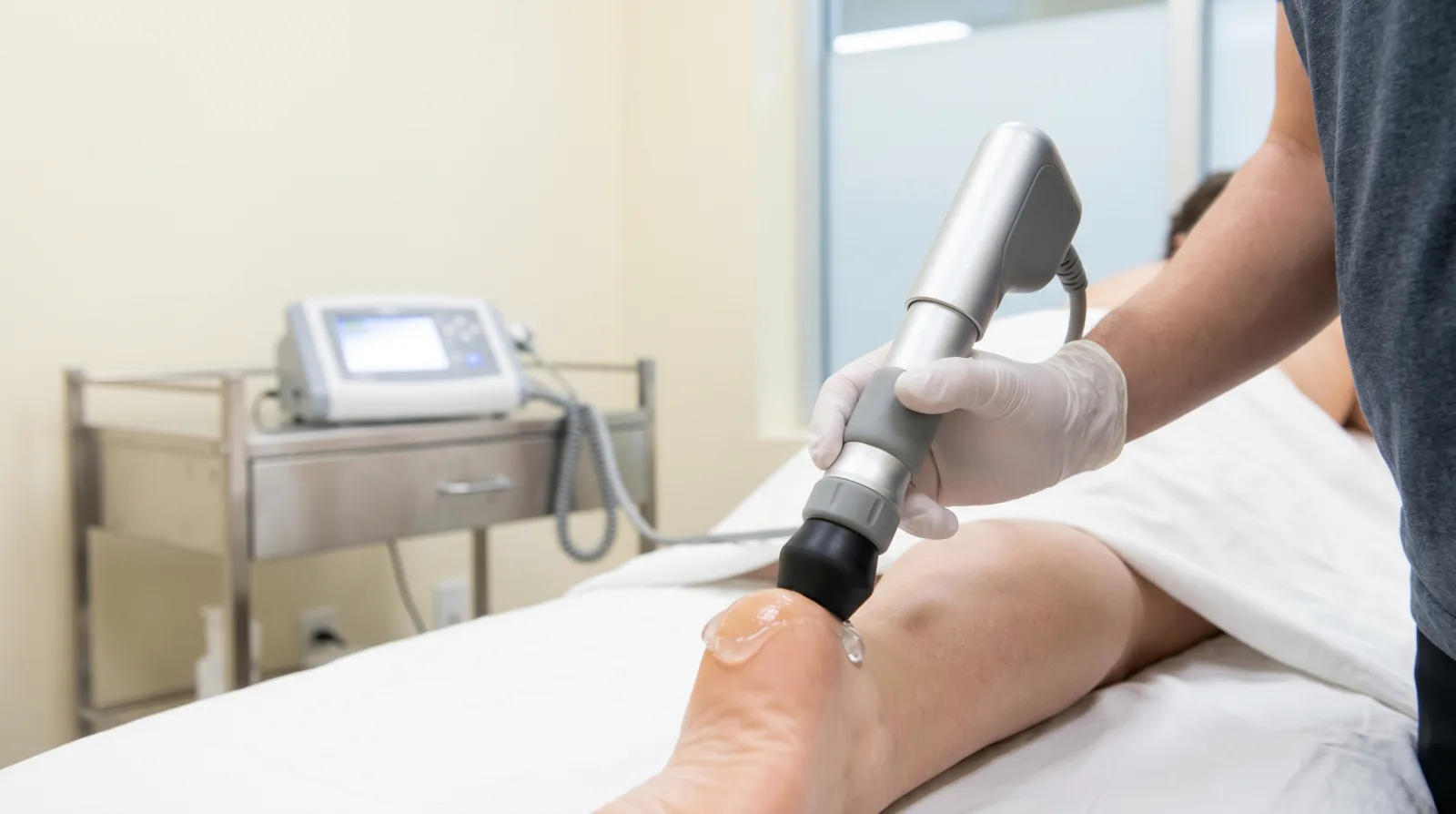
The session itself is short, usually 10 to 15 minutes of active treatment, with a quick reassessment and the next exercise progression added at the end. Conductive ultrasound gel is applied to the skin over the target tendon, and the applicator is pressed firmly against the area. The device delivers pulses at a frequency of around 4 to 15 hertz, with the energy level dialed up to your tolerance.
The sensation is distinctive: a percussive tapping that builds to a deep, dull ache as energy intensity increases. Most patients describe it as 'uncomfortable but tolerable.' For very superficial or sensitive tissue (like the insertion of plantar fascia at the heel), we sometimes spread the same total energy over a slightly longer session at a lower per-pulse intensity to keep it manageable.
Shockwave is never the whole plan. We pair every session with the loading exercise the tendon actually needs to rebuild: heavy-slow resistance for Achilles, calf eccentrics for plantar fascia, isometric holds for patellar tendinopathy. The shockwave gets the tissue out of its stuck inflammatory-degenerative pattern; the loading rebuilds it. Without the loading, the gain is temporary.
Conditions we treat with this
See how shockwave therapy fits into specific recovery plans.
- Plantar fasciitis & heel pain: shockwave's strongest evidence base
- Shoulder & rotator cuff: calcific tendinitis specifically
- Tennis elbow: chronic lateral epicondylalgia
- Hip pain: greater trochanteric pain syndrome
- Ankle & Achilles injuries: chronic Achilles tendinopathy
- Runner's knee & patellar tendinopathy: jumper's knee
What to expect
Most patients notice a measurable change inside 3 sessions. Plantar fasciitis and calcific shoulder tendinitis are the strongest responders: a 2024 network meta-analysis in JBJS Reviews (pubmed.ncbi.nlm.nih.gov/38913773) ranked shockwave among the more effective conservative treatments for chronic plantar fasciitis, with a moderate, real but modest effect size. The biological response continues after the final session, so peak benefit is often felt 8 to 12 weeks after treatment ends, not the day after.
Talk to us
Not sure if it's the right fit?
Send a quick note about what's going on. A physiotherapist will read it and tell you honestly whether shockwave therapy is the right tool, or whether something else makes more sense first.
Common questions
About shockwave therapy.
How is shockwave therapy different from ultrasound therapy?
Ultrasound therapy uses low-intensity continuous sound waves that produce mild heat in tissue, and its evidence base for tendinopathy is weak. Shockwave delivers high-energy single pressure pulses that mechanically disrupt degenerative tissue and trigger a regenerative biological response. The two are not interchangeable, and pulse energy is orders of magnitude apart. Shockwave's evidence for specific tendinopathies is dramatically stronger.
Does shockwave therapy hurt?+
It's uncomfortable but tolerable for most patients. The sensation is a deep percussive tapping that intensifies as the energy is dialed up. We always start at the lower end of the tolerance range and increase gradually. We'll back off immediately if the discomfort crosses into sharp or burning. Most patients tolerate a full session without difficulty after the first few minutes of acclimation.
How many sessions will I need?+
The standard protocol is 3 to 6 sessions, spaced 5 to 7 days apart. Most conditions resolve in the lower end of that range; only the most stubborn calcific deposits or longest-standing tendinopathies need more. After 3 sessions we'll have a clear read on whether shockwave is moving the case forward. If it isn't, we stop and rethink rather than racking up more visits.
Are there side effects or risks?+
The most common side effects are mild post-treatment soreness and occasionally a small bruise at the treatment site, both resolving within 24 to 48 hours. Contraindications include pregnancy (over the area), active infections, malignancy in the area, blood-clotting disorders, and the immediate region around major nerves or large blood vessels. Pacemakers and other implanted devices may require additional screening. Tell your physio about all medical history before the first session.
Is shockwave covered by ICBC or extended health insurance?+
Shockwave is delivered within a physiotherapy appointment and billed as physiotherapy on your receipt, so the same direct-billing rules apply. Extended-health plans that cover physiotherapy cover shockwave-inclusive visits. ICBC's pre-approved physiotherapy sessions cover shockwave-inclusive treatment with no additional charge. There is no separate shockwave line item.
Should I keep doing my exercises during the shockwave series?+
Yes, with one caveat. Continue the loading and mobility work prescribed by your physio; that's what rebuilds the tendon. But avoid hard high-intensity training (max effort sprints, plyometrics, near-maximum lifts) for 24 to 48 hours after each session, because the treated tissue is briefly more reactive. We'll write up the specific 'okay this week / not okay this week' list at each visit.
Can I drive home after a session?+
Yes. There's no sedation, no anaesthetic, and no impairment. You walk in and walk out. The one exception is plantar fascia treatment, where some patients prefer to drive with a different shoe than usual for the first hour while the treated heel settles. Most sessions are brief, so many patients book shockwave around a work break rather than setting aside a separate block of the day.
What conditions respond best to shockwave therapy?+
Shockwave has its strongest evidence for tendinopathies and calcific deposits: chronic plantar fasciitis, Achilles tendinopathy, patellar tendinopathy, calcific rotator cuff tendinitis, and lateral elbow tendinopathy are the conditions it's most commonly prescribed for. It works by mechanically disrupting degenerative tissue and triggering a regenerative biological response, which is why it's chosen for stubborn, chronic tendon problems rather than fresh acute injuries.
How is a treatment session structured?+
The physiotherapist applies a coupling gel and delivers pulses through a handpiece directly over the treatment site, starting at the lower end of your tolerance and increasing gradually. A session is brief, and you'll feel a deep percussive tapping that intensifies as the energy is dialed up, backing off immediately if it crosses into sharp or burning discomfort.
Reviewed by Amir Ahmadi, PhD, MSc PT, Registered Physiotherapist, Certified IMS Therapist, College of Physical Therapists of British Columbia (CPTBC). Last reviewed May 2026.
This page is for general information only and does not constitute medical advice, diagnosis, or treatment. Treatment suitability is determined case-by-case during assessment; not every service is appropriate for every presentation. If you have a medical implant, are pregnant, take blood thinners, or have an active infection, tell your physiotherapist before treatment. Physiotherapy at Medstar Sport Physio & Health is provided by physiotherapists registered with the College of Physical Therapists of British Columbia (CPTBC).
Ready to book?