
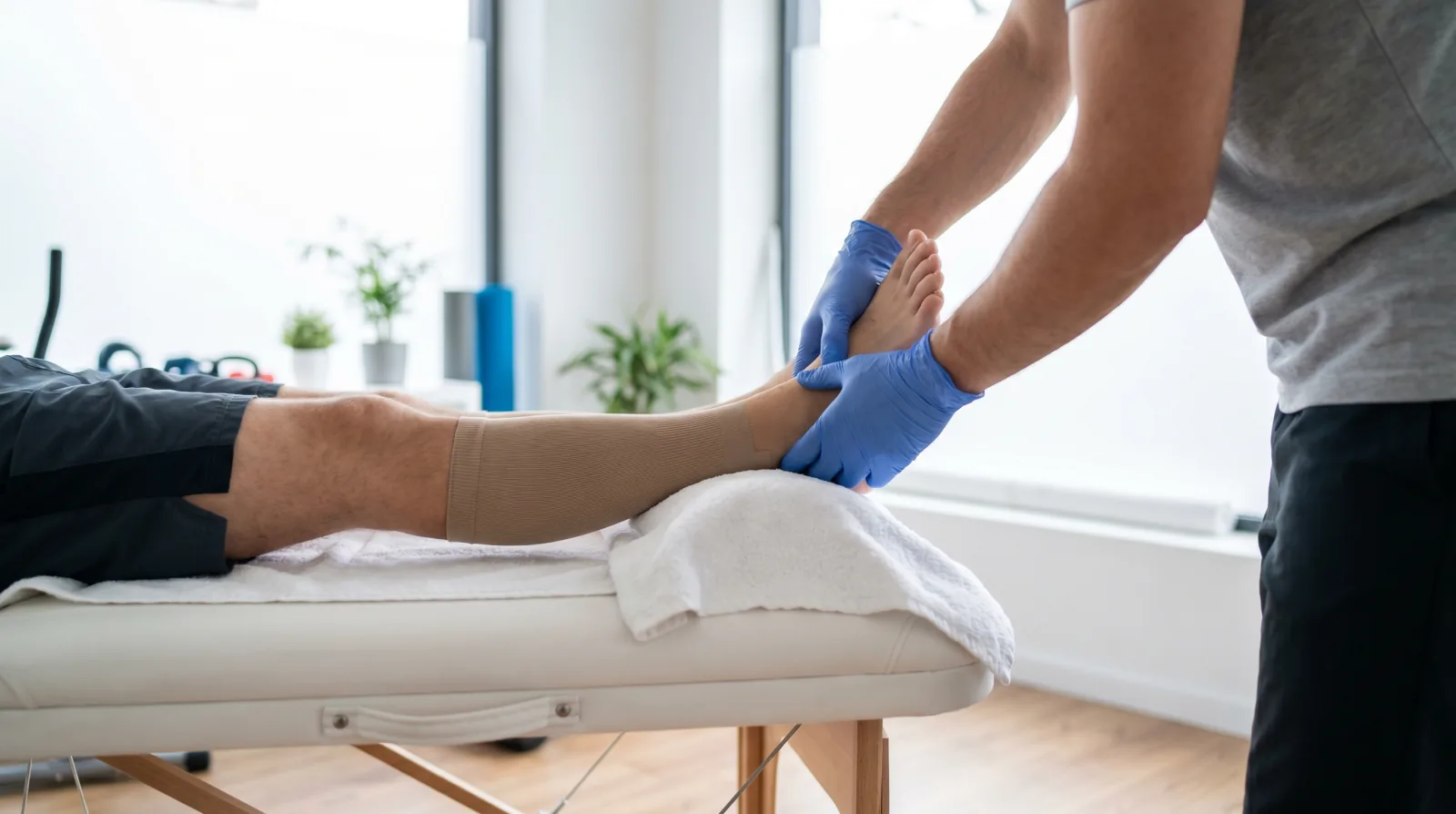
Ankle & lower leg
Ankle Pain & Achilles Injuries | North Vancouver
An ankle sprain that still isn't right six weeks later. Achilles stiffness that warms up after ten minutes but comes back the next morning. Recurring rolls on trail runs. Ankle injuries are often under-treated because the initial pain fades, so we pick up where that leaves off.
What it is
Understanding your ankle pain & achilles injuries.
The ankle is the joint most commonly injured in sport, and also one of the most commonly under-rehabilitated. A lateral ankle sprain happens when the ankle rolls or turns beyond its normal range, whether on uneven trail, on a bad landing, or just stepping off a curb wrong. It is more likely when the lower-leg muscles are weak, balance is off, you skipped a warm-up, you're fatigued, or you've sprained that ankle before. Sprains run on a spectrum from a mild overstretch to a complete ligament tear, and they typically bring pain, swelling, bruising, difficulty putting weight through the foot, and a sense of instability when you walk. Too often it's treated with a few days of ice and then declared healed once the swelling goes down. The proprioceptive deficit and mechanical laxity that remain are what cause the second, third, and fourth sprains. Chronic ankle instability is almost always the downstream result of an under-treated first injury. At Medstar Sport Physio in North Vancouver, we assess and treat this through a one-on-one physiotherapy appointment, confirming the pattern and building a plan from there. We see patients from across Vancouver and the North Shore, many of whom cross Lions Gate Bridge or take the SeaBus for treatment here.
Achilles tendinopathy is the other major category. The Achilles is the thickest, strongest tendon in the body, and one of the most load-sensitive. Insertional Achilles pain (at the back of the heel) and mid-portion pain (a few centimetres up the tendon) behave differently and respond to different treatment approaches. Knowing which one you have changes the protocol significantly.
We also see posterior tibial tendon dysfunction, peroneal tendon injuries, sinus tarsi syndrome after complex sprains, os trigonum syndrome (posterior ankle impingement from an extra bone behind the ankle that catches during forceful downward pointing of the foot), and stress reactions in the fibula or calcaneus in high-mileage runners. The foot and ankle work as a unit with the knee and hip, so a thorough assessment includes looking at the whole chain.
What to expect
Acute lateral ankle sprains typically resolve functionally in 4 to 8 weeks with a proper proprioceptive program, though full stability sometimes takes longer. Achilles tendinopathy is more variable: mid-portion responds well to loading over 8 to 12 weeks; insertional cases take longer and respond differently to certain exercises (heel drops below neutral are contraindicated early). Your physiotherapist will set a realistic timeline at your first appointment after assessing which structure is involved and how irritable the tissue currently is.

Book a sports assessment with Ali Shafiei
Ali leads sport and orthopaedic physiotherapy at the clinic: manual therapy, IMS dry needling, and exercise-based rehab built around getting you back to your sport, with pain relief along the way. He is taking new patients with same-week availability.
Get a plan
Not sure if we're the right fit?
Send us a quick note about what's going on. A physiotherapist will read it personally and reply with what they'd recommend. No commitment to book.
Common questions
About ankle pain & achilles injuries.
My ankle was X-rayed and nothing was broken, so why does it still hurt?
X-ray rules out fracture but doesn't assess ligament integrity, joint mechanics, or the proprioceptive deficit that follows even a mild sprain. Persistent pain after a negative X-ray is common and usually means the ligament and joint rehab hasn't been completed. Ankle sprains run on a spectrum from a mild overstretch to a complete ligament tear, and the joint position sense that goes missing after either one doesn't come back on its own. That's the piece a normal X-ray can't measure, and it's what a physiotherapy assessment checks next.
Is Achilles pain the same as plantar fasciitis?+
No, they're different structures. Plantar fasciitis is on the underside of the heel; Achilles tendinopathy is at the back. They can occur together in the same foot, which is why a proper assessment matters. We treat both, and the management is different: Achilles tendinopathy is further split into insertional pain at the back of the heel and mid-portion pain a few centimetres up the tendon, and each of those responds to a different loading protocol.
Should I stretch my Achilles?+
For mid-portion Achilles tendinopathy, moderate stretching can help. For insertional Achilles pain, aggressive stretching, especially heel drops below the step, compresses the tendon against the bone and often makes it worse. The two types behave differently and respond to different loading approaches, so we assess which structure is involved first, then tell you which stretches and exercises are appropriate for your case and which ones to avoid.
I keep rolling the same ankle. Can that be fixed?+
Yes. Chronic ankle instability is almost always the downstream result of an under-treated first sprain, and it responds well to a targeted balance and strength program that re-educates the muscles and restores the joint's position sense. Some patients with persistent mechanical laxity benefit from bracing during high-risk activity while rehab progresses. Surgical reconstruction is rarely necessary once the proprioceptive and strength deficits are properly addressed.
Do you direct-bill extended health?+
Yes. We direct-bill most major extended-health plans, plus ICBC and WorkSafeBC for ankle injuries sustained in accidents or at work. Ankle sprains and Achilles injuries are common outcomes of falls, bad landings, and workplace incidents, so both claim types come through this clinic regularly. We handle the paperwork so you can focus on the rehab instead of the forms.
My ankle pain has numbness or tingling: could it be tarsal tunnel syndrome?+
It's worth ruling out. Tarsal tunnel syndrome is nerve entrapment behind the inner ankle bone, and it can mimic or accompany a sprain. Burning, tingling, or numbness along the sole is the distinguishing feature, since a ligament or tendon injury gives mechanical pain and swelling instead. A proper assessment separates it from ligament and tendon injuries, since the treatment approach is different.
My ankle catches or aches at the back when I point my toes down hard: could it be os trigonum syndrome?+
Possibly. Os trigonum syndrome, also called posterior ankle impingement, happens when an extra small bone behind the ankle gets pinched between the shin bone and heel bone during forceful downward pointing of the foot, the movement used in ballet dancers pushing onto pointe, soccer players striking a ball, and downhill runners. It causes deep aching or catching at the back of the ankle rather than the outer-ankle pain of a typical sprain. Conservative care, rest from the aggravating movement, physiotherapy, and activity modification, is the first approach and works for many people. When conservative care does not resolve it, endoscopic removal of the extra bone has shown strong outcomes in recreational athletes: one study of 81 athletes found 93.8 percent achieved excellent results, with an average return to sport at 9.1 weeks (Nikolopoulos et al., 2020, PMID 35097403). We start with the conservative pathway and refer out if surgery becomes the right next step.
How long until my ankle sprain feels normal again?+
Most acute lateral ankle sprains resolve functionally within four to eight weeks with a proper proprioceptive program, though full stability can take a bit longer. Achilles tendinopathy runs on a different timeline: mid-portion cases typically respond over eight to twelve weeks, while insertional cases are slower and need a modified exercise approach. Your physiotherapist sets a realistic timeline once they know which structure is involved.
What does ankle rehab actually involve, beyond rest and ice?+
Rest, ice, compression, and elevation only settle a fresh sprain. Ankle pain treatment also includes manual therapy and dry needling to restore joint mechanics, proprioceptive and balance retraining to rebuild the ankle's position sense, tendon loading for Achilles cases, and return-to-sport testing like hop tests and lateral movement assessment before clearing you for trail running or field sport. Skipping the balance and loading work is what leaves an ankle prone to re-injury.

Reviewed by Amir Ahmadi, PhD, MSc PT, Registered Physiotherapist, Certified IMS Therapist, College of Physical Therapists of British Columbia (CPTBC). Last reviewed July 2026.
This page is for general information only and does not constitute medical advice, diagnosis, or treatment. Individual presentations vary, and assessment findings and treatment plans differ from person to person. If you are experiencing severe symptoms, neurological changes (numbness, weakness, bowel or bladder changes), or a significant trauma, contact your physician or emergency services. Physiotherapy at Medstar Sport Physio & Health is provided by physiotherapists registered with the College of Physical Therapists of British Columbia (CPTBC).
Related reading
- Ankle and foot injuries after a car crash: ICBC-covered rehab →
- Runner's knee (PFPS): the other common lower-limb overuse injury →
- Plantar fasciitis: heel pain that travels →
- Return to sport guide: criteria-based clearance for trail runners and field athletes →
- The acute phase: what to do in the first 48-72 hours after a sprain →
- Ankle sprain rehab beyond RICE: balance retraining and why reinjury is the real risk →
- Chronic ankle instability: why your ankle keeps giving way →