IMS dry needling
IMS / Dry Needling in North Vancouver
Release the muscle trigger points that keep dragging you back into pain. Fine-needle treatment by a UBC-certified IMS physiotherapist.
What it is
IMS / Dry Needling in North Vancouver at Medstar.
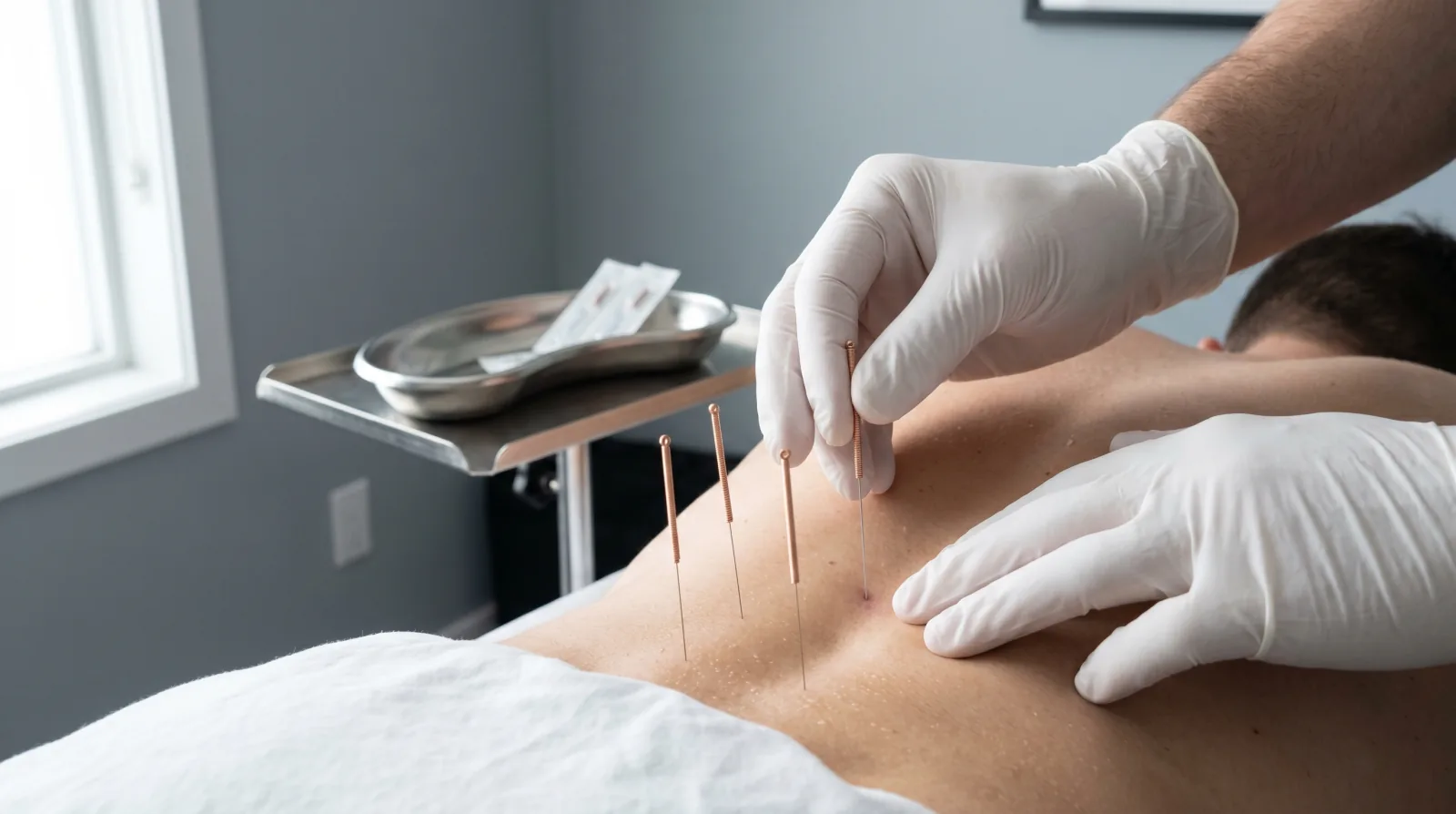
IMS, or Intramuscular Stimulation, is a dry-needling technique developed in the 1970s at UBC by Dr. Chan Gunn. It uses very fine, sterile filiform needles (the same gauge used in acupuncture) to release dysfunctional shortened muscle that's holding chronic pain in place. "Dry" means there's nothing injected through the needle; the needle itself is the treatment.
It is not acupuncture. Acupuncture is rooted in Traditional Chinese Medicine and works along meridian lines selected by TCM differential diagnosis. IMS is grounded in Western neuroanatomy. The physiotherapist palpates for specific shortened, taut bands within muscle, often in a predictable distribution downstream of a sensitised spinal nerve root, and needles those points directly. The two techniques look superficially similar but the reasoning behind needle placement is completely different.
At Medstar, IMS is performed only by physiotherapists who hold the post-graduate IMS certification through the UBC-affiliated Institute for the Study and Treatment of Pain (ISTOP). Only our physiotherapists deliver it, because the technique requires a physiotherapy assessment to be applied correctly.
How it works
Inside a session.
When you arrive for an IMS-inclusive visit, the physio first re-assesses what's actually driving your pain. IMS works as one tool inside the larger physiotherapy plan. They'll palpate the muscle groups in question, identify the specific trigger points or taut bands, and then insert needles one at a time directly into those points.
The sensation is distinctive: a deep, dull ache or a brief cramping response (the "twitch") as the muscle releases. It is not the prolonged stinging pain people often expect. Each needle is usually retained for a few seconds to a minute, depending on tissue response, then removed and discarded. A typical IMS treatment uses 5 to 15 needle insertions over 5 to 10 minutes of needling time.
We pair IMS with manual therapy and a follow-up exercise prescription in the same session. The needling resets muscle tone, the manual work restores joint range, and the exercises reinforce the new pattern so the pain doesn't simply return.
Conditions we treat with this
See how ims dry needling fits into specific recovery plans.
What to expect
Most patients notice a measurable change after the first IMS session, often a reduction in resting tightness and an increase in pain-free range of motion that holds for 2 to 7 days. We typically schedule 3 to 6 IMS-inclusive sessions across a 4 to 8 week window, then re-assess whether further needling adds value or whether the case is now in the loading and strengthening phase.
Talk to us
Not sure if it's the right fit?
Send a quick note about what's going on. A physiotherapist will read it and tell you honestly whether ims dry needling is the right tool, or whether something else makes more sense first.
Common questions
About ims dry needling.
Is IMS dry needling the same as acupuncture?
No. The needles look identical and the technique looks superficially similar, but the clinical reasoning is completely different. Acupuncture is performed by a Registered Acupuncturist based on Traditional Chinese Medicine differential diagnosis, working along meridian points. IMS is performed by a physiotherapist based on Western musculoskeletal assessment, targeting specific muscle motor points and trigger points identified on physical exam. At Medstar, IMS and acupuncture are delivered by different practitioners with different training.
Does IMS hurt?+
The needle insertion itself is barely felt, because the needles are extremely fine. The sensation that follows is distinctive: a brief deep ache or a cramping twitch as the muscle releases, which subsides within seconds. Most patients describe it as 'uncomfortable but oddly satisfying.' It is not the prolonged stinging pain people often expect. If a particular point is too uncomfortable, the needle comes out. No points are forced.
Are there side effects?+
The most common side effects are mild post-treatment muscle soreness (similar to a workout) and occasionally a small pinpoint bruise at the needle site. Both typically resolve within 24 to 48 hours. Serious complications are extremely rare when IMS is delivered by a certified physiotherapist using sterile, single-use needles in regulated body regions. We screen for contraindications (blood-thinning medications, infections, pregnancy, lymphedema) before treatment.
Who shouldn't have IMS?+
Patients on therapeutic-dose blood thinners (warfarin, certain DOACs) require physician clearance first. Patients with active local skin infections, severe needle phobia, immunosuppression, or who are in the first trimester of pregnancy are generally treated with alternative techniques. Tell your physio about any medications, infections, or medical conditions before the first treatment.
How is IMS billed, and is it covered?+
IMS is delivered as part of your physiotherapy appointment, not as a separate service line. It's billed as physiotherapy on your receipt and direct-billed through extended-health, ICBC, and WorkSafeBC the same way any physio visit would be, with no additional charge for the needling itself. A typical IMS-inclusive session runs 5 to 10 minutes of actual needling time, folded into a longer visit that also includes manual therapy and exercise prescription. Check your specific extended-health policy for any annual physiotherapy cap.
How many sessions before I notice a difference?+
Most patients feel a meaningful change after the first session, usually within 24 to 48 hours as the immediate post-needling muscle response settles. If you've completed 3 sessions and there's been no measurable change in symptoms or movement, that's the conversation we have at visit four: IMS may not be the right tool for your case, and we adjust the plan.
Can I exercise after IMS?+
Light movement (walking, easy cycling, mobility work) is encouraged the same day, because it helps the muscle reorganise. Avoid heavy lifting or hard training in the first 24 hours; the treated muscle is briefly less able to generate force and the soreness can mask normal protective signals.
What conditions is IMS typically used for?+
IMS targets muscle shortening and trigger points linked to chronic tension, overuse injuries, and pain that hasn't fully resolved with standard hands-on treatment alone. Your physiotherapist identifies the specific motor points and trigger points on physical exam before deciding whether IMS fits your presentation. It is commonly used alongside manual therapy for cases involving a sensitised spinal nerve root, where the downstream muscle stays shortened even after the original irritation has settled. A typical treatment uses 5 to 15 needle insertions.
Who performs IMS at Medstar?+
A physiotherapist trained in IMS technique, based on Western musculoskeletal assessment rather than Traditional Chinese Medicine diagnosis. This is a different practitioner and a different clinical reasoning process than the acupuncture offered at the same clinic, even though both use fine needles. At Medstar, only physiotherapists holding the post-graduate IMS certification through the UBC-affiliated Institute for the Study and Treatment of Pain deliver the technique, because it depends on a physiotherapy assessment done first.

Reviewed by Amir Ahmadi, PhD, MSc PT, Registered Physiotherapist, Certified IMS Therapist, College of Physical Therapists of British Columbia (CPTBC). Last reviewed May 2026.
This page is for general information only and does not constitute medical advice, diagnosis, or treatment. Treatment suitability is determined case-by-case during assessment; not every service is appropriate for every presentation. If you have a medical implant, are pregnant, take blood thinners, or have an active infection, tell your physiotherapist before treatment. Physiotherapy at Medstar Sport Physio & Health is provided by physiotherapists registered with the College of Physical Therapists of British Columbia (CPTBC).
Ready to book?