
Spine
Low Back Pain in North Vancouver
From the desk-job ache that won't quit to acute disc flare-ups and radiating nerve pain, with practical care that gets you moving instead of stuck on rest.
What it is
Understanding your low back pain.
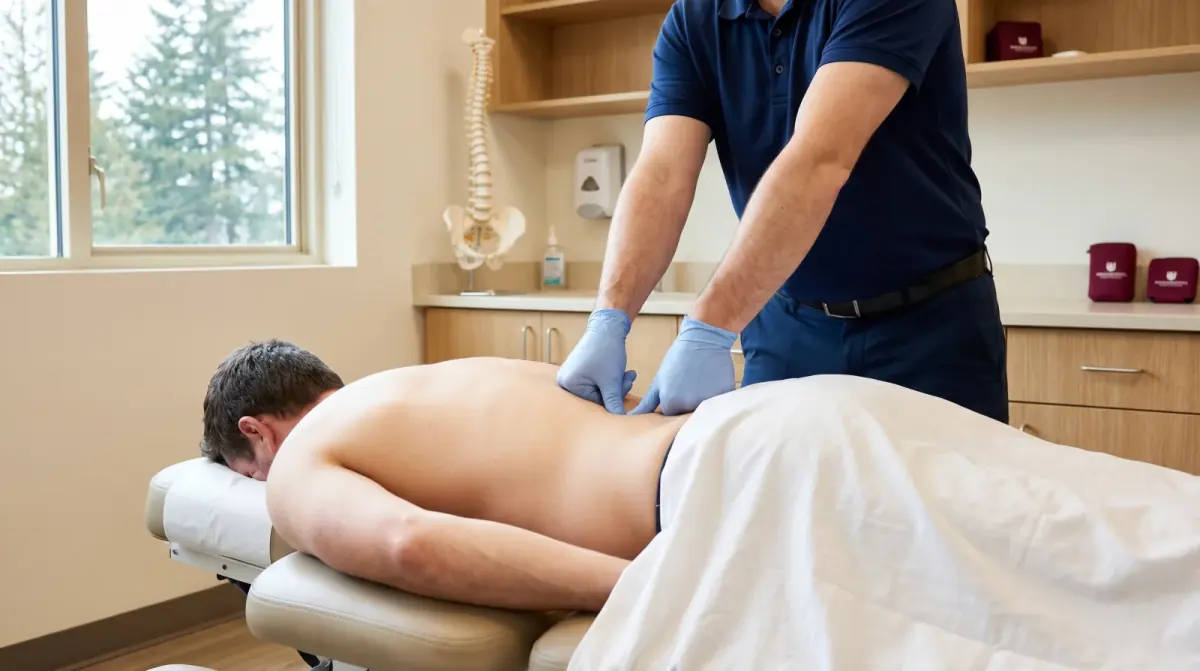
Low back pain is the most common reason patients come through the door at Medstar's North Vancouver clinic. It shows up in every form: the runner whose lumbar seized after a long hill, the desk worker on Marine Drive who's been nursing a dull ache for six months, the post-surgical patient referred from Lions Gate Hospital, and the ICBC claimant with a rear-end whiplash that settled in the lumbar region instead of the neck.
Most low back pain is not structural, even when it feels like something terrible happened. The disc, the joint, the muscle, and the nerve all share the same neighbourhood, and irritation in any of them can produce a similar story: it hurts to bend, it hurts to sit, and the morning feels worse than the night.
Rest alone usually makes it worse after the first few days. The job is to figure out which movements settle the system and which provoke it, then do more of the first and less of the second, in the right amounts. Pain or numbness that travels down the leg is a different picture, with its own causes and its own recovery path. See our dedicated sciatica page for that.
What to expect
Treatment timelines vary by type. Acute low back pain (less than 6 weeks, no leg symptoms): most patients are significantly better after 2 to 4 sessions; the initial assessment and 1 to 2 follow-ups often close the chapter. Subacute (6 to 12 weeks): expect a 4 to 6 session block focused on manual therapy and a progressive loading plan. Chronic low back pain (over 3 months): 8 to 12 weeks of structured graded exercise, with hands-on care in the early phase; the goal shifts from pain control to load capacity. If leg symptoms are part of the picture, see our sciatica page for that specific timeline.
Get a plan
Not sure if we're the right fit?
Send us a quick note about what's going on. A physiotherapist will read it personally and reply with what they'd recommend. No commitment to book.
Common questions
About low back pain.
Should I get an MRI before starting physio?
Almost never. MRIs of low backs show "abnormalities" in roughly half of pain-free adults, meaning the scan often finds things that aren't the cause of your pain. We start with a thorough physical assessment. If we see red flags or you're not responding to treatment, we'll send you to your GP for imaging.
I've heard "bend with your knees, not your back." Is that real?+
Partially. The back is built to bend, and telling people to avoid it forever often makes things worse because the tissue de-conditions. The real skill is loading the right amount for what the back is currently ready for, then progressing. Part of our treatment includes graded loading with hip hinge mechanics, dead bugs, and carries, along with lifting-mechanics coaching so the pattern that caused the flare stops repeating.
My back pain doesn't travel down my leg. Is it still worth seeing a physio?+
Yes. Most low back pain never sends symptoms down the leg, and it responds just as well to hands-on treatment and graded loading. Leg pain or numbness is a separate pattern with its own causes; see our dedicated sciatica page if that's what you're dealing with.
I sit at a desk all day. Will physio actually help, or do I need to quit my job?+
Help, not quit. Position changes every 20 to 30 minutes, a few targeted breaks, and 10 minutes of the right loading work usually offset 8 hours at the desk. We also cover desk setup as part of treatment, since the desk worker on Marine Drive nursing a dull ache for months is one of the most common patterns we see at this clinic.
Should I use heat or ice?+
Whichever feels better. Heat for muscle tension and chronic stiffness, ice for fresh injuries or after a hard day. There is no "right answer" here, so let your symptoms decide. Heat and ice ease discomfort in the moment, but they work alongside the manual therapy, joint mobilization, and graded loading that actually resolve the underlying pain.
How many physiotherapy sessions will I need for low back pain?+
For acute low back pain without leg symptoms, most patients see major improvement in 2 to 4 sessions. Subacute cases (6 to 12 weeks) typically need 4 to 6 sessions. Chronic low back pain usually takes 8 to 12 weeks of structured rehab. At Medstar we reassess after every 4 sessions and adjust the plan based on measurable progress.
Can physiotherapy help low back pain from a car accident?+
Yes. ICBC physiotherapy is a significant part of our caseload at the Marine Drive clinic. Under BC's Enhanced Care model you're pre-approved for 25 sessions in the first 12 weeks after a crash. Low back pain from a rear-end collision (whether lumbar muscle strain, joint irritation, or disc involvement) typically responds well to early hands-on care and graded activity. Book with your claim number and we handle the rest.
Where can I find a physiotherapist for low back pain in North Vancouver?+
Medstar Sport Physio is at 1325 Marine Drive, North Vancouver. We direct-bill ICBC, WorkSafeBC, and most extended-health plans. For acute low back pain, same-week bookings are usually available. Call (604) 988-5411 or book through Jane App. Patients come from across North Vancouver, Lynn Valley, Edgemont, West Vancouver, and via the SeaBus from downtown Vancouver.
Is rest or movement better for a newly sore low back?+
Movement, within what the back can currently tolerate. Long bed rest tends to make low back pain worse because the tissue de-conditions and stiffens. The goal in the first few days is to keep moving in ways that don't spike the pain, then progressively load the back as symptoms allow.
What actually gets reassessed at each visit?+
We track measurable markers: how far you can bend or rotate without pain, how much load your back tolerates in specific positions, and how your symptoms behave day to day. At Medstar we reassess after every 4 sessions and adjust the plan based on that progress rather than a fixed schedule.

Reviewed by Amir Ahmadi, PhD, MSc PT, Registered Physiotherapist, Certified IMS Therapist, College of Physical Therapists of British Columbia (CPTBC). Last reviewed July 2026.
This page is for general information only and does not constitute medical advice, diagnosis, or treatment. Individual presentations vary, and assessment findings and treatment plans differ from person to person. If you are experiencing severe symptoms, neurological changes (numbness, weakness, bowel or bladder changes), or a significant trauma, contact your physician or emergency services. Physiotherapy at Medstar Sport Physio & Health is provided by physiotherapists registered with the College of Physical Therapists of British Columbia (CPTBC).
Sources
- Qaseem A et al. Noninvasive Treatments for Acute, Subacute, and Chronic Low Back Pain: A Clinical Practice Guideline from the American College of Physicians, Annals of Internal Medicine (2017)
- Foster NE et al. Prevention and treatment of low back pain: evidence, challenges, and promising directions, Lancet (2018)
- College of Physical Therapists of British Columbia (CPTBC)
- HealthLink BC: Back Pain
Related reading
- Sciatic nerve pain: dedicated treatment guide for leg symptoms →
- Physiotherapy: hands-on assessment and movement rehab for low back pain →
- IMS dry needling: release the deep lumbar muscle guarding that stretching does not reach →
- Class IV laser therapy: adjunct for acute disc-irritation flares →
- Acute low back pain: what to do in the first 72 hours of a flare →
- Getting back to lifting after low back pain: why loading is the cure, not the risk →
- Low back pain after a rear-end crash: ICBC rehab guide →
- Disc bulge & herniation: how we treat nerve-root pain →
- ICBC physiotherapy: North Vancouver hub →