
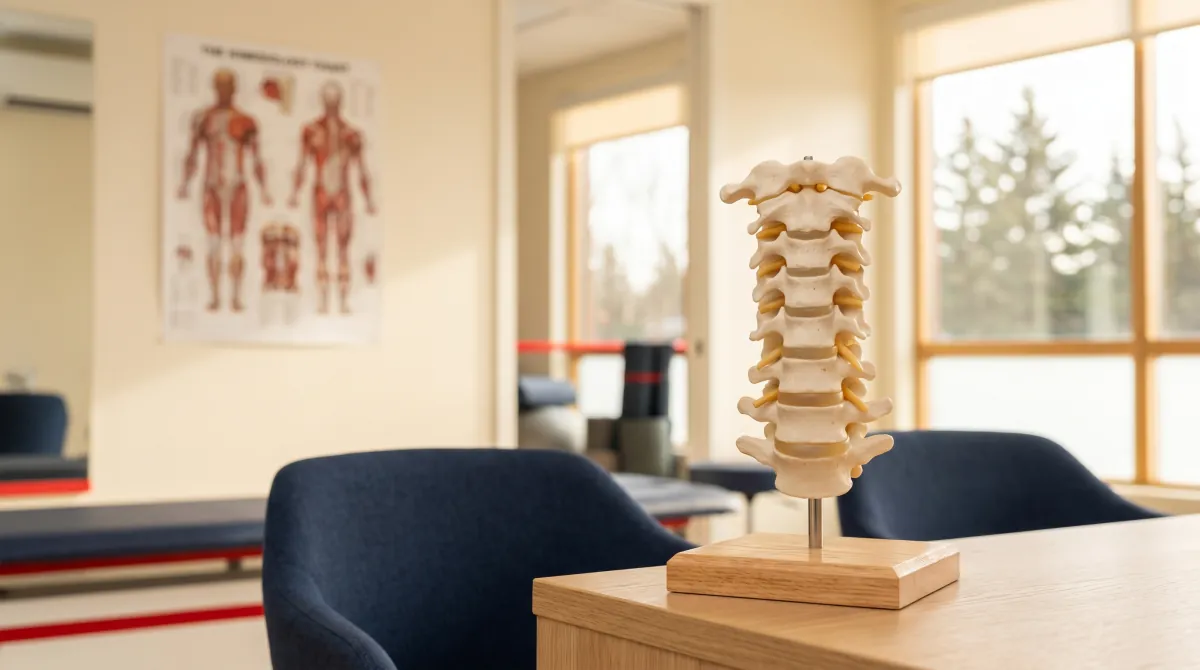
Neck
Neck Pain & Stiffness | North Vancouver
The stiff turn checking your blind spot, the ache that creeps up by mid-afternoon at the desk, the headache that starts at the base of your skull. Most mechanical neck pain settles faster than people expect once the right joints and muscles get unstuck.
What it is
Understanding your neck pain.
Neck pain runs the full range from a low background stiffness to a sharp catch that stops you turning your head. It tends to settle in the neck and upper shoulders, but it can spread into the head, the upper back, or down an arm. When it reaches the head it shows up as the kind of headache that starts behind the eyes or at the base of the skull, sometimes brings a touch of dizziness, and sometimes sends numbness or tingling into the fingers. At Medstar Sport Physio in North Vancouver, we assess and treat this through a one-on-one physiotherapy appointment, confirming the pattern and building a plan from there. We see patients from across Vancouver and the North Shore, many of whom cross Lions Gate Bridge or take the SeaBus for treatment here.
Most of it is mechanical. The small joints of the neck and the muscles around them get irritated by the positions we hold for hours, a forward head over a laptop, a phone tucked against a shoulder, a pillow that's too high. Sudden loads matter too: a sleep in an odd position, a heavy lift, an awkward reach. With age, the discs and joints stiffen and become a little more sensitive, which is normal and not a sentence.
Stress quietly feeds the cycle. Tense shoulders and shallow breathing keep the upper-neck muscles working when they should be resting, and that tightness reduces blood flow and prolongs the soreness. Pinning down which of these is driving your particular neck is the first job of the assessment.
What to expect
A simple stiff, acutely sore neck often loosens meaningfully within two or three visits. The longer-standing desk-pattern necks (the ones that have been grumbling for months) usually need four to six sessions plus a short daily routine before the gains hold on their own. You should feel more range early; the staying power comes from the strength work.
Get a plan
Not sure if we're the right fit?
Send us a quick note about what's going on. A physiotherapist will read it personally and reply with what they'd recommend. No commitment to book.
Common questions
About neck pain.
My neck pain started after a car crash. Is this the right page?
Not quite. Crash-related neck pain (the whiplash kind that comes on in the day or two after a rear-ender) has its own assessment and is billed differently. See our whiplash page and the ICBC guide, since that care is covered under Enhanced Care with no out-of-pocket cost.
Can a tight neck really cause my headaches?+
Often, yes. When the joints and muscles of the upper neck are irritated they refer pain up into the head, that's a cervicogenic headache, and it usually sits on one side, starts at the base of the skull, and eases when the neck is treated. We assess to confirm it's coming from the neck rather than something that needs your physician.
I work at a desk on Lonsdale all day. Will physio help if I can't change my job?+
Yes. The fix is breaking up the static load rather than quitting the desk. Small position changes every 20 to 30 minutes, a screen at the right height, and a few minutes of targeted neck and shoulder work usually offset a full day of sitting. Treatment also includes a desk, screen, and pillow review tailored to how you actually sit and sleep, matched to your setup instead of handed out as a generic sheet.
Should I get a scan for my neck?+
Rarely at the start. Neck X-rays and MRIs show age-related changes in most adults who have no pain at all, so a scan often raises alarm without explaining the problem. We assess first; if there are red flags or you stall, we'll send you to your GP for imaging.
What causes ordinary neck pain?+
Most neck pain is mechanical. The small joints of the neck and the muscles around them get irritated by the positions we hold for hours, a forward head over a laptop, a phone tucked against a shoulder, a pillow that's too high. Sudden loads matter too, like a sleep in an odd position, a heavy lift, or an awkward reach. Stress also feeds the cycle by keeping the upper-neck muscles tense.
Can neck pain spread to my arm or cause tingling?+
Yes. Neck pain tends to settle in the neck and upper shoulders, but it can spread into the head, the upper back, or down an arm, sometimes with numbness or tingling into the fingers. It's worth an assessment to confirm the neck is the source before assuming it's something else.
What does neck pain treatment actually involve?+
Joint mobilization of the stiff cervical segments so the neck turns without that guarded catch, IMS dry needling for the deep upper-trapezius and suboccipital knots that trigger headaches, and specific deep-neck-flexor and scapular strengthening, because a neck that can hold itself up stops flaring. We also do hands-on release of the upper-back and shoulder muscles that pull the head forward.
How long does it take for neck pain to get better?+
A simple stiff, acutely sore neck often loosens meaningfully within two or three visits. Longer-standing desk-pattern necks that have been grumbling for months usually need four to six sessions plus a short daily routine before the gains hold on their own. You should feel more range early, with strength work building the staying power.

Reviewed by Amir Ahmadi, PhD, MSc PT, Registered Physiotherapist, Certified IMS Therapist, College of Physical Therapists of British Columbia (CPTBC). Last reviewed July 2026.
This page is for general information only and does not constitute medical advice, diagnosis, or treatment. Individual presentations vary, and assessment findings and treatment plans differ from person to person. If you are experiencing severe symptoms, neurological changes (numbness, weakness, bowel or bladder changes), or a significant trauma, contact your physician or emergency services. Physiotherapy at Medstar Sport Physio & Health is provided by physiotherapists registered with the College of Physical Therapists of British Columbia (CPTBC).
Sources
- Blanpied PR et al., Neck Pain: Revision 2017, Clinical Practice Guidelines Linked to the International Classification of Functioning, Disability and Health, Journal of Orthopaedic & Sports Physical Therapy (2017)
- College of Health and Care Professionals of BC (CHCPBC): Physical Therapist registry
- HealthLink BC: Neck Pain
Related reading
- IMS dry needling: for the deep upper-neck knots that drive headaches →
- Whiplash & neck pain after a crash: ICBC-covered assessment →
- Postural problems: when forward-head posture keeps the neck flaring →
- Massage therapy: neck and upper-back soft-tissue release →
- ICBC physiotherapy | North Vancouver hub →