
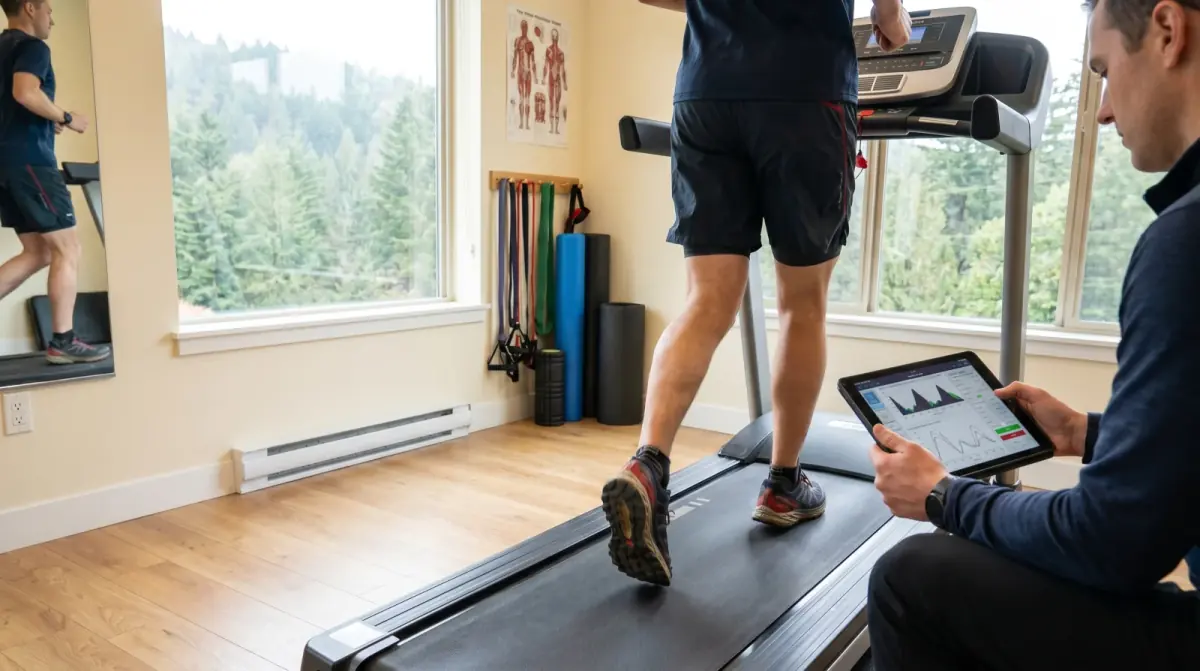
Running injuries
Runner's Knee & IT Band Pain | North Vancouver
The dull ache around the kneecap or the sharp outer-knee zing at km 5. We sort out the mechanics and get you back to your weekly mileage without the rebuild-from-zero advice.
What it is
Understanding your runner's knee / it band pain.
Two different problems usually get bundled together under "runner's knee." Patellofemoral pain (PFP) is the dull, diffuse ache around or under the kneecap, worse going downstairs, worse after long runs. IT band syndrome is sharper, more lateral, often hitting at the same point in a run and then easing once you stop. At Medstar Sport Physio in North Vancouver, we assess and treat this through a one-on-one physiotherapy appointment, confirming the pattern and building a plan from there. We see patients from across Vancouver and the North Shore, many of whom cross Lions Gate Bridge or take the SeaBus for treatment here.
Both share a few common drivers, usually some combination of weekly mileage going up faster than the tissue can adapt, hip muscles that don't control rotation under fatigue, and a cadence that's a bit too slow for current load.
The fix is rarely "stop running." In fact, complete rest tends to detrain the system that needs to get stronger. The trick is finding the dose of running that keeps you fit while you build the missing pieces.
What to expect
Most runners are back to full training inside 4 to 6 weeks, often without losing race fitness in between. We almost never tell people to stop running entirely, usually it's a temporary cap on volume or pace while we build capacity.

Book a sports assessment with Ali Shafiei
Ali leads sport and orthopaedic physiotherapy at the clinic: manual therapy, IMS dry needling, and exercise-based rehab built around getting you back to your sport, with pain relief along the way. He is taking new patients with same-week availability.
Get a plan
Not sure if we're the right fit?
Send us a quick note about what's going on. A physiotherapist will read it personally and reply with what they'd recommend. No commitment to book.
Common questions
About runner's knee / it band pain.
Do I need to stop running completely?
Almost never. Reducing the dose and changing some variables (cadence, terrain, surface) gets most people through without losing fitness. Complete rest tends to detrain the system that needs to get stronger, so it usually delays your return rather than speeding it up. Most runners we see are back to full training inside 4 to 6 weeks on a reduced-dose plan, not a stop-running one.
Are minimalist / maximalist shoes the answer?+
Shoes are a smaller factor than people think. Cadence, hip strength, and weekly load progression matter more, since both patellofemoral pain and IT band syndrome usually come from mileage rising faster than the tissue can adapt and hip muscles that don't control rotation well under fatigue. If shoes are part of the problem, we'll say so, but we don't sell shoes and we don't have a strong opinion to push.
What if I have a race in 6 weeks?+
We work backward from race day and build race-prep planning into the return-to-run programming, with weekly mileage targets rather than vague advice to see how it feels. Many of our patients hit their goal races even while rehabbing, since most are back to full training inside 4 to 6 weeks. Some don't, and we'll tell you honestly which category you're in by visit two.
Is foam rolling my IT band actually doing anything?+
Yes, but probably not what you think. The IT band itself is too thick to "release." What rolling does is desensitize the surrounding tissue temporarily, useful before a run, less useful as a fix. The fix is glute med strength, delivered through hip-driven work like single-leg squats, lateral step-downs, and Copenhagen planks, paired with manual therapy or IMS for the lateral quad, glute med, and TFL.
I'm older / not competitive, is this still for me?+
Absolutely. Most of our runners aren't elite. They're 35 to 60-year-olds doing 30 to 60km a week who want to keep running for the next 20 years. The same run gait analysis, hip-driven strength work, and return-to-run programming we use with racers applies here, just scaled to your mileage and goals. That's exactly who this is for.
Is runner's knee the same thing as IT band pain?+
No, they're two different problems that get bundled under the same name. Patellofemoral pain is a dull, diffuse ache around or under the kneecap that's worse going downstairs or after long runs. IT band syndrome is sharper and more on the outside of the knee, often hitting at the same point in a run and easing once you stop. We tell them apart during assessment and treat them differently.
What's actually causing my knee pain when I run?+
Usually a combination of factors: weekly mileage going up faster than the tissue can adapt, hip muscles that don't control rotation well under fatigue, and a cadence that's a bit too slow for your current load. That's why treatment includes hip-driven strength work like single-leg squats and lateral step-downs alongside run gait analysis, rather than just addressing the knee in isolation.
How long before I'm back to full training?+
Most runners are back to full training inside 4 to 6 weeks, often without losing race fitness along the way. We almost never prescribe stopping running entirely. Usually it's a temporary cap on volume or pace, paired with the return-to-run programming and hip strength work, while we build the capacity that was missing.
Reviewed by Amir Ahmadi, PhD, MSc PT, Registered Physiotherapist, Certified IMS Therapist, College of Physical Therapists of British Columbia (CPTBC). Last reviewed July 2026.
This page is for general information only and does not constitute medical advice, diagnosis, or treatment. Individual presentations vary, and assessment findings and treatment plans differ from person to person. If you are experiencing severe symptoms, neurological changes (numbness, weakness, bowel or bladder changes), or a significant trauma, contact your physician or emergency services. Physiotherapy at Medstar Sport Physio & Health is provided by physiotherapists registered with the College of Physical Therapists of British Columbia (CPTBC).
Related reading
- Knee injury & ACL recovery: when the knee injury is more serious →
- Ankle pain & Achilles injuries: the other common runner complaint →
- Return to sport guide: how we progress you back to full training →
- Early rehab: restoring pain-free range before you add load back in →
- Runner's knee (patellofemoral pain): what it is and what actually settles it →
- IT band syndrome: why the outside of your knee hurts when you run or ride →