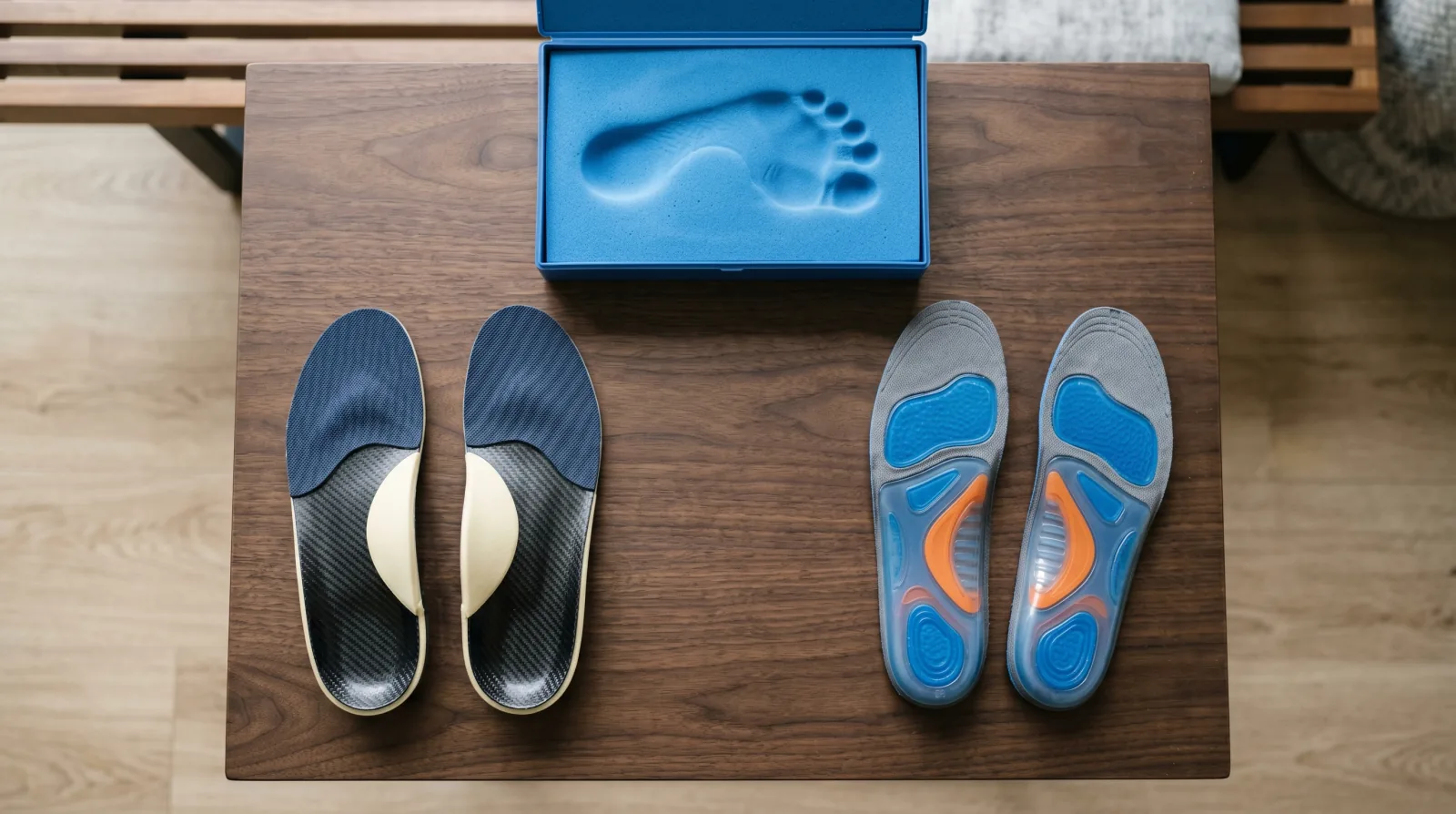
Custom Orthotics vs. Off-the-Shelf Inserts: When the Extra Cost Is Worth It
Custom orthotics and the $40 insole at the drugstore are different tools for different problems. Here is how we decide which one is right for you at our North Vancouver clinic.
BY AMIR AHMADI, PHD
For most people with plantar fasciitis or arch pain, a well-fitted over-the-counter insole works as effectively as a custom orthotic in published trials. The extra cost of a custom device is often justified in a narrower set of situations: a clinically measured anatomic asymmetry such as a leg-length difference or forefoot varus, a sport-specific demand that no prefabricated insole can meet, post-surgical structural replacement, or a case where a properly trialed prefab insole has not changed the symptom. At Medstar Sport Physio in North Vancouver, a four-week trial with a properly fitted over-the-counter insole typically runs before casting for a custom. Whether a custom device is the right call depends on the specific clinical findings at your assessment, not on the severity of the pain alone.
This is the answer the evidence supports, and it differs from what many retail orthotic providers say.
What the evidence actually says
The clearest synthesis is the 2018 Cochrane review on non-surgical interventions for plantar heel pain. The reviewers concluded that there is no consistent evidence that custom-made foot orthoses are superior to prefabricated foot orthoses for short- or long-term pain reduction in plantar heel pain. Subsequent systematic reviews in patellofemoral pain and Achilles tendinopathy have found similar patterns. Orthoses can help, but the custom premium does not reliably translate into better outcomes for the average patient.
That does not mean orthoses are useless. The same evidence base shows that orthoses (custom or prefabricated) can modify symptoms and reduce pain compared to no orthoses in selected populations. The right reading is that the insole category works for the right patient. The custom-vs-prefab distinction is where the cost-effectiveness conversation gets muddier.
When a custom orthotic is the right call
There are real cases where a custom device earns its cost. The pattern we look for in our clinic:
- Anatomic asymmetry. A clinically measured leg-length difference, a forefoot varus that requires a specific post angle, a rigid first-ray restriction. Off-the-shelf insoles cannot match a posted angle to within the degree.
- Sport-specific demand. A road cyclist on a stiff carbon shoe with a forefoot symptom. A trail runner with chronic plantar fascia symptoms who needs a rigid shell with a specific heel cup depth. Prefabricated insoles in these niches are limited in shell thickness, rigidity, and depth.
- Post-surgical reconstruction or structural replacement. After a tarsal coalition resection, a Lapidus fusion, or a Charcot-Marie-Tooth presentation, the device is replacing a structural function the foot has lost. A custom is usually the right tool.
- Failed prefabricated trial. A patient who has used a properly sized over-the-counter insole for 4 to 6 weeks alongside stretching and strength work and has not changed the symptom. The trial result tells us the foot has a specific need a prefab cannot meet.
The decision is patient-specific. A 55-year-old with plantar fasciitis whose primary load is walking the seawall and going to work is rarely a custom case. A 30-year-old North Shore trail runner training for the Knee Knacker, with chronic plantar fascia symptoms, a measured leg-length difference, and a failed prefab trial, often is.
When an off-the-shelf insole is the right call
The much larger group. The pattern:
- A generic mechanical foot symptom: plantar fasciitis, arch fatigue, generalized foot pain at the end of a long day.
- A foot anatomy that fits a standard insole shape, which covers most people.
- A walking-volume or low-mileage running load, not a competitive training load.
- A first presentation, not a recurrent case.
- A patient who can afford to replace the insole annually rather than waiting on a custom.
In these cases, the prefabricated insole is the first-line conservative intervention, combined with a stretching and strengthening program targeting the calf, the intrinsic foot muscles, and proximal hip strength. Our shockwave for plantar fasciitis post describes the cases where shockwave becomes an adjunct, and our patellar tendinopathy and tendinopathy management content covers the broader loading principle that applies to most lower-limb mechanical pain.
What the casting process actually produces
For patients who do need a custom, the production pathway matters. The two common casting methods:
- Foam-box casting. The patient steps into a foam impression block in a semi-weight-bearing position. The block is sent to the lab and the orthotic shell is produced from the impression. Simple, fast, and adequate for most cases.
- 3D scan capture. A digital scan of the foot in subtalar neutral, often with the practitioner manually positioning the foot. More expensive, faster turnaround, and useful for documenting the exact captured position.
The shell material (polypropylene, carbon fibre, EVA blends), the heel post angle, the medial arch height, and the topcover (cushioning, friction) are all prescription choices made by the practitioner. A custom orthotic without these prescription details is just a casting. The prescription is what makes it custom.
The "extended health plan covers it" question
A common driver of custom orthotic decisions is the extended health benefit. Most plans cover custom orthotics annually, with a physician, podiatrist, physiotherapist, or appropriately credentialed practitioner's prescription. The covered amount varies, and common ranges are $200 to $500 per pair, with some plans paying a percentage of the full cost up to a cap.
A few realities to weigh:
- "Covered by my plan" answers a different question than "is this the right intervention for my foot."
- Plans often require proof of clinical need, not just a casting.
- ICBC and WorkSafeBC cover orthotics when prescribed within an active claim. Our ICBC pre-approved physiotherapy post covers the funding pathway and our WorkSafeBC post covers the claim mechanics.
- Coverage changes the out-of-pocket cost while leaving the clinical decision the same.
A retail orthotic provider whose business model depends on extended-health billing has a structural incentive to recommend the custom. A regulated practitioner with no orthotic-sales incentive can have the harder conversation about whether the device is the right call.
What a custom orthotic visit looks like at Medstar
Two appointments (a casting visit and a fitting visit) built around an assessment and prescription rather than a retail transaction:
- A 60-minute initial assessment screening lower-limb mechanics, functional symptoms, footwear, and training load.
- A specific clinical decision: prefab trial, custom prescription, or no orthotic indicated.
- If casting: a foam-box impression in subtalar neutral and a written prescription with shell, post angle, and topcover specs.
- A 4-to-6-week lab turnaround.
- A fitting visit to confirm the device sits correctly in the patient's footwear, with adjustments at the heel cup, arch height, or forefoot if needed.
- A 4-week follow-up to assess whether the device changed the symptom. If it did not, that is the trigger to revisit the prescription.
The strongest outcomes happen when the orthotic is one part of a broader plan. The device addresses what it can change (foot mechanics, force distribution), and the strength and load-management work addresses the rest.
This article is general education about foot orthoses and is not personal medical advice. A regulated practitioner can confirm whether a custom orthotic, a prefabricated insole, or no orthotic is the right call for your foot, your symptom, and your training load.
Sources
- Hawke, Burns and Radford. Custom-made foot orthoses for treating foot pain, Cochrane Database of Systematic Reviews
- Bonanno et al. Effectiveness of foot orthoses for the prevention of lower limb overuse injuries, BJSM
- Whittaker et al. Foot orthoses for plantar heel pain: a systematic review and meta-analysis, BJSM
- College of Physical Therapists of BC (CPTBC)
Common questions
Frequently asked questions.
Are custom orthotics worth the price?
It depends on the diagnosis. For most generic mechanical foot symptoms (plantar fasciitis, arch fatigue, mild pronation) an over-the-counter insole performs equivalently in published trials. Custom orthotics earn their price tag for anatomical asymmetries (leg-length difference, forefoot varus, rearfoot deformity), sport-specific demands a prefab cannot meet, and cases where a properly trialed prefab has not changed the symptom. The right answer is patient-specific.
Will an off-the-shelf insole fix plantar fasciitis?+
Often, yes, when combined with stretching, calf strengthening, and load management. The 2018 Cochrane review on insoles for plantar heel pain found no consistent advantage for custom over prefabricated insoles at standard adult walking volumes. For higher-mileage runners and patients with specific anatomic findings, a custom may add value, but the prefab trial usually runs first.
Are custom orthotics covered by extended health insurance in BC?+
Most extended health plans cover custom orthotics annually, with a prescription from a regulated practitioner (physician, podiatrist, physiotherapist, or chiropractor with the appropriate scope). The covered amount varies widely, and common ranges are $200 to $500 per pair per year, with some plans capping at a percentage of the full cost. ICBC and WorkSafeBC cover orthotics when prescribed within an active claim for a covered injury. Verify the specific benefit on your plan before casting, and ask what proof of need the plan requires.
How long do custom orthotics last?+
Most custom orthotic shells last 3 to 5 years before refurbishment is needed. The topcover (the fabric layer the foot sits on) typically wears out at 12 to 24 months and can be replaced without recasting. Off-the-shelf insoles generally last 6 to 12 months before the cushioning compresses and the device loses its function, which is a real cost-of-ownership factor when comparing prices.
Do I need to see a physiotherapist to get custom orthotics, or can I go to a foot store?+
Some retail orthotic providers cast and produce orthotics without a clinical diagnosis. The risk is producing a custom for a problem that did not warrant one, or missing the real driver of the symptom (a calf strength deficit, a hip mechanics issue, a footwear problem). A physiotherapist or podiatrist assessment links the device to a specific clinical finding, which is what extended health plans generally require for reimbursement and what the device needs to actually solve.
How do I properly trial an over-the-counter insole before considering a custom?+
A proper trial means a correctly sized insole worn consistently for four to six weeks in the footwear you actually use, combined with stretching and calf-strengthening work rather than the insole alone. Tracking whether the symptom changes over that window is what tells your physiotherapist whether a prefab insole is enough or whether the foot has a specific need only a custom device can meet.
When does foot pain need more than an orthotic, custom or off-the-shelf?+
Get assessed rather than trialing an insole further if you have sudden severe foot pain, an inability to bear weight after an injury, visible deformity, signs of infection, or numbness that does not fit ordinary arch fatigue. Orthotics address mechanical load distribution, and they are not the right first step for an injury that needs medical assessment or imaging.
Does footwear matter as much as the orthotic itself?+
Yes. An orthotic or insole only works within the shoe it sits in, and a shoe with poor support or the wrong fit can undermine even a well-prescribed custom device. Assessing footwear, not just the insert, is part of why a physiotherapist looks at what shoes you actually train and work in before prescribing either a prefab trial or a custom orthotic.
Share this post
Copies a ready-to-publish LinkedIn post to your clipboard and opens the LinkedIn share dialog. Paste the text into the composer and publish.

Written by
Amir Ahmadi, PhDDr. Amir Ahmadi is a Registered Physiotherapist, Certified IMS Therapist and former Associate Professor. 20+ years of clinical practice in North Vancouver.
This article is for general information only and does not constitute medical advice, diagnosis, or treatment. Individual presentations vary, and assessment findings and treatment plans differ from person to person. If you are experiencing severe symptoms, neurological changes (numbness, weakness, bowel or bladder changes), or a significant trauma, contact your physician or emergency services. Care at Medstar Sport Physio & Health is provided by practitioners registered with their respective British Columbia regulatory colleges.
Filed under
- custom-orthotics
- insoles
- footwear
- plantar-fasciitis
- north-vancouver