
Custom orthotics
Custom Orthotics in North Vancouver
Prescription orthotics from a 3D foot scan and biomechanical gait assessment by a registered physiotherapist. Direct-billed to most extended-health plans.
What it is
Custom Orthotics in North Vancouver at Medstar.
Custom orthotics at Medstar are prescription medical devices manufactured to the specific biomechanics of your foot. The prescription is written by a registered physiotherapist after a full gait and biomechanical assessment, capturing the shape of your foot, how it loads, where it collapses, and the resulting chain effects up the lower limb.
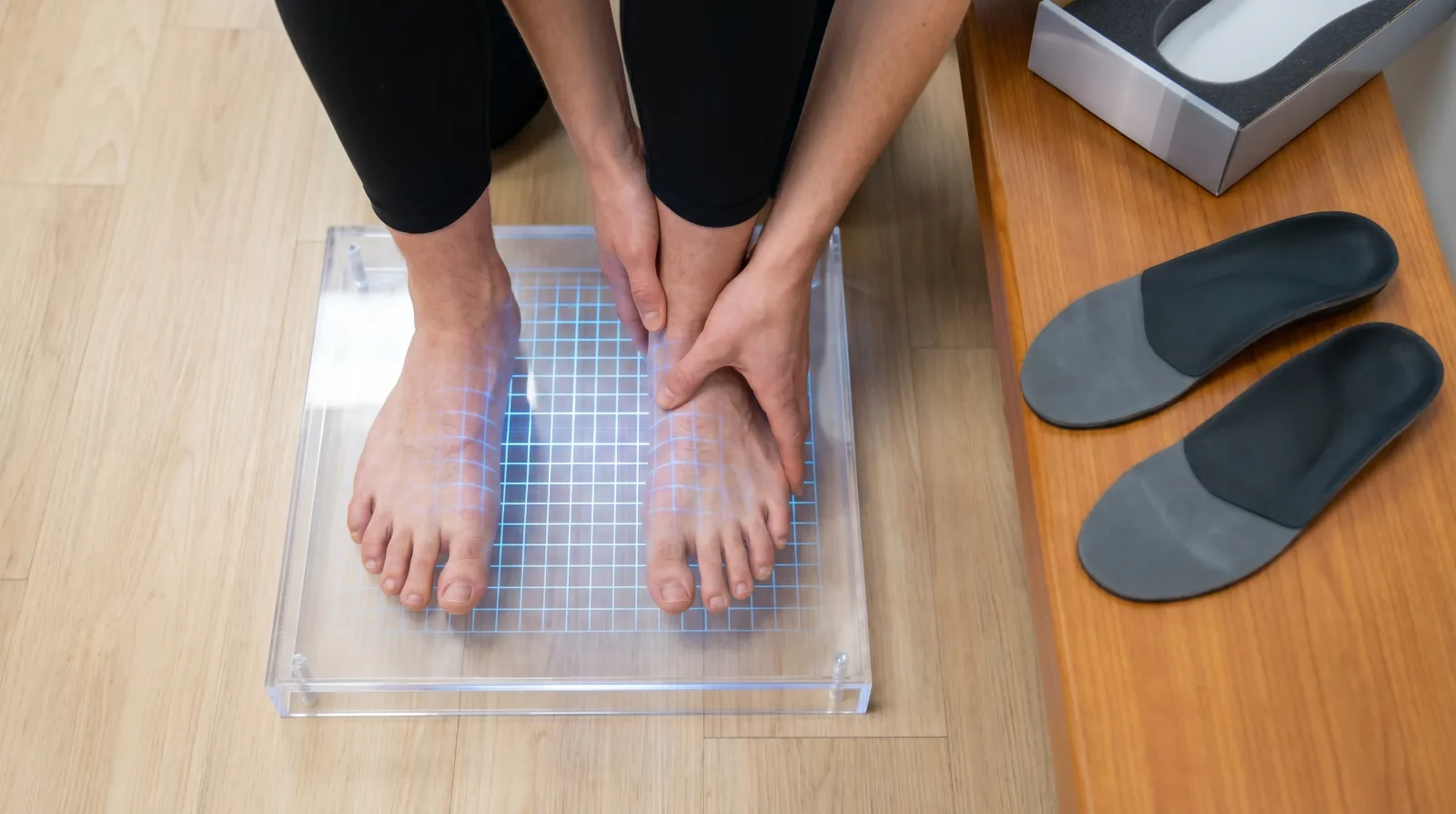
The capture itself uses either a high-resolution 3D foot scanner or a traditional foam impression box, depending on what gives the cleanest read for your foot shape. The resulting prescription is sent to a Canadian orthotic manufacturer that custom-mills the shells, top covers, and any specific posting, padding, or metatarsal support the case requires. Most prescriptions return finished within 2 to 3 weeks.
The reason this is delivered by a physiotherapist (rather than a podiatrist or pedorthist) is that the orthotic is one tool inside a broader rehab plan. A custom orthotic is most useful when paired with the strengthening work, footwear coaching, and treatment of the actual driving problem (calf tightness, intrinsic foot weakness, hip control). Orthotics alone, without the rest of that plan, often disappoint.
How it works
Inside a session.
The assessment visit runs 45 to 60 minutes. The physio takes a movement and footwear history (what you wear, when, for how long, what specifically hurts), then walks you through a structured gait assessment: barefoot, in your current footwear, and sometimes on a treadmill so we can see your loaded walking and running pattern. Then a passive biomechanical exam: subtalar range, midfoot mobility, first MTP function, calf length, hip and knee control.
If orthotics are indicated, the physio captures your feet in scan or foam. They'll also discuss the prescription decisions with you (full-length vs three-quarter, semi-rigid vs accommodative, posting at the heel or forefoot, top-cover material) so you understand what's being made and why. The lab manufactures over the next 2 to 3 weeks.
The dispense visit is 30 minutes. The orthotics are fitted into the shoes you'll wear them in, walked in, and adjusted on the spot for any pressure points. You leave with a structured break-in schedule (start at 1 to 2 hours per day, build to all-day wear over 7 to 14 days) and a follow-up scheduled at 2 to 4 weeks to confirm fit and adjust if needed.
Conditions we treat with this
See how custom orthotics fits into specific recovery plans.
- Plantar fasciitis & heel pain: orthotics as part of the broader fix
- Ankle & Achilles injuries: recurrent sprains and chronic instability
- Runner's knee & IT band: when knee pain traces down to foot mechanics
- Hip pain & groin injuries: when lower-limb chain alignment contributes
- Low back pain: selected cases with significant leg-length discrepancy
- Knee injury: patellofemoral cases with valgus chain involvement
What to expect
Most patients feel a noticeable change in comfort within the first week of wearing the orthotics, though the full benefit lands after the 1 to 2 week break-in period as the foot and lower limb adapt to the new alignment. Orthotics typically last 2 to 3 years before the shells fatigue; top covers can be refurbished partway through if they wear unevenly.
Talk to us
Not sure if it's the right fit?
Send a quick note about what's going on. A physiotherapist will read it and tell you honestly whether custom orthotics is the right tool, or whether something else makes more sense first.
Common questions
About custom orthotics.
Do I really need custom orthotics, or would over-the-counter ones work?
Honest answer: many patients do well with quality off-the-shelf options (Superfeet, Powerstep, specific running-shoe inserts) and never need custom devices. We'll tell you straight if that's the right call for your case. Custom orthotics make the most sense when off-the-shelf hasn't held the gain, when there's a significant asymmetry or specific biomechanical requirement (leg-length discrepancy, posterior tibial dysfunction, diabetic offloading), or when the foot needs unusual posting that off-the-shelf can't deliver.
How long do custom orthotics take to make?+
Typically 2 to 3 weeks from scan to dispense. The manufacturing lab mills the shells, applies the prescribed top cover and any specific posting or accommodation, then ships them back to the clinic for the fitting appointment. Rush turnaround is occasionally possible for an additional fee, depending on the lab's current production schedule.
Will they fit in all my shoes?+
No, and this is important to plan for. Most custom orthotics are sized to fit running shoes, walking shoes, and roomier dress shoes with a removable factory insole. They generally do not fit in narrow dress shoes, dress flats, ballet flats, or many heels. We'll discuss with you what shoes you actually wear before designing the prescription; some patients have two pairs (one for athletic use, one for work shoes) to maximise wearability.
How long do they last?+
Typically 2 to 3 years for the shells, depending on body weight, activity volume, and the specific materials in the prescription. Athletes putting in high running mileage may see shells fatigue sooner. The top covers (the part you actually feel under your foot) wear faster and can be refurbished at the manufacturing lab partway through the orthotic's life for a fraction of the cost of new pairs.
Are custom orthotics covered by extended health?+
Most major extended-health insurers cover custom orthotics dispensed by a registered healthcare professional, with specific limits per pair, per year, and often requiring a physician note. Coverage varies dramatically by plan, so check your specific policy or send us a screenshot of the orthotic benefit page and we'll help you read it. We provide detailed receipts that meet insurer documentation requirements.
Do they hurt at first?+
Often yes, briefly. A correctly prescribed orthotic changes how the foot loads, and that change is felt. Most patients describe arch pressure or a strange-feeling foot position for the first few days, which settles within 1 to 2 weeks as the foot and lower limb adapt. We give you a structured break-in schedule (1 to 2 hours day one, building progressively to full-day wear over 7 to 14 days). If discomfort persists or sharp pain develops, come back for an adjustment, because small modifications often make a big difference.
Can I run in them, or are they only for walking?+
Yes. Most prescriptions are designed for both walking and running use, depending on what you've discussed at the assessment. Running orthotics are typically slightly lower-profile and use a more responsive material than orthotics designed primarily for standing-work use. Tell the physio about your specific running volume, terrain, and shoe model at the assessment so the prescription is right for what you'll actually do.
What happens at the appointment where I pick up my orthotics?+
The dispense visit for custom orthotics runs 30 minutes. The orthotics are fitted into the shoes you'll actually wear them in, walked in, and adjusted on the spot for any pressure points. You leave with a structured break-in schedule and a follow-up scheduled at 2 to 4 weeks to confirm fit and make further adjustments if needed.

Reviewed by Amir Ahmadi, PhD, MSc PT, Registered Physiotherapist, Certified IMS Therapist, College of Physical Therapists of British Columbia (CPTBC). Last reviewed May 2026.
This page is for general information only and does not constitute medical advice, diagnosis, or treatment. Treatment suitability is determined case-by-case during assessment; not every service is appropriate for every presentation. If you have a medical implant, are pregnant, take blood thinners, or have an active infection, tell your physiotherapist before treatment. Physiotherapy at Medstar Sport Physio & Health is provided by physiotherapists registered with the College of Physical Therapists of British Columbia (CPTBC).
Ready to book?