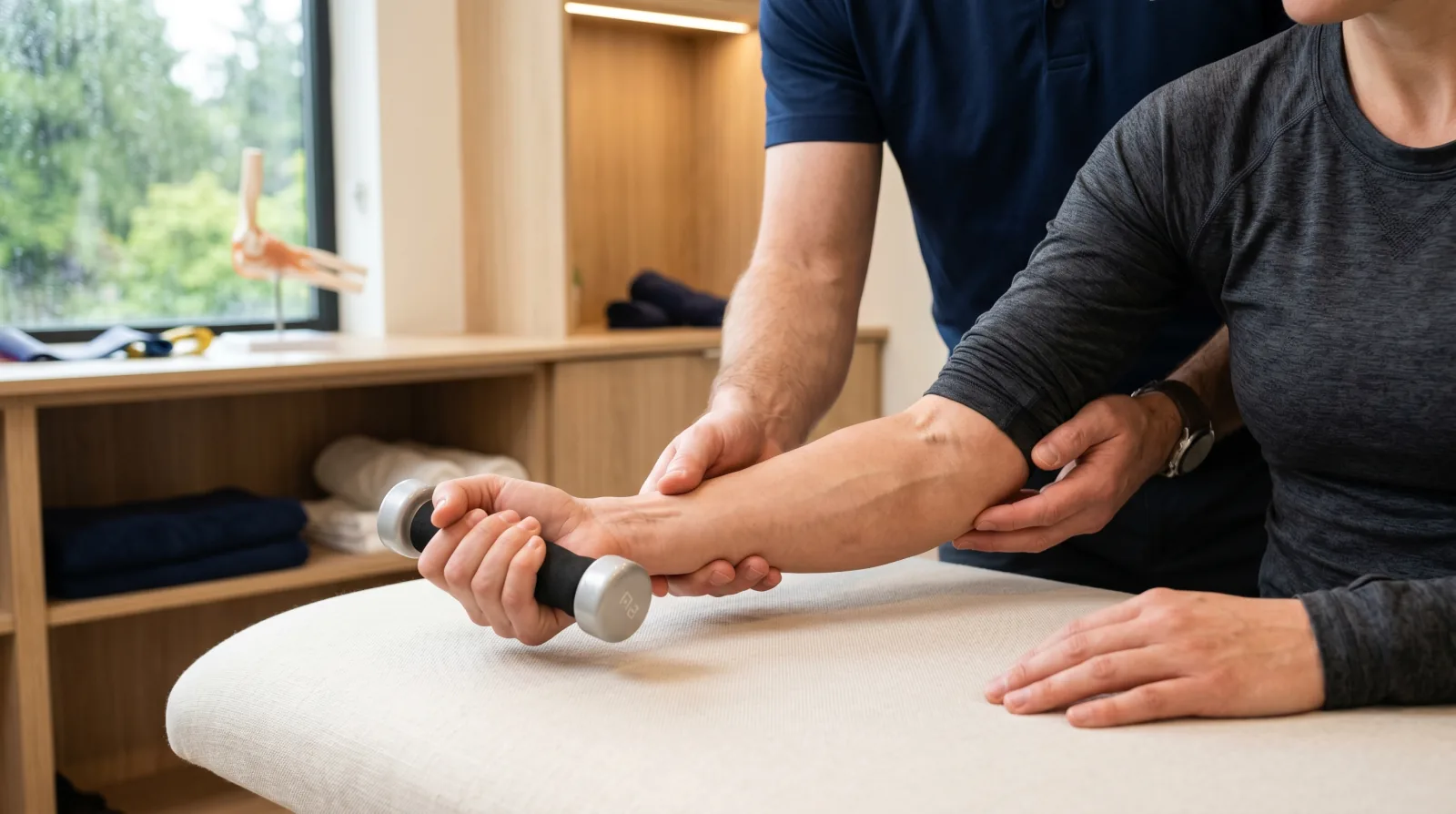

Eccentric or Heavy Slow Resistance? Same Result, a Third of the Time
Two loading programmes for the same tendon problem produced the same result at one year. One asked for five hours a week, the other for under two.
BY MEDSTAR SPORT PHYSIO TEAM
Two loading programmes for a painful Achilles produced the same outcome after a year. The difference between them was how much of the patient's week they consumed.
At Medstar Sport Physio in North Vancouver, tendon loading programmes are chosen on the load and on what a person will realistically complete, because a 2015 randomised trial in the American Journal of Sports Medicine found no difference in outcome between eccentric training and heavy slow resistance for chronic midportion Achilles tendinopathy. Fifty-eight patients were randomised and 47 completed 12 weeks of training with follow-up to 52 weeks. Function scores improved in both groups with no significant difference between them, and pain during running fell in both. The separation was in time cost and adherence: the eccentric programme required 308 minutes per week against 107 minutes for heavy slow resistance, with compliance of 78 percent against 92 percent.
Here is what each programme involves, what the trial measured, and how to choose between them.
What the two programmes actually ask of you
The 2015 randomised controlled trial by Beyer and colleagues published the protocols in enough detail to compare them directly.
The eccentric programme is the one most people have met. Three sets of 15 slow eccentric repetitions, performed twice daily, seven days a week. That is 14 sessions in a week, every week, for 12 weeks. The lowering phase is the working phase, and the load comes from body weight plus any added weight.
The heavy slow resistance programme runs three times per week. Three exercises per session, three to four sets of each, with two to three minutes rest between sets. Every repetition takes six seconds, split evenly as three seconds lowering and three seconds lifting. The load is set by repetition maximum and progresses on a schedule: a 15 repetition maximum in week 1, a 12 repetition maximum in weeks 2 and 3, a 10 repetition maximum in weeks 4 and 5, and heavier from there.
Two features separate them. The eccentric approach removes the lifting phase and asks for high frequency at moderate load. Heavy slow resistance keeps both phases, slows them down, and pushes the load up while dropping the frequency.
What the trial found
Fifty-eight patients with chronic midportion Achilles tendinopathy, meaning symptoms present for more than three months, were randomised to one of the two programmes for 12 weeks. Forty-seven completed the study, 25 in the eccentric group and 22 in the heavy slow resistance group.
The main outcome was the VISA-A score, a questionnaire measuring Achilles symptoms and function where higher is better. The eccentric group went from 58 at baseline to 72 at 12 weeks and 84 at 52 weeks. The heavy slow resistance group went from 54 to 76 to 89. There was a significant effect of time at p below 0.0001 and no significant difference between the groups.
Pain during running, measured on a visual analogue scale where lower is better, followed the same pattern. The eccentric group went from 49 to 20 to 12. The heavy slow resistance group went from 54 to 17 to 5. The difference between groups was not significant, at p equals 0.71.
Both groups also showed changes on imaging: reduced tendon thickness and reduced neovascularisation, which describes the small new blood vessels often seen in a painful tendon.
Two details in those numbers deserve attention. Both groups kept improving between 12 weeks and 52 weeks, so the three-month result understated where people ended up. And the size of the improvement was substantial in both arms, which means this is a comparison between two things that work.
The time cost, and why it decides things
The trial reported the time each programme demanded. The eccentric programme cost 308 minutes per week. Heavy slow resistance cost 107 minutes per week.
That is roughly five hours a week against under two hours, for the same result at one year.
Adherence followed. Compliance was 78 percent in the eccentric group and 92 percent in the heavy slow resistance group, significant at p below 0.005. Patient satisfaction at 12 weeks was 20 of 25 patients, or 80 percent, in the eccentric group and 22 of 22, or 100 percent, in the heavy slow resistance group, at p equals 0.052. At 52 weeks it was 19 of 25, or 76 percent, against 21 of 22, or 96 percent, at p equals 0.10.
Those satisfaction figures did not reach the usual threshold for statistical significance, so they should be read as a consistent direction rather than a proven difference. Compliance did reach it.
For a patient trying to fit rehabilitation around work, family, and training, this is the practical finding. Twelve weeks of twice-daily exercise every single day is a large ask, and a programme completed at 78 percent delivers less than the same programme completed in full.
The load matters more than the contraction type
Putting the two sets of results together gives a straightforward principle. Both programmes loaded the tendon progressively over 12 weeks. Both improved function and pain. Both changed the tendon on imaging. The contraction type differed and the outcomes did not.
Other work points the same way. The 2025 review in Frontiers in Rehabilitation Sciences reports a 2012 study by Dimitrios and colleagues showing VISA-P improvement in patellar tendinopathy at four weeks, at p below 0.0005. The same review reports a 2021 study by Breda and colleagues in which a progressive tendon-loading exercise programme was superior to eccentric exercise alone at 24 weeks, scoring 28 points against 18, at p equals 0.023.
That last comparison is worth reading carefully. It compares a progressive loading programme against eccentric work alone, which supports progression and adequate load rather than any single contraction type.
The same reasoning applies to the debate over isometric holds, covered in our article on isometrics for tendon pain.
Choosing between them in practice
Both are defensible choices, and the decision usually comes down to circumstances rather than to one being better.
Heavy slow resistance suits someone with access to a gym or loaded equipment, and someone whose main barrier is time. Three sessions a week fits alongside work and training. The heavier loads need somewhere to put them, which is the main practical limitation.
Eccentric work suits someone with no equipment beyond a step, or someone in the early stage of a very irritable tendon where heavy loading is not tolerated yet. Heel drops can be done at home, which is why the protocol became popular in the first place.
Two things apply either way. The load has to progress, because a programme that stays at week one loading for two months is not loading the tendon in any meaningful sense. And the programme has to run long enough, since the trial showed continued improvement between 12 and 52 weeks.
Our detailed programmes for the Achilles and the patellar tendon set out how the load progresses week by week. Where the goal is a return to running, the loading work sits alongside a graded running plan of the kind described in our guide to returning to running after a calf strain.
When to get it looked at
Achilles or patellar tendon pain that has been present for more than a few weeks, that is limiting training, or that has come back after a previous episode is worth having assessed. The reason to have a professional set the load is that both under-loading and over-loading look the same from the outside, and both stall progress.
Some situations need medical attention first. Sudden severe pain in the back of the leg with a snapping sensation, an inability to push off or rise onto the toes, a visible gap in the tendon, or a tendon area that is red, hot, and swollen with fever are reasons to contact your physician or attend Lions Gate Hospital rather than booking a rehabilitation appointment.
If you have been doing heel drops for months without much change, book a 30-minute assessment and we will look at whether the load is high enough and the programme long enough. You can see what we treat or reach the clinic here.
This article is general information, not personal medical advice. A regulated practitioner can confirm whether the patterns described apply to you.
Sources
- Heavy Slow Resistance Versus Eccentric Training as Treatment for Achilles Tendinopathy: A Randomized Controlled Trial (The American Journal of Sports Medicine, 2015)
- A systematic review: impact of dry needling, isometric, and eccentric exercises on pain and function in individuals with patellar tendinopathy (Frontiers in Rehabilitation Sciences, 2025)
- College of Health and Care Professionals of BC public registry
Common questions
Frequently asked questions.
What is the difference between eccentric and concentric loading?
Eccentric loading is the lowering phase, where the muscle produces force while it lengthens. Concentric loading is the lifting phase, where the muscle shortens. Traditional eccentric tendon programmes ask you to lower slowly and then use the other leg or an assist to return to the start. Heavy slow resistance keeps both phases, performing each one slowly under a heavier load.
Which one works better for Achilles tendinopathy?+
A 2015 randomised controlled trial in the American Journal of Sports Medicine compared them over 12 weeks in 58 patients with chronic midportion Achilles tendinopathy. Both groups improved significantly over time, with a significant effect of time at p below 0.0001, and there was no significant difference between the groups at 12 weeks or at 52 weeks.
How much time does each programme take?+
In that trial the eccentric programme required 308 minutes per week and the heavy slow resistance programme required 107 minutes per week. The eccentric group trained twice daily, 7 days a week. The heavy slow resistance group trained 3 times per week. That difference in time cost is the clearest practical separation between the two.
Does the shorter programme have better adherence?+
In that trial, yes. Compliance was 78 percent in the eccentric group and 92 percent in the heavy slow resistance group, a statistically significant difference at p below 0.005. Patient satisfaction at 12 weeks was 80 percent for eccentric and 100 percent for heavy slow resistance, which did not reach the usual threshold for significance at p equals 0.052.
What does a heavy slow resistance session look like?+
The published protocol used 3 exercises, 3 times per week, with 3 to 4 sets per exercise and 2 to 3 minutes rest between sets. Each repetition lasted 6 seconds, split as 3 seconds lowering and 3 seconds lifting. Load started at a 15 repetition maximum in week 1, moved to a 12 repetition maximum in weeks 2 and 3, then a 10 repetition maximum in weeks 4 and 5, progressing from there.
How long before I see a change?+
Timelines vary between people and depend on how long the problem has been present. In the 2015 Achilles trial, function scores improved over 12 weeks and continued improving out to 52 weeks in both groups, so the one-year mark showed better results than the three-month mark. Tendon rehabilitation is generally measured in months, and stopping when symptoms ease is a common reason problems return.
Do these programmes change the tendon itself?+
In the 2015 trial, both groups showed reduced tendon thickness and reduced neovascularisation, which refers to the new small blood vessels often seen in a painful tendon on imaging. Those changes appeared with both loading approaches, which supports the idea that the load matters more than the specific contraction type used to deliver it. The imaging changes accompanied the improvements in symptoms and function reported in the same trial.
Is eccentric training obsolete now?+
No. Eccentric training produced good results in that trial, with function scores rising from 58 to 84 over 52 weeks. It remains a valid option, especially where equipment is limited, because heel drops need only a step. The practical argument for heavy slow resistance is that it delivered comparable results in a third of the weekly time with better adherence.
Share this post
Copies a ready-to-publish LinkedIn post to your clipboard and opens the LinkedIn share dialog. Paste the text into the composer and publish.
Written by
Medstar Sport Physio Team
Registered clinician at Medstar Sport Physio & Health, North Vancouver.
This article is for general information only and does not constitute medical advice, diagnosis, or treatment. Individual presentations vary, and assessment findings and treatment plans differ from person to person. If you are experiencing severe symptoms, neurological changes (numbness, weakness, bowel or bladder changes), or a significant trauma, contact your physician or emergency services. Care at Medstar Sport Physio & Health is provided by practitioners registered with their respective British Columbia regulatory colleges.
Filed under
- eccentric-training
- heavy-slow-resistance
- tendinopathy
- loading
- north-vancouver