
Disc involvement
Disc Bulge & Herniation | North Vancouver
Lifted something wrong, woke up with leg pain, or the MRI report finally landed. We figure out what the disc is actually doing and build a plan that respects it.
What it is
Understanding your disc bulge / herniation.
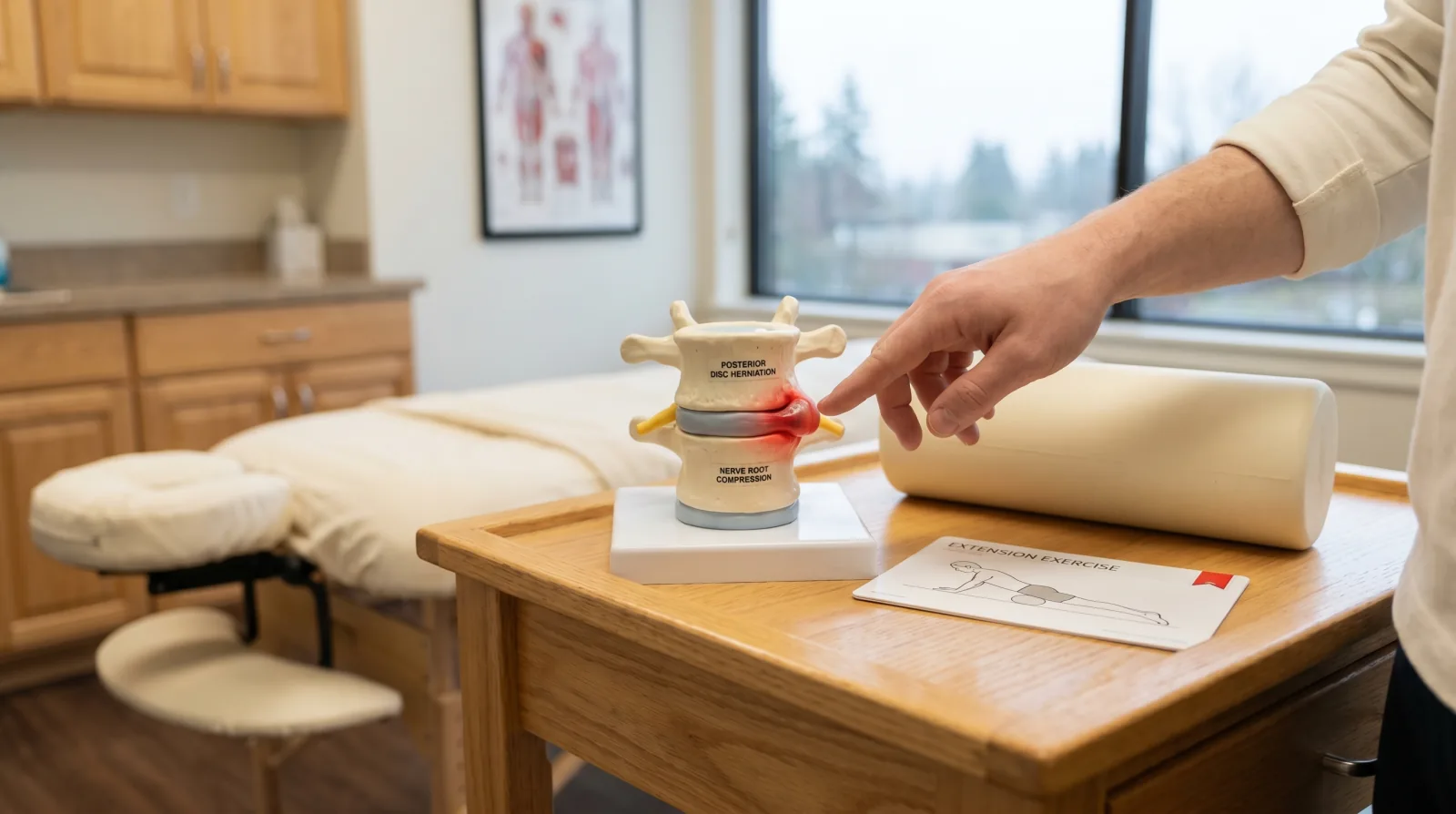
Discs are the load-distributing cushions between vertebrae. When one of them bulges, herniates, or starts to wear down, the surrounding structures all react: the joints, the nerves exiting the spine, and the muscles trying to protect everything. The pain you feel often does not come from the disc itself; it comes from a nerve root that the disc is now compressing, or from the joints and muscles working overtime to splint the area. At Medstar Sport Physio in North Vancouver, we assess and treat this through a one-on-one physiotherapy appointment, confirming the pattern and building a plan from there. We see patients from across Vancouver and the North Shore, many of whom cross Lions Gate Bridge or take the SeaBus for treatment here.
What people mean by 'disc problem' covers a wide range. A small bulge with localized back pain behaves very differently from a frank herniation pressing on the L5 nerve root and sending pain down the leg. Imaging findings also age along with you, and a fair number of asymptomatic adults walk around with bulges they will never feel. Your symptoms, your movement, and your response to load matter more than what the MRI report says in isolation.
Discs rarely give out from one dramatic moment. More often it's accumulated load: repetitive bending, twisting, or lifting with sloppy mechanics, plus long stretches of prolonged sitting that keep the disc under steady pressure. Over time the outer wall weakens, and then a single awkward lift or sudden movement is enough to push the inner material outward against a nerve.
The reassuring part is that most disc-driven pain settles with conservative care. Some take weeks, some take longer. The unhelpful part is that not every protocol works for every disc, because what calms one presentation can wind up another. The first assessment exists to figure out which set of movements is yours.
A related presentation worth naming: nerve root impingement. When a disc, a bone spur, or narrowing of the spinal canal (stenosis) presses on a specific nerve root, the symptoms follow that root's path: sharp pain, numbness, tingling, or weakness travelling into a defined area of the arm or leg. The treatment principles are the same as for disc-driven pain: find the position that takes pressure off the nerve, build tolerance for the positions you cannot avoid, and progress load as the nerve calms. Persistent or progressive weakness in a single muscle group is the signal to escalate care rather than continue conservative work in isolation.
What to expect
Many disc-related cases ease meaningfully within 4 to 8 weeks of consistent care. Full return to heavy lifting, running, or contact sport takes longer and depends on irritability, deficits at assessment, and whether radicular signs are clearing. Your physiotherapist will set the next milestone after the first visit.
Get a plan
Not sure if we're the right fit?
Send us a quick note about what's going on. A physiotherapist will read it personally and reply with what they'd recommend. No commitment to book.
Common questions
About disc bulge / herniation.
I have a herniation on MRI: do I need surgery?
Usually not, at least not as a first step. Most disc herniations resolve or settle clinically with conservative care, even when the imaging looks dramatic. Surgical referral is reasonable when there is progressive neurological deficit, intractable pain that hasn't responded to a proper rehab trial, or red-flag findings. We'll be honest about which camp you're in.
Should I avoid bending and lifting entirely?+
No. Total avoidance keeps the spine deconditioned and the disc just as vulnerable when life eventually forces a lift. We coach a graded return to bending and lifting once the irritability is down. The goal is a back that handles loaded movement, not one that fears it.
Is McKenzie / extension the right approach for everyone?+
No. Extension-biased exercise helps a sub-group whose symptoms centralize with backward bending, meaning the pain pulls back from the leg toward the spine. Others do better with flexion or unloading positions instead. Directional preference testing at the first assessment is what tells us which pattern fits your disc, rather than defaulting to one exercise for every back.
Will the disc 'go back in'?+
Sometimes. Disc material can shrink or be reabsorbed over time, which is part of why many herniations look quieter on imaging months later. We don't bank on any specific imaging change, because a fair number of adults walk around with bulges on their scan that never caused a symptom. We measure progress by symptoms, movement, and load tolerance instead of chasing a particular MRI result.
Do you direct-bill ICBC and extended health?+
Yes. Direct billing for most major extended-health insurers, plus ICBC and WorkSafeBC. We handle the paperwork. This matters for disc-related pain in particular, since a lot of the herniations and bulges we see follow a car accident or a heavy lift at work, so the claim is already in the ICBC or WorkSafeBC system before treatment even starts.
What if a bone spur or narrowed spinal canal is pinching the nerve, not the disc itself?+
The treatment principles for disc involvement are the same either way. Whether it's a disc, a bone spur, or spinal stenosis pressing on a nerve root, we find the position that takes pressure off the nerve, build tolerance for positions you can't avoid, and progress load as the nerve calms. Persistent or worsening weakness in one muscle group is the signal to escalate care rather than continue conservative treatment alone.
What treatments do you use for disc-related pain besides exercise?+
Alongside directional preference exercise and manual therapy for the joints and gluteal muscles around the affected level, we use high-power (Class IV) laser, IMS intramuscular stimulation, electrotherapy, or gentle heat when radicular pain and muscle guarding are slow to settle with movement alone. Graded core and hip strengthening comes in once acute disc symptoms are easing, so the spine has support that lasts outside the clinic.
How long does it take for disc-related pain to improve?+
Many disc-related cases ease meaningfully within four to eight weeks of consistent care. A full return to heavy lifting, running, or contact sport takes longer for disc involvement, depending on irritability, deficits found at assessment, and whether radicular signs down the leg or arm are clearing. Your physiotherapist sets the next milestone after your first visit.

Reviewed by Amir Ahmadi, PhD, MSc PT, Registered Physiotherapist, Certified IMS Therapist, College of Physical Therapists of British Columbia (CPTBC). Last reviewed July 2026.
This page is for general information only and does not constitute medical advice, diagnosis, or treatment. Individual presentations vary, and assessment findings and treatment plans differ from person to person. If you are experiencing severe symptoms, neurological changes (numbness, weakness, bowel or bladder changes), or a significant trauma, contact your physician or emergency services. Physiotherapy at Medstar Sport Physio & Health is provided by physiotherapists registered with the College of Physical Therapists of British Columbia (CPTBC).