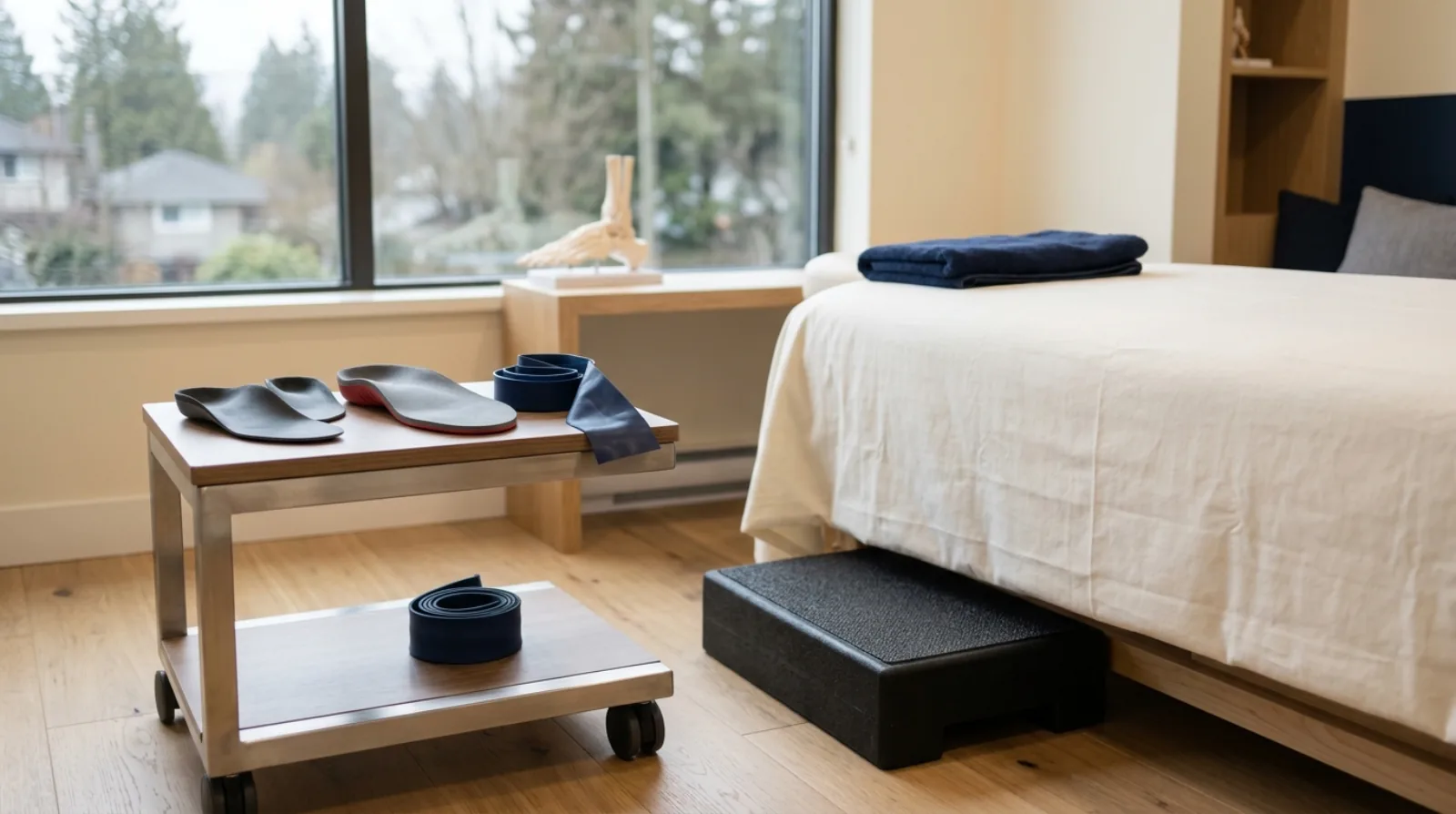

Hallux Rigidus: The Stiff Big Toe That Changes How You Walk
A big toe that will not bend upward changes every step you take. Most people can manage it without an operation, if the right things are changed early.
BY MEDSTAR SPORT PHYSIO TEAM
A big toe that will not bend upward sounds like a small problem. It sits under a joint that carries more than your body weight on every step, which is why people usually notice it somewhere else first.
At Medstar Sport Physio in North Vancouver, a stiff and painful big toe joint that has come on gradually usually points to hallux rigidus, which is degenerative arthritis of the first metatarsophalangeal joint. The name is Latin for stiff toe. Movement is lost mainly in upward bending, and bone spurs on the top of the joint are the main early finding on X-ray. Because that joint carries approximately 119 percent of body weight during each step, losing its movement changes how the whole foot pushes off. Clinical references report that 55 percent of patients achieve adequate pain relief without surgical intervention, using footwear changes, orthoses and activity adjustment.
Here is what the joint does, how the grading works, and which non-surgical measures the literature actually supports.
The joint under the most load in your foot
The first metatarsophalangeal joint sits at the base of the big toe, where the long bone of the foot meets the first bone of the toe. It has to do two jobs at once: hold up a large share of body weight, and bend upward far enough for the heel to lift off the ground.
The StatPearls review of hallux rigidus reports that this joint carries approximately 119 percent of body weight during each step of gait. That figure is higher than body weight because of the way force moves forward through the foot as you push off.
Hallux rigidus is degenerative arthritis of that joint. As the joint surface wears down, bone spurs form, most commonly on the top of the joint. Those spurs physically get in the way when the toe tries to bend upward, which is why the loss of movement is mainly in dorsiflexion, the upward direction. In milder disease, pain appears at the end of the available range rather than throughout it.
The same review reports that hallux rigidus affects 25 percent of patients older than 50 who have foot disorders, and as high as 73 percent in a population with end-stage ankle arthritis. Females are twice as likely as males to develop it. It can occur in adolescence, though that is uncommon.
Why a stiff toe shows up as a problem somewhere else
Walking normally needs the big toe to bend upward as the heel comes off the ground. When that movement is blocked, the body finds another route through the step. Most people roll off the outside of the foot, shorten the stride on that side, or turn the foot outward to avoid loading the toe.
Any of those changes shifts load elsewhere. The outer border of the foot, the calf, the knee and the hip all end up working differently. People often arrive at the clinic describing pain in one of those places and mention the toe only when asked directly.
This is why the assessment for a stiff toe does not stop at the toe. It looks at how the whole foot is loading, in the same way that assessment for plantar fasciitis or for other forefoot problems has to account for what is happening upstream. Where forefoot pain is the main complaint, the pattern also needs separating from the problems covered in our comparison of Morton's neuroma and metatarsalgia, which sit further along the ball of the foot.
How it is graded
The Coughlin and Shurnas system is the grading most commonly used, and it combines available upward movement with the pain pattern.
Grade 0 has 40 to 60 degrees of dorsiflexion, or a 10 to 20 percent loss compared with normal, with no pain. Grade 1 has 30 to 40 degrees, or a 20 to 50 percent loss, with mild pain at the extremes of movement. Grade 2 has 10 to 30 degrees, or a 50 to 75 percent loss, with moderate to severe constant pain. Grade 3 has 10 degrees or less, or a 75 to 100 percent loss, with nearly constant pain. Grade 4 has the same range as grade 3, but pain occurs at mid-range of passive motion rather than only at the ends.
The step from grade 3 to grade 4 is the one worth understanding. Both have the same amount of movement left. The difference is that in grade 4 the joint hurts through the middle of its range, which suggests the joint surface itself is the problem rather than the spurs blocking the ends.
Grading matters because it shapes the conversation about what to expect. A grade 1 toe with pain only at the extremes has more options than a grade 4 toe that hurts in mid-range.
What the examination looks for
Examination findings described in the StatPearls review are fairly specific. A practitioner looks for a swollen, tender first toe joint with palpable bone spurs on the top surface. Pain with forced upward bending is characteristic, as is a positive grind test, where the joint is compressed and rotated to load the surface directly.
One finding catches people out. Compression of the medial dorsal cutaneous nerve, which runs over the top of the joint area, can cause numbness. That means a stiff arthritic toe can produce numbness as well as pain, and the numbness does not mean a separate nerve problem elsewhere.
Imaging is weight-bearing X-rays taken in front, side and oblique views. Weight-bearing matters, because the joint has to be loaded to show how it behaves under real conditions. A dorsal bone spur is the main early finding.
The non-surgical options, and the number behind them
The most useful figure in this whole condition is that 55 percent of patients achieve adequate pain relief without surgical intervention. That is more than half, and it is the reason a proper trial of conservative measures comes first.
The non-operative options listed in the StatPearls review fall into a few groups.
Medication and injection. Anti-inflammatory medication is used for symptom control. For steroid injection, the review notes that dexamethasone phosphate is preferred over triamcinolone.
Footwear. High toe-box shoes give the joint room and reduce pressure on the bone spurs from above. Rocker-bottom soles let the foot roll forward through the step without requiring the toe to bend, which is the single most direct way of unloading this joint during walking.
Orthoses. Carbon fibre or spring steel orthoses add stiffness under the forefoot so the sole does not flex where the joint would have to. A Morton's extension is a firm extension under the big toe specifically designed to reduce dorsiflexion.
The theme is consistent. All of these reduce how far the joint bends under load. That is a different goal from the cushioning most people reach for, and it is worth understanding when choosing between an off-the-shelf insert and a custom device, which we cover in our comparison of custom orthotics and off-the-shelf inserts.
What physiotherapy can and cannot change
Being direct about this saves disappointment later. Movement lost to bone spurs and worn joint surfaces will not be restored by exercise. The structural block is real.
What can change is the rest of the picture. Pain levels usually respond to load management and to getting the footwear right. Strength through the foot, calf and hip can be rebuilt, since most people have lost some by avoiding push-off on that side for months. Walking pattern can be reviewed so the compensations do not create a second problem in the knee or hip.
Activity choices matter too. Movements that force the toe into deep upward bending under load, such as deep lunges, sprint starts and some yoga positions, are the ones that provoke this joint most. Modifying those is usually more effective than reducing overall activity, and the principle is the same one that applies in managing knee osteoarthritis with exercise first, where staying active in a modified way beats resting.
When to get it looked at
A big toe that has become stiff and sore over months, that hurts when you push off, or that has developed a bump on the top of the joint is worth having assessed. Getting the footwear and load right earlier gives the conservative approach a fairer trial.
Some situations need a physician rather than a physiotherapy booking. Sudden severe pain with redness and swelling in the joint can indicate gout or infection rather than arthritis, particularly if there is a fever. That needs same-day medical assessment, and a hot swollen joint with fever means contacting your physician or going to Lions Gate Hospital. A toe that became painful immediately after a specific injury should also be assessed medically, since a fracture behaves differently from arthritis and is managed differently. Pain that came on suddenly in a single moment while pushing off points toward a different problem, covered in our article on turf toe and sesamoiditis.
If your big toe has been getting stiffer and you have started walking differently to avoid it, book a 30-minute assessment and we will look at the joint and at what the rest of the foot is doing to compensate. You can see what we treat or reach the clinic here.
This article is general information, not personal medical advice. A regulated practitioner can confirm whether the patterns described apply to you.
Sources
- Hallux Rigidus, StatPearls, NCBI Bookshelf
- College of Health and Care Professionals of BC public registry
Common questions
Frequently asked questions.
What is hallux rigidus?
It is degenerative arthritis of the first metatarsophalangeal joint, the joint at the base of the big toe. The name is Latin for stiff toe. The joint surface wears down and bone spurs form, most often on the top of the joint, which physically blocks the toe from bending upward. It is one of the more common arthritic problems in the foot.
Who tends to get it?+
Clinical references report that it affects 25 percent of patients older than 50 who have foot disorders, rising as high as 73 percent in a population with end-stage ankle arthritis. Females are twice as likely as males to develop it. It can occur in adolescence, though that is uncommon. Age and existing foot problems are the main patterns.
Why does one stiff toe affect my whole walk?+
Because that joint takes a large share of load. The first metatarsophalangeal joint carries approximately 119 percent of body weight during each step of gait. Walking normally also requires the toe to bend upward as the heel lifts. When it cannot, people push off through the outside of the foot instead, which changes loading further up the leg.
What does the grading mean?+
The Coughlin and Shurnas system grades 0 to 4 by how much upward movement is lost. Grade 0 keeps 40 to 60 degrees with no pain. Grade 1 has 30 to 40 degrees and mild pain at the extremes. Grade 2 has 10 to 30 degrees with moderate to severe constant pain. Grade 3 has 10 degrees or less with nearly constant pain. Grade 4 has the same range as grade 3 but pain occurs in mid-range.
Do I need surgery?+
Not necessarily. Clinical references report that 55 percent of patients achieve adequate pain relief without surgical intervention. That figure is the main reason to try shoe changes, orthoses and activity adjustment properly before considering an operation. Surgery becomes a reasonable discussion when a genuine trial of those measures has not brought the pain down enough.
What footwear helps a stiff big toe?+
The aim is to stop the joint bending upward under load. Options described in the literature include high toe-box shoes, rocker-bottom soles, carbon fibre or spring steel orthoses, and a Morton's extension, which is a firm extension under the big toe that reduces how far it bends. A stiffer sole usually does more for this joint than extra cushioning.
What does an examination involve?+
A practitioner looks for a swollen tender first toe joint with palpable bone spurs on the top, pain with forced upward bending, and a positive grind test where the joint is compressed and rotated. Compression of the medial dorsal cutaneous nerve can also cause numbness. Weight-bearing X-rays in front, side and oblique views are the standard imaging, and a dorsal bone spur is the main early finding.
Can physiotherapy restore the movement I lost?+
Movement lost to bone spurs and joint surface wear cannot be fully restored by exercise, so that should be said plainly. What treatment can change is how much pain the joint produces, how well the surrounding muscles support it, and how the rest of the foot and leg handle the altered push-off. Many people walk comfortably with a permanently stiff toe once those pieces are addressed.
Share this post
Copies a ready-to-publish LinkedIn post to your clipboard and opens the LinkedIn share dialog. Paste the text into the composer and publish.
Written by
Medstar Sport Physio Team
Registered clinician at Medstar Sport Physio & Health, North Vancouver.
This article is for general information only and does not constitute medical advice, diagnosis, or treatment. Individual presentations vary, and assessment findings and treatment plans differ from person to person. If you are experiencing severe symptoms, neurological changes (numbness, weakness, bowel or bladder changes), or a significant trauma, contact your physician or emergency services. Care at Medstar Sport Physio & Health is provided by practitioners registered with their respective British Columbia regulatory colleges.
Filed under
- hallux-rigidus
- big-toe
- foot-arthritis
- orthotics
- north-vancouver