
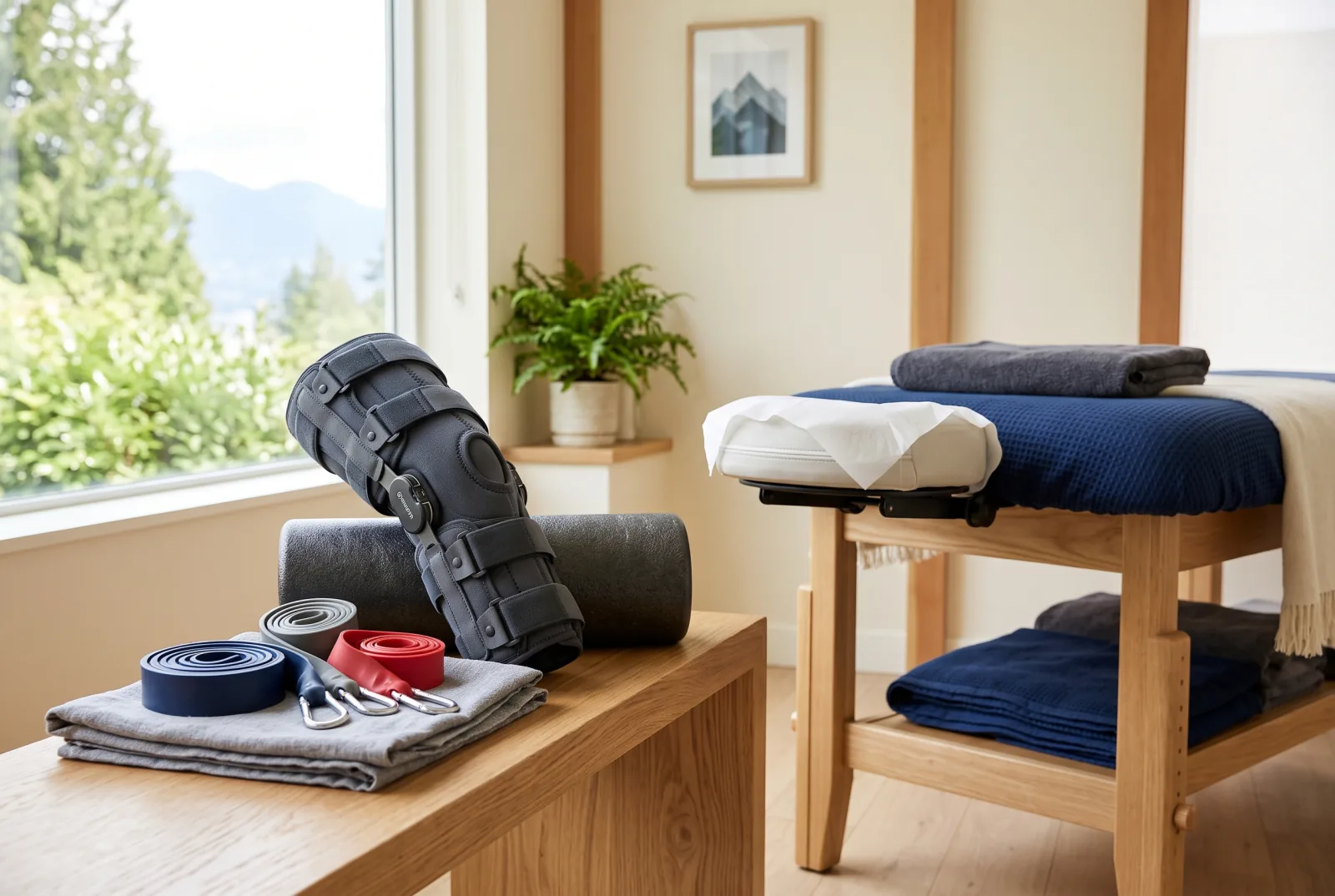
Post-surgical & post-operative rehab
Post-Surgical Rehabilitation | North Vancouver
Structured rehabilitation from the day your surgeon clears you to move, through regaining range of motion, rebuilding strength, and returning to work, sport, or daily activity. Serving patients across North Vancouver and Vancouver recovering from orthopaedic surgery.
What it is
Post-Surgical Rehabilitation | North Vancouver at Medstar.
Post-surgical rehabilitation is physiotherapy built specifically around a surgeon's protocol, the defined sequence of movement restrictions, weight-bearing rules, and exercise progressions that protect a healing repair while restoring function as fast as the tissue safely allows. It's not generic exercise; every phase has a reason tied to how the specific tissue (ligament graft, tendon repair, bone, cartilage) heals over time.
We see this most often after ACL reconstruction, meniscus repair, rotator cuff repair, hip and knee replacement, shoulder labral repair, and hip arthroscopy, but the same protocol-driven approach applies to most orthopaedic procedures. Some patients also come to us before surgery for 'prehab', building strength and range of motion ahead of a planned procedure, since going into surgery stronger is consistently linked to a smoother post-operative course.
The work is genuinely collaborative with your surgical team. We follow the exact protocol your surgeon provides (or a standard evidence-based protocol for that procedure if none is provided), flag anything that looks off-track at a follow-up appointment, and coordinate directly when your surgeon's office has questions about your rehab progress.
How it works
Inside a session.
The first visit happens once your surgeon has cleared you to start physiotherapy, timing varies by procedure. We review your operative report and protocol, assess your current range of motion, swelling, pain, and any movement restrictions, and set a realistic phase-by-phase plan through to your goal, whether that's a return to sport, a return to physical work, or simply moving around your home without pain.
Early sessions focus on protecting the repair while restoring the motion you're cleared for: gentle range-of-motion work, scar mobilization once the incision has closed, swelling management, and gait or movement pattern correction if you're using a brace or crutches. As healing progresses through the surgeon's timeline, sessions shift toward progressive strengthening, balance and proprioception work, and eventually sport- or activity-specific loading.
Throughout, we track objective markers: range of motion in degrees, strength compared to the uninjured side, and specific functional tests. Both you and your surgeon can then see concrete progress against the expected timeline instead of relying on a subjective sense of 'feeling better.'
Conditions we treat with this
See how post-surgical rehabilitation fits into specific recovery plans.
- Knee injury & ACL recovery: ligament reconstruction rehab
- Knee meniscal injuries: repair vs. meniscectomy rehab pathways
- Shoulder rotator cuff: post-repair protocol and return to overhead activity
- Hip pain: pre- and post-arthroplasty and arthroscopy care
- Physiotherapy for seniors: joint replacement recovery for older adults
What to expect
Timelines are set by the surgical procedure and your surgeon's protocol, not by us. As general reference points: ACL reconstruction rehab commonly runs 6-9 months to full sport clearance; rotator cuff repair is often 4-6 months; hip and knee replacement typically reaches most functional milestones by 3-4 months, with continued strength gains beyond that. Your surgeon's specific protocol and your own healing response are the actual timeline, not these general ranges.
Talk to us
Not sure if it's the right fit?
Send a quick note about what's going on. A physiotherapist will read it and tell you honestly whether post-surgical rehabilitation is the right tool, or whether something else makes more sense first.
Common questions
About post-surgical rehabilitation.
When can I start physiotherapy after surgery?
This is set by your surgeon, not by us, and it varies by procedure and sometimes by the specifics of your surgery. Some post-operative protocols start gentle motion work within days; others require several weeks of protected rest first. Follow your surgeon's specific instructions and bring your discharge paperwork or protocol sheet to your first physiotherapy visit.
Do you follow my surgeon's exact protocol, or your own approach?+
We follow your surgeon's specific protocol whenever one is provided. That's the priority, since it reflects the exact repair technique and tissue used in your surgery. If no specific protocol was given, we work from a standard evidence-based protocol for that procedure and flag anything unusual with your surgical team. We don't substitute our own judgment for a surgeon's explicit post-operative restrictions.
What if I'm still in a brace or using crutches?+
That's expected in the early phase for many procedures. We work within whatever restrictions your surgeon has set, including brace angle limits, weight-bearing status, and crutch use. We progress those restrictions only as your protocol allows, on your surgeon's timeline. Bring your brace or crutches to every visit so the physiotherapist can check the fit and settings, and tell us right away if a restriction feels unclear or the equipment is causing new discomfort.
How many physiotherapy visits will I need?+
It depends heavily on the procedure, your protocol, and how your individual healing progresses. A knee replacement and an ACL reconstruction have very different visit counts and total timelines. We'll give you a realistic estimate at your first visit based on your specific surgery and discuss it again as you progress through the phases.
Can I do 'prehab' before my surgery date?+
Yes, and it's worth asking about if your surgery date is more than a few weeks out. Building strength and range of motion ahead of a planned procedure is associated with a smoother post-operative course for several common surgeries, including ACL reconstruction and joint replacement. Ask us or your surgeon whether prehab makes sense for your specific procedure and timeline.
Is post-surgical physiotherapy covered by ICBC, WorkSafeBC, or extended health?+
If your surgery followed a motor-vehicle crash or a workplace injury, ICBC or WorkSafeBC typically covers the physiotherapy directly, often with pre-approved visits. For other surgeries, most extended health plans include a physiotherapy allowance, and we direct-bill the major providers. Bring your claim number (for ICBC/WorkSafeBC) or ask us to check your extended health coverage before your first visit.
What should I bring to my first post-surgical visit?+
Your surgeon's discharge summary and post-operative protocol if you have one, any imaging reports you were given, a list of current medications, and whatever mobility aids you're currently using (brace, crutches, walker). Wear or bring clothing that allows access to the surgical site: shorts for knee or hip surgery, a loose top for shoulder surgery.
How do you actually measure my progress after surgery, not just how I feel?+
We track objective markers throughout post-surgical rehab: range of motion in degrees, strength compared to your uninjured side, and specific functional tests matched to your procedure. That way both you and your surgeon can see concrete progress against the expected timeline, rather than relying only on a subjective sense of feeling better.
Reviewed by Amir Ahmadi, PhD, MSc PT, Registered Physiotherapist, Certified IMS Therapist, College of Physical Therapists of British Columbia (CPTBC). Last reviewed May 2026.
This page is for general information only and does not constitute medical advice, diagnosis, or treatment. Treatment suitability is determined case-by-case during assessment; not every service is appropriate for every presentation. If you have a medical implant, are pregnant, take blood thinners, or have an active infection, tell your physiotherapist before treatment. Physiotherapy at Medstar Sport Physio & Health is provided by physiotherapists registered with the College of Physical Therapists of British Columbia (CPTBC).
Related reading
- What to expect after surgery: general recovery timeline and normal symptoms →
- ACL prehab before surgery: building strength ahead of a planned procedure →
- Meniscus tear: rehab vs. surgery: how the decision affects your rehab path →
- Rotator cuff pain: exercise vs. surgery: what determines the right path →
- Kinesiology & active rehab: the strengthening phase after physiotherapy →
Ready to book?