
Rotator Cuff Shoulder Pain: Why Exercise Usually Comes Before Surgery
Most rotator cuff shoulder pain responds to a structured loading program. Surgery has a narrower role than people expect, and the evidence is clear on where it sits.
BY AMIR AHMADI, PHD
A sore shoulder that aches at night and bites when you reach overhead sends a lot of people straight to "I probably need surgery." For most rotator cuff related shoulder pain, that is the wrong first stop. The first stop is a loading program, and the evidence on that is unusually consistent. Post-surgical rehab has its own timeline and criteria when surgery is genuinely the right call.
For most rotator cuff related shoulder pain, a well-designed strengthening program produces outcomes comparable to surgery, and the evidence on this point is unusually consistent. Clinical trials comparing subacromial decompression surgery with exercise therapy or placebo surgery found no meaningful benefit from the operation for the common gradual-onset presentations. Surgery has a clearer role for acute traumatic full-thickness tears, particularly in younger or high-demand shoulders. For the larger group with subacromial pain, tendinopathy, or partial atraumatic tears, a loading program is the appropriate first step. At Medstar Sport Physio in North Vancouver, we begin with a progressive loading protocol and reassess against function around the six-week mark. Whether surgery becomes relevant depends on tear type, response to rehab, and your activity goals.
This is the conversation we have at the first visit when someone arrives convinced an operation is coming.
What rotator cuff related shoulder pain actually means
"Rotator cuff related shoulder pain" is the umbrella term clinicians now use for the cluster of presentations that used to get split into shoulder impingement, bursitis, tendinopathy, and partial cuff tears. They share a similar pattern: pain on reaching, lifting, and lying on the shoulder, often with weakness or apprehension in certain ranges.
The grouping matters because the treatment is broadly the same across the cluster. You do not need a precise sub-label to start rehab well. You need a clear screen, a sense of what aggravates the shoulder, and a loading plan that respects the irritability.
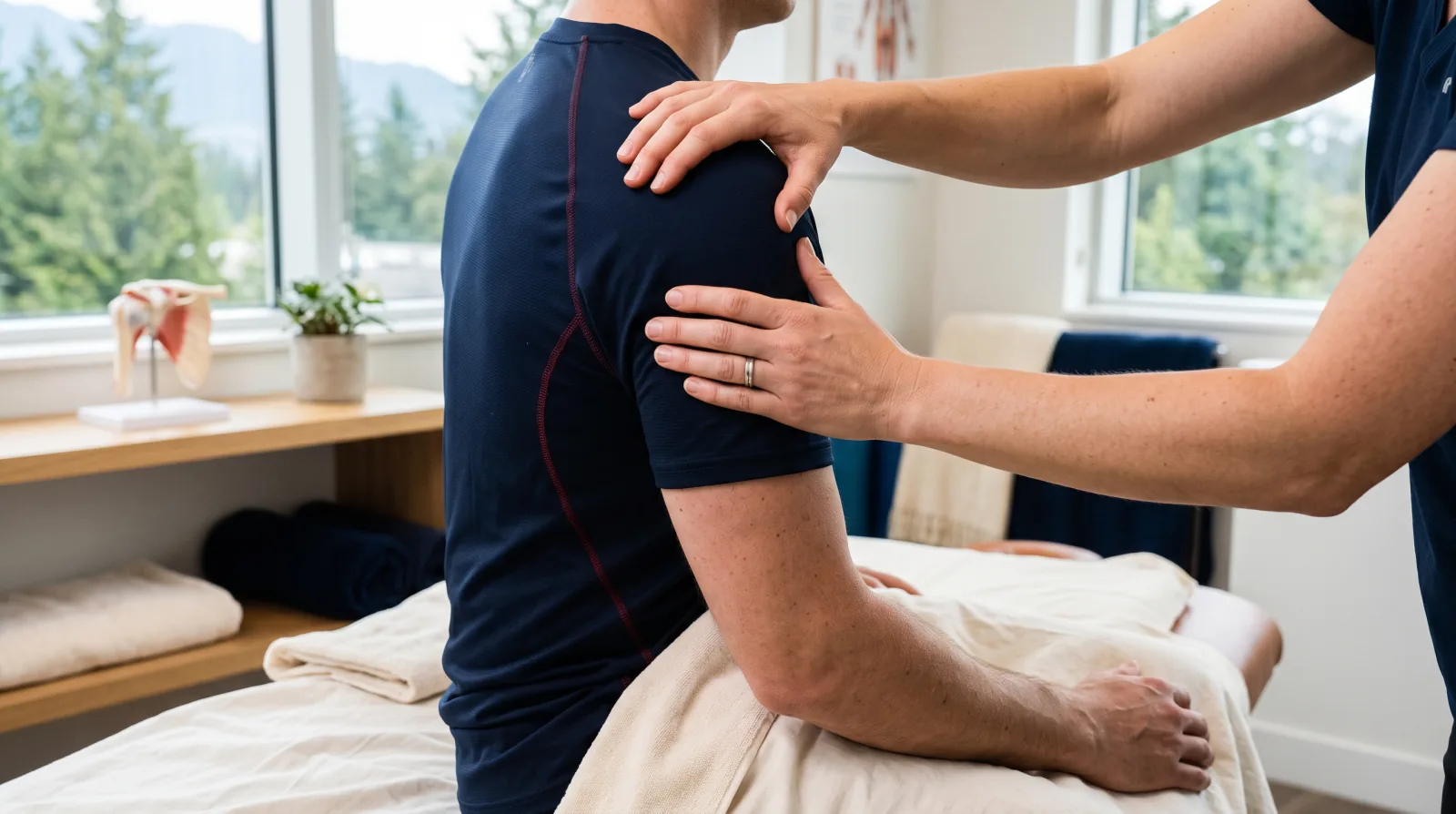
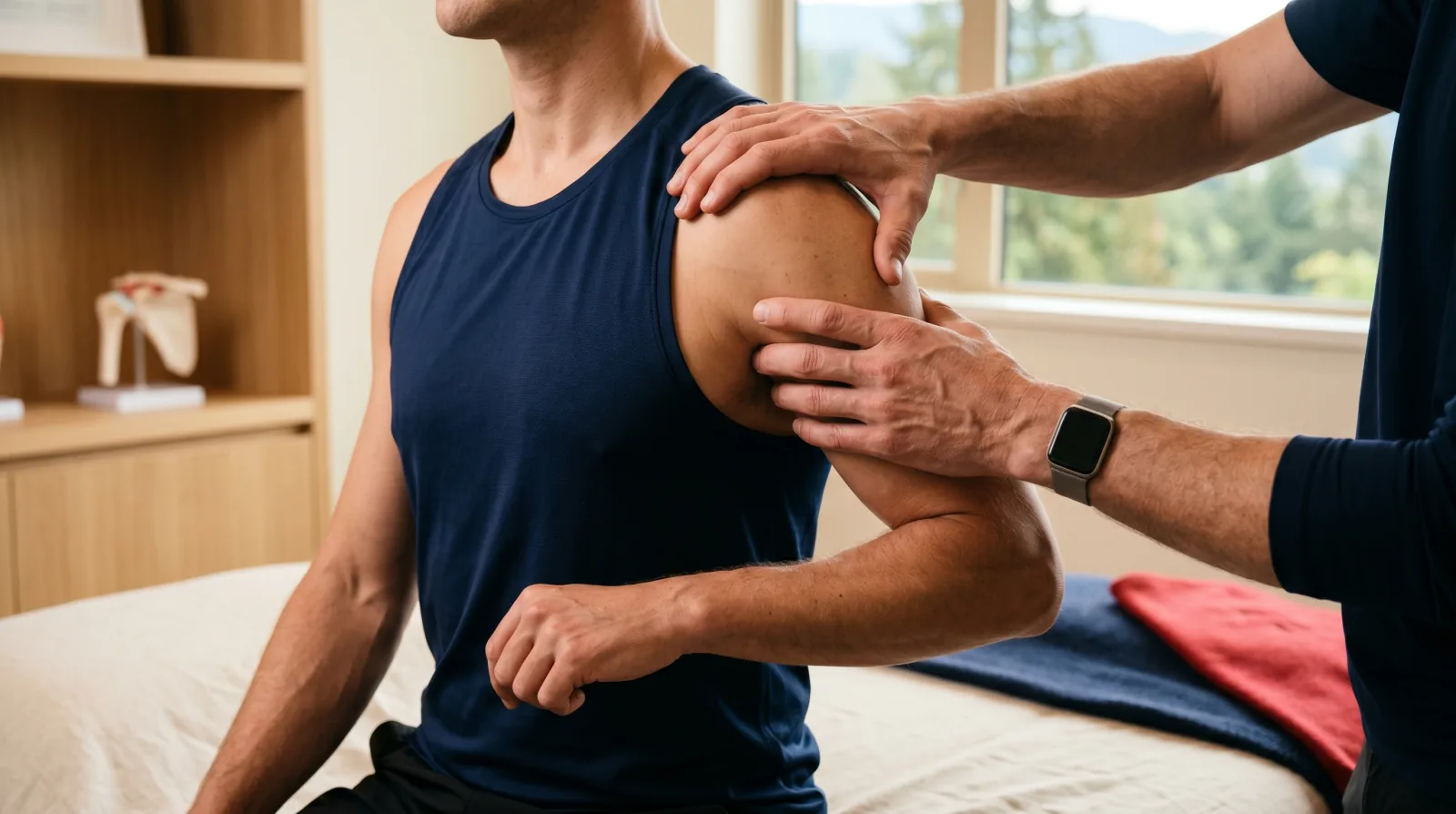
A loading test at assessment, resisted external rotation, scaption, and a few provocative reaches, tells us more about where to start than a label does.
Why exercise is the first-line treatment
Across clinical practice guidelines, exercise therapy is recommended as the first-line treatment to improve pain, mobility, and function in subacromial and rotator cuff related shoulder pain. A systematic review and network meta-analysis of exercise for rotator cuff related shoulder pain found exercise had the most robust evidence of being an effective non-surgical treatment, with combined strengthening generally performing best.
The mechanism is not mysterious. The cuff and the muscles around the shoulder blade tolerate more load when you load them progressively. Strength returns, the painful arc shrinks, and function follows. There is no passive modality that replaces that adaptation.
In our clinic, the early weeks focus on loading the cuff in ranges you can manage and calming the most provocative positions, not avoiding the shoulder altogether. We adjust the dose based on how the shoulder responds the next morning.
Where surgery does and does not help
This is where the evidence gets pointed. In randomised trials, subacromial decompression surgery provided no important benefit compared with placebo surgery or exercise therapy. For the large group of people with subacromial pain and no acute traumatic tear, the operation that was once routine does not beat a good loading program.
That does not make surgery pointless. It narrows where it belongs. An acute, traumatic full-thickness tear, particularly in a younger or high-demand shoulder, is a genuine surgical conversation, and we refer promptly when that pattern shows up. So is a cuff that has failed a competent, consistent rehab trial and continues to lose function.
The distinction is between the common atraumatic, gradual-onset shoulder pain, where loading is first-line, and the less common traumatic tear, where a surgical opinion is part of the early plan.
Why the scan rarely settles the decision
People often expect an MRI to deliver a verdict. It usually does not. Rotator cuff changes, including partial and full-thickness tears, are common findings in people with no shoulder pain at all. A scan that shows a tear does not prove the tear is what hurts, and it does not by itself mean you need an operation.
The decision comes from the clinical picture: your symptoms, your function, the mechanism of injury, and how the shoulder responds to a loading trial. Imaging enters the conversation when a traumatic tear is suspected, when the response to rehab has stalled, or when a surgeon needs it to plan. Your family physician, often via the Lions Gate Hospital catchment, is the route for that referral when it is warranted.
What a realistic rehab block looks like
A typical course for rotator cuff related shoulder pain in our clinic runs roughly like this. Early on, we settle the most irritable positions and start loading the cuff and scapular muscles in tolerable ranges. As tolerance builds, the load increases and the painful ranges open up. Later, the program moves toward the demands you actually have, overhead work, sport, lifting, or carrying.
We monitor two things: pain behaviour and function on the loading tests. A mild ache that settles overnight is usually acceptable. Symptoms that climb day to day, sharp catching pain, or worsening night pain are signals to reassess rather than push through.
Recovery timelines depend on irritability, baseline strength, age, and how consistently the loading gets done. We set expectations after the assessment rather than promising a fixed number of weeks.
When to get it looked at sooner
Most rotator cuff pain is not an emergency, but a few patterns warrant earlier attention. A shoulder that gave out after a fall or a sudden traumatic load, with marked weakness lifting the arm, should be assessed promptly for a traumatic tear. Fever, a hot swollen joint, or pain with no mechanical pattern is a call to your physician, not a physio booking.
If your shoulder pain has been building gradually, aches overhead, and bothers you at night without those red flags, a loading program is almost always the right place to start. Book a 30-minute assessment and we will screen the shoulder, run the loading tests, and set a plan before anyone talks about a scan.
This article is general information about rotator cuff related shoulder pain. It is not personal medical advice. A regulated practitioner can confirm whether the patterns described apply to you.
Sources
- Lin et al., Effects of seven types of exercise in the treatment of rotator cuff related shoulder pain: a systematic review and Bayesian network meta-analysis (2025)
- JOSPT: An update of systematic reviews examining conservative physical therapy interventions for subacromial shoulder pain (2020)
- College of Physical Therapists of BC (CPTBC)
Common questions
Frequently asked questions.
Does a rotator cuff tear always need surgery?
No. Many partial and even some full-thickness atraumatic tears settle with a loading program and never need an operation. Surgery is more clearly indicated for acute traumatic full-thickness tears, especially in younger or high-demand shoulders. Your physiotherapist and surgeon decide together based on the tear type, your function, and how you respond to rehab.
How long before I know if exercise is working?+
We reassess against function as well as pain, usually around the six-week mark. If pain-free range and strength on the loading tests are improving, the program is on track. If nothing has shifted after a competent, consistent block of loading, that is the point to revisit the diagnosis or consider imaging through your family physician.
Should I rest my shoulder until it stops hurting?+
Total rest usually backfires for rotator cuff pain. The tissue needs graded load to tolerate more. We modify the aggravating positions early, then load the cuff and the surrounding muscles in a range you can manage, and progress from there based on symptom response.
Is it safe to exercise into some shoulder pain?+
Often, yes, within limits. A mild ache during and shortly after loading that settles by the next morning is usually acceptable and sometimes necessary. Sharp pain, night pain that worsens, or symptoms that climb day to day are different and worth a reassessment.
Will an MRI tell me whether I need surgery?+
Not on its own. Imaging often shows rotator cuff changes in people with no pain at all, so a scan rarely settles the treatment decision by itself. The decision comes from your symptoms, your function, the tear type if one is present, and your response to a loading trial.
Share this post
Copies a ready-to-publish LinkedIn post to your clipboard and opens the LinkedIn share dialog. Paste the text into the composer and publish.

Written by
Amir Ahmadi, PhDDr. Amir Ahmadi is a Registered Physiotherapist, Certified IMS Therapist and former Associate Professor. 20+ years of clinical practice in North Vancouver.
This article is for general information only and does not constitute medical advice, diagnosis, or treatment. Individual presentations vary, and assessment findings and treatment plans differ from person to person. If you are experiencing severe symptoms, neurological changes (numbness, weakness, bowel or bladder changes), or a significant trauma, contact your physician or emergency services. Care at Medstar Sport Physio & Health is provided by practitioners registered with their respective British Columbia regulatory colleges.
Filed under
- rotator-cuff
- shoulder-pain
- subacromial
- active-rehab
- north-vancouver