After a Knee Replacement: What Rehab Actually Looks Like Month by Month
The surgery replaces the joint. It does not replace the muscle that moves it. That is the part rehab has to rebuild, and it is the part that decides how the knee feels a year later.
BY MEDSTAR SPORT PHYSIO TEAM
A new knee joint arrives with a working surface and a leg that has spent years learning to avoid using it. Rehab is the process of teaching the leg that it is allowed to work again.
At Medstar Sport Physio in North Vancouver, the part of knee replacement recovery that decides how the leg feels a year later is quadriceps strength, not the joint itself. The surgery replaces a worn joint surface, but the thigh muscle that straightens and controls the knee has usually been weakening for years while the arthritic joint hurt, and surgery adds swelling and pain on top of that. The 2026 clinical practice guideline for physiotherapist management of total knee arthroplasty recommends starting exercise before the operation, using active range-of-motion work rather than a passive motion machine, and retraining movement patterns like walking and balance as a strong recommendation. Progress keeps building for a year or more, and the first three months are usually where the change is most visible.
Here is what the current evidence says should happen, why the quadriceps matter more than the range-of-motion number everyone fixates on, and what a realistic month-by-month picture looks like.
The surgery fixes the joint, not the muscle
A total knee replacement resurfaces the worn ends of the thigh bone and shin bone. It is a mechanical solution to a mechanical problem, and for a knee that has been painful and stiff for years, it works well for most people.
What it does not do is restore the muscle. By the time someone reaches the operating room, the quadriceps on that side has usually been quietly weakening for a long time, because a knee that hurts to load is a knee you stop loading. Surgery then adds swelling, pain, and a period of reduced activity on top of a muscle that was already behind.
That is why so many people describe the same thing a few months out: the knee itself feels reasonable, but the leg feels unreliable, especially going down stairs or standing up from a low chair. The joint was replaced. The muscle was not.
Start before the operation, if you still can
If your surgery date is ahead of you, that time is useful. The 2026 clinical practice guideline for physical therapist management of total knee arthroplasty, published in Physical Therapy, includes a recommendation that physiotherapists design and implement preoperative exercise programs to improve strength, flexibility, and endurance before surgery.
The logic is straightforward. Whatever strength you bring into the operation is the level you start rebuilding from afterward. A leg that is already weak going in has further to climb.
This is the same principle we describe for ACL prehab before surgery, and it applies just as much to an older knee heading for a replacement as it does to a young athlete heading for a reconstruction.
What the current guideline recommends, and what it dropped
The 2026 revision of that guideline is a useful document because it is specific about what to do and what to stop doing. A few points stand out for anyone about to go through this.
Continuous passive motion, the machine that slowly bends the knee for you, now carries a recommendation against its use. So does routine early bracing or splinting. For years these were standard parts of the post-operative picture, and the current evidence does not support them.
What the guideline does recommend includes active, active-assisted, and passive range-of-motion exercise, cryotherapy for early pain and swelling, positioning with the knee elevated for swelling management, and early physical activity with a plan to progressively increase it.
Two carry particular weight. Movement pattern retraining, which covers gait retraining, dynamic balance, and feedback on how you are moving, is a strong recommendation. Neuromuscular electrical stimulation applied to the quadriceps, started early and at the highest intensity you can tolerate, is a moderate recommendation. Both exist for the same reason: the muscle needs a direct route back to switching on.
The first six weeks are about swelling, bend, and switching the muscle on
The early phase is less about strength and more about clearing the obstacles to strength. A swollen knee inhibits the quadriceps, so swelling management is not cosmetic housekeeping, it is what allows the muscle to fire at all.
Range of motion gets attention early because the window matters. Getting the knee straight is as important as getting it to bend, and it is the one people neglect, since a slightly bent knee feels more comfortable to rest in. A knee that does not fully straighten changes how you walk and loads everything else differently.
Straightening work, quadriceps activation, and walking mechanics fill most of this phase. In our clinic, the people who do best in the first six weeks are usually the ones doing short sessions several times a day rather than one long session, because an irritable post-surgical knee responds better to frequency than to volume.
Months two and three are where strength comes back
Once swelling is settling and the knee moves reasonably, the work shifts. This is the strengthening phase, and it is the one that determines how the leg feels much later.
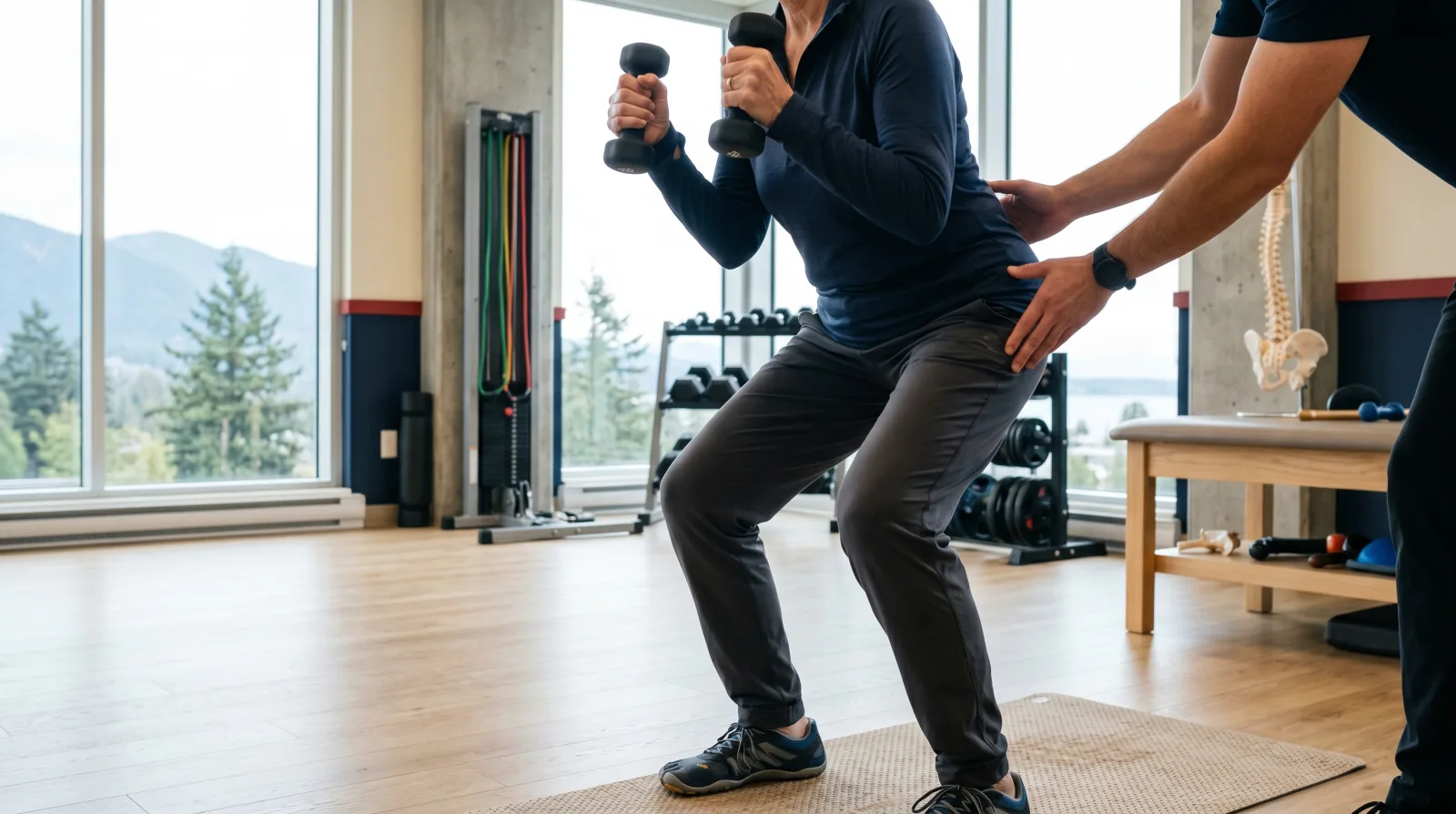
Loading progresses from supported work to standing work: sit-to-stand from progressively lower surfaces, step-ups, controlled step-downs, and balance work on one leg. The step-down is often the honest test, because it demands the quadriceps control the knee while the body lowers, which is exactly the task people report struggling with on stairs.
Walking mechanics get retrained deliberately here rather than left to sort themselves out. Years of limping on a painful knee build habits that persist after the pain is gone. The guideline's strong recommendation for movement pattern retraining exists because that habit does not correct itself just because the joint was replaced.
Beyond three months, progress is slower but keeps coming
Function continues improving well past the point where most people stop formal rehab. That is worth knowing in advance, because the pace changes and it can feel like progress has stopped when it has really just slowed.
This phase is about capacity for whatever your actual life demands. Getting in and out of a car, managing the stairs at home, walking the Lower Seymour trails, gardening, carrying groceries up from the street. The exercises get less clinical and more like the tasks themselves.
For people who want to return to more than walking, this is also where the conversation about impact and load happens, and it belongs with your surgeon, since implants and surgical approaches differ.
What tends to slow recovery down
A few patterns show up often enough to be worth naming.
Stopping the strengthening work once the pain goes away is the most common. Pain resolves before strength returns, and the gap between those two is where people quietly stall.
Chasing the bend number at the expense of everything else is another. Range of motion matters, but a knee that bends beautifully and cannot control a step-down is not a knee you trust.
Other joints and conditions matter too. Hip strength, ankle mobility, the other knee, and general health all shape the timeline. Someone managing knee osteoarthritis in the opposite knee has a different rehab picture than someone with one good leg to lean on.
When to call someone
Persistent stiffness that is not improving, a knee that will not straighten, or a leg that feels like it might give way are all reasons to be reassessed rather than to push harder on your own.
Increasing swelling with warmth, redness, fever, or calf pain is a different category. That is a same-day call to your surgeon or physician, or to Lions Gate Hospital if it is severe, not something to bring to a physiotherapy appointment first.
If you have a knee replacement scheduled or are already recovering from one, book a 30-minute assessment and we will look at where the strength actually is, what the knee is doing when you load it, and what needs attention next. You can see what we treat or reach the clinic here.
This article is general information, not personal medical advice. A regulated practitioner can confirm whether the patterns described apply to you, and your surgeon's own protocol takes priority over any general guidance.
Sources
- Clinical Practice Guideline for Physical Therapist Management of Total Knee Arthroplasty: Revision 2026, Physical Therapy
- Improved Outcomes Following a Care Guideline Implementation: An Analysis of 12,355 Patients After Total Knee Arthroplasty, JOSPT (2022)
- College of Health and Care Professionals of BC public registry
Common questions
Frequently asked questions.
How soon after a knee replacement should physiotherapy start?
Early. Most surgical teams have you moving the day of surgery or the day after, and outpatient physiotherapy usually begins within the first week or two of getting home. The 2026 clinical practice guideline from the American Physical Therapy Association also recommends exercise before the operation, so if your surgery date is still ahead of you, that window is worth using.
Is it normal for the knee to still be swollen months after surgery?+
Some swelling for several months is common, and it tends to come and go with how much you have done that day. Swelling that suddenly increases, with warmth, redness, or calf pain, is a different situation and needs a same-day call to your surgeon or physician rather than a physio appointment.
Will I get my full knee bend back?+
Most people regain enough bend for stairs, driving, and getting out of a chair, but the final range varies with the type of implant, how stiff the knee was before surgery, and how consistently the early range-of-motion work gets done. Your surgeon can tell you what range your specific implant is built for.
Should I be using a machine that bends the knee for me?+
The 2026 clinical practice guideline for physiotherapist management of total knee arthroplasty recommends against continuous passive motion machines, the devices that slowly bend the knee for you. That is a change from how knee replacements were managed for years, and the guideline also recommends against routine early bracing or splinting. What it does support is active, active-assisted, and passive range-of-motion exercise, where your own muscles do the work. Your surgeon's own post-operative protocol always takes priority over general guidance.
How long does the whole recovery take?+
Function keeps improving for a year or more after the operation, and the first three months are usually where the fastest visible change happens. Your own timeline depends on your strength before surgery, other joints and health conditions, and what you are trying to get back to.
What happens at the first physiotherapy visit after a knee replacement?+
The physiotherapist checks your wound, swelling, range of motion, and how well the quadriceps is firing, then reviews the walking aid and any surgeon-specific precautions you were given. Early goals usually centre on managing swelling, working toward a straight knee, and switching the thigh muscle back on. The plan is built around your surgeon's own protocol, which always takes priority over general guidance.
Does MSP or extended health cover knee replacement physiotherapy?+
Coverage varies by plan, so check your extended health benefits or ask your case manager what applies to your situation. The clinic can direct bill many extended health plans. What matters clinically is starting the recommended exercise program early, whatever the funding source, since the 2026 guideline for knee replacement rehab treats early active movement as central to the outcome.
How is knee replacement rehab different from meniscus tear rehab?+
Knee replacement rehab follows a surgeon's post-operative protocol and works around a new joint surface, with swelling control and quadriceps activation as early priorities. Meniscus tear rehab, covered in our post on [meniscus tears and rehab versus surgery](/journal/meniscus-tear-rehab-vs-surgery), usually starts with an intact joint and focuses on rebuilding strength and control around it. Both rely on progressive loading, but the starting point and the surgical precautions differ.
Share this post
Copies a ready-to-publish LinkedIn post to your clipboard and opens the LinkedIn share dialog. Paste the text into the composer and publish.
Written by
Medstar Sport Physio Team
Registered clinician at Medstar Sport Physio & Health, North Vancouver.
This article is for general information only and does not constitute medical advice, diagnosis, or treatment. Individual presentations vary, and assessment findings and treatment plans differ from person to person. If you are experiencing severe symptoms, neurological changes (numbness, weakness, bowel or bladder changes), or a significant trauma, contact your physician or emergency services. Care at Medstar Sport Physio & Health is provided by practitioners registered with their respective British Columbia regulatory colleges.
Filed under
- knee-replacement
- post-surgical-rehab
- osteoarthritis
- healthy-aging
- north-vancouver