Knee Osteoarthritis: Why Strength Work Comes Before the Surgeon
A worn knee on an X-ray does not have to mean a joint replacement is next. For knee osteoarthritis, the first-line treatment is strength work, not surgery.
BY AMIR AHMADI, PHD
A knee X-ray with the word "osteoarthritis" on it sends a lot of people straight to thoughts of a joint replacement. For most knees, that is not the next step. The first-line treatment for knee osteoarthritis is strength work and education, and the guidelines are clear about it.
Clinical guidelines are clear that progressive strengthening exercise, not surgery or passive treatments, is the first-line approach for knee osteoarthritis. A worn knee on an X-ray does not mean a joint replacement is the next step. The amount of arthritis visible on imaging often does not match how much pain or limitation a person has. At Medstar Sport Physio in North Vancouver, we start with a graded strength program the knee can handle, then build from there. A mild ache that settles after loading is usually acceptable. Research on structured exercise programs for knee osteoarthritis has shown reduced need for surgery in follow-up for many patients, though not all. What determines the plan is your symptoms and how your knee responds to exercise, not the X-ray grade alone.
This is the conversation we have when someone arrives with a worn knee and the assumption that surgery is inevitable.
What knee osteoarthritis actually is
Osteoarthritis is the gradual change in a joint over time, involving the cartilage, the bone underneath, and the surrounding tissues. In the knee it shows up as pain with activity, stiffness after sitting, and sometimes swelling or a sense of the knee not trusting itself on stairs.
It is common with age, and it is manageable. The word "arthritis" carries a heavy, end-of-the-road feeling that the condition does not actually deserve for most people. A worn knee is not a broken knee, and the trajectory is far from fixed.
The first thing we do at assessment is separate the X-ray story from the symptom story, because they often disagree.
Why exercise is the first-line treatment
The guidance here is consistent. Core treatments for knee osteoarthritis, per the OARSI guidelines for the non-surgical management of osteoarthritis, are patient education and structured land-based exercise, with weight management where relevant. Physiotherapy and education are recommended as first-line care, ahead of injections, imaging, or surgery for the typical case.
The reasoning is that stronger muscles around the knee, better movement control, and a knee that is conditioned to load all reduce pain and improve function. There is no passive treatment that replaces that adaptation, and the worry that loading a worn knee wears it out faster does not hold for graded, tolerable strength work.
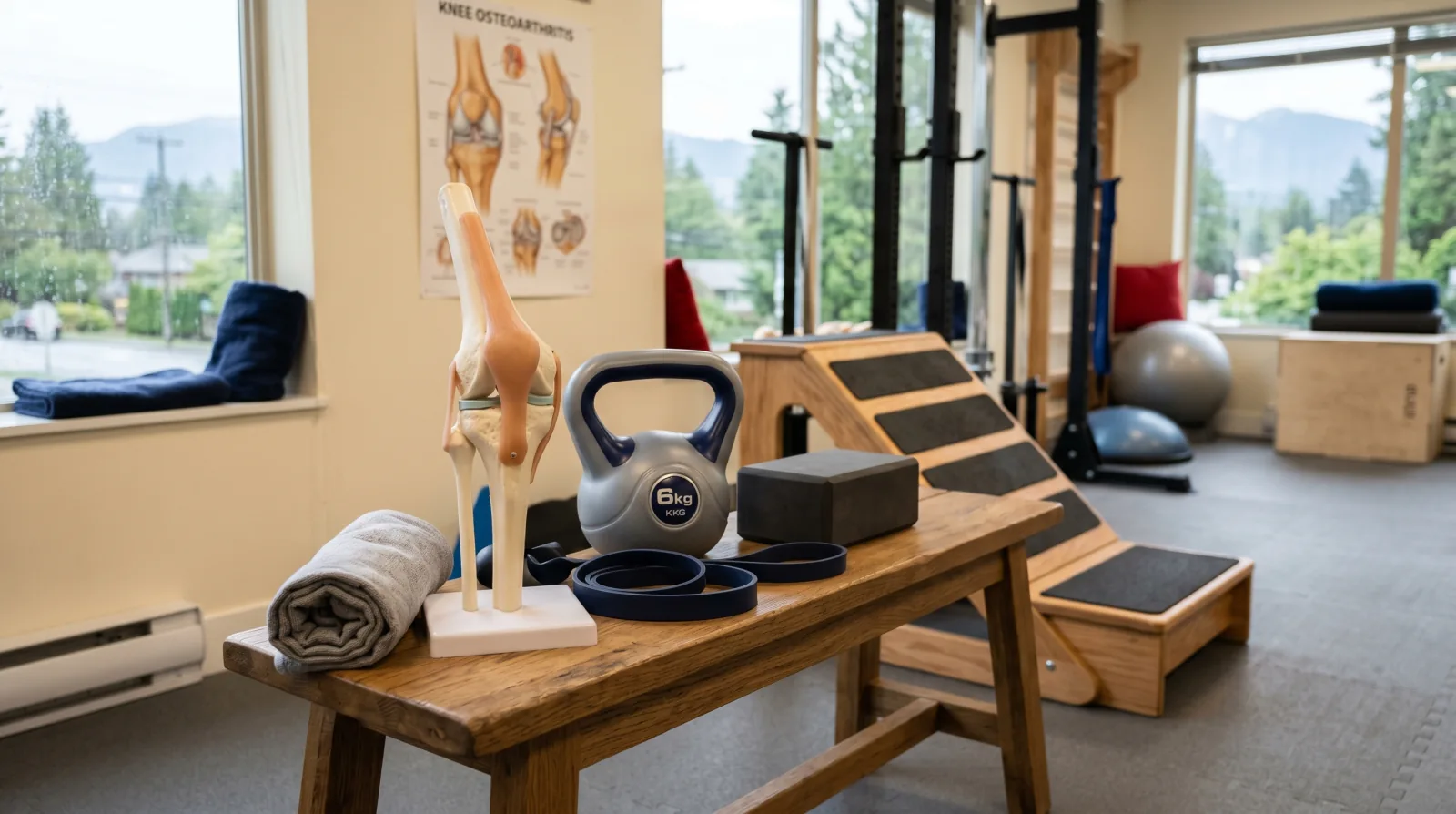
In our clinic, a knee osteoarthritis program starts at a level the knee can handle and builds from there. A mild ache during and after loading that settles is usually acceptable. Sharp or escalating pain means we adjust the dose rather than push through.
What the GLA:D program is
One well-known way to deliver this first-line care is the GLA:D program, short for Good Life with osteoArthritis from Denmark. It is a structured program that pairs education about the condition with a supervised exercise plan over several weeks, and it has been implemented across Europe, Australia, and North America, including in Canada.
The value of a structured format is that it combines the two ingredients that matter, understanding the condition and doing the exercise, in a planned, progressive way rather than a handful of generic stretches. The principles, graded strengthening, movement control, and good information, are what we apply to knee osteoarthritis regardless of the exact program label.
How exercise changes the surgery question
This is the part that reframes the whole decision. Research on education and exercise programs for hip and knee osteoarthritis has found that they can change willingness for surgery and reduce the rate of joint replacement over time. A longitudinal cohort study of more than 55,000 people in a hip and knee osteoarthritis program reported that becoming unwilling for surgery after the program was associated with a meaningful reduction in joint replacements at follow-up.
That does not mean exercise removes the need for surgery in every case. Some knees genuinely reach the point where a replacement is the right call, and we support that decision when it comes. But it does mean a structured exercise and education trial is a reasonable, evidence-based first step that often changes the picture, rather than something to skip on the way to the operating room.
Why the X-ray does not run the show
People expect the X-ray grade to dictate the plan. It usually does not. The amount of arthritis visible on imaging often does not match how much pain or limitation a person has. Worn-looking knees can be comfortable, and milder-looking ones can be very painful.
Because of that mismatch, the treatment decision leans on your symptoms and your function, what you can and cannot do, how the knee responds to a loading trial, far more than on the picture. Imaging has a role in surgical planning and in ruling out other problems, but it does not by itself decide whether you need an operation.
It is not too late to start
A common worry, especially among older patients, is that strength work is for younger bodies and the moment has passed. It has not. These programs are designed for exactly the age group living with osteoarthritis, and people make real gains in pain and function at any age. We scale the starting point to your fitness and health and progress it gradually.
If your knee is sore, stiff, and an X-ray has put the word "arthritis" in front of you, strength work comes before the surgeon, not after the scan. Book a 30-minute assessment and we will look at how the knee actually moves and loads, then build a plan that gives the joint a real chance before anyone talks about replacing it.
This article is general information about knee osteoarthritis. It is not personal medical advice. A regulated practitioner can confirm whether the patterns described apply to you.
Sources
- OARSI guidelines for the non-surgical management of knee, hip, and polyarticular osteoarthritis (2019)
- Skou et al., Outcomes following the GLA:D program for symptomatic knee and hip osteoarthritis in Denmark, Canada and Australia, Osteoarthritis and Cartilage (2020)
- Change in willingness for surgery and risk of joint replacement after an education and exercise program for hip/knee osteoarthritis: a longitudinal cohort study of 55,059 people
Common questions
Frequently asked questions.
Will exercise make my knee arthritis worse?
For most people, no. Structured, graded strength and movement is a recommended first-line treatment for knee osteoarthritis and tends to reduce pain and improve function rather than wear the joint out faster. We start at a level the knee tolerates and build from there. A mild ache that settles is usually fine; sharp or escalating pain means we adjust.
What is the GLA:D program?+
GLA:D stands for Good Life with osteoArthritis from Denmark. It is a structured education and exercise program for hip and knee osteoarthritis, delivered over several weeks, that pairs learning about the condition with a supervised exercise plan. It has been rolled out internationally, including in Canada, as a first-line, guideline-based option.
Does my X-ray decide whether I need a knee replacement?+
Not on its own. The amount of arthritis visible on imaging often does not match how much pain or limitation a person has. The decision about surgery is based mostly on your symptoms, your function, and how you respond to a trial of exercise and education, not the X-ray grade alone.
Can exercise help me avoid knee surgery?+
For some people, yes. Research on education and exercise programs for hip and knee osteoarthritis has shown reduced willingness for surgery and, in follow-up, fewer joint replacements. It is not a guarantee, and some knees still need surgery, but a structured program is a reasonable first step that often changes the picture.
I am older. Is it too late to start strength work?+
No. Strength and movement programs for knee osteoarthritis are designed for the typical age group living with it, and people make meaningful gains in function and pain at any age. We scale the program to your starting point and health, and progress it gradually.
Share this post
Copies a ready-to-publish LinkedIn post to your clipboard and opens the LinkedIn share dialog. Paste the text into the composer and publish.

Written by
Amir Ahmadi, PhDDr. Amir Ahmadi is a Registered Physiotherapist, Certified IMS Therapist and former Associate Professor. 20+ years of clinical practice in North Vancouver.
This article is for general information only and does not constitute medical advice, diagnosis, or treatment. Individual presentations vary, and assessment findings and treatment plans differ from person to person. If you are experiencing severe symptoms, neurological changes (numbness, weakness, bowel or bladder changes), or a significant trauma, contact your physician or emergency services. Care at Medstar Sport Physio & Health is provided by practitioners registered with their respective British Columbia regulatory colleges.
Filed under
- knee-osteoarthritis
- arthritis
- active-rehab
- strength
- north-vancouver