Falls Are Not Just Bad Luck: What Balance Training Actually Changes
A near-miss on the stairs gets remembered as clumsiness. Most of the time it is a strength and balance problem, which means it is a problem with a plan attached.
BY MEDSTAR SPORT PHYSIO TEAM
A stumble on the stairs gets filed away as clumsiness or a moment of not paying attention. More often it is the first visible sign of something measurable.
At Medstar Sport Physio in North Vancouver, most balance problems in older adults are trainable rather than an inevitable part of ageing. The Otago Exercise Programme, developed by the New Zealand Falls Prevention Research Group and originating at the University of Otago, is one of the best-established approaches: 17 strength and balance exercises plus a walking programme, typically performed three times a week and progressed over a course of several months to a year. It has been delivered effectively in home, outpatient, community, assisted living, and long-term care settings, and in both individual and group formats. The exercises themselves are ordinary, and the results come from doing them consistently and progressing them properly.
Here is what actually keeps you upright, why the quiet avoidance of activities matters more than any single stumble, and what a falls-prevention programme involves.
Balance is a system, not a talent
Staying upright is the product of several systems working together. Your eyes tell you where you are in space. Your inner ear tracks head position and movement. Sensors in your joints and the soles of your feet report on the ground beneath you. Your muscles then have to respond fast enough and strongly enough to correct what all that information is telling you.
Any of those can decline. Vision changes, inner-ear problems, reduced sensation in the feet, slower reaction times, and reduced leg strength all shift the odds. Medications and medical conditions add to the picture.
The reason this matters practically is that "poor balance" is not one problem with one solution. It is a description of an outcome, and the assessment is about working out which parts of the system need attention.
The strength half is the part people underestimate
Balance is often imagined as a purely neurological skill, something you either have or do not. In practice, a large part of it is whether your legs can produce force quickly enough to catch you.
When you trip, the correction requires the muscles around your hip, knee, and ankle to generate a rapid response. If that strength has been declining for years, the reaction happens too slowly or is not strong enough, and a recoverable stumble becomes a fall.
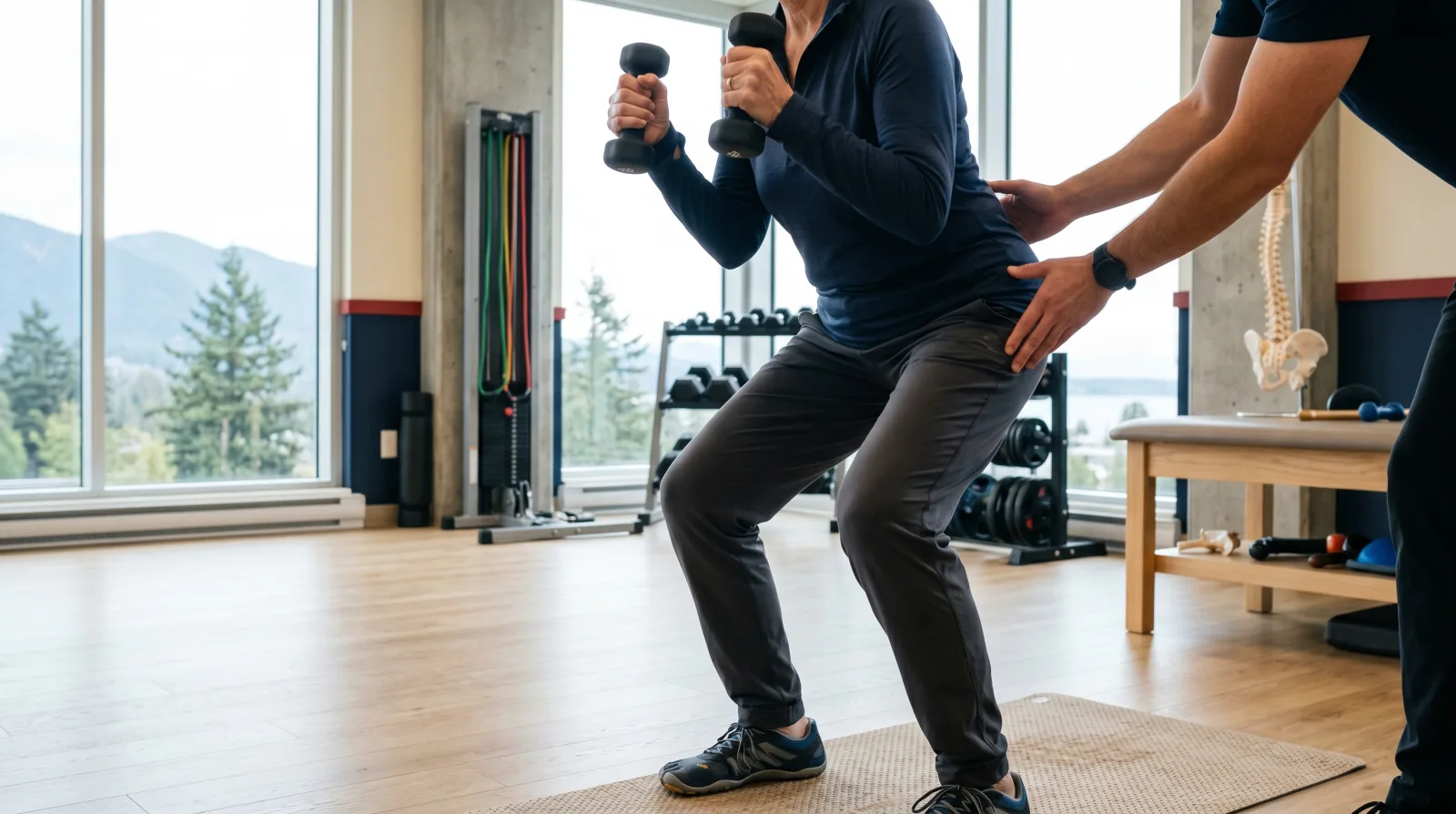
That is why falls-prevention programmes are always strength and balance rather than balance alone. The Otago programme's strength component targets exactly the muscles involved: knee extensors, knee flexors, hip abductors, calf raises, and toe raises.
For anyone also managing bone density, this overlaps directly with the loading discussed in our guide to osteoporosis and strength training. The same work that reduces the chance of falling also improves the bone's ability to tolerate one.
What the Otago programme involves
The Otago Exercise Programme is a series of 17 strength and balance exercises originally designed for delivery by a physiotherapist in the home.
The structure includes a warm-up covering head, neck, back, trunk, and ankle movements, then the strength exercises listed above, then balance work: knee bends, sit-to-stand, various walking patterns, and one-leg stands. A progressive walking component runs alongside.
Delivery is typically three times a week, with difficulty increasing over a course that usually runs six months to a year. The programme has been validated across skilled nursing, long-term care, assisted living, outpatient, and online settings, and works in both individual and group formats. Research at the University of North Carolina reported statistically significant improvement in clinical scores after as little as eight weeks.
The exercises are deliberately unremarkable. That is a feature, not a limitation. Something done three times a week for a year has to be something a person can actually do at home without equipment or supervision.
The quiet avoidance is the real warning sign
The thing worth watching for is not a dramatic fall. It is the gradual narrowing of what someone does.
Taking the elevator instead of the stairs. Making two trips with the groceries instead of one. Holding the handrail on both sides. Not going out when it is wet. Declining the walk on the seawall that used to be routine.
Each of those looks like sensible caution in isolation. Together they remove precisely the activities that maintain the strength and balance keeping a person upright, which makes the next year harder than the last. The avoidance is usually a response to a confidence problem that started with a wobble nobody mentioned.
Families often notice this pattern before the person does, and it is a much better moment to act than after a fracture.
Dizziness is a separate question worth asking about
If losing balance comes with a spinning sensation, lightheadedness, or a feeling that the room is moving, that is a different conversation from general unsteadiness.
Some causes of dizziness are highly treatable and unrelated to strength. Benign paroxysmal positional vertigo, for example, often responds to a specific repositioning manoeuvre rather than an exercise programme, as covered in our guide to vestibular rehab for BPPV. Other causes need ruling out first, which our article on when dizziness is not BPPV discusses.
Getting that distinction right early avoids months spent on the wrong plan.
What an assessment looks at
A falls-prevention assessment is mostly about finding which parts of the system are contributing.
Leg strength gets tested directly, often including how many times someone can stand from a chair without using their arms. Balance gets tested in progressively harder positions. Walking gets watched, including speed and how the person turns, since turning is where a disproportionate number of falls happen. Footwear comes into it. So does the home environment, and so do the activities the person has quietly stopped doing.
In our clinic, the most useful part of the conversation is often the list of things someone has stopped doing, because that list defines what the programme is actually for. Getting back to carrying groceries in one trip is a better goal than an abstract balance score.
What changes with consistent work
The measurable improvements across balance and strength interventions include faster timed sit-to-stand-and-walk performance, increased walking speed, gains in lower-limb strength, and better reactive balance responses, which is the ability to catch yourself when something unexpected happens.
The reactive part matters most in real life. Most falls do not happen while standing still. They happen when something surprises you: a curb, a wet floor, a dog, an uneven bit of pavement. Training that only involves standing still on a firm surface does not prepare for that, which is why programmes progress into movement, direction changes, and less stable surfaces over time.
Older adults recovering from a motor vehicle collision have their own considerations layered on top, which our seniors after a crash page covers.
When to get it looked at
Any fall is worth mentioning to your physician or physiotherapist, particularly a fall you cannot explain. So is a near-miss that shook your confidence, a new reluctance to go out, or noticing that you are holding onto furniture as you move around the house.
Some situations need prompt medical attention rather than a rehabilitation appointment: a fall involving a head impact, loss of consciousness, a fall with new confusion, an inability to bear weight afterwards, or fainting. Those are calls to your physician, Lions Gate Hospital, or 911 depending on severity.
Book a 30-minute assessment and we will test strength and balance properly, look at what has been quietly dropped from your week, and build a programme around getting those things back. Our physiotherapy for seniors page has more on how we approach this. You can also reach the clinic here.
This article is general information, not personal medical advice. A regulated practitioner can confirm whether the patterns described apply to you.
Sources
- The Otago Exercise Program, University of North Carolina Center for Aging and Health
- Efficacy of the Otago Exercise Programme to reduce falls in community-dwelling adults aged 65-80, BMC Nursing (2024)
- Otago Exercise Programme to prevent falls in older adults, Accident Compensation Corporation New Zealand
- College of Health and Care Professionals of BC public registry
Common questions
Frequently asked questions.
Is losing your balance just part of getting older?
Some change in balance with age is normal, but the degree is trainable. Balance depends on vision, the inner ear, sensation in the joints and feet, and whether your legs can produce force fast enough to catch you. Strength and balance both respond to training at any age, which is why falls-prevention programmes exist. A wobble or a near-miss is worth assessing rather than accepting as part of getting older.
What is the Otago Exercise Programme?+
It is a set of 17 strength and balance exercises plus a walking programme, developed by the New Zealand Falls Prevention Research Group and originating at the University of Otago. It is usually delivered by a physiotherapist and progresses in difficulty over a course of several months to a year.
How much exercise does it take to make a difference?+
The Otago Exercise Programme is typically performed three times a week, alongside the progressive walking component, with the difficulty increasing over a course that usually runs six months to a year. Research at the University of North Carolina reported statistically significant improvement in clinical scores after as little as eight weeks, so early gains are possible well before the course ends. Consistency across the week matters more for falls risk than any single long session.
Should I be worried after one fall?+
One fall is worth mentioning to your physician or physiotherapist, particularly if you are not sure why it happened, if you felt dizzy or faint, or if you have started avoiding activities because of it. A fall with a head impact or loss of consciousness needs prompt medical assessment.
Does walking count as balance training?+
Walking is valuable and a progressive walking component runs alongside the Otago Exercise Programme, so it counts as part of the plan. On its own, walking does not challenge balance the way targeted balance work does, because the movement stays predictable. Standing on one leg, heel-to-toe walking patterns, knee bends, and controlled sit-to-stand work train the systems that catch you when you stumble. A physiotherapist pairs the walking with those exercises and makes them harder over time.
What happens at a first falls-prevention assessment?+
The physiotherapist tests leg strength directly, often including how many times you can stand from a chair without using your arms, checks balance in progressively harder positions, and watches how you walk and turn, since turning is where many falls happen. We also ask about footwear, the home environment, and any activities you have quietly stopped doing, because that list often points straight to the plan.
Do I need a doctor's referral to start a falls-prevention program?+
Not to be assessed by a physiotherapist, though your family physician is a good person to mention any fall or near-miss to, particularly if the cause is unclear. Some funding sources, such as extended health plans, may have their own referral or documentation requirements, so it is worth checking your specific plan before booking if cost is a factor.
What can I do at home between sessions to reduce fall risk?+
Practise the specific exercises your physiotherapist assigns, since consistency across the week matters more than any single session. Keep pathways clear of clutter and cords, improve lighting on stairs, and wear supportive, well-fitting footwear rather than loose slippers. Returning to activities you may have quietly stopped, like carrying groceries in one trip, is often part of the plan once strength allows it.
Share this post
Copies a ready-to-publish LinkedIn post to your clipboard and opens the LinkedIn share dialog. Paste the text into the composer and publish.
Written by
Medstar Sport Physio Team
Registered clinician at Medstar Sport Physio & Health, North Vancouver.
This article is for general information only and does not constitute medical advice, diagnosis, or treatment. Individual presentations vary, and assessment findings and treatment plans differ from person to person. If you are experiencing severe symptoms, neurological changes (numbness, weakness, bowel or bladder changes), or a significant trauma, contact your physician or emergency services. Care at Medstar Sport Physio & Health is provided by practitioners registered with their respective British Columbia regulatory colleges.
Filed under
- falls-prevention
- balance
- healthy-aging
- strength-training
- north-vancouver