Golfer's Elbow: The Inner-Elbow Tendinopathy That Loading Fixes
Golfer's elbow is the inner-elbow cousin of tennis elbow, and the fix is the same principle: load the tendon progressively. Rest and braces alone rarely do it.
BY ALI SHAFIEI, RPT
Tennis elbow gets all the attention, but its inner-elbow counterpart, golfer's elbow, is just as common and just as treatable. The lack of awareness costs people time, because they often try the wrong things first. The reassuring news is that golfer's elbow follows the same rules as every other tendinopathy, and the fix is a well-established one.
Golfer's elbow is a tendinopathy of the wrist-flexor tendons on the inner side of the elbow. Despite the name, most people who develop it have never played golf. It usually comes from repetitive gripping, lifting, or wrist flexion at work or in the gym. Rest alone often disappoints, because the tendon becomes weaker and just as sensitive when activity resumes. At Medstar Sport Physio in North Vancouver, we prescribe a progressive loading program that rebuilds the tendon's tolerance over time, paired with changes to the grip and lift tasks that keep re-irritating it. A counterforce brace may help with comfort during loading. Recovery often takes a couple of months, and the timeline depends on how irritable the tendon is and how consistently the program is followed.
What golfer's elbow is
Golfer's elbow, clinically called medial epicondylalgia, is a tendinopathy of the wrist-flexor tendons where they attach on the inner side of the elbow. Like its outer-elbow cousin, the name is misleading: most people who develop it do not play golf. It usually comes from repetitive gripping, lifting, and wrist flexion, the demands of manual work, gym training, racquet sports, or everyday tasks like carrying and lifting.
The pain shows up on the inner side of the elbow, often with gripping, lifting palm-up, and certain wrist movements, and it can be tender right over the bony point on the inside of the elbow. It is part of the family of golfer's elbow and related tendon problems we treat.
The same problem as tennis elbow, on the other side
Golfer's elbow and tennis elbow are essentially the same type of problem on opposite sides of the elbow. Tennis elbow affects the wrist-extensor tendons on the outer elbow, while golfer's elbow affects the wrist-flexor tendons on the inner elbow. Both are tendinopathies driven by load, and both respond to the same core principle.
That means the lessons from our piece on tennis elbow loading versus cortisone apply directly here. The tendon gets better when you give it a reason to adapt, through progressive loading, and it does not get better from rest alone.
Why rest disappoints
The instinct with a sore tendon is to rest it. But complete rest tends to leave the tendon weaker and just as sensitive when you return to activity, so the pain comes straight back the first time you grip something heavy. This is the recurring theme across every tendinopathy we treat, from the Achilles to the gluteal tendons: rest is not the cure, and often makes the eventual return harder.
What works instead is modifying the aggravating activities while loading the tendon progressively. We strip back the worst grip and lift provocations early, keep the tendon loading at a tolerable level, and build the load as it settles.
The loading program
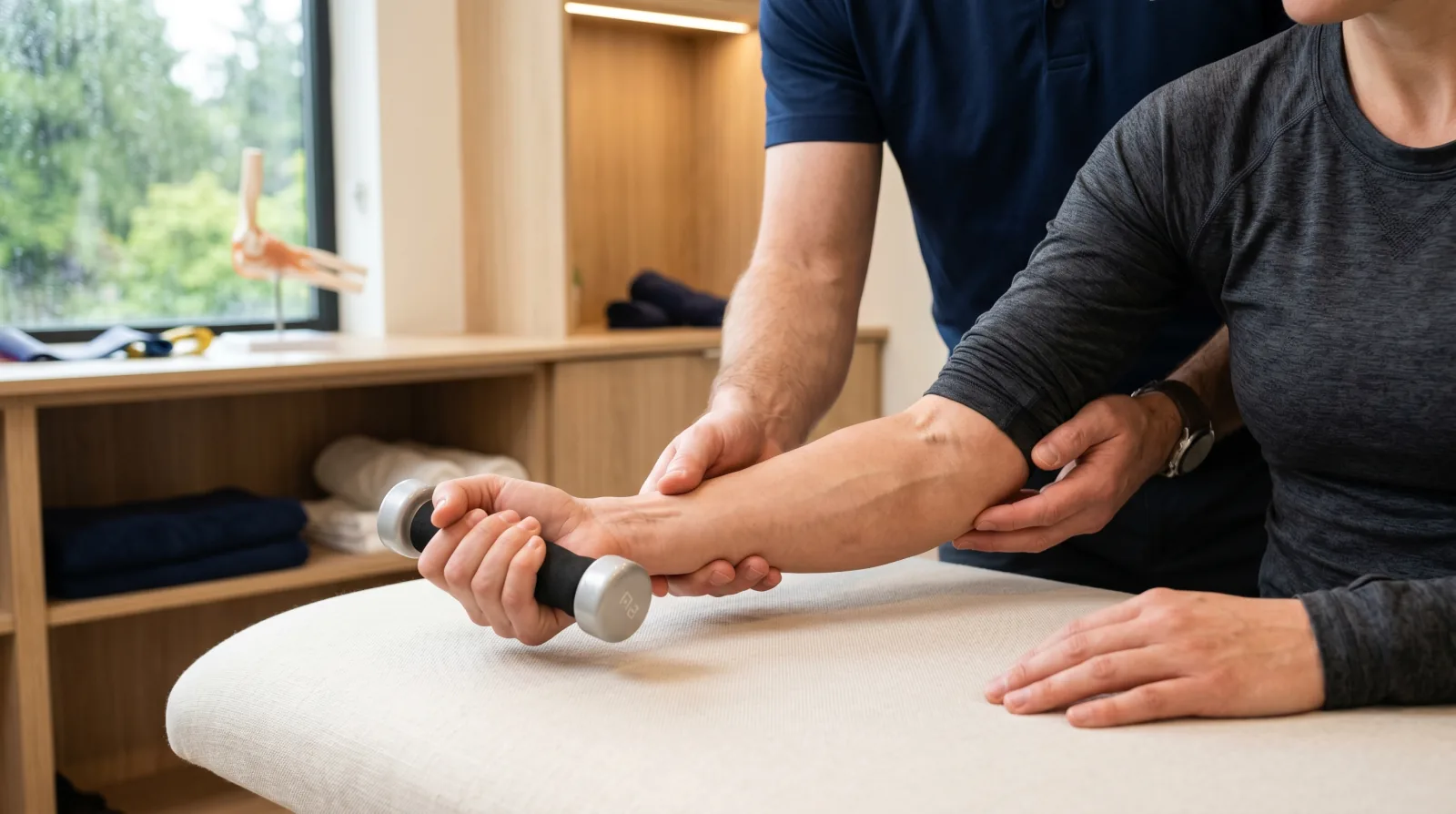
A loading program for golfer's elbow centres on progressive strengthening of the wrist-flexor tendons, the muscles that flex the wrist and grip. We start at a level the tendon can handle, often with light resistance through a controlled tempo, and progress the load over time as tolerance builds.
Alongside the loading, we look hard at the daily tasks that keep re-irritating the tendon, the grip pattern at work, the lifting technique, the gym exercises that flare it. Fixing those inputs is often half the result, because a tendon that gets re-aggravated every day cannot settle no matter how good the loading is.
The guideline we use for how much discomfort is acceptable is the same one across tendon rehab: a mild ache during or shortly after loading that settles by the next morning is fine, while pain that climbs day to day means the dose is too high and we back off.
What about braces?
A counterforce brace, worn around the forearm just below the elbow, can reduce symptoms during aggravating activities for some people, making loading and daily tasks more comfortable. It is a symptom aid rather than a treatment on its own. We may use it alongside the loading program when it helps someone stay active and load the tendon more comfortably, but the loading is what actually rebuilds the tendon's tolerance. A brace on its own, without loading, tends to disappoint.
A realistic timeline
Like other tendinopathies, golfer's elbow is often slow, improving over a couple of months or more with consistent loading rather than in a few weeks. The timeline depends on how irritable the tendon is and how long it has been there before treatment starts. The slow pace tempts people toward quick fixes, but the unglamorous combination of progressive loading and activity modification is what reliably settles it.
We reassess against function, your grip strength and pain-free lifting, rather than chasing the pain alone, because pain is a noisy signal in tendons and tends to lag behind the actual recovery.
When to get it assessed
If you have pain on the inner side of your elbow with gripping and lifting, an assessment confirms it is golfer's elbow, rules out other causes, and builds a loading program to settle it. Pain with numbness or tingling into the hand, or pain that does not follow the usual grip-related pattern, is worth assessing to be sure it is a simple tendinopathy.
Book a 30-minute appointment and we will assess the elbow, screen the aggravating tasks, and build a loading plan that rebuilds the tendon's tolerance.
This article is general information about golfer's elbow (medial epicondylalgia). It is not personal medical advice. A regulated practitioner can confirm whether the patterns described apply to you.
Sources
- Vinod & Ross, An effectiveness and cost-effectiveness analysis of conservative interventions for medial epicondylitis, Journal of Hand Therapy (2015)
- Stasinopoulos & Stasinopoulos, Comparison of effects of eccentric training, eccentric-concentric training, and eccentric-concentric training combined with isometric contraction in the treatment of lateral elbow tendinopathy, Journal of Hand Therapy (2017)
- College of Physical Therapists of BC (CPTBC)
Common questions
Frequently asked questions.
What is golfer's elbow?
Golfer's elbow, or medial epicondylalgia, is a tendinopathy of the wrist-flexor tendons where they attach on the inner side of the elbow. Despite the name, most people who get it do not play golf; it usually comes from repetitive gripping, lifting, and wrist flexion. The pain shows up on the inner elbow with gripping and certain wrist movements.
How is golfer's elbow different from tennis elbow?+
They are the same type of problem on opposite sides of the elbow. Tennis elbow affects the wrist-extensor tendons on the outer elbow, while golfer's elbow affects the wrist-flexor tendons on the inner elbow. Both are tendinopathies driven by load, and both respond to the same principle of progressive tendon loading rather than rest.
Will rest fix golfer's elbow?+
Usually not on its own. Complete rest tends to leave the tendon weaker and just as sensitive when you return to activity, so the pain comes back. As with other tendinopathies, the tendon improves when you load it progressively to build its tolerance. We modify the aggravating activities while loading the tendon, rather than resting it completely.
How long does golfer's elbow take to heal?+
Like other tendinopathies, it is often slow, improving over a couple of months or more with consistent loading rather than in a few weeks. The timeline depends on how irritable the tendon is and how long it has been there. Consistency with the loading program and modifying the aggravating grip and lift tasks are what move it along.
Does a brace help golfer's elbow?+
A counterforce brace can reduce symptoms during aggravating activities for some people, making loading and daily tasks more comfortable. It is a symptom aid rather than a treatment on its own. We may use it alongside the loading program when it helps, but the loading is what actually rebuilds the tendon's tolerance.
What happens at a first physiotherapy visit for golfer's elbow?+
The physiotherapist checks the inner elbow for tenderness, tests grip strength and resisted wrist flexion to confirm the wrist-flexor tendons are involved, and asks about the work, gym, or lifting tasks that provoke it. From there they set a starting load for the exercise program and identify which daily grip and lift habits need adjusting so the tendon is not being re-irritated between sessions.
What work or daily tasks should I change if I have golfer's elbow?+
The tasks worth adjusting are usually repetitive gripping, heavy lifting with the palm up, and sustained wrist flexion, since these are the movements that load the affected tendons. Modifying grip size, alternating hands, or breaking up repetitive tasks can reduce the daily irritation while the loading program rebuilds tolerance. A physiotherapist can help identify which specific tasks in your work or gym routine are the main drivers.
Does stretching help golfer's elbow?+
Stretching alone is unlikely to resolve it, in the same way rest alone does not. As with other tendinopathies, the tendon needs progressive loading to build its tolerance to grip and lift demands. Gentle stretching may be included as part of a broader program, but it is not a substitute for the strengthening work that actually changes the tendon's capacity.
Share this post
Copies a ready-to-publish LinkedIn post to your clipboard and opens the LinkedIn share dialog. Paste the text into the composer and publish.
Written by
Ali Shafiei, RPTAli Shafiei is a Registered Physiotherapist with 10+ years of clinical experience in musculoskeletal, neurological and sports rehabilitation. North Vancouver.
This article is for general information only and does not constitute medical advice, diagnosis, or treatment. Individual presentations vary, and assessment findings and treatment plans differ from person to person. If you are experiencing severe symptoms, neurological changes (numbness, weakness, bowel or bladder changes), or a significant trauma, contact your physician or emergency services. Care at Medstar Sport Physio & Health is provided by practitioners registered with their respective British Columbia regulatory colleges.
Filed under
- golfers-elbow
- medial-epicondylalgia
- tendinopathy
- loading
- north-vancouver