
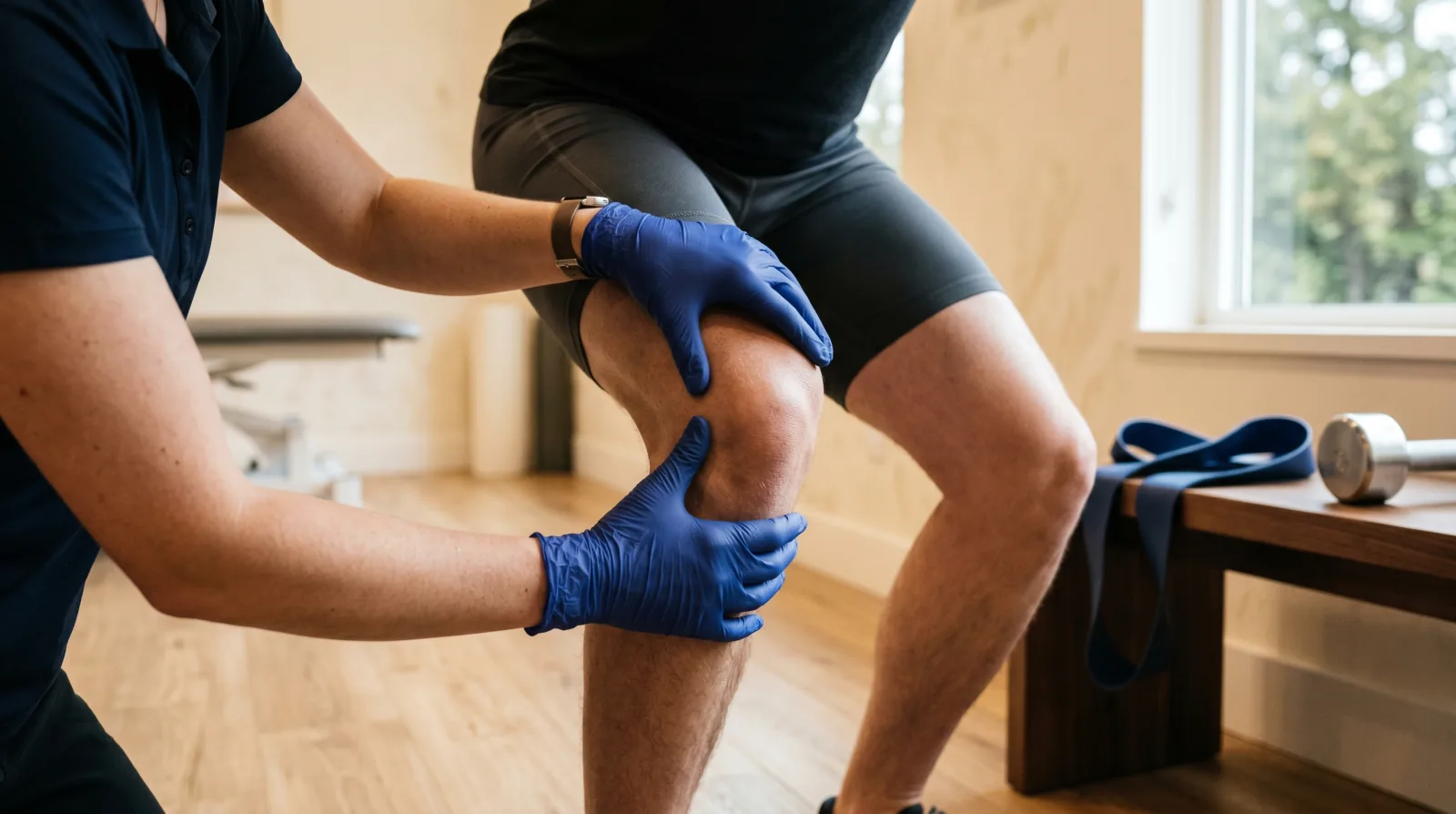
Patellar Tendinopathy (Jumper's Knee): Why Heavy Slow Resistance Beats Stretching and Rest
Patellar tendinopathy does not respond to rest. It responds to heavy, slow, controlled loading. Here is the evidence behind it, what the protocol looks like, and the mistakes that send people back to square one.
BY AMIR AHMADI, PHD
Patellar tendinopathy (jumper's knee) is a load-management problem that responds best to heavy slow resistance training, not rest or stretching. Rest deconditions the tendon and makes it less able to handle jumping and running loads when you return. At Medstar Sport Physio in North Vancouver, we use a 12-week progressive loading program built around three sessions per week, with exercises in the knee extensor chain performed at a slow, controlled tempo. Most patients keep playing at a modified volume during this period rather than stopping sport completely. Pain during loading up to a manageable level is often acceptable, provided symptoms settle within 24 hours. What determines the program is how irritable the tendon is and how quickly load tolerance builds over the first several weeks.
If you are a North Shore athlete with a familiar ache at the lower pole of the kneecap on the first jump warm-up, the first squat at the gym, or the first kilometre of a Capilano descent, this is the conversation we have when you book in.
Why "tendinitis" stopped being the right word
The current understanding of patellar pain is that the tendon is degenerative at the cellular level and underloaded for its functional demand, with inflammation playing a small part. The British Journal of Sports Medicine consensus on tendinopathy terminology and management replaced "tendinitis" with "tendinopathy" precisely because anti-inflammatory strategies (rest, ice, ibuprofen, ultrasound) do not address the underlying tissue remodelling that pain-free loading does.
The implication for the patient matters. Treating a tendon like a sprained ankle delays recovery. The tissue needs progressive mechanical load to rebuild its tolerance, the same way a bone responds to load, the way muscle responds to strength training. Removing load is what created the symptom in the first place.
What heavy slow resistance loading actually looks like
The protocol most clinics use comes from the Kongsgaard et al. trial in the Scandinavian Journal of Medicine and Science in Sports and subsequent confirmations. The dose:
- Three exercises targeting the knee extensor chain: squats, leg press, and Bulgarian split squats or hack squats.
- 3 to 4 sets per exercise, 6 to 8 repetitions per set.
- Tempo of about 6 seconds per repetition: 3 seconds down, 3 seconds up. The movement stays slow and controlled throughout.
- Three sessions per week, with at least 48 hours between sessions.
- Load progresses each week as tolerated, beginning at a weight the patient can complete with form at the prescribed tempo.
The dose is the active ingredient. A patient doing two sessions a week of 12 reps at a fast tempo is doing general strength work, which is a different thing. The slow tempo plus the heavy load plus the frequency is what changes the tendon over the 12 weeks.
The Silbernagel monitoring rule: pain during loading is fine
Patients are commonly taught to stop any exercise that hurts. For tendinopathy that rule is wrong and counterproductive. The widely-used monitoring framework from Karin Silbernagel's work on Achilles tendinopathy, also applied to patellar presentations allows pain up to 3 out of 10 during loading, provided:
- The symptom does not exceed 3 out of 10 during the lift.
- The symptom returns to baseline within 24 hours.
- The symptom does not progressively worsen across the week.
- Morning stiffness is stable or improving over the program.
This rule lets patients keep loading at the dose needed without overshooting. The biggest clinic-side coaching task is convincing the patient that working with the symptom, within those limits, is what rebuilds the tendon.
Where the season fits in the rehab plan
Volleyball, basketball, and trail-running athletes do not have the luxury of a 12-week off-season for tendon work. Our job is to fit the rehab into the season rather than the other way around. A typical in-season plan at our clinic looks like this:
- Heavy slow resistance loading three times a week on non-game, non-hard-session days.
- Sport-specific volume reduced: fewer jump repetitions, shorter speed sessions, lower-intensity descents.
- Tendon-specific monitoring at each session, using the 24-hour symptom rule above.
- A planned mid-cycle reassessment at week 4 and week 8 to adjust load and volume.
For trail runners, the loading program coexists with a mileage and descent plan. Our running gait analysis post talks about the eccentric quadriceps demand of long descents and why the highest-yield intervention is usually more strength work.
The mistakes that send patients back to square one
A short list of patterns we see in patients returning to the clinic with a recurrence:
- Stopping the program at week 6. Symptoms ease around weeks 4 to 6. Patients stop, return to full training, and re-flare within four weeks. The capacity is rebuilt in weeks 8 through 12, so it is still missing at that point.
- Substituting passive modalities for loading. Shockwave, high-power laser, and TECAR therapy can be useful adjuncts in stubborn cases (see our posts on shockwave for plantar fasciitis, TECAR for tendinopathy, and high-power laser), but they do not replace the loading work.
- Static stretching as the intervention. Stretching the quadriceps or the patellar tendon does not change tendon capacity. It can briefly modulate pain, but does not rebuild load tolerance.
- Returning to jump training before the loading capacity is rebuilt. The decision to return to high-intensity jump work is based on load tolerance, not on the calendar. Our criteria-based return-to-sport post covers the testing-based approach we use.
- Single-leg deficits not screened. Most patellar tendinopathies are unilateral. If the rehab is bilateral only, the involved side under-loads relative to the uninvolved side and the program does not progress the involved tendon adequately.
When imaging is useful and when it isn't
Imaging is not required to start treatment. Ultrasound or MRI of the patellar tendon often shows degenerative changes in asymptomatic athletes, so a positive image does not tell us why the patient is symptomatic. The Cook and Purdam continuum model for tendinopathy frames imaging as supplementary. It is useful for ruling out alternative diagnoses such as a full-thickness tear, fat-pad impingement, or patellofemoral involvement, and it is a poor tool for routine progress tracking.
If the symptom is not responding to a well-applied loading program after 8 weeks, that is the point to involve the family physician and consider imaging, usually ultrasound first.
What a first visit at Medstar looks like for jumper's knee
A 60-minute initial assessment with a sport physiotherapist at our North Vancouver physiotherapy clinic, covering:
- A symptom history: sport, training load, irritability pattern, prior episodes.
- A functional screen: single-leg squat, single-leg decline squat, hop testing as appropriate, hip abduction strength, ankle dorsiflexion.
- A localized examination of the patellar tendon: palpation of the inferior pole, load-provocation tests, comparison to the uninvolved side.
- A discussion of the season, the goals, and the realistic timeline to full load.
- A first-week loading prescription with the tempo, sets, reps, and load progression rule.
- A follow-up plan for week 4 to reassess and progress.
If you keep getting the same flare in the same spot in the first half-hour of a Mount Fromme descent or the first quarter of a Lonsdale league night, that is the pattern this program is designed to fix. The strongest outcomes happen when patients commit to the full 12-week loading program rather than stopping at the first sign of symptom relief.
This article is general education about patellar tendinopathy rehabilitation. It is not personal medical advice. A regulated practitioner can confirm whether the patterns described apply to you and prescribe a load progression suited to your tissue, history, and sport.
Sources
- Scott et al. ICON 2019 consensus on tendinopathy terminology, BJSM
- Kongsgaard et al. Corticosteroid injections, eccentric decline squat training, and heavy slow resistance training in patellar tendinopathy, Scand J Med Sci Sports
- Silbernagel et al. Continued sports activity using a pain-monitoring model during eccentric training for Achilles tendinopathy
- Cook and Purdam. Is tendon pathology a continuum?, BJSM
- College of Physical Therapists of BC (CPTBC)
Common questions
Frequently asked questions.
Should I stop playing while I rehab a patellar tendinopathy?
In most cases, no. Complete rest deconditions the tendon and makes the return harder. We usually modify training volume (reduce jump count, reduce session frequency) while adding the loading program, then progress both as symptoms allow. Stopping sport completely is reserved for high-irritability presentations where every session flares the symptom for more than 24 hours.
How long until heavy slow resistance loading shows results?+
Most patients notice a meaningful change in their symptom-with-loading by week 4 to 6 of consistent loading three times a week. Full rehab to pre-symptom load capacity is usually a 12-week minimum. The catch: people stop the program when symptoms ease rather than when load capacity is rebuilt, and the symptom returns within a season.
Is it normal for the tendon to hurt during the lifts?+
Yes, up to a point. Current consensus (the Silbernagel monitoring protocol) treats pain up to 3 out of 10 during loading as acceptable, provided the symptom does not worsen over 24 hours and does not progressively increase across the week. We coach patients to use this scale rather than to avoid pain entirely, because avoiding load is what created the problem.
Why not just use shockwave or laser instead?+
Shockwave and high-power laser can be useful adjuncts in stubborn presentations, but neither replaces the loading program. The 2019 ICON consensus on tendinopathy and most clinical practice guidelines list progressive loading as the first-line intervention. Passive modalities support the loading work without substituting for it.
Is patellar tendinopathy the same as jumper's knee?+
Yes. Jumper's knee is the common name for patellar tendinopathy, particularly when it affects the proximal portion of the patellar tendon at the lower pole of the kneecap. The condition is most common in jumping athletes (volleyball, basketball, high jump) but is also seen in trail runners, cyclists, and weekend skiers.
What is the heavy slow resistance protocol for patellar tendinopathy?+
The heavy slow resistance protocol for patellar tendinopathy is a structured loading program developed by Kongsgaard and colleagues (Scandinavian Journal of Medicine and Science in Sports, 2009). The key parameters: 3 to 4 sets of 6 to 8 repetitions per exercise, a 6-second tempo per rep (3 seconds lowering, 3 seconds lifting), three sessions per week with at least 48 hours between sessions, and progressive load increases each week. The exercises target the knee extensor chain, typically squats, leg press, and Bulgarian split squats or hack squats. The slow tempo is the active ingredient: a fast lift at the same weight does not produce the same tendon adaptation. Duration is 12 weeks minimum; most patients who stop early at symptom resolution re-flare within a training season.
Is it safe to feel pain during the heavy slow resistance exercises?+
Yes, within limits. The Silbernagel monitoring rule, developed for Achilles tendinopathy and also applied to patellar presentations, allows pain up to 3 out of 10 during loading, provided the symptom returns to baseline within 24 hours, does not progressively worsen across the week, and morning stiffness stays stable or improves. Working with the symptom inside those limits is what rebuilds the tendon, rather than avoiding it entirely.
Why do so many patients with patellar tendinopathy re-flare after they feel better?+
The most common pattern is stopping the loading program around week 4 to 6, when symptoms first ease, and returning to full training before the tendon's capacity has actually been rebuilt. That rebuilding happens in weeks 8 through 12, not at the point symptoms resolve. Returning to jump training should be based on tested load tolerance, not on the calendar or on how the knee feels on a given day.
Share this post
Copies a ready-to-publish LinkedIn post to your clipboard and opens the LinkedIn share dialog. Paste the text into the composer and publish.

Written by
Amir Ahmadi, PhDDr. Amir Ahmadi is a Registered Physiotherapist, Certified IMS Therapist and former Associate Professor. 20+ years of clinical practice in North Vancouver.
This article is for general information only and does not constitute medical advice, diagnosis, or treatment. Individual presentations vary, and assessment findings and treatment plans differ from person to person. If you are experiencing severe symptoms, neurological changes (numbness, weakness, bowel or bladder changes), or a significant trauma, contact your physician or emergency services. Care at Medstar Sport Physio & Health is provided by practitioners registered with their respective British Columbia regulatory colleges.
Filed under
- patellar-tendinopathy
- jumpers-knee
- tendinopathy
- rehab-loading
- north-vancouver


