Achilles Tendinopathy: Why Loading Beats Rest for a Sore Heel Cord
A sore, stiff Achilles in the morning is one of the most common running injuries on the North Shore. The fix is rarely rest. It is loading the tendon in the right way.
BY AMIR AHMADI, PHD
A stiff, sore Achilles for the first few steps out of bed is one of the most common complaints we see from North Shore runners, hikers, and anyone who has ramped up their walking on the trails too quickly. The instinct is to rest it until the pain stops. For most people, that is the slowest road back.
Progressive loading of the Achilles tendon, not rest, rebuilds the tendon's strength and reduces pain for most people with this condition. A tendon is living tissue that adapts to load. Remove the load entirely and it often stays just as sensitive, which is why rest alone tends to disappoint. The approach that has the strongest track record is heavy slow resistance: calf and heel-raise loading that is genuinely challenging and progressed over time. At Medstar Sport Physio in North Vancouver, this is the core of most Achilles programs. The distinction between mid-portion and insertional pain matters too, because each type responds to slightly different loading positions. Recovery is often slow and may take several months, and how quickly progress comes depends on how long the tendon has been irritable and how consistently the loading is done.
Here is what Achilles tendinopathy actually is, why loading the tendon works better than resting it, and what a realistic recovery looks like.
What Achilles tendinopathy is
The Achilles is the thick cord that connects your calf muscles to your heel bone. Tendinopathy is the term for a tendon that has been overloaded faster than it could adapt, which leaves it sore, sometimes thickened, and sensitive to load. It is not usually an inflammatory problem in the way a fresh sprain is, which is part of why anti-inflammatory approaches alone tend to disappoint.
The hallmark is morning stiffness and pain in the first steps of the day or at the start of activity, which often warms up and then returns afterward. The pain sits either in the body of the tendon a few centimetres above the heel, called mid-portion tendinopathy, or right at the heel attachment, called insertional tendinopathy. Telling those two apart matters, because they respond to slightly different loading.
Why rest is the wrong tool
A tendon is living tissue that responds to the demands you place on it. Load it sensibly and it adapts and tolerates more. Take the load away entirely and it does the opposite, getting weaker and staying just as sensitive. That is why so many people rest for weeks, feel fine walking around, then flare straight back up the first time they run.
Rest can have a place in the very early, highly irritable phase, where we strip back the most provocative activity for a short window. But the goal is never to wait out the pain. It is to get the tendon loading again at a level it can handle, then build from there.
Loading is the active ingredient
The treatment that has the strongest track record for Achilles tendinopathy is progressive calf and heel-raise loading. This line of work goes back to the eccentric heel-drop programs studied in the late 1990s and has been refined since into heavy slow resistance, where you load the calf through both the lifting and lowering phases with a controlled tempo and a weight that is genuinely challenging.
The principle is the same one behind every credible tendon program, and we use it for other lower-limb tendons too, as in our guide to patellar tendinopathy and heavy slow resistance. The tendon gets better when you give it a reason to.
In our clinic, an Achilles plan usually starts with calf-raise loading set at a level you can manage, paired with a hard look at what overloaded it in the first place. For most runners that is a spike in volume, a jump in hill or trail work, or a change in footwear. Fixing the input is often half the result.
Mid-portion versus insertional, and why it changes the plan
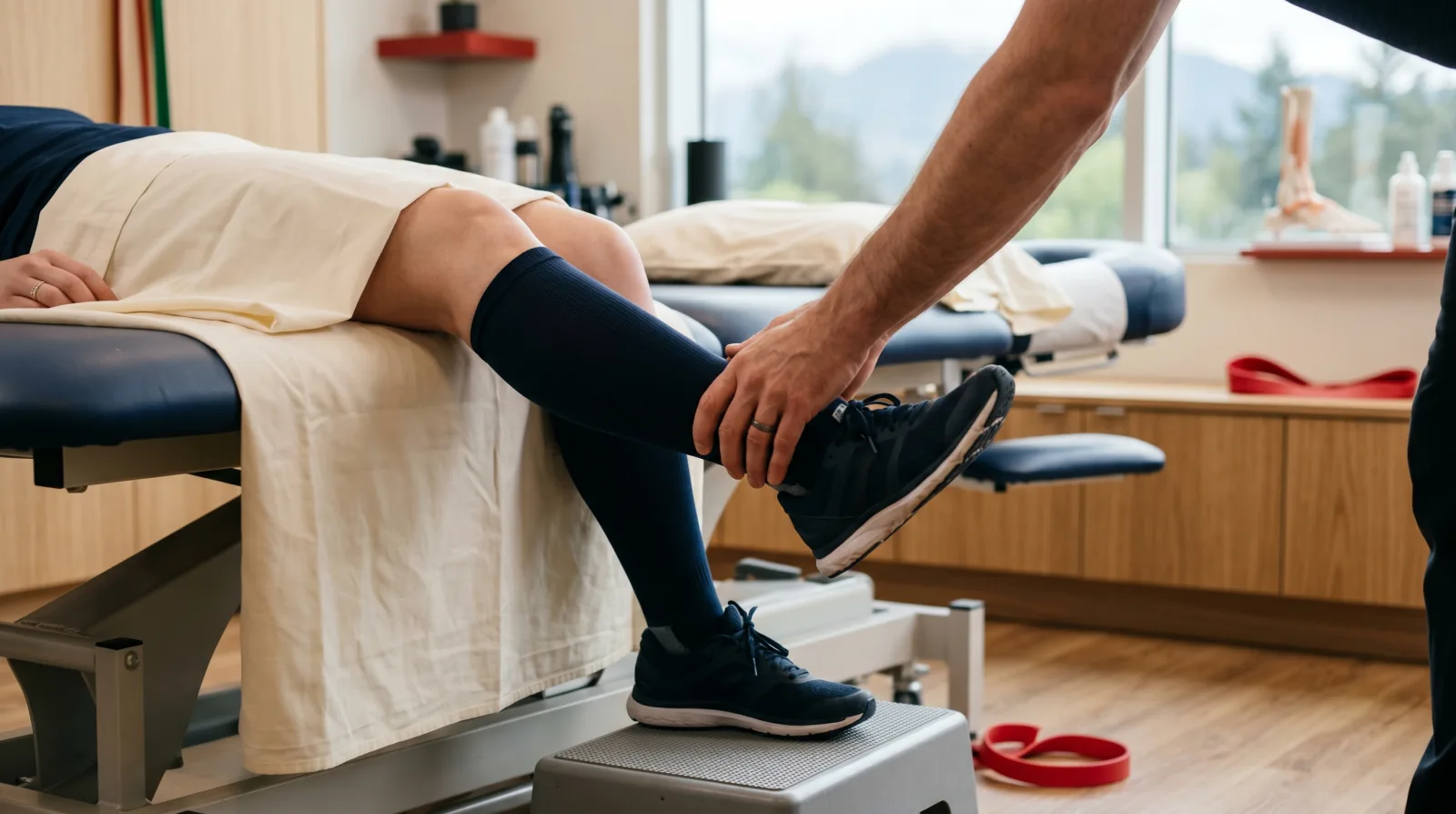
For mid-portion tendinopathy, loading that takes the tendon into a stretched position, such as heel drops off a step, is generally well tolerated and often helpful. For insertional tendinopathy, where the pain is right at the heel, those deep stretched-position drops can compress the tendon against the heel bone and make things worse. So we keep the loading in a flatter range early on and progress more cautiously.
This is one of the main reasons a generic set of heel raises pulled from the internet often stalls. The right program depends on where your pain actually is, and that is something a physiotherapist confirms at assessment.
How much pain is okay
People are often surprised that we allow some discomfort during loading. The guideline we use is straightforward. A mild ache during or shortly after loading that settles by the next morning is acceptable and does not harm the tendon. Pain that climbs day to day, or morning stiffness that gets steadily worse over a week, means the dose is too high and we back off.
The same logic applies to running. Many people can keep running through Achilles rehab at a reduced volume, as long as pain stays low during the run and calms within 24 hours. We do not insist on stopping running unless the tendon is too irritable to tolerate it, which is similar to how we handle a return to load after other lower-limb injuries like a calf strain returning to running.
What a realistic timeline looks like
Achilles tendinopathy is often slow. Many cases improve over three to six months of consistent loading, and a tendon that has been sore for a year before anyone touched it can take longer. That timeline frustrates people, and it is exactly why the false promise of rest is so appealing. Resting feels like doing something, while it quietly lets the tendon decondition.
We pace the program to the tendon, not the calendar. Early on we set a tolerable load and reduce the worst aggravators. As the tendon settles, the load increases and the running volume comes back gradually. Later, the program rebuilds the specific demands of your sport, whether that is trail hills, sprint work, or simply longer easy runs.
We reassess against function, your calf strength, your single-leg heel-raise capacity, and your tolerance to running, rather than pain alone. Pain is a noisy signal in tendons, and chasing it day to day leads people to stop and start in a way that never builds tolerance.
When to get it assessed
Most Achilles pain is a straightforward tendinopathy, but a few patterns deserve a proper look before assuming that. Sudden, sharp pain with a sense that something snapped, especially with a gap you can feel in the tendon or sudden weakness pushing off, can signal a tendon rupture and needs urgent assessment. Pain with significant swelling, redness, or warmth, or pain that does not fit the usual morning-stiffness pattern, is also worth ruling out.
If your Achilles has been stiff and sore for a few weeks and rest has not fixed it, that is the typical story, and loading is almost certainly the answer. Book a 30-minute appointment and we will confirm whether it is mid-portion or insertional, screen what overloaded it, and build a loading plan that fits your running.
This article is general information about Achilles tendinopathy. It is not personal medical advice. A regulated practitioner can confirm whether the patterns described apply to you.
Sources
- Alfredson et al., Heavy-load eccentric calf muscle training for the treatment of chronic Achilles tendinosis, American Journal of Sports Medicine (1998)
- Beyer et al., Heavy Slow Resistance Versus Eccentric Training as Treatment for Achilles Tendinopathy: A Randomized Controlled Trial, American Journal of Sports Medicine (2015)
- College of Physical Therapists of BC (CPTBC)
Common questions
Frequently asked questions.
Should I rest my Achilles tendon until the pain goes away?
Usually not. Complete rest tends to leave the tendon weaker and just as sensitive when you return to running. The better approach for most Achilles tendinopathy is to keep loading the tendon at a level you can tolerate while you reduce the activities that flare it. A physiotherapist sets the starting load after assessing how irritable the tendon is.
How long does Achilles tendinopathy take to get better?+
It is often slow. Many cases improve over three to six months with a consistent loading program, and some take longer if the tendon has been sore for a year or more before treatment starts. The timeline depends on how long it has been going on, how irritable it is, and how consistently the loading gets done.
Is it okay to run with Achilles tendinopathy?+
Often yes, in a modified form. Many people can keep running at a reduced volume if pain stays low during the run and settles by the next morning. We use a simple rule: a mild ache that calms within 24 hours is acceptable, while pain that climbs day to day means the load is too high and we scale back.
What is the difference between mid-portion and insertional Achilles pain?+
Mid-portion tendinopathy is pain a few centimetres above the heel bone, in the body of the tendon. Insertional tendinopathy is pain right where the tendon attaches to the heel. The distinction matters because insertional pain often does worse with deep heel-drop stretches, so the loading program is set up differently for each.
Will heel raises alone fix my Achilles?+
Calf and heel-raise loading is the core of most programs, but the details matter. The load has to be heavy enough and progressed over time, and the rest of the chain, your running volume, footwear, and calf strength, often needs attention too. A generic set of heel raises that never gets harder usually stalls.
Why is my Achilles worse in the first few steps in the morning?+
Morning stiffness and pain that eases after a few steps is one of the most recognizable signs of Achilles tendinopathy. The tendon settles overnight, then reacts to the first load of the day before it warms up, which is different from an acute injury where pain tends to stay constant regardless of the time of day.
Can I use ice or anti-inflammatories for Achilles tendinopathy?+
Ice can help ease pain after a loading session, and short-term use of over-the-counter anti-inflammatories is a decision to discuss with your doctor or pharmacist. Neither replaces the loading program, since the tendon needs progressive load to rebuild its tolerance, and pain relief on its own does not change the underlying tissue capacity.
What footwear helps with Achilles tendinopathy?+
A shoe with a slight heel-to-toe drop can reduce the stretch and load on the Achilles during walking and running, which some people find helpful early in a flare. This is usually a temporary or supportive measure alongside the loading program, not a fix on its own, since footwear changes do not build the tendon's capacity the way progressive loading does.
Share this post
Copies a ready-to-publish LinkedIn post to your clipboard and opens the LinkedIn share dialog. Paste the text into the composer and publish.

Written by
Amir Ahmadi, PhDDr. Amir Ahmadi is a Registered Physiotherapist, Certified IMS Therapist and former Associate Professor. 20+ years of clinical practice in North Vancouver.
This article is for general information only and does not constitute medical advice, diagnosis, or treatment. Individual presentations vary, and assessment findings and treatment plans differ from person to person. If you are experiencing severe symptoms, neurological changes (numbness, weakness, bowel or bladder changes), or a significant trauma, contact your physician or emergency services. Care at Medstar Sport Physio & Health is provided by practitioners registered with their respective British Columbia regulatory colleges.
Filed under
- achilles-tendinopathy
- tendinopathy
- loading
- running
- north-vancouver