Wrist Fracture Rehab: Regaining Grip and Motion After the Cast
A healed wrist fracture still leaves stiffness, swelling and a weak grip. Here are the rehab stages, what the research reports, and when driving, lifting, work and sport return.
BY ALI SHAFIEI, RPT
A cast, a splint, or a plate and screws protects a broken wrist while the bone heals. They also leave the wrist stiff, the hand swollen and the grip weak. This guide explains the stages of rehab after a distal radius fracture, which is a break in the forearm bone on the thumb side, close to the wrist. It also covers when driving, lifting, work and sport return.
After a distal radius (wrist) fracture, your surgeon sets the timing, and rehab then moves in three stages: keep the fingers, elbow and shoulder moving, restore wrist and forearm movement, then rebuild grip and strength. A physiotherapist at Medstar Sport Physio in North Vancouver can guide each stage inside your surgeon's limits.
Your surgeon sets when the wrist may move
The doctor or surgeon who treats the fracture decides how long the wrist stays protected. A 2024 clinical practice guideline from the physical therapy groups of the American Physical Therapy Association says a break with acceptable alignment is typically treated in a short arm cast for 4 to 6 weeks. A break that cannot be held in position needs surgery, often with a metal plate on the palm side of the bone. The NHS says recovery from a broken arm or wrist usually takes 6 to 12 weeks, and longer after a severe injury.
After surgery the timing varies. A 2018 trial by Watson and colleagues placed 133 adults who had plate surgery into groups that wore a cast for 1, 3 or 6 weeks. At 6 weeks the 1-week and 3-week groups had better wrist function and movement than the 6-week group. At 12 weeks and at 6 months no group did better than another.
Your surgeon sees the X-rays, so the surgeon gives the rule. Ask what the wrist may do, whether the splint may come off for exercises, and when the next X-ray is planned. If you are not yet sure the wrist is broken, our article on wrist sprain or scaphoid fracture explains why a sore wrist after a fall needs an X-ray.
Stiffness, swelling and a weak grip are expected
After weeks of protection the wrist bends and turns less, the fingers feel stiff and the hand swells by the end of the day. The guideline reports ranges that depend on the break and the study: loss of joint movement in as many as 31% of people, nerve injury in as many as 17%, and complex regional pain syndrome in 1% to 32%. That syndrome is a long-lasting pain condition, and the warning signs section below describes it. For swelling, the guideline says a mix of raising the hand, exercise, compression gloves and low-stretch bandages may reduce swelling in the first 2 to 6 weeks (grade C, a weaker grade).
Rehab moves through three stages
The guideline describes the same three stages after a cast and after surgery. Every fracture has its own plan, and your physiotherapist sets the pace inside your surgeon's limits.
Stage 1 protects the bone and keeps the other joints moving. While the wrist is in a cast or splint, you move the fingers, thumb, elbow and shoulder to prevent stiffness. After surgery, the guideline gives its strongest grade (A) to early therapy in the first 3 weeks: active movement of the hand, wrist, elbow and shoulder, meaning movement with your own muscles, plus light daily activity. It improved pain, wrist movement, grip strength and function up to 3 months, and wrist movement and grip strength at 6 months or later.
Stage 2 restores wrist and forearm movement. It starts once the surgeon confirms enough healing, and after a cast it begins right after the 4 to 6 weeks of casting. The aims are less pain and swelling, and more wrist bend and forearm rotation, which is turning the palm up and down. Finger tendon gliding exercises and hands-on joint techniques matched to your tolerance are part of it (grade B). A splint that stretches the wrist gradually may help when stiffness persists, although the guideline says the evidence is weak.
Stage 3 rebuilds strength and load. The guideline places the start at 6 to 8 weeks after fracture treatment began, provided healing is adequate. It builds grip, forearm and shoulder strength with progressive resistance, then tasks that match your job or sport. Our article on wrist pain in yoga explains graded loading for hands-on-the-floor positions, which many people meet again in this stage.
Supervised therapy helps some people more than others
The research results are mixed. The Cochrane review of rehabilitation for distal radial fractures, updated in 2015, included 26 trials with 1,269 mainly female and older patients. The authors rated the evidence as low or the lowest quality and concluded it was insufficient to show which methods work best. The 2020 guideline from the American Academy of Orthopaedic Surgeons and the American Society for Surgery of the Hand found inconsistent evidence of any difference between a home program and supervised therapy. Its authors write that routine supervised hand therapy does not seem to give a benefit on average, and that a subset of people may benefit.
Single trials show where the benefit may lie. In a 2015 trial by Valdes and colleagues, 50 people after plate surgery did clinic therapy or a monitored home program, and at 12 weeks the groups did not differ in function, movement, pain or grip strength. A 2024 trial by Gutiérrez-Espinoza and colleagues studied 74 people over 60 with a break that did not reach the joint surface. Six weeks of supervised physiotherapy scored 18.6 points better on a wrist function questionnaire than a home program at 6 weeks, and 18.5 points better at 1 year. At 2 years the difference was 3.3 points. The authors report no difference between the groups on the other measures, and grip strength still favoured supervised therapy.
The 2024 physiotherapy guideline, written by physical therapy organizations, turns this into advice. People aged 60 or older, and people with complications or other health conditions, should attend supervised therapy at least once a week and follow a home program as well (grade B). A physiotherapist or occupational therapist should teach the home program (grade A). For younger people with no complications, the evidence conflicts and the guideline makes no recommendation for or against supervised therapy.
Driving, typing, lifting, work and sport return in stages
No source gives one date for each activity, so your surgeon's rules come first.
For driving, the NHS says to avoid driving and heavy lifting until you have been told it is safe. A 2024 study by Tan and colleagues followed 26 adult drivers after plate surgery. Of the 21 who finished, the median time to pass a driving test was 6 weeks for the off-road test and 8 weeks for the on-road test. The authors suggest a driving assessment from 4 to 6 weeks after surgery when pain is controlled and forearm rotation has returned. In a 2024 Western Australia study of 37,107 adults, people with more severe injury patterns had 79% higher odds of a car crash in the first 3 months after the fracture. Ask your surgeon, and read your insurance policy.
Typing and mouse use are light tasks, and the guideline supports light daily activity with early movement after surgery in the first 3 weeks. No study read for this article gives a date for typing, so the date is your surgeon's decision. For lifting, the guideline places strengthening at 6 to 8 weeks after treatment began, once healing is adequate, and a physiotherapist adds loads in stages.
For work, a Finnish study by Palola and colleagues followed 614 working-age adults. The median time lost from work was 55 days (7.9 weeks): 49 days after cast treatment and 70 days after surgery. Surgery is used for unstable breaks, so the two groups are not alike. Ask your surgeon for a written note with limits, and plan gradual hours with your employer.
For sport, a 2020 review of distal radius fractures in athletes reports that outcomes after cast and surgical treatment are generally excellent and that most athletes return to the same level of sport. X-rays that confirm bone union help guide the timing of contact sports, the guideline notes. If a snowboard fall caused the break, our article on snowboard wrist fracture prevention explains wrist guards and why beginners are at risk.
Warning signs need medical care the same day
Go to the Lions Gate Hospital emergency department or call 911 if you have a cast or splint and any of these:
- Pain that keeps growing, with a tight or bulging forearm and numbness. Cleveland Clinic lists these as symptoms of acute compartment syndrome, a pressure build-up in the arm muscles, and advises emergency care right away.
- A hand that is blue, pale or cold compared with the other hand. HealthLinkBC says this can mean a sudden change in blood supply.
- New or worse numbness or tingling, or weakness in the arm or hand that lasts more than an hour.
The NHS also lists worse pain, a cast that feels too tight or too loose, a high temperature, and a bad smell or fluid from under the cast as reasons to ask for urgent advice. In BC, call your doctor or 8-1-1 the same day.
Call your doctor soon for signs of complex regional pain syndrome. HealthLinkBC describes pain much more severe and longer lasting than expected, blotchy or shiny skin, skin hotter or colder than other areas, swelling and stiffness, usually in one limb. The NHS advises getting help as soon as possible, because early treatment may reduce painful symptoms. The guideline also advises an urgent hand therapy consultation for extreme finger stiffness, a hypersensitive hand or skin changes.
How physiotherapy fits and how to book
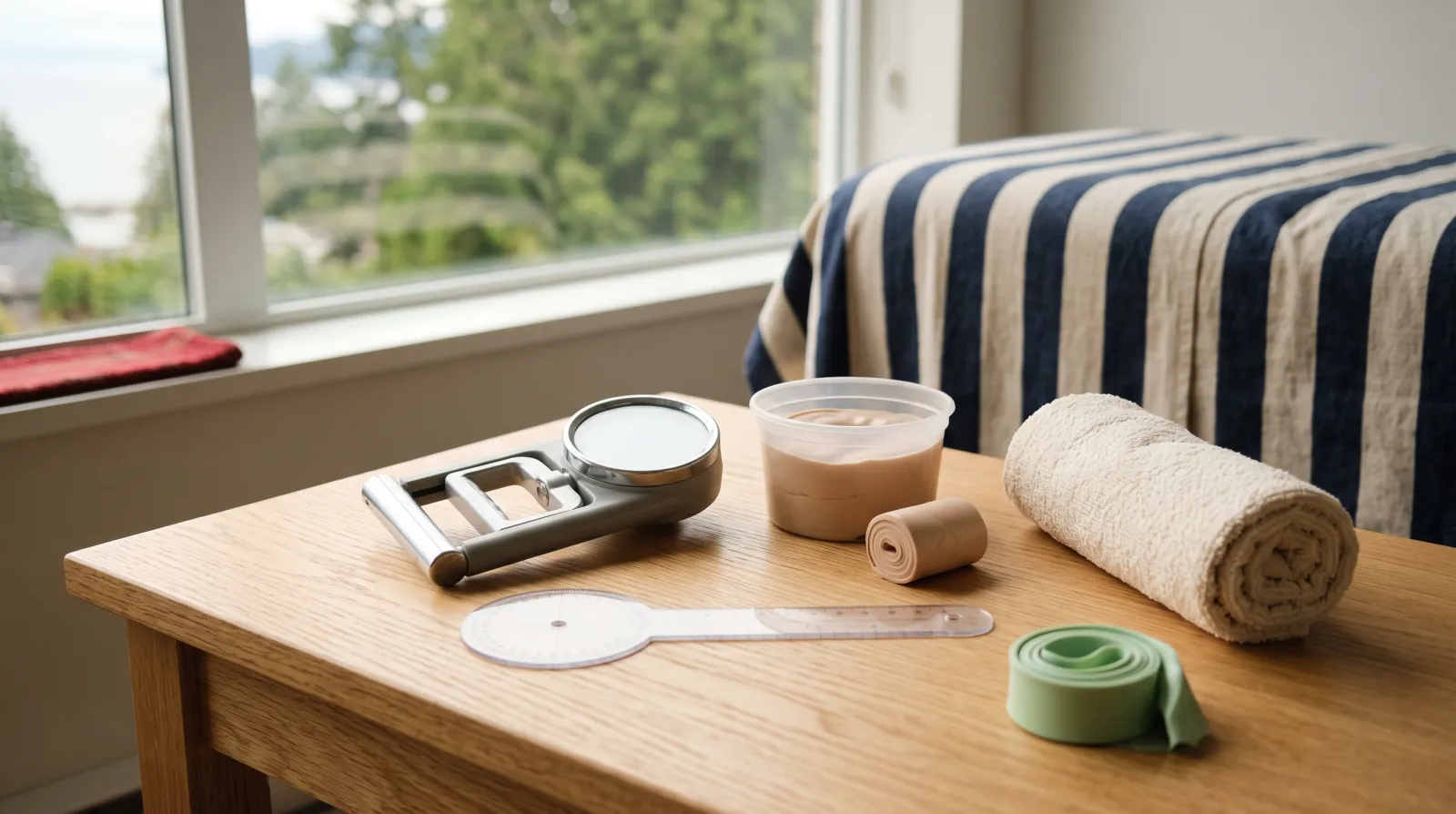
A physiotherapist starts by measuring how far the wrist and forearm move, how strong the grip is and how much the hand swells. The guideline recommends measuring movement and grip strength at the first visit and at 2 later points, including discharge, so that progress shows in numbers (grade A). The plan then follows your surgeon's limits and your goals. Our fracture rehabilitation page and physiotherapy service page describe the clinic's approach.
You do not need a referral to book physiotherapy in British Columbia. The clinic is at 1325 Marine Drive, North Vancouver, BC V7P 3E5. You can book at medstar.janeapp.com or call (604) 988-5411. Physiotherapists in BC are licensed by the College of Health and Care Professionals of BC, and you can check any name in its public registry.
Bring your surgeon's instructions and any X-ray reports, so the physiotherapist can plan around the real limits from the first visit.
This article is general information, not personal medical advice, and is not a substitute for assessment by a regulated practitioner. A regulated practitioner can confirm whether the patterns described apply to you.
Sources
- Mehta SP, et al. Distal Radius Fracture Rehabilitation: Clinical Practice Guidelines. J Orthop Sports Phys Ther, 2024
- Handoll HH, Elliott J. Rehabilitation for distal radial fractures in adults. Cochrane Database Syst Rev, 2015
- American Academy of Orthopaedic Surgeons. Management of Distal Radius Fractures: Evidence-Based Clinical Practice Guideline, 2020
- Gutiérrez-Espinoza H, et al. Supervised physiotherapy versus a home exercise program in patients with distal radius fracture: a randomized controlled trial with a 2-year follow-up. Physiotherapy, 2024
- Valdes K, Naughton N, Burke CJ. Therapist-supervised hand therapy versus home therapy with therapist instruction following distal radius fracture. J Hand Surg Am, 2015
- Watson N, et al. One, three, or six weeks of immobilization after open reduction and internal fixation of distal radial fractures: a randomized controlled trial. J Bone Joint Surg Am, 2018
- Tan CMP, et al. When is it safe to return to driving after distal radius fracture fixation? A prospective study. J Orthop Sci, 2024
- Stinton SB, et al. Who crashes their car following wrist fracture? J Hand Ther, 2024
- Palola V, et al. Sick leave length and the costs of operatively and conservatively treated distal radius fractures in the working age population. BMC Musculoskelet Disord, 2023
- Sobel AD, Calfee RP. Distal Radius Fractures in the Athlete. Clin Sports Med, 2020
- NHS: Broken arm or wrist
- HealthLinkBC: Finger, Hand, and Wrist Injuries
- HealthLinkBC: Complex Regional Pain Syndrome
- Cleveland Clinic: Compartment Syndrome
- NHS: Complex regional pain syndrome
- College of Health and Care Professionals of BC: public registry
Common questions
Frequently asked questions.
How long does a wrist take to heal after a fracture?
The NHS says recovery from a broken arm or wrist usually takes 6 to 12 weeks, and longer after a severe injury. A 2024 physiotherapy guideline reports that a stable break is usually treated in a short arm cast for 4 to 6 weeks. Surgery changes the timeline, and your surgeon sets the dates after looking at your X-rays. Stiffness and a weak grip can last after the bone has healed.
Is it normal for my wrist to stay swollen and stiff after the cast comes off?+
Yes, some swelling and stiffness are expected after weeks of protection. The 2024 physiotherapy guideline reports loss of joint movement in as many as 31% of people after a distal radius fracture. It says raising the hand, gentle exercise, compression gloves and low-stretch bandages may reduce swelling in the first 2 to 6 weeks. Severe pain, skin colour change or extreme finger stiffness needs a doctor.
When can I drive after a wrist fracture?+
Your surgeon decides, and your insurer may set its own rules. In a 2024 study of 21 adult drivers who finished testing after plate surgery, the median time to pass a driving test was 6 weeks for the off-road test and 8 weeks for the on-road test. The authors suggest a driving assessment can be considered from 4 to 6 weeks after surgery if pain is controlled and forearm rotation has returned.
When can I type or use a mouse again?+
No study read for this article gives a date for typing, so your surgeon decides. After surgery, the 2024 physiotherapy guideline supports light daily activity with early active movement in the first 3 weeks, inside the surgeon's limits. With a cast or splint in place, ask whether the fingers may type. A physiotherapist can build up typing time in short sessions as swelling and pain allow.
Do I need a physiotherapist, or can I do the exercises at home?+
The evidence is mixed. A 2020 guideline for surgeons found no clear difference on average between a home program and supervised therapy. The 2024 physiotherapy guideline advises supervised therapy at least once a week, plus a home program, for people aged 60 or older and for people with complications. A therapist should teach the home exercises. If movement is not returning, book an assessment.
When can I go back to work after a wrist fracture?+
It depends on your job, the treatment and your pain. A Finnish study of 614 working-age adults reported a median of 55 days (7.9 weeks) lost from work, 49 days after cast treatment and 70 days after surgery. Surgery is used for less stable breaks, so those groups are not alike. Ask your surgeon for a written note with limits, and plan gradual hours.
Will my grip strength come back to normal?+
Many trials measure grip as a share of the other hand, and the sources read for this article give no date for full grip. In a 2024 trial of 74 people over 60, grip strength still favoured the group that had supervised physiotherapy at 2 years, although other measures had evened out. A physiotherapist measures grip at the first visit and at later visits to track progress.
What are the signs of complex regional pain syndrome after a wrist fracture?+
HealthLinkBC lists pain that is much more severe and lasts much longer than expected, blotchy or shiny skin, skin that feels hotter or colder than other areas, swelling, stiffness, weakness, sweating, numbness or tingling, usually in one limb. It can start after a broken bone. See your doctor soon if these appear, because early treatment may reduce painful symptoms, as the NHS explains.
When is pain after a wrist fracture an emergency?+
Go to the Lions Gate Hospital emergency department or call 911 for pain that keeps growing under a cast, a tight and bulging forearm with numbness, or a hand that is blue, pale or cold compared with the other hand. Cleveland Clinic advises emergency care right away when compartment syndrome, a pressure build-up in the arm muscles, is possible.
Can I go back to snowboarding or cycling after a wrist fracture?+
A 2020 review of athletes reports that most return to the same level of sport after a distal radius fracture. Your surgeon decides when sports with a risk of falling onto the hand are safe, and X-rays that confirm the bone has united help guide that decision. A physiotherapist builds grip, forearm and shoulder strength first, then adds sport tasks in stages.
Do I need a referral to see a physiotherapist after a wrist fracture?+
No. In British Columbia you can book physiotherapy without a referral. At Medstar Sport Physio, 1325 Marine Drive in North Vancouver, you can book at medstar.janeapp.com or call (604) 988-5411. Some extended health plans ask for a referral before they reimburse you, so read your policy. A new injury or a suspected fracture needs a doctor first.

Written by
Ali Shafiei, RPTAli Shafiei is a Registered Physiotherapist with 10+ years of clinical experience in musculoskeletal, neurological and sports rehabilitation. North Vancouver.
This article is for general information only and does not constitute medical advice, diagnosis, or treatment. Individual presentations vary, and assessment findings and treatment plans differ from person to person. If you are experiencing severe symptoms, neurological changes (numbness, weakness, bowel or bladder changes), or a significant trauma, contact your physician or emergency services. Care at Medstar Sport Physio & Health is provided by practitioners registered with their respective British Columbia regulatory colleges.
Filed under
- wrist-fracture
- distal-radius-fracture
- post-fracture-rehab
- grip-strength
- return-to-driving
- return-to-work
- return-to-sport
- north-vancouver