Pre-Season Conditioning: How to Build Up Without Getting Hurt
Most fall-sport injuries do not come from bad luck. They come from doing too much too soon after an off-season of doing too little. Here is how to build up the safer way.
BY MEDSTAR SPORT PHYSIO TEAM
Every fall on the North Shore, the same story repeats. Someone eases off over the summer, then the season starts and they go straight into full practices and games, and a couple of weeks later a muscle or a joint has had enough. It looks like bad luck, but most of these injuries come from a pattern we can see coming: doing too much too soon after an off-season of doing too little.
Pre-season conditioning lowers injury risk mainly by smoothing out the jump from an easy off-season to a hard first few weeks of sport. The biggest risk is a sudden spike in load, so the safer plan is to build up your training gradually over several weeks rather than arriving unprepared and catching up all at once. Structured warm-up and strength programs help too, and simple movement screening can find the gaps worth targeting. At Medstar Sport Physio in North Vancouver, we build a conditioning plan around your sport, your starting point, and the timing of your season.
Why the first weeks of a season are risky
The off-season is not the problem by itself. The problem is the contrast. If you spend the summer doing little and then start a fall sport at full intensity, your body faces a large, sudden increase in load right when it is least prepared for it. Muscles, tendons, and bones all adapt to load, but they adapt slowly, and they cannot catch up in a single hard week.
This is why the first two or three weeks of a season see so many injuries. The player feels motivated and pushes hard, but the tissues have not built the capacity to handle that push yet. A conditioning block done before the season starts closes that gap, so the first hard practice is not the first hard thing the body has done in months.
The too much too soon problem, explained
There is a helpful way to think about training load. Your body cares less about how much you do on a single day and more about how that compares to what you have been doing recently. A week that is only a little harder than your recent average is usually fine. A week that is far harder than your recent average is a spike, and spikes are where the risk climbs.
Training load research made this idea popular with the acute to chronic workload ratio, which compares a recent week of load against the average of the previous few weeks, and found the lowest injury risk when the two are reasonably close rather than the current week being far higher. It is worth being honest that the researchers themselves have since stepped back from the strongest claims, so this is a useful guiding idea rather than an exact formula to obey. The plain-English version still holds: big jumps in load raise risk, and gradual builds protect.
How a gradual build actually works
The fix follows directly from the problem. Instead of arriving at the season unprepared, you raise your load in steps over several weeks so each week is only a bit more than the last. This gives your muscles, tendons, and bones time to adapt and get stronger before the season demands full intensity.
A sensible pre-season block starts well before the first game and builds fitness, strength, and sport-specific work in stages. The details depend on your sport and your starting point, but the principle is the same one we use when bringing someone back from injury, where we progress by meeting targets rather than rushing. We describe that step-by-step logic in our guide to criteria-based return to sport.
What conditioning does besides fitness
It is easy to think of conditioning as just getting fit, but the more important part for injury risk is building tissue capacity. Stronger muscles and tendons can absorb more load before they fail, and a body used to running, cutting, and jumping handles those movements more safely than one that has not done them in months.
Structured programs add to this. Warm-up and neuromuscular routines such as the FIFA 11+ program have been shown in reviews of randomised trials to reduce injuries in soccer players by around 30 percent. That is a meaningful effect from something as simple as a consistent, well-run warm-up and strength routine done regularly. These programs work partly by preparing the body and partly by improving control during the fast, unplanned movements that cause many injuries. The same thinking helps specific injuries, such as the eccentric strength work we cover in our piece on hamstring strain rehab for soccer and rugby.
Where screening fits
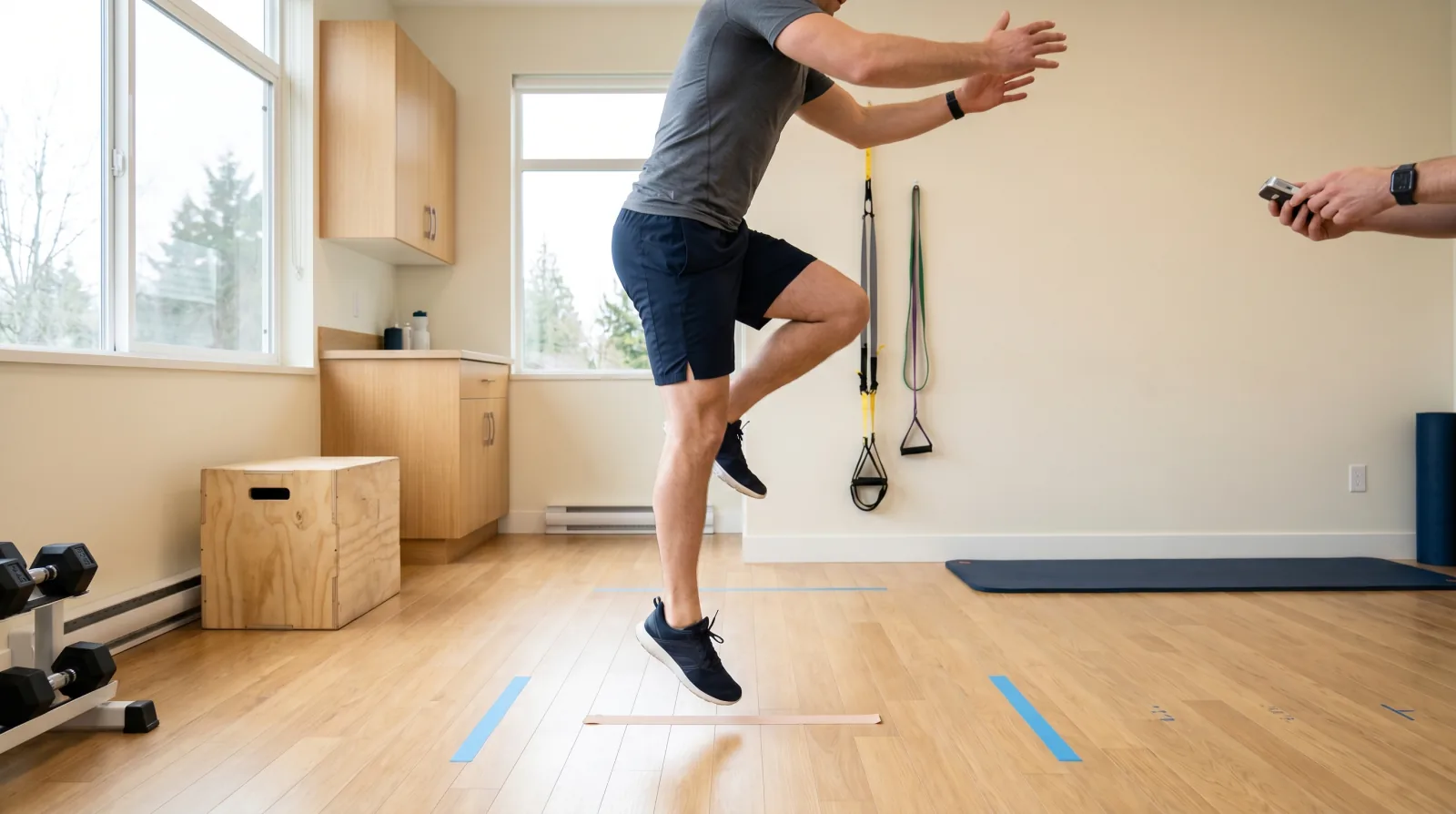
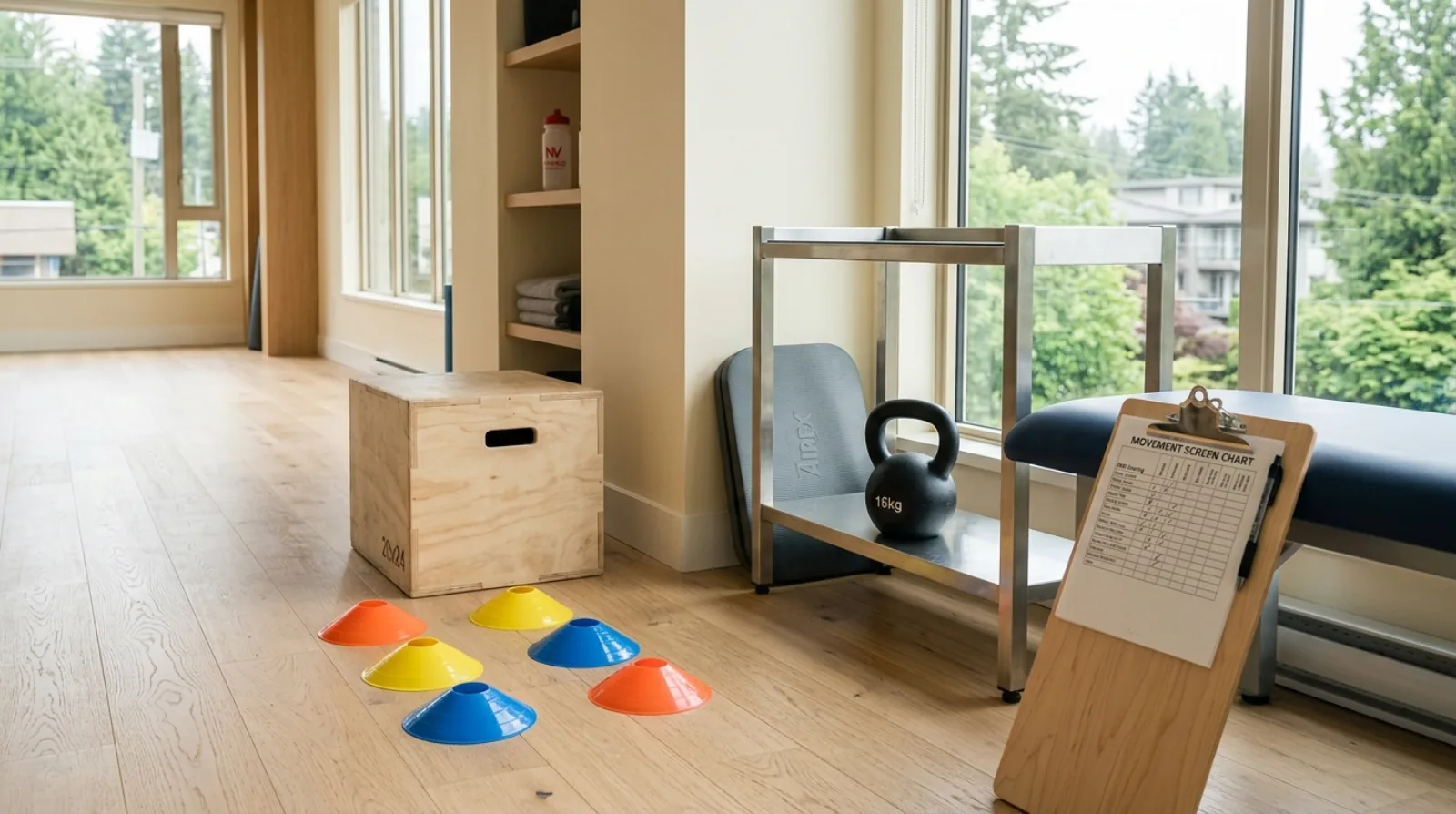
Before building a conditioning plan, it helps to know where your gaps are. Movement screening is a check of how you move, balance, and control force during sport-relevant tasks. It can reveal weaknesses, large differences between your left and right sides, or movement patterns worth improving.
A screen is not a crystal ball. It does not predict with certainty who will get hurt, and it should not be sold that way. What it does is give a starting point, so the conditioning block targets your specific gaps rather than being a generic routine. A player with a weak, poorly controlled hip needs different work than one with limited ankle movement, and screening is how we tell the difference.
North Shore timing for fall sports
Local fall sports, from soccer and field hockey to rugby and the start of the hockey season, tend to ramp up quickly once school and clubs return. That timing is exactly why the summer-to-fall jump catches so many people. If you know your season starts in early September, starting a gradual build a few weeks earlier gives your body the runway it needs.
This matters just as much for the parents of young athletes as for adults. A teenager who grew over the summer and did little activity can face a large jump in load at the first practices, and that combination deserves attention rather than being ignored until something hurts.
If you left it late
Not everyone reads this in July. If the season is close and you have done little to prepare, the plan changes but there is still value in doing something. The key is to resist the urge to cram, because a rushed catch-up is the exact spike that raises risk. A careful, gradual build from where you actually are now, even over a shorter window, is safer than trying to force months of missed preparation into a single week.
When to get assessed
If you are heading into a fall season and you know you did little over the summer, if you have a history of the same injury coming back each season, or if you want a conditioning plan built around your sport rather than a generic routine, an assessment is worth it. We screen how you move, find the gaps that matter, and set a gradual build that fits the time you have before your season starts.
Book a 30-minute appointment and we will assess where you are, screen your movement, and build a pre-season plan that raises your load safely so you start the season ready rather than playing catch-up.
This article is general information about training and injury prevention. It is not personal medical advice. A regulated practitioner can confirm whether the patterns described apply to you.
Sources
- The FIFA 11+ injury prevention program reduces the incidence of knee injury among soccer players: a systematic review and meta-analysis of randomized controlled trials (Journal of Science and Medicine in Sport)
- The Relationship Between Acute:Chronic Workload Ratios and Injury Risk (Open Access Journal of Sports Medicine)
- College of Physical Therapists of BC (CPTBC)
Common questions
Frequently asked questions.
How long before the season should I start conditioning?
Giving yourself several weeks of gradual build before the season starts is sensible, and many athletes benefit from a block of a couple of months rather than a rushed week or two. The exact length depends on your sport, your starting fitness, and how much you did over the off-season. The point is to raise your load slowly so your body has time to adapt, rather than arriving at the first hard practice unprepared and then trying to catch up all at once.
What does too much too soon mean in sport?+
It means increasing your training or playing load faster than your body can adapt to it. After an off-season of lower activity, jumping straight into full-intensity practices and games is a large, sudden spike in load, and sudden spikes are linked to higher injury risk. The safer pattern is to raise your load in steps so each week is only a little more than the average of recent weeks, which gives muscles, tendons, and bones time to get stronger.
Does pre-season conditioning actually prevent injuries?+
Structured programs can lower injury risk, though nothing removes it completely. Warm-up and neuromuscular programs like the FIFA 11+ have been shown in reviews of randomised trials to reduce injuries in soccer players by around 30 percent. Pre-season conditioning works by building the capacity of muscles, tendons, and bones and by smoothing out the jump from off-season to in-season, so the first hard weeks are not a shock to the body.
What is movement screening before a season?+
Movement screening is a check of how you move, balance, and control force during sport-relevant tasks before the season begins. It looks for weaknesses, big differences between sides, or movement patterns that may raise your risk, so those can be addressed in the conditioning block. A screen does not predict injury with certainty, but it gives a starting point for a program that targets your specific gaps rather than a generic routine.
I did nothing over the summer. Is it too late to condition?+
It is rarely too late to help, but the plan changes. If you have done little over the off-season, the priority is a careful, gradual build rather than trying to make up for lost time in a week, because that catch-up rush is exactly what raises injury risk. A physiotherapist can set a realistic starting point based on where you are now and step it up safely as the season approaches, even if time is short.
Share this post
Copies a ready-to-publish LinkedIn post to your clipboard and opens the LinkedIn share dialog. Paste the text into the composer and publish.
Written by
Medstar Sport Physio Team
Registered clinician at Medstar Sport Physio & Health, North Vancouver.
This article is for general information only and does not constitute medical advice, diagnosis, or treatment. Individual presentations vary, and assessment findings and treatment plans differ from person to person. If you are experiencing severe symptoms, neurological changes (numbness, weakness, bowel or bladder changes), or a significant trauma, contact your physician or emergency services. Care at Medstar Sport Physio & Health is provided by practitioners registered with their respective British Columbia regulatory colleges.
Filed under
- pre-season
- conditioning
- injury-prevention
- load-management
- return-to-sport
- north-vancouver