
Sports Physiotherapy vs General Physiotherapy: What Changes in the Assessment
Both are physiotherapists. The difference is in the questions asked, the tests used, and how the decision to return to your sport gets made.
BY ALI SHAFIEI, RPT
You hurt yourself running, lifting or playing, and you now have to pick a clinic. The two kinds of clinic you will see advertised are general physiotherapy and sports physiotherapy.
At Medstar Sport Physio in North Vancouver, both kinds of care come from the same licensed profession; what changes in a sports-focused assessment is the history taken about your training, the movement tests matched to your sport, and a return-to-sport decision made against test results and criteria written down in advance.
What "sports physiotherapist" means in BC
In British Columbia the College of Health and Care Professionals of BC (CHCPBC) regulates physical therapists. Its website lists physical therapists as one of nine health professions it regulates. The College's page for physical therapists says that a person who cancels their licence must not use the protected titles Physical Therapist, Physiotherapist, Registered Physical Therapist or Registered Physiotherapist.
In the CHCPBC pages we read, no separate title for sports physiotherapist appears. The words describe a focus of practice. The word physiotherapist inside that phrase is a protected title, so anyone using it must be registered with the College. You can check any clinician on the public register.
There is a national credential for the specialty. Sport Physiotherapy Canada is a division of the Canadian Physiotherapy Association. Its public resources page says: "A 'Sport Physiotherapist' is a Physiotherapist who has completed the Diploma in Sport Physiotherapy through Sport Physiotherapy Canada (SPC)." The same page says the training involves over 1600 hours of on-field care in a variety of sports. It also reports that over 350 physiotherapists hold the Certificate level and over 250 hold the Diploma. Those counts are the association's own figures, and we have not audited them.
So the phrase can mean two things. It can mean a physiotherapist who holds the national Diploma. It can also mean a physiotherapist who spends most of their time with athletes and active people. Ask the clinic which one it means. At Medstar, Ali Shafiei's profile lists sport and orthopaedic physiotherapy as his focus, with a BSc (PT). It does not list the Sport Physiotherapy Canada Diploma.
The history questions go further
Every physiotherapy assessment starts with a history. A general assessment asks where it hurts, when it started, what makes it worse and what you do for work. These are the right first questions for any injury.
A sports-focused history adds questions about the demand you place on your body. We ask which sport, which position or event, and how many sessions you do in a normal week. We ask what changed in the last few weeks: a new pair of shoes, a new surface, a race entry, a jump in distance, a return after a break. Many overuse injuries trace back to a change in load, so those answers often explain why the injury appeared when it did.
We also ask about your past. An ankle sprain that has happened before is a different problem from a first sprain. Earlier surgery, earlier rehab and whether you ever returned to full sport afterwards all change what we test and how we plan. Athletes often describe a new injury as coming from nowhere, and the history then shows an older one that never fully settled.
Last, we ask what you want to do again. "Walk without pain" and "play a full 90 minutes of soccer" are two different goals. The goal decides the end point of the rehab plan.
Load and training questions shape the plan
In a general assessment, load usually means how much you lift, carry or sit during the day. In a sports assessment, load means training volume, intensity, speed, jumping, change of direction and how much recovery you get between sessions.
This matters because rest and exercise advice depends on it. A runner with a sore tendon does not always need to stop. Often the plan changes the amount, the hills, the speed work or the surface while keeping some running in the week. A general plan of "rest for two weeks" may keep the pain away and leave the tendon less ready for the next block of training.
Your physiotherapist reviews your training log or a description of a normal week, looking for sudden jumps and missing rest days. The plan then protects the injured area while keeping the rest of your fitness as high as is safe. Expect homework that looks like training.
Our page on sports physiotherapy services lists the hands-on treatments we use alongside that plan.
Movement and sport-specific testing
A general physical examination checks range of motion, strength, joint tests and pain on movement. A sports assessment includes those and then tests the movements your sport demands.
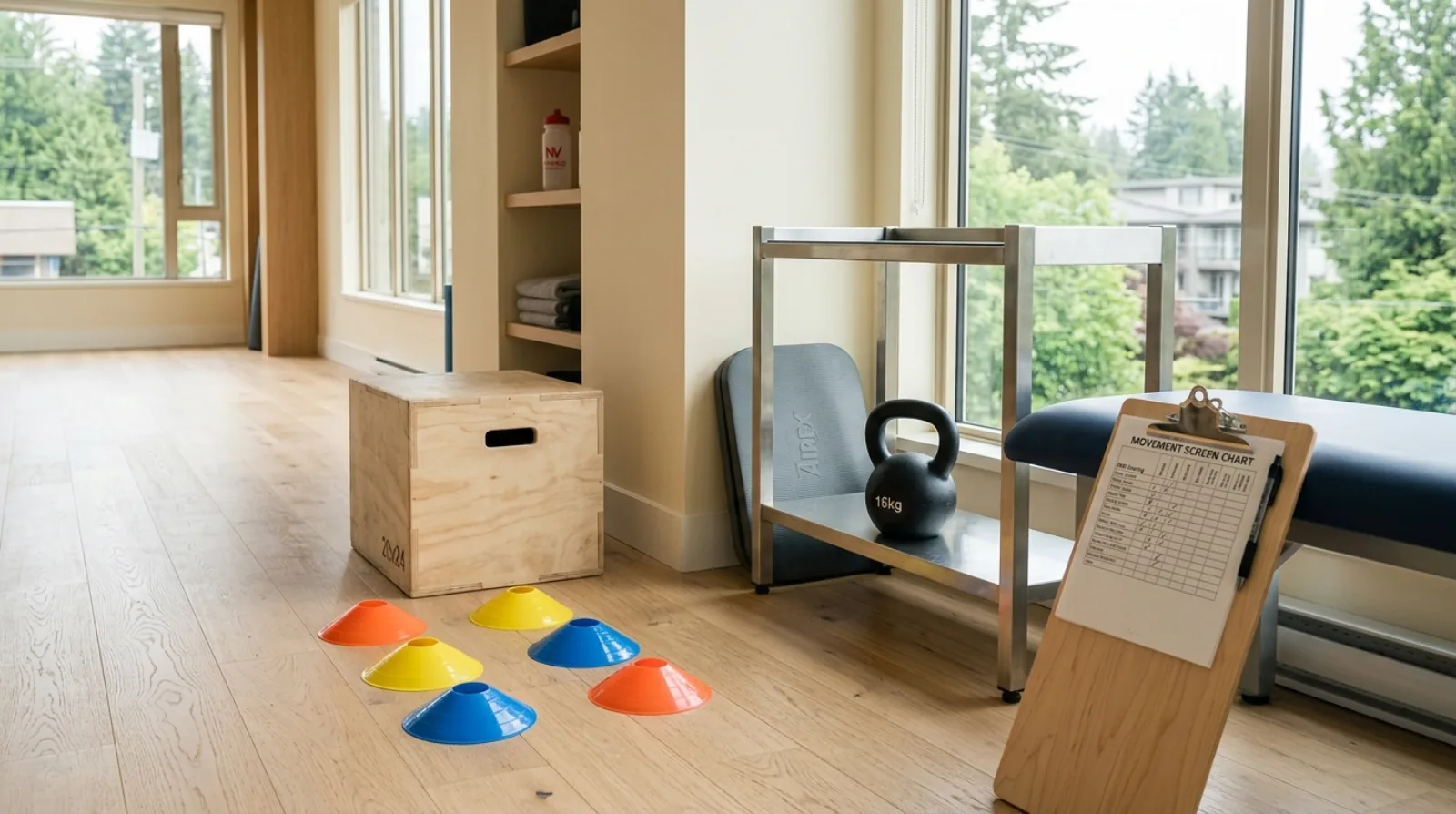
For a runner, that can mean watching you run on a treadmill and testing single-leg calf endurance and hip strength. For a basketball or soccer player it can mean single-leg hops, landing mechanics and quick change-of-direction tasks. For a swimmer or climber, it can mean shoulder control in overhead positions.
The reason is simple. An ankle can pass a standard strength test on a table and still fail when you land on it at speed. The sport-specific test shows what the basic test misses. It also gives a baseline. When we repeat the same test a few weeks later, you and the physiotherapist both see the change.
Strength compared with the other side is one of the most useful numbers. A 2016 study from the Delaware-Oslo ACL cohort followed 106 people in pivoting sports after surgery to rebuild the anterior cruciate ligament (ACL) in the knee. The tests included thigh muscle (quadriceps) strength and hop test symmetry. Among those who failed any test, 38.2% had a reinjury, against 5.6% of those who passed, although the authors note the gap was too small to rule out chance. They did report that more symmetrical quadriceps strength before return reduced the reinjury rate, and that the reinjury rate fell by 51% for each month return was delayed until 9 months after surgery. A study that follows a group over time shows a link and cannot prove that testing prevents injury. It does give a reason to test before we clear anyone.
Return-to-sport criteria replace the calendar
A general rehab plan often ends when pain is gone and daily tasks are easy. For an athlete that is the middle of the process. Pain-free walking does not show that an ankle, knee or shoulder can take the forces of a game.
One consensus statement on this topic is the 2016 statement from the First World Congress in Sports Physical Therapy in Bern, published in the British Journal of Sports Medicine. Seventeen expert clinicians took part. Its abstract says return to sport should be viewed as a continuum that runs alongside recovery and rehabilitation. The decision is made throughout rehab and at no single moment at the end. The abstract describes the decision as complex, with many factors involved, and it names a framework, Strategic Assessment of Risk and Risk Tolerance, that helps decision-makers weigh the risk against what the athlete will accept. The abstract also says that research evidence to support return to sport decisions in clinical practice is scarce.
That last point is worth stating plainly. There is no single test, number or week count that every athlete must reach. Good criteria combine several things: strength compared with the other side, results on hop or jump tests, how the area reacts to sport-like training, your confidence, and the demands of your sport and level. We write the criteria down early, so you know what you are working toward.
Our post on criteria-based return to sport and the return to sport guide cover the phases.
The consensus abstract says return-to-sport decisions are made by clinicians, athletes and coaches, ideally in a collaborative way. We work the same way.
The physiotherapist brings the test results and explains the risks in plain words. You bring your goals and the amount of risk you accept. A hockey player in the last game of a season may accept a different risk from a recreational runner with no race on the calendar. A coach or a surgeon adds what the sport, the team and the repair require. If you had an operation, the surgeon's limits come first.
A general clinic can run this process too. In a sports-focused clinic, a return plan with named tests and a shared decision is the usual end of treatment. Our clinicians do not guarantee a return date, because healing and test results set that date.
When a general physiotherapy clinic is the right choice
Sports physiotherapy suits some problems and general physiotherapy suits others. For many problems a general clinic is a sound choice.
If you sprained an ankle stepping off a curb, have neck pain from desk work, or feel stiff in your back after gardening, you have no sport demand to rebuild. Registered physiotherapists all meet the same licensing standard from CHCPBC. A clinic that is close to home, has appointments that fit your week and lets you see the same physiotherapist each visit may serve you better than a longer trip.
Ask how long the first assessment is, whether you will see the same clinician each time, and whether they treat problems like yours often. Our guide on how to choose a physiotherapist in North Vancouver lists the questions.
A sports-focused clinic is worth a longer trip when you train often, compete, have had surgery, keep re-injuring the same area, or need to reach a specific level of sport again.
What to do next
No referral is needed to book a physiotherapist in BC. Some extended health plans want one before they pay, so check your policy.
Bring your training log, your shoes or equipment, any imaging reports, surgeon notes and your competition dates. Tell the physiotherapist what you want to do again. Our team is listed on the team page, and Ali Shafiei has his own profile. You can also contact the clinic with a question before you book.
Medstar Sport Physio is at 1325 Marine Drive, North Vancouver, BC V7P 3E5. Call (604) 988-5411 or book at medstar.janeapp.com.
Get urgent help first if you have any of these: a limb that looks visibly deformed, numbness or weakness that is spreading, chest pain, loss of bladder or bowel control, a fever with a hot swollen joint, or a head injury with confusion, repeated vomiting or a worsening headache. Call 911 or go to the emergency department at Lions Gate Hospital.
This article is general information, not personal medical advice, and it is not a substitute for assessment by a regulated practitioner. A regulated practitioner can confirm whether the patterns described apply to you.
Sources
- College of Health and Care Professionals of BC: home page, professions regulated
- CHCPBC: Physical Therapists, protected titles
- CHCPBC public register
- Sport Physiotherapy Canada, Canadian Physiotherapy Association: public resources
- Ardern CL et al. 2016 consensus statement on return to sport from the First World Congress in Sports Physical Therapy, Bern. Br J Sports Med 2016;50(14):853-64. PMID 27226389
- Grindem H et al. Simple decision rules can reduce reinjury risk by 84% after ACL reconstruction: the Delaware-Oslo ACL cohort study. Br J Sports Med 2016;50(13):804-8. PMID 27162233
Common questions
Frequently asked questions.
Is a sports physiotherapist a different kind of licence in BC?
No. BC regulates the titles physical therapist and physiotherapist through the College of Health and Care Professionals of BC (CHCPBC). The words sports physiotherapist describe a focus of practice. Sport Physiotherapy Canada, a division of the Canadian Physiotherapy Association, offers a separate Certificate and Diploma in Sport Physiotherapy that a registered physiotherapist can earn after the licence.
Do I need a referral to see a physiotherapist for a sports injury?+
No. In BC you can book a physiotherapist directly, including at Medstar Sport Physio in North Vancouver. Some extended health plans ask for a doctor's referral before they reimburse you, so check your policy wording first. ICBC and WorkSafeBC claims have their own approval steps, and the clinic can explain them when you book.
What does a sports physiotherapist ask that a general clinic may not?+
They ask about your sport, your position or event, your weekly training volume, recent changes in load, your equipment and surfaces, and your competition calendar. A general assessment still covers pain, strength and movement. The sport questions add the context that explains why this injury appeared now and what you need to be able to do before you play again.
How do I know when I am ready to return to sport?+
Readiness comes from several results considered together. Common ones are strength compared with the other side, hop or jump test results, how the area responds to sport-like loading, and how confident you feel. A 2016 consensus statement in the British Journal of Sports Medicine describes return to sport as a continuum that runs alongside rehabilitation.
Who makes the return-to-sport decision?+
The same consensus statement says these decisions are made by clinicians, athletes and coaches, ideally together. Your physiotherapist presents test results and risks. You describe your goals and how much risk you accept. A coach or surgeon adds what the sport and the repair require. No single person decides alone.
When is a general physiotherapy clinic the right choice?+
A general clinic is a sound choice for most first-time sprains, a stiff back after gardening, neck pain from desk work, or any problem with no sport demand attached. Registered physiotherapists share the same licensed baseline. Choose on the clinician's experience with your problem, how long the assessment lasts, and whether you see the same person each visit.
Does a longer injury history change the assessment?+
Yes. A first sprain and a fifth sprain of the same ankle call for different questions. A sports-focused assessment looks at earlier injuries, past surgery, what rehab you completed, and whether you returned to full sport afterwards. Earlier injuries often point to a movement or strength pattern that the new injury shares with the old one.
What should I bring to a sports physiotherapy assessment?+
Bring your training log or a description of a normal training week, the shoes or equipment you use, any imaging reports, surgeon notes if you had an operation, and your competition dates. Wear clothes you can move in. Tell the physiotherapist what you want to do again, because that goal sets the tests you will be given.

Written by
Ali Shafiei, RPTAli Shafiei is a Registered Physiotherapist with 10+ years of clinical experience in musculoskeletal, neurological and sports rehabilitation. North Vancouver.
This article is for general information only and does not constitute medical advice, diagnosis, or treatment. Individual presentations vary, and assessment findings and treatment plans differ from person to person. If you are experiencing severe symptoms, neurological changes (numbness, weakness, bowel or bladder changes), or a significant trauma, contact your physician or emergency services. Care at Medstar Sport Physio & Health is provided by practitioners registered with their respective British Columbia regulatory colleges.
Filed under
- sports-physiotherapy
- general-physiotherapy
- return-to-sport
- assessment
- how-to-choose
- north-vancouver