Criteria-Based Return to Sport: Why the Calendar Is Not Your Coach
Two athletes with the same injury can be in completely different places at six weeks. Here is how sport physiotherapy makes the return-to-play decision, and why the calendar is the wrong tool for the job.
BY AMIR AHMADI, PHD
Looking to book a return-to-play assessment at Medstar? See the Return-to-Play Testing page in our Return to Sport guide.
An athlete is ready to return to sport when they meet measurable criteria, including strength symmetry, hop test performance, and psychological readiness, not simply when a set number of weeks has passed. Time alone does not reveal the deficits that cause reinjury. A 2016 systematic review in the American Journal of Sports Medicine reported a second ACL injury rate of roughly 23% in athletes under 25 who returned on time-based criteria. At Medstar Sport Physio in North Vancouver, clearance is staged: athletes may be cleared for modified running first, then retested before progressing to cutting and full competition. Criteria, not the calendar, drive each step. What the battery includes depends on the injury and the demands of the sport involved.
The most common error in unsupervised rehab is not under-doing the early phase. It is over-trusting the calendar in the late phase. "It has been six weeks" is the sentence that puts athletes back on the field still carrying the deficit that injured them.
A physiotherapist who watches this play out repeatedly stops thinking about return in weeks. They think about it in criteria: specific, measurable findings that have to line up before clearance. This post is a plain-English walk through what those criteria are, why they exist, and what they catch that the calendar misses.
Why time-based return goes wrong
The simplest reason: tissue healing rates vary widely between patients with the same injury. Age, baseline fitness, comorbidities, how early rehab started, surgical technique in post-operative cases, compliance with the loading phase. All of them shift the curve. A 22-year-old club soccer player and a 47-year-old recreational skier with the same ACL reconstruction will not be at the same place at six months.
The deeper reason is that time does not capture capacity. An athlete can be far enough past the injury to feel normal in daily life and still be 30% weaker on the injured side. The deficit only shows up under the specific demands of the sport: a hard cut, an awkward landing, a sprint at the end of a game when fatigue is high. The calendar does not measure those.
The result, when athletes return on time-based criteria alone, is a well-documented reinjury problem. The 2016 systematic review and meta-analysis by Wiggins et al. in the American Journal of Sports Medicine reported a second-ACL-injury rate of roughly 23% in athletes under 25 returning to high-risk pivoting sports. Criteria-based clearance is one of the few modifiable variables that lowers that number.
What a return-to-play test battery actually looks like
The exact composition depends on injury and sport. For most of the lower-limb cases we see (knees, ankles, hips), the battery covers a familiar set of categories.
Strength symmetry
The injured side is compared to the uninjured side on the muscle groups that matter for the sport. The metric is the limb symmetry index (LSI): the ratio of injured-side performance to uninjured-side performance.
For ACL rehab specifically, the consensus target before considering return to cutting and pivoting sports is an LSI of 90% or better on quadriceps strength, reported across multiple BJSM consensus statements and clinical practice guidelines. Targets vary by tissue and sport. Hamstring rehab uses different thresholds. Achilles rehab uses calf-raise endurance.
Hop tests
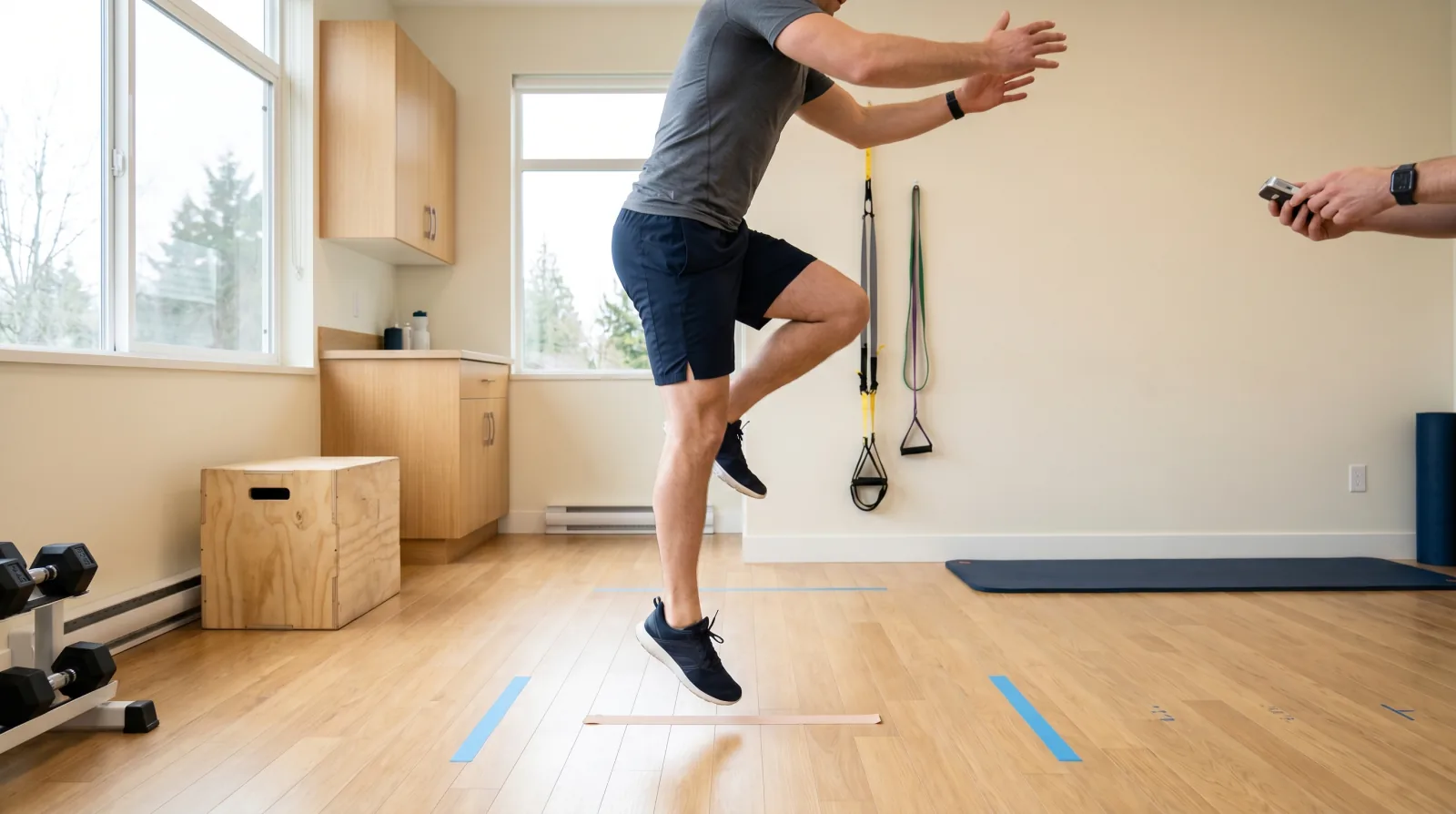
The hop battery (single-leg hop for distance, triple hop, crossover hop, timed six-metre hop) has been studied extensively in lower-limb rehab. The battery surfaces deficits that isolated strength tests miss because it captures the coordination, eccentric control, and reactive strength required to absorb landings.
The hop battery is well-validated. The original Noyes et al. work in 1991 established its sensitivity to functional deficits, and it has been refined repeatedly since.
Movement quality under fatigue
A reassessment that looks at the tenth rep, not just the third. Many athletes have reasonable mechanics fresh and reveal control problems when the system is tired. The test is set up to reproduce that fatigue.
Agility and reactive control
Direction changes, deceleration, planned and unanticipated cuts. The unanticipated component is important. Anticipated agility tests can underestimate reinjury risk because the athlete has time to pre-set the movement. Real sport rarely gives that warning.
Psychological readiness
Fear of reinjury is a well-studied independent predictor of reinjury, particularly in ACL rehab. The standard tool is the ACL Return to Sport after Injury (ACL-RSI) questionnaire, originally published by Webster et al. in 2008 and used in clinical practice and research since. It surfaces the athlete who passes the physical tests but is not yet psychologically ready.
Sport-specific load tolerance
A session that looks like the actual sport. For a soccer player, a session with sprints, cuts, and shots. For a trail runner, a downhill run on terrain similar to what they will return to. The clearance question covers both whether you can do it and how you feel the next morning. The 24-hour response is one of the cleanest signals in the late phase of rehab.
What criteria do not replace
Criteria-based clearance is necessary. It is not sufficient on its own. Three things still matter alongside.
Time-based minimums. Some tissues do not finish healing inside a certain window regardless of test results. Post-operative ACL grafts in particular have biological remodeling timelines that no amount of strength symmetry overrides. A graft at four months that tests well on hops is not the same as one at twelve months.
Sport context. The same set of criteria might clear an athlete for non-contact training and hold them back from competition. Return-to-play is rarely a single decision. It is a staged progression of decisions.
Clinician judgement. Numbers do not tell the full story. A physiotherapist who has watched the athlete move for months catches things the test battery cannot quantify.
The clearance conversation, in practice
The clearance conversation at Medstar usually covers what the athlete passed, what they did not, and what the next progression layer looks like. It is rarely a single "you're cleared". More commonly, it is "you are cleared for the modified return-to-running plan we just discussed, and we will retest before progressing to direction changes."
The athlete should leave knowing which step they are at and what comes next. If "cleared" is a single yes-or-no, the conversation has been compressed in a way that loses information.
Why this changes the return-to-sport conversation
Criteria-based return is not a higher-tier service. It is the standard of care in sport physiotherapy because the alternative (clearing on time alone) produces a documented reinjury rate. The test battery is what changes the conversation from "it should be fine by now" to "here is what we measured, here is what it tells us, here is the next decision."
If you are at the late stage of a rehab and want a test battery rather than a guess, that is the work of a return-to-play assessment.
This article is general information about criteria-based return to sport. It is not personal medical advice. A regulated practitioner can confirm whether the criteria and timelines described apply to your specific injury and sport.
Sources
- Wiggins et al. Risk of Secondary Injury in Younger Athletes After Anterior Cruciate Ligament Reconstruction: A Systematic Review and Meta-Analysis, American Journal of Sports Medicine (2016)
- Ardern et al. 2016 Consensus statement on return to sport from the First World Congress in Sports Physical Therapy, British Journal of Sports Medicine
- Webster et al. Anterior Cruciate Ligament Return-to-Sport After Injury (ACL-RSI) questionnaire, Orthopaedic Journal of Sports Medicine (2018)
- Noyes et al. The Noyes Knee Rating System: an assessment of subjective, objective, ligamentous, and functional parameters, American Journal of Knee Surgery (1989)
- College of Physical Therapists of BC (CPTBC)
Common questions
Frequently asked questions.
What is criteria-based return to sport?
Criteria-based return to sport is the clinical model in which an athlete is cleared to play based on a battery of measurable tests (strength symmetry, hop performance, agility under fatigue, psychological readiness, and sport-specific load tolerance) rather than the number of weeks since injury. It is the consensus approach in current sport-physiotherapy literature.
What tests are included in a return-to-sport assessment?+
A standard return-to-sport assessment is a battery of measurable tests rather than a single check. It includes limb symmetry index testing, comparing the injured and uninjured side, with 90% or better on quadriceps strength for ACL cases. It also includes the four-hop battery (single-leg hop for distance, triple hop, crossover hop, and timed six-metre hop), movement quality checked again once the athlete is fatigued, unanticipated agility testing, and the ACL-RSI psychological readiness questionnaire.
Why is time-based return to sport risky?+
Time alone does not capture physical capacity. An athlete can be months past injury yet still carry a 30% strength deficit that only shows under sport-specific demands. A 2016 systematic review in the American Journal of Sports Medicine reported a second ACL injury rate of roughly 23% in athletes under 25 who returned to high-risk sports on time-based criteria alone.
When is an athlete cleared for return to sport at Medstar?+
Clearance at Medstar happens in stages, with a specific decision at each one. An athlete is typically cleared for a modified return-to-running program first, then retested before progressing to direction changes, then retested again before full competition. Measurable criteria drive each step: strength symmetry between sides, the four-hop battery, movement quality under fatigue, unanticipated agility, and psychological readiness. Time-based minimums still apply alongside the testing, since some tissues heal on their own biological timeline.
What does a return-to-sport test battery actually involve for the athlete?+
A session covering strength symmetry testing between the injured and uninjured side, the four-hop battery, movement quality checked again once fatigued, agility drills including unanticipated direction changes, and a psychological readiness questionnaire such as ACL-RSI for ACL cases. The exact tests depend on the injury and sport, and the athlete gets specific feedback on what passed and what still needs work.
Why does psychological readiness matter as much as strength in return to sport?+
Fear of reinjury is an independent predictor of reinjury, particularly after ACL reconstruction. An athlete can pass every strength and hop test and still hold back, brace awkwardly, or avoid full commitment to a movement because part of them does not trust the joint yet. Screening this with a tool like the ACL-RSI questionnaire catches athletes who are physically ready but not yet ready to play at full intensity.
Does criteria-based clearance mean an athlete can return to sport at any time after injury?+
No. Criteria-based testing works alongside time-based minimums, not instead of them. Some tissues, post-operative ACL grafts in particular, have biological healing timelines that strength symmetry and hop scores cannot override. A graft that tests well at four months is not treated the same as one that tests well at twelve months, because the tissue itself is at a different stage.
What happens if an athlete fails part of the return-to-sport test battery?+
The athlete continues rehab targeting the specific deficit the battery identified, whether that is a strength asymmetry, a hop-test gap, or low psychological readiness, and is retested rather than cleared on partial results. Clearance is staged, so failing one component usually means progressing to the next training layer while that specific area keeps being addressed, rather than starting over completely.
Share this post
Copies a ready-to-publish LinkedIn post to your clipboard and opens the LinkedIn share dialog. Paste the text into the composer and publish.

Written by
Amir Ahmadi, PhDDr. Amir Ahmadi is a Registered Physiotherapist, Certified IMS Therapist and former Associate Professor. 20+ years of clinical practice in North Vancouver.
This article is for general information only and does not constitute medical advice, diagnosis, or treatment. Individual presentations vary, and assessment findings and treatment plans differ from person to person. If you are experiencing severe symptoms, neurological changes (numbness, weakness, bowel or bladder changes), or a significant trauma, contact your physician or emergency services. Care at Medstar Sport Physio & Health is provided by practitioners registered with their respective British Columbia regulatory colleges.
Filed under
- return-to-sport
- acl-rehab
- hop-tests
- sport-physiotherapy
- north-vancouver