Hamstring Strains in BC Soccer and Rugby: Nordic Curls, the L-Protocol, and What the Evidence Supports
Hamstring strains are the most common time-loss injury in soccer and rugby. They also have one of the highest reinjury rates. The Askling L-protocol and Nordic hamstring program change both numbers, but only when the dose is right.
BY AMIR AHMADI, PHD
Hamstring strains have one of the highest reinjury rates in sport, often above 15% within the first year. Two evidence-supported programs, the Nordic hamstring exercise protocol and the Askling L-protocol, can reduce that risk and shorten return-to-sport time compared with generic stretching and rest-based decisions. At Medstar Sport Physio in North Vancouver, we incorporate both into hamstring rehab plans for soccer and rugby players. Both protocols work through eccentric loading, which rebuilds the specific strength the hamstring needs during high-speed sprinting. Returning to play on calendar days rather than objective strength and sprint criteria is one of the main reasons reinjury rates stay high. The right approach depends on strain grade, injury location, and how far strength has recovered.
If you play recreational or competitive soccer or rugby on the North Shore (North Shore United, Capilano Rugby, the West Vancouver Field Hockey league, or a Burnaby Heights pickup) and you have a recurring hamstring grumble, this article describes the program structure we use at our clinic.
Why hamstring strains keep coming back
The reinjury rate is the problem. The Ekstrand et al. UEFA injury studies in professional football show a hamstring reinjury rate well above other muscle injuries, with most reinjuries occurring within the first two months of return-to-play. The recreational picture is similar. Two drivers explain most recurrences:
- Time-based return decisions. "It's been three weeks, I feel fine, I'm playing Saturday." Symptoms ease before tissue capacity recovers. The same sprint that caused the first strain causes the second.
- Eccentric strength deficits at return. The hamstring is most vulnerable during the late swing phase of sprinting, when the muscle is lengthening eccentrically to decelerate the lower leg. Eccentric strength is the specific quality that protects against this, and it is the specific quality that fades fastest with rest and is slowest to rebuild without targeted programming.
A rehab that does not measure eccentric strength at return and does not include eccentric loading is incomplete.
The Nordic hamstring program: what it is and why it works
The Nordic curl is a knee-flexion exercise performed by kneeling, anchoring the ankles, and slowly lowering the torso forward against gravity, resisting the descent with the hamstrings. The lowering phase is the active ingredient. It is a maximal eccentric contraction at long muscle length.
The Petersen et al. trial in the American Journal of Sports Medicine tested a 10-week Nordic program in over 900 male soccer players. The protocol cut new hamstring injuries by approximately 60% and recurrence by approximately 70% compared with a control group doing standard warm-up. The BJSM systematic review by van Dyk et al. confirmed the effect across multiple subsequent studies.
The dose used in published protocols:
- Week 1: 1 session, 2 sets of 5 reps.
- Weeks 2 to 3: 2 sessions per week, building to 3 sets of 6 to 8 reps.
- Weeks 4 to 10: 3 sessions per week, 3 sets of 8 to 12 reps with controlled tempo.
- Post-week 10 maintenance: 1 to 2 sessions per week to retain the effect.
Initial soreness is real. The first two weeks produce significant delayed-onset muscle soreness, which fades by week 3 to 4. Players who push through the initial soreness with reduced sport volume that week typically tolerate the rest of the program well.
The Askling L-protocol: when end-range control matters
The Askling et al. trial in the BJSM compared two rehab protocols in elite Swedish athletes with acute hamstring strain. One protocol used conventional exercises focused on the muscle midrange. The other (the L-protocol) used three specific exercises emphasizing the lengthened position of the hamstring at end range:
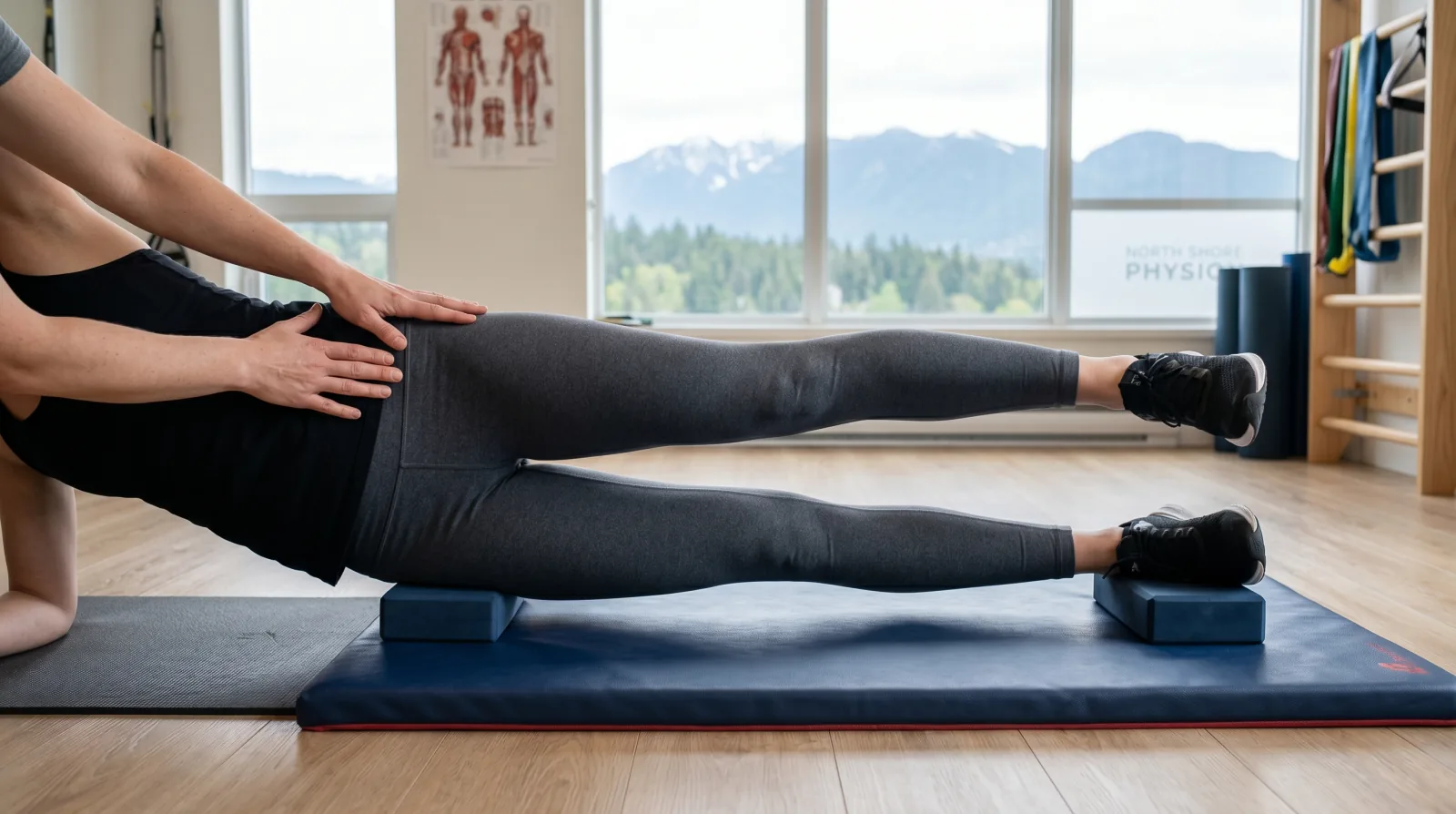
- The Extender: lying supine, the patient slowly straightens the knee at the hip-flexed position to load the hamstring at long length.
- The Diver: single-leg standing, hinging forward at the hip to a near-horizontal trunk position with the rear leg extended.
- The Glider: supine on a wheeled surface, sliding the heel away to load the hamstring at extended position.
The L-protocol group returned to sport faster (median 28 days vs 51 days) without an increase in reinjury rate. The mechanism is thought to be specific adaptation of the hamstring at the muscle lengths where injury actually occurs, which is the late swing phase of sprinting.
In our clinic, the L-protocol is the early-phase rehab pathway for most hamstring strains, with the Nordic program layered in once the patient tolerates eccentric loading.
How we sequence the rehab phases
A typical 6-to-10-week plan in our practice:
- Week 1 to 2, acute phase. Pain control, gentle activation, walking, range-of-motion within tolerance. The PEACE & LOVE framework describes the early-acute principles we use.
- Week 2 to 4, Askling L-protocol. Daily exercise prescription, progressive end-range loading, isometric and slow eccentric work.
- Week 4 to 6, Nordic program build. Adding eccentric Nordic curls to the L-protocol, progressing speed and volume in lower-limb running.
- Week 6 to 8, sport reintroduction. Sport-specific running mechanics, sprint progression, change-of-direction drills, controlled match-volume exposure.
- Week 8 to 10, return-to-play decision. Objective testing (isokinetic or handheld strength, sprint time symmetry, single-leg hop symmetry, full-intensity sport session tolerance) drives the return-to-play call.
The plan is patient-specific and tissue-specific. A grade-I mid-belly strain in a recreational midfielder progresses faster than a grade-II proximal strain in a competitive rugby winger.
The return-to-play criteria we use
The criteria-based return-to-sport post covers our general framework. For hamstrings specifically, the benchmarks before clearing for match play:
- Less than 10% side-to-side eccentric strength deficit on handheld dynamometry or isokinetic testing.
- Pain-free maximal sprinting at full distance.
- Single-leg hop symmetry within 90% of the uninvolved side.
- Completed full-intensity sport-specific training session within the last 5 to 7 days.
- No symptom flare in the 24 hours after that session.
A player who has been off for 6 weeks, feels fine, and has not yet sprinted at full intensity is not ready to play a match. The fail point in most reinjury cases is precisely this: the final intensity step is skipped.
In-season hamstring programming for North Shore amateur teams
The most effective recurrence-prevention measure is to integrate Nordic-style loading into the pre-season and in-season program before the first injury happens. A practical structure for a recreational soccer or rugby team:
- Pre-season (4 to 6 weeks before first match): 2 Nordic sessions per week alongside regular training.
- In-season: 1 Nordic session per week as part of the pre-training warm-up or post-training routine.
- Mid-season camp or break: re-build to 2 sessions per week for 2 weeks to refresh the eccentric capacity.
The cost is 10 to 15 minutes twice a week. The published benefit in soccer cohorts is a roughly 60% reduction in new strains. Few interventions in sports medicine carry that ratio.
What a hamstring strain visit looks like at Medstar
A 60-minute initial assessment with a sport physiotherapist covering:
- A grading of the strain (I, II, III) based on examination, with imaging considered only for proximal or atypical presentations.
- A phase-appropriate exercise prescription, typically the Askling L-protocol for early phase, progressing to Nordic loading.
- A running and sprinting reintroduction plan.
- A return-to-play discussion built on objective criteria rather than a calendar date.
- A maintenance program for after the all-clear, because dropping the eccentric work is the most common reinjury driver.
The strongest outcomes happen when the player commits to the eccentric loading both during rehab and after return to sport. The hamstring is one of the few tissues where prevention work and rehab work are nearly identical. The same Nordic curl that rebuilt the injured side keeps the contralateral side from being next.
This article is general education about hamstring strain rehabilitation. It is not personal medical advice. A regulated practitioner can confirm grade, screen for proximal involvement, and tailor the loading dose to your tissue, history, and sport.
Sources
- Petersen et al. Preventive effect of eccentric training on acute hamstring injuries in men's soccer, American Journal of Sports Medicine
- Askling et al. Acute hamstring injuries in Swedish elite sprinters and jumpers: a prospective randomised controlled clinical trial comparing two rehabilitation protocols, BJSM
- van Dyk et al. Including the Nordic hamstring exercise in injury prevention programmes halves the rate of hamstring injuries, BJSM
- Ekstrand et al. Injury incidence and injury patterns in professional football: the UEFA injury study, BJSM
- College of Physical Therapists of BC (CPTBC)
Common questions
Frequently asked questions.
How long does a hamstring strain take to heal?
Depends on grade and location. A grade I (mild fibre disruption) often clears in 2 to 3 weeks. A grade II (partial tear) often takes 4 to 8 weeks. Grade III (complete tear or proximal avulsion) can take 12 weeks or longer and may require surgical opinion. Proximal hamstring injuries (near the ischial tuberosity) take meaningfully longer than mid-belly injuries. Timeline is a guide. Return-to-play should be based on objective criteria rather than the calendar.
Why do hamstring strains keep coming back?+
Two main reasons. First, return-to-sport is often based on time off and pain ease, not on objective recovery of strength, sprint mechanics, and side-to-side symmetry, so the player returns while still functionally deficient. Second, the eccentric strength work that protects against recurrence often gets dropped after the all-clear. The reinjury rate in soccer is well documented. Players returning on time-based criteria reinjure at meaningfully higher rates than those returning on objective testing.
Are Nordic curls safe and worth the soreness?+
For most healthy athletes, yes, and the soreness is part of the protective effect. Initial doses produce significant delayed-onset muscle soreness (DOMS), which fades as the program progresses over 3 to 4 weeks. The Petersen trial used a dose of 2 to 3 sessions per week over 10 weeks; the protective benefit comes from the eccentric loading. The exercise is contraindicated only in acute strain phases. In healthy hamstrings it is safe to use as a recurrence-prevention tool.
Should I get an MRI before starting hamstring rehab?+
Usually no. Most hamstring strains can be graded clinically without imaging. MRI is useful when the clinical picture suggests a proximal avulsion (deep posterior thigh pain near the sitting bone, marked weakness, difficulty walking) or when the injury is failing to progress as expected after 3 to 4 weeks of well-applied rehab. Routine imaging at week 1 does not change the early rehab plan in the typical case.
When can I return to soccer or rugby after a hamstring strain?+
When you meet objective criteria, not when the calendar says so. The usual benchmarks: pain-free maximal sprinting, less than 10% strength deficit on isokinetic or handheld testing, full eccentric range without symptom reproduction, completed a full sport-specific training session at intensity, and no symptom flare in the 24 hours after. We use a [criteria-based return-to-sport framework](/journal/criteria-based-return-to-sport) rather than a fixed timeline.
What happens at a first physiotherapy visit for a hamstring strain?+
A physiotherapist takes a history of how the strain happened, then examines strength, range of motion, and tenderness to grade the injury (I, II, or III) and rule out a proximal avulsion. From there you get a phase-appropriate exercise plan, usually starting with the Askling L-protocol, and a rough sense of what the next few weeks of rehab will look like. Imaging is only ordered when the exam suggests it.
What is the difference between a hamstring strain and sciatica?+
A hamstring strain is muscle or tendon damage from a specific loading event, often sprinting, and hurts more with resisted knee bending or stretching the muscle. Sciatica is nerve irritation from the low back that can refer pain down the back of the thigh and calf, often with numbness or tingling that a muscle strain does not produce. A physiotherapist tests both patterns at assessment, since treating one as the other slows recovery.
Does ICBC or extended health cover hamstring strain physiotherapy?+
If the strain happened in a motor vehicle collision, ICBC's Enhanced Care coverage funds physiotherapy in the first weeks after a crash without needing a claim number. Sport and recreational hamstring strains are typically billed to extended health benefits, and most plans include physiotherapy up to an annual limit. Direct billing is available for both at our clinic, so check your specific plan for the details that apply to you.
Is stretching enough to prevent a hamstring strain?+
Static stretching eases muscle tightness but does little to protect the hamstring from a strain. The hamstring gets hurt most often during the late swing phase of sprinting, when the muscle lengthens under load to slow the lower leg down. Building strength in that same lengthened position is what the Nordic hamstring program and the Askling L-protocol are designed to do. A rehab plan built around stretching alone skips the strength work that lowers the chance of a repeat strain.
Share this post
Copies a ready-to-publish LinkedIn post to your clipboard and opens the LinkedIn share dialog. Paste the text into the composer and publish.

Written by
Amir Ahmadi, PhDDr. Amir Ahmadi is a Registered Physiotherapist, Certified IMS Therapist and former Associate Professor. 20+ years of clinical practice in North Vancouver.
This article is for general information only and does not constitute medical advice, diagnosis, or treatment. Individual presentations vary, and assessment findings and treatment plans differ from person to person. If you are experiencing severe symptoms, neurological changes (numbness, weakness, bowel or bladder changes), or a significant trauma, contact your physician or emergency services. Care at Medstar Sport Physio & Health is provided by practitioners registered with their respective British Columbia regulatory colleges.
Filed under
- hamstring-strain
- soccer
- rugby
- nordic-curls
- north-vancouver