ACL Injury Prevention: What Warm-Up Programs Do and How to Use Them
Warm-up programs lowered ACL tear risk in a 2026 review of 18 studies. Here is what the programs contain, how often to do them, and who has the best evidence.
BY SANAZ DAVARIAN, PHD
A first ACL tear often happens during a jump landing or a quick, speed-related movement: a 2026 review of video of 1,333 ACL injuries (79.4% male athletes) found these activities most common. Neuromuscular warm-up programs train those movements before the season starts. Neuromuscular means the link between your nerves and your muscles, which decides how quickly and how well your muscles control your joints.
In a 2026 meta-analysis of 18 studies, athletes who used an ACL prevention warm-up had a 54% lower risk of ACL rupture than athletes who did not. Programs such as FIFA 11+ and PEP take 15 to 20 minutes and are done 2 to 3 times a week through the season. They lower the risk and do not remove it. A physiotherapist at Medstar Sport Physio in North Vancouver can check your landing and single-leg control.
Warm-up programs lower ACL risk and do not remove it
A 2026 meta-analysis in the American Journal of Sports Medicine pooled the results of 18 studies of ACL prevention programs. Nine were randomized trials and nine were cohort studies that followed athletes over time. The 25,166 athletes played handball, soccer, basketball or volleyball, more than 85% were female, and their mean age was 19.3 years. Athletes who used a program were less likely to tear an ACL, with a pooled risk ratio of 0.46 (95% confidence interval 0.36 to 0.57).
A risk ratio of 0.46 means the group with a program had 0.46 times the risk of the group without one, which is 54% lower. The range of 0.36 to 0.57 is the 95% confidence interval. It stays below 1.0, so the result points one way. Odds ratios and rate ratios below 1.0 are read the same way.
Other reviews agree. A 2018 meta-analysis of eight earlier meta-analyses reported that programs cut the risk of all ACL injuries in all athletes by 50% (odds ratio 0.5, range 0.41 to 0.59). A 2019 meta-analysis of 18 studies in young female athletes reported that the risk fell from 1 injury in 54 athletes to 1 in 111 (odds ratio 0.51).
In those studies, 1 athlete in 111 still tore an ACL after doing the program. Nine of the 18 studies in the 2026 review were cohort studies, where chance did not assign athletes to groups, so the groups may have differed in ways the studies could not measure.
FIFA 11+, PEP and similar programs share the same parts
Published programs differ in detail and share a design. The FIFA 11+ is a soccer warm-up that builds core and leg strength, balance, agility and jump technique. The Government of Canada describes the full set as a 20-minute warm-up done twice a week at the start of training. Before games, a shorter version with only the running exercises is used.
The PEP program (Prevent injury and Enhance Performance) comes from the Santa Monica Sports Medicine Research Foundation. It combines a warm-up jog, stretching, strengthening, jumping drills and sport-specific agility drills. An NHS hospital leaflet describes it as a 15 to 20 minute routine that needs no special equipment and replaces the usual warm-up.
Position statements describe what these programs have in common. The National Athletic Trainers' Association statement from 2018 recommends that a program give feedback on movement technique in at least 3 of 5 exercise types: strength, plyometrics (jumping drills), agility, balance and flexibility.
A 2015 meta-analysis of 14 trials in young females found fewer ACL injuries with programs built around strengthening (odds ratio 0.32), proximal control exercises that train the muscles above the knee (0.33), or several exercise types together (0.32).
How often and how long to do a program
The published programs agree on a pattern. A 2026 position statement from Exercise and Sport Science Australia says effective programs typically run 10 to 30 minutes, 2 to 3 times a week. The PEP guide asks for 3 times a week. The trials in the 2019 meta-analysis averaged 24.1 minutes a session and 2.51 sessions a week. The studies in the 2026 review each followed athletes for at least one season (mean 1.3 seasons), so the program is part of the season.
More sessions may add benefit, but the data do not settle it. A 2025 meta-analysis of soccer trials reported a 0.57 rate ratio for trials with fewer than 3 sessions a week and 0.43 for trials with 3 or more. The ranges overlap, so the data cannot show with certainty that 3 sessions beat 2.
The program replaces the usual warm-up, so it costs no extra time on the field. Early sessions take longer while athletes learn the exercises, as the PEP guide notes, so start slowly with correct movements. The PEP guide asks coaches to stress straight up-and-down jumps and soft landings.
Who benefits most, and where the evidence is weaker
Younger athletes show the larger effects. The 2019 meta-analysis reported an odds ratio of 0.38 in middle and high school athletes and 0.65 in college and professional athletes. The 2026 review reported a risk ratio of 0.35 under age 18 and 0.50 at 18 and older. Both ranges exclude 1.0, so each age group had a lower risk.
Sex differences are the clearest gap. The 2026 and 2019 reviews are mostly female athletes, and the 2018 meta-analysis found insufficient data to draw conclusions for male athletes. A trial in 61 analysed men's college soccer teams that used the FIFA 11+ recorded 3 ACL injuries in the intervention group and 16 in the control group, after 4 intervention teams dropped out. The 2025 soccer meta-analysis reported a 50% lower rate in male participants (range 0.29 to 0.88). These results suggest benefit from fewer trials and fewer injuries.
Sport and level of play add more uncertainty. The 2026 review gave separate results for soccer (risk ratio 0.30) and handball (0.66) and none for basketball or volleyball. A 2026 review of 89 studies found the highest ACL injury rates in female semiprofessional handball, female professional basketball and female professional alpine skiing, with large gaps in the data. The Australian position statement calls the evidence in males, elite athletes and several high-risk sports unclear. Our ski conditioning guide describes a single study of adolescent racers, so the soccer figures do not transfer to skiing directly.
Individual trials also vary. In the 2008 Norwegian trial of a warm-up program in 1,892 girls aged 13 to 17, the main result, all leg injuries, was not statistically significant (rate ratio 0.71, range 0.49 to 1.03), which means chance could explain it. In the 2012 Swedish trial, 7 of 2,479 players in the program group and 14 of 2,085 in the control group tore an ACL (rate ratio 0.36, range 0.15 to 0.85), yet the absolute difference in rate per 1,000 playing hours was not statistically significant, which the authors say may be owing to the small number of events. A 2024 network meta-analysis reported that its results changed for female players only, and its authors advise caution.
Doing the program well matters as much as choosing one
Athletes who complete more sessions seem to gain more. A 2012 meta-analysis of 6 studies found lower ACL injury rates in studies with high compliance (rate ratio 0.27). The range was wide (0.02 to 0.77), and the authors call it a potential dose-response link. In a Norwegian cohort, players with high compliance had a 35% lower risk of any injury than players with intermediate compliance. These findings are observational: players who do more sessions may differ in other ways, so they show an association only.
Coaches affect how often a team does the program. In the Canadian trial of 31 female youth teams, teams whose coaches attended a workshop completed 81.3% to 85.6% of the possible sessions. Teams given only a website completed 73.5%. The gap was not statistically significant after adjustment, and the authors still concluded that a pre-season workshop worked better for adherence. In the Norwegian cohort, teams whose coaches had used injury prevention training before had a 46% lower injury risk (odds ratio 0.54).
A 2025 International Olympic Committee consensus on injury prevention for female athletes, the FAIR recommendations, lists 56 recommendations, and 14 of them cover how to put prevention into practice.
How to start a program this season
Pick one published program and use it as written for the first month, in place of the usual warm-up. Our guide to pre-season conditioning covers the gradual build-up of training load.
Parents and coaches can check that the program includes strength, jumping, balance and agility work, that someone watches and corrects technique, and that the team does it at least twice a week. An athlete with a sore knee should skip the jumping drills until the knee is checked.
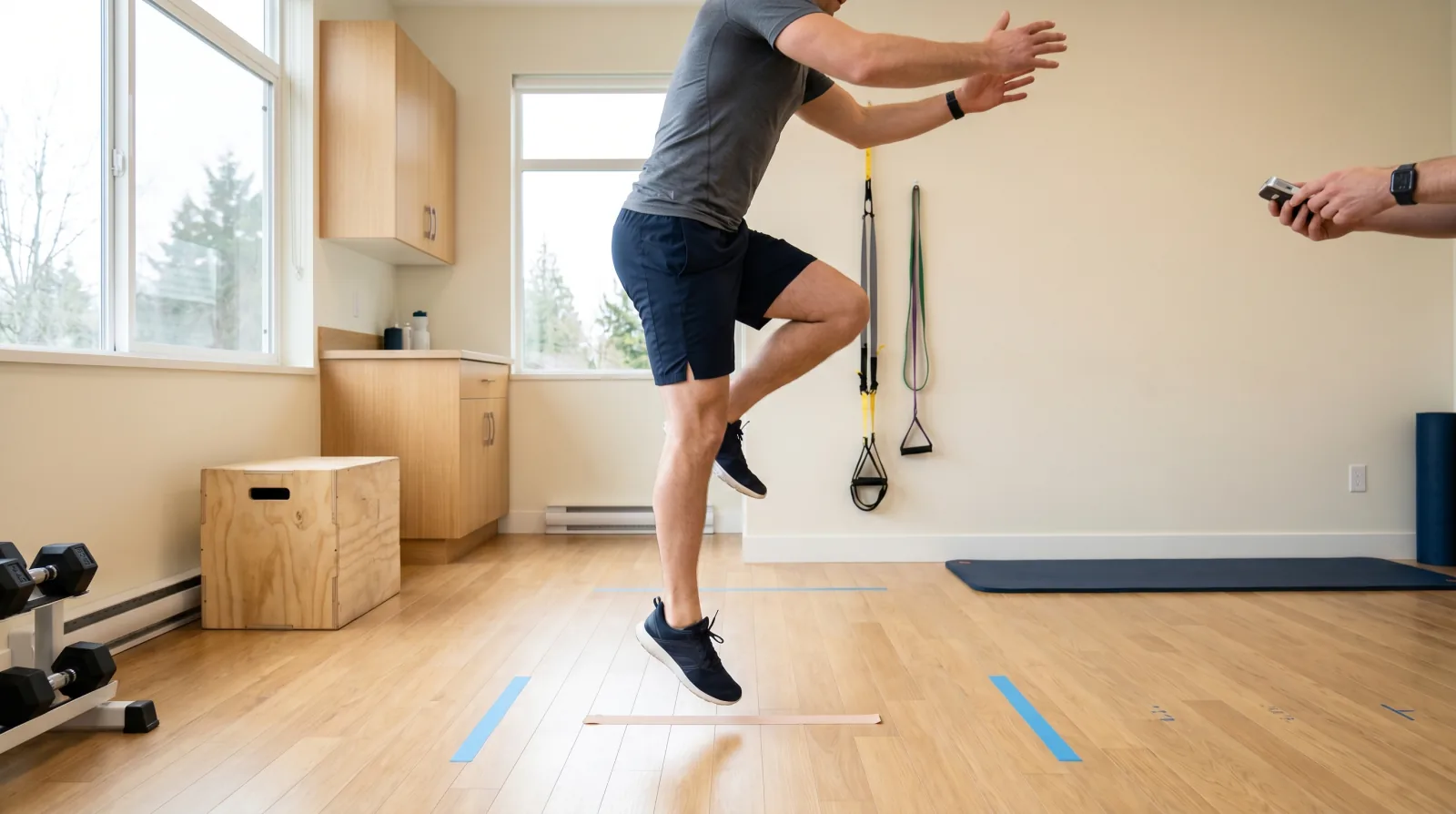
A physiotherapist can add an individual check. A single-leg squat, a drop landing and a balance test show how one athlete controls the knee, and the exercises can be adjusted for age, sport and past injury. Our youth athlete physiotherapy page describes assessment for younger players. After an ACL tear, our guide to physiotherapy after ACL reconstruction covers the rehab stage.
Warning signs after a knee injury need prompt assessment
HealthLinkBC says some ACL injuries happen anyway. It lists three signs of an ACL injury: a pop in the knee at the time of injury, swelling within the first few hours, and a knee that feels unstable, buckles or gives out. A knee that gives out collapses under your weight.
HealthLinkBC advises calling a doctor now for severe pain or severe swelling right after the injury, and the same day for a knee that swells within 2 hours or is unstable. Its knee injury page advises you to avoid putting weight on the knee until you get advice, and says to call 9-1-1 for a leg that turns cold or pale. A knee that is locked, so it will not straighten, also needs prompt assessment. Go to the Lions Gate Hospital emergency department or an urgent care clinic if the pain is severe, the knee looks deformed, or you cannot put any weight on the leg.
Our guide to MCL and ACL sprains in skiers explains how an MCL sprain differs from an ACL tear.
You do not need a referral to book physiotherapy in British Columbia. The clinic is at 1325 Marine Drive, North Vancouver, BC V7P 3E5. You can book at medstar.janeapp.com or call (604) 988-5411. Physiotherapists in BC are regulated by the College of Health and Care Professionals of BC, and you can check any name in its public registry.
This article is general information, not personal medical advice, and is not a substitute for assessment by a regulated practitioner. A regulated practitioner can confirm whether the patterns described apply to you.
Sources
- Watson SL, et al. A Systematic Review and Meta-analysis of Anterior Cruciate Ligament Injury Prevention Programs. Am J Sports Med, 2026
- Webster KE, Hewett TE. Meta-analysis of meta-analyses of anterior cruciate ligament injury reduction training programs. J Orthop Res, 2018
- Petushek EJ, et al. Evidence-Based Best-Practice Guidelines for Preventing Anterior Cruciate Ligament Injuries in Young Female Athletes. Am J Sports Med, 2019
- Sugimoto D, et al. Specific exercise effects of preventive neuromuscular training on ACL injury risk in young females. Br J Sports Med, 2015
- Su W, et al. Injury risk reduction programs including balance training reduce the incidence of ACL injuries in soccer players. J Orthop Surg Res, 2025
- Sugimoto D, et al. Compliance with neuromuscular training and ACL injury risk reduction in female athletes. J Athl Train, 2012
- Soligard T, et al. Compliance with a comprehensive warm-up programme to prevent injuries in youth football. Br J Sports Med, 2010
- Steffen K, et al. Implementation strategies of the FIFA 11+ in Canadian female youth football. Br J Sports Med, 2013
- Soligard T, et al. Comprehensive warm-up programme to prevent injuries in young female footballers. BMJ, 2008
- Waldén M, et al. Prevention of acute knee injuries in adolescent female football players. BMJ, 2012
- Silvers-Granelli HJ, et al. Does the FIFA 11+ reduce the incidence of ACL injury in male soccer players? Clin Orthop Relat Res, 2017
- Magaña-Ramírez M, et al. Exercise programmes to mitigate ACL injury risk in football players: network meta-analysis. J Sci Med Sport, 2024
- Norman D, et al. ACL injury incidence across sex, sport, and competition level. J Athl Train, 2026
- D'Ambrosi R, et al. Mechanisms of ACL injury across sports: a systematic review and meta-analysis of video-based studies. Knee Surg Sports Traumatol Arthrosc, 2026
- Padua DA, et al. National Athletic Trainers' Association position statement: prevention of ACL injury. J Athl Train, 2018
- Collings TJ, et al. Exercise and Sport Science Australia position statement on reducing ACL injury risk. Sports Med, 2026
- Crossley KM, et al. FAIR practical recommendations: IOC consensus meeting, 2025. Br J Sports Med, 2025
- Government of Canada: FIFA 11+ movement preparation, 2015
- Santa Monica Sports Medicine Research Foundation: The PEP Program (hosted by UC Davis Health)
- Royal United Hospitals Bath NHS Foundation Trust: ACL injury prevention programme leaflet
- HealthLinkBC: Anterior Cruciate Ligament (ACL) Injuries
- HealthLinkBC: Knee Problems and Injuries
- College of Health and Care Professionals of BC: public registry
Common questions
Frequently asked questions.
Do ACL injury prevention warm-ups work?
In a 2026 meta-analysis of 18 studies, athletes who used an ACL prevention program had a pooled risk ratio of 0.46 for ACL rupture. That is a 54% lower risk than athletes who did not use one. Programs lower the risk and do not remove it, and some ACL tears happen even when an athlete does everything correctly.
What is the FIFA 11+ program?+
FIFA 11+ is a warm-up for soccer that builds core and leg strength, balance, agility and jump technique. The Government of Canada describes the full set as a 20-minute warm-up, done twice a week at the start of training. Before games, a shorter version with only the running exercises is used. It was designed for soccer, and athletes in other sports use similar programs.
What is the PEP program?+
PEP stands for Prevent injury and Enhance Performance. The Santa Monica Sports Medicine Research Foundation published it as a warm-up with stretching, strengthening, jumping and sport-specific agility drills. It takes 15 to 20 minutes and replaces the usual warm-up. The foundation's guide recommends doing it 3 times a week, and an NHS hospital leaflet says 2 to 3 times a week.
How often should my team do an ACL prevention program?+
Most published programs ask for 2 to 3 sessions a week, each lasting 10 to 30 minutes, during the playing season. A 2026 position statement from Exercise and Sport Science Australia gives that range. A 2019 meta-analysis found the trials averaged 2.51 sessions a week of 24.1 minutes.
Do ACL prevention programs work for boys and men?+
The evidence is thinner. A 2018 meta-analysis of earlier reviews found too little data to draw conclusions for male athletes. A 2025 meta-analysis of soccer trials that included balance training reported a 50% lower ACL injury rate in male participants (rate ratio 0.50, 95% confidence interval 0.29 to 0.88). Male athletes can use the same programs, but the research is smaller.
Do these programs work in basketball and volleyball?+
The 2026 meta-analysis included athletes in handball, soccer, basketball and volleyball, but its abstract reports separate results only for soccer and handball. A 1999 study of high school soccer, volleyball and basketball players found that untrained female athletes had a 3.6 times higher rate of serious knee injury than trained female athletes, though it was not a randomized trial. Basketball and volleyball have less sport-specific evidence.
Can a coach lead the program or do we need a physiotherapist?+
A coach can lead it after proper instruction. A trial in Canadian female youth soccer teams found that coaches who attended a pre-season workshop led the FIFA 11+ with an adherence of 81.3% to 85.6% of sessions, with or without a physiotherapist on the field. Teams given only a website reached 73.5%. A physiotherapist can still check your technique.
Does a prevention program help with skiing?+
Less is known for skiing. Our ski conditioning guide describes one study of adolescent competitive alpine skiers, so the soccer and handball figures do not transfer to skiing directly. Skiers can still build single-leg strength, balance and landing control before the season, and a physiotherapist can match the exercises to your sport and your knee history.
What are the warning signs of an ACL tear?+
HealthLinkBC lists a pop in the knee at the time of injury, swelling within the first few hours, and a knee that feels unstable or gives way. Severe pain or severe swelling right after the injury needs a doctor now. A knee that is unstable or swells within 2 hours needs a doctor the same day. Avoid putting weight on the knee until you get advice.
Do I need a referral to see a physiotherapist about my knee?+
No. In British Columbia you can book physiotherapy without a referral. At Medstar Sport Physio, 1325 Marine Drive in North Vancouver, you can book online at medstar.janeapp.com or call (604) 988-5411. Some extended health plans ask for a referral before they reimburse you, so read your policy. A knee that locked, buckled with rapid swelling, or cannot bear weight needs a doctor first.

Written by
Sanaz Davarian, PhDDr. Sanaz Davarian is a Registered Physiotherapist with a PhD and 20+ years of experience. Certified IMS Therapist, former Assistant Professor of Physiotherapy. North Vancouver.
This article is for general information only and does not constitute medical advice, diagnosis, or treatment. Individual presentations vary, and assessment findings and treatment plans differ from person to person. If you are experiencing severe symptoms, neurological changes (numbness, weakness, bowel or bladder changes), or a significant trauma, contact your physician or emergency services. Care at Medstar Sport Physio & Health is provided by practitioners registered with their respective British Columbia regulatory colleges.
Filed under
- acl
- injury-prevention
- warm-up
- fifa-11-plus
- youth-athletes
- soccer
- basketball
- volleyball
- north-vancouver