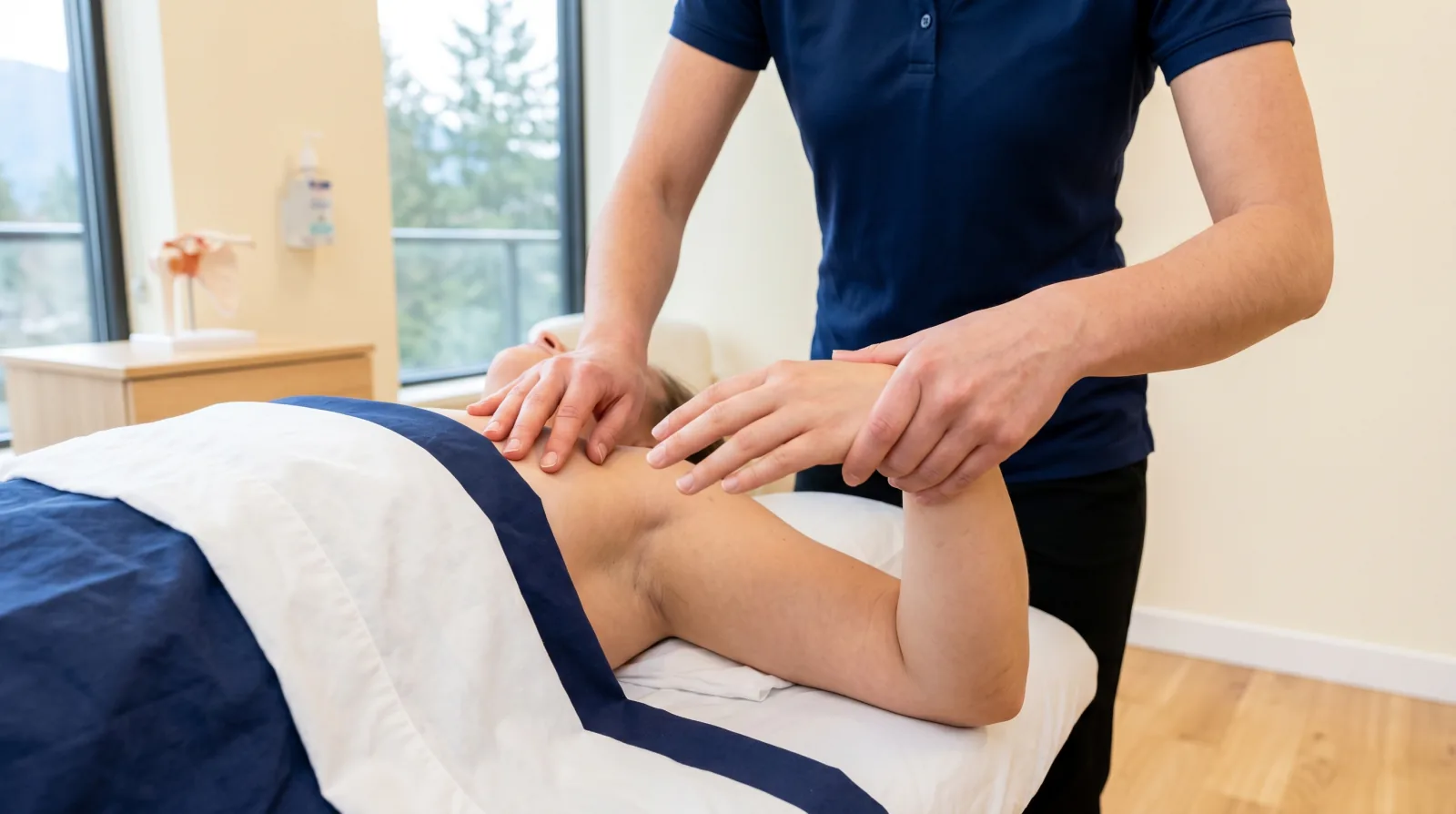

What Hands-On Treatment Actually Does: An Honest Look at Manual Therapy
Hands-on treatment often feels like something was put back in place. A 2025 review of 62 reviews suggests the real effect happens in the nervous system instead.
BY MEDSTAR SPORT PHYSIO TEAM
Hands-on treatment often ends with a sense that something was moved, freed, or put back where it belongs. A 2025 review of the research suggests the useful part of that session is happening somewhere else.
At Medstar Sport Physio in North Vancouver, manual therapy is used as one part of a plan that is built around exercise. A 2025 living review in PLOS ONE pooled 62 reviews of how manual therapy works and graded the evidence by category. Neurovascular, neurological, and neurotransmitter or neuropeptide changes were graded moderate quality. Neuroimmune, neuromuscular, and neuroendocrine changes were graded low. Biomechanical changes, meaning ideas such as realignment or lasting tissue lengthening, were graded critically low. The authors state directly that the clinical value of these mechanistic responses has not been well established. Hands-on treatment can still reduce pain and make movement easier in the short term, and the honest description of why sits in the nervous system rather than in the joint being repositioned.
Here is what the 2025 review found, what it means for the explanation you get in a treatment room, and how hands-on work still earns a place in a plan.
What the 2025 living review actually did
The paper is The mechanisms of manual therapy: A living review of systematic, narrative, and scoping reviews, published in PLOS ONE in 2025 by Keter and colleagues. A living review is one designed to be updated as new evidence appears, rather than published once and left alone.
The authors included 62 reviews in total: 35 systematic reviews, 24 narrative reviews, and 4 scoping reviews. Each was assessed with AMSTAR-2, a standard tool used to judge how well a review was conducted. That grading step matters. It separates findings that come from careful, well-run reviews from findings that come from looser summaries.
The result was a map of proposed mechanisms with a quality grade attached to each one. That is more useful than a list of claims, because it lets a clinician say which explanations are on firmer ground.
The grading, category by category
Three categories were graded moderate quality. Neurovascular changes cover blood flow and related circulatory responses. Neurological changes cover the activity of the nervous system itself. Neurotransmitter and neuropeptide changes cover chemical messengers, including the endorphin findings described below.
Three categories were graded low quality: neuroimmune changes, neuromuscular changes, and neuroendocrine changes.
One category was graded critically low: biomechanical changes.
Moderate is the highest grade any category reached. No mechanism in this field is settled. What the grading does show is a clear ranking, and the popular explanation sits at the bottom of it.
The claim that does not hold up well
The idea that hands-on treatment realigns a joint, corrects a position, or permanently lengthens tissue is the explanation most people have heard. It is intuitive, it matches how the treatment feels, and it makes a satisfying story.
The evidence supporting biomechanical change was graded critically low quality in this review. That grade tells you the underlying reviews had serious methodological problems, so the claim cannot be leaned on.
The nervous system explanation carries better support. A mechanical force applied to the body starts a chain of responses in the peripheral and central nervous system, and those responses appear to drive the clinical effects. This model was set out by Bialosky and colleagues in their 2009 comprehensive model of manual therapy mechanisms, and the 2025 review sits within that same framework.
Both statements can be true at once. The technique involves a real mechanical force applied by a real pair of hands. What follows that force is a nervous system response rather than a structural repositioning.
What the nervous system findings look like
Several specific findings appear repeatedly across the included reviews.
Increased local pressure pain thresholds were reported in 12 reviews. Pressure pain threshold is measured by pressing on an area with a controlled force and recording the point at which it starts to hurt. A higher threshold after treatment means the area has become less sensitive to pressure.
Sympathoexcitation was found across 12 reviews. This refers to a short-term increase in activity of the sympathetic nervous system, the part that handles arousal and readiness. Interestingly, skin temperature showed no change in 14 reviews, so the response is not a simple warming effect.
Beta-endorphin, one of the body's own pain-modulating chemicals, increased after manual therapy compared with a control condition. Results were less consistent when treatment was compared with a sham. That difference is informative. It suggests part of the response comes from touch, expectation, and the treatment situation rather than from the specific technique.
The review describes mechanisms operating at three levels: peripheral, segmental spinal, and supraspinal. In plain terms, effects appear in the local tissue, in the spinal cord segment serving that area, and in the brain.
The caution the authors themselves put in writing
Two lines from the paper deserve to be quoted directly, because they are unusually plain for an academic publication.
The first: "The clinical value of these mechanistic responses has not been well established."
The second: "care must be taken in assuming translation to clinical relevance."
Read together, they say that measuring a change in a laboratory does not prove the change is why a patient feels better. A pressure pain threshold can rise on a testing device while the person's day-to-day function stays the same. The mechanism research and the outcome research are separate bodies of work, and the bridge between them is still under construction.
The review also notes that responses are influenced by many intrinsic and extrinsic factors, with variability between individuals. Two people receiving identical treatment can respond differently, and that is an expected feature of the picture rather than a fault in the technique.
Where this leaves hands-on treatment in a real plan
Manual therapy remains a reasonable part of physiotherapy care when it is used honestly and alongside active work.
Short-term reductions in pain and sensitivity can make it easier to start exercising, and exercise is where the durable change comes from. A shoulder that hurts less for the next hour is a shoulder that can complete a loading session it would otherwise have skipped. That is a legitimate reason to use a technique, and it is a reason you can state out loud.
The place to be careful is dependence. If hands-on treatment is the entire plan, week after week, with no progression in what you can load or tolerate, the plan needs revisiting. Choosing between different types of hands-on care is a related question, and our comparisons of physiotherapy and chiropractic care, physiotherapy and registered massage therapy, and physiotherapy and manual osteopathy in BC walk through how the professions differ in scope and training.
For persistent pain in particular, the framing of the whole plan matters more than any single technique. Our article on graded exposure for persistent pain covers that approach in detail.
When to get it looked at
Hands-on treatment is appropriate for many common musculoskeletal problems, and an assessment should come before any technique is chosen.
Some situations call for a physician rather than a physiotherapy booking. Sudden severe pain after a significant injury, new weakness in a limb, numbness in the saddle area, loss of bladder or bowel control, unexplained weight loss with new back pain, fever with spinal pain, or pain that is unrelenting at night all need medical assessment first. For anything sudden and severe, Lions Gate Hospital emergency is the right destination.
If you have been receiving hands-on treatment for a while without a clear plan for progressing your loading, an assessment can reset the direction. You can see what we treat or reach the clinic here.
This article is general information, not personal medical advice. A regulated practitioner can confirm whether the patterns described apply to you.
Sources
- The mechanisms of manual therapy: A living review of systematic, narrative, and scoping reviews (PLOS ONE, 2025)
- The mechanisms of manual therapy in the treatment of musculoskeletal pain: a comprehensive model (Manual Therapy, 2009)
- College of Health and Care Professionals of BC public registry
Common questions
Frequently asked questions.
Does manual therapy put joints back in place?
The evidence for biomechanical changes such as realignment or lasting tissue lengthening was graded critically low quality in a 2025 living review of 62 reviews. The better supported explanations are nervous system responses that happen after the hands-on force is applied. Treatment can still reduce pain and improve movement, and the reason for that effect is where the science has shifted.
What is the strongest evidence for how manual therapy works?+
The 2025 living review by Keter and colleagues graded three categories as moderate quality using AMSTAR-2, a standard tool for judging review quality. Those were neurovascular changes, neurological changes, and neurotransmitter or neuropeptide changes. Neuroimmune, neuromuscular, and neuroendocrine categories were graded low, and biomechanical changes were graded critically low. Moderate is the highest grade any category reached, so no mechanism has been proven beyond doubt.
Does manual therapy reduce pain sensitivity?+
Increased local pressure pain thresholds after treatment were reported in 12 of the reviews included in the 2025 living review. A higher pressure pain threshold means more pressure is needed before an area feels painful. This is one of the more consistent findings in the literature, though the authors caution that a measurable change in the clinic does not automatically mean a better outcome for the patient.
Does the effect come from endorphins?+
Partly, based on current evidence. The 2025 living review reports that beta-endorphin increased after manual therapy compared with a control condition, and that results were less consistent when compared with a sham treatment. That pattern suggests the response is real but not fully explained by the hands-on technique alone. Expectation, context, and touch itself all appear to contribute.
Is manual therapy enough on its own?+
General practice is to use it alongside exercise rather than by itself. The 2025 living review states that the clinical value of the mechanistic responses has not been well established, so hands-on work is best treated as one part of a plan. Exercise carries the loading progression that builds tissue capacity over time, and manual therapy can make that work more comfortable to start.
Why do results vary so much between people?+
The 2025 living review describes responses that are influenced by many intrinsic and extrinsic factors, with variability between individuals. Intrinsic factors include the state of a person's nervous system and their previous experiences. Extrinsic factors include the setting and the interaction with the clinician. Two people can receive the same technique and report different results, and that is expected rather than a sign of failure.
Should I be worried that the evidence is uncertain?+
Uncertainty about mechanism is normal in medicine and is separate from whether a treatment helps. The 2025 living review examined how manual therapy produces its effects, not whether people improve. What the findings change is the explanation a clinician should give you. A practitioner who says the technique adjusted your alignment is going beyond what the current evidence supports.
What should my physiotherapist tell me about hands-on treatment?+
A reasonable explanation covers what the technique is meant to do in the short term, how it fits with your exercise program, and how you will both judge whether it is working. Honest language about uncertainty is a marker of good practice. If hands-on treatment is the only thing on offer visit after visit, ask what the plan is for building strength and capacity.
Share this post
Copies a ready-to-publish LinkedIn post to your clipboard and opens the LinkedIn share dialog. Paste the text into the composer and publish.
Written by
Medstar Sport Physio Team
Registered clinician at Medstar Sport Physio & Health, North Vancouver.
This article is for general information only and does not constitute medical advice, diagnosis, or treatment. Individual presentations vary, and assessment findings and treatment plans differ from person to person. If you are experiencing severe symptoms, neurological changes (numbness, weakness, bowel or bladder changes), or a significant trauma, contact your physician or emergency services. Care at Medstar Sport Physio & Health is provided by practitioners registered with their respective British Columbia regulatory colleges.
Filed under
- manual-therapy
- hands-on-treatment
- evidence-based-practice
- pain-science
- north-vancouver