Physiotherapy vs. RMT: Which One Is Right for Your Injury?
Both are regulated in BC. The difference is in scope, not quality — and knowing which to book first can save you a month of the wrong treatment.
BY AMIR AHMADI, PHD
Quick answer. Physiotherapy and registered massage therapy (RMT) are separate regulated professions in British Columbia. A physiotherapist assesses, diagnoses, and builds a rehabilitation program — movement analysis, load progression, and clinical reasoning are the core tools. An RMT works within soft-tissue assessment and treatment, using manual techniques to address muscle tension, circulation, and range of motion. For most sport and orthopaedic injuries, physiotherapy is the first call. RMT works best as a complement to that plan, or as a standalone choice for soft-tissue overload that does not involve structural injury.
Physiotherapy and registered massage therapy (RMT) are both regulated professions in BC, but they have different scopes. A physiotherapist assesses and diagnoses, builds a rehabilitation program, and progresses loading over time. An RMT works within soft-tissue assessment and treatment, addressing muscle tension, circulation, and range of motion. For most sport or structural injuries, physiotherapy is the better first step, because a diagnosis needs to come before treatment. RMT often works well alongside a physiotherapy plan, especially when soft-tissue tension is limiting progress. At Medstar Sport Physio in North Vancouver, many patients run both concurrently. Which one fits your situation depends on whether the goal is structural rehabilitation or soft-tissue relief, and whether a diagnosis is already in place.
How each profession is regulated in BC
Registered massage therapists in BC are regulated by the College of Complementary Health Professionals of BC (CCHPBC), which also oversees chiropractors, naturopathic physicians, and traditional Chinese medicine practitioners. Entry to practice requires completion of a two-year massage therapy program at an institution recognised by the college, covering anatomy, physiology, pathology, kinesiology, manual skills, orthopaedics, and clinical training. RMTs practise under the Health Professions and Occupations Act (HPOA), which replaced the former Health Professions Act on April 1, 2026.
Physiotherapists are regulated by the College of Physical Therapists of BC (CPTBC), which requires a Master of Physical Therapy degree from an accredited program plus the national Canadian Physiotherapy Examination. Both professions are primary-contact providers — neither requires a physician referral to book. Both are eligible for direct billing with most extended health insurers.
| Dimension | Physiotherapy | Registered Massage Therapy (RMT) |
|---|---|---|
| Regulatory college (BC) | CPTBC | CCHPBC |
| Entry-level credential | Master of Physical Therapy | 2-year diploma program |
| Scope | Assessment, diagnosis, rehab programming | Soft-tissue assessment and treatment |
| ICBC pre-approval | Yes | Yes (specific session structure applies) |
| WorkSafeBC billing | Yes | Yes |
| Direct billing | Yes | Yes |
What a physiotherapist does at an initial assessment
At Medstar, the physiotherapy initial assessment is the clinical starting point for most injury presentations. The physiotherapist takes a full history — mechanism of injury, symptom behaviour, aggravating and easing factors, baseline activity level — then moves through a physical assessment covering range of motion, strength, neurological screening where indicated, and movement quality. The goal is to identify the tissue or pattern driving symptoms and determine what load it can currently tolerate.
From that assessment, the physiotherapist builds a rehabilitation plan. That plan will include what treatment happens in the clinic (joint mobilization, manual therapy, intramuscular stimulation (IMS) / dry needling where indicated, or a passive modality like high-power laser) and what the patient does between visits (a structured loading program). The active component is what distinguishes physiotherapy from passive-only treatment — the aim is to build capacity so the problem does not return after discharge.
What an RMT does in a session
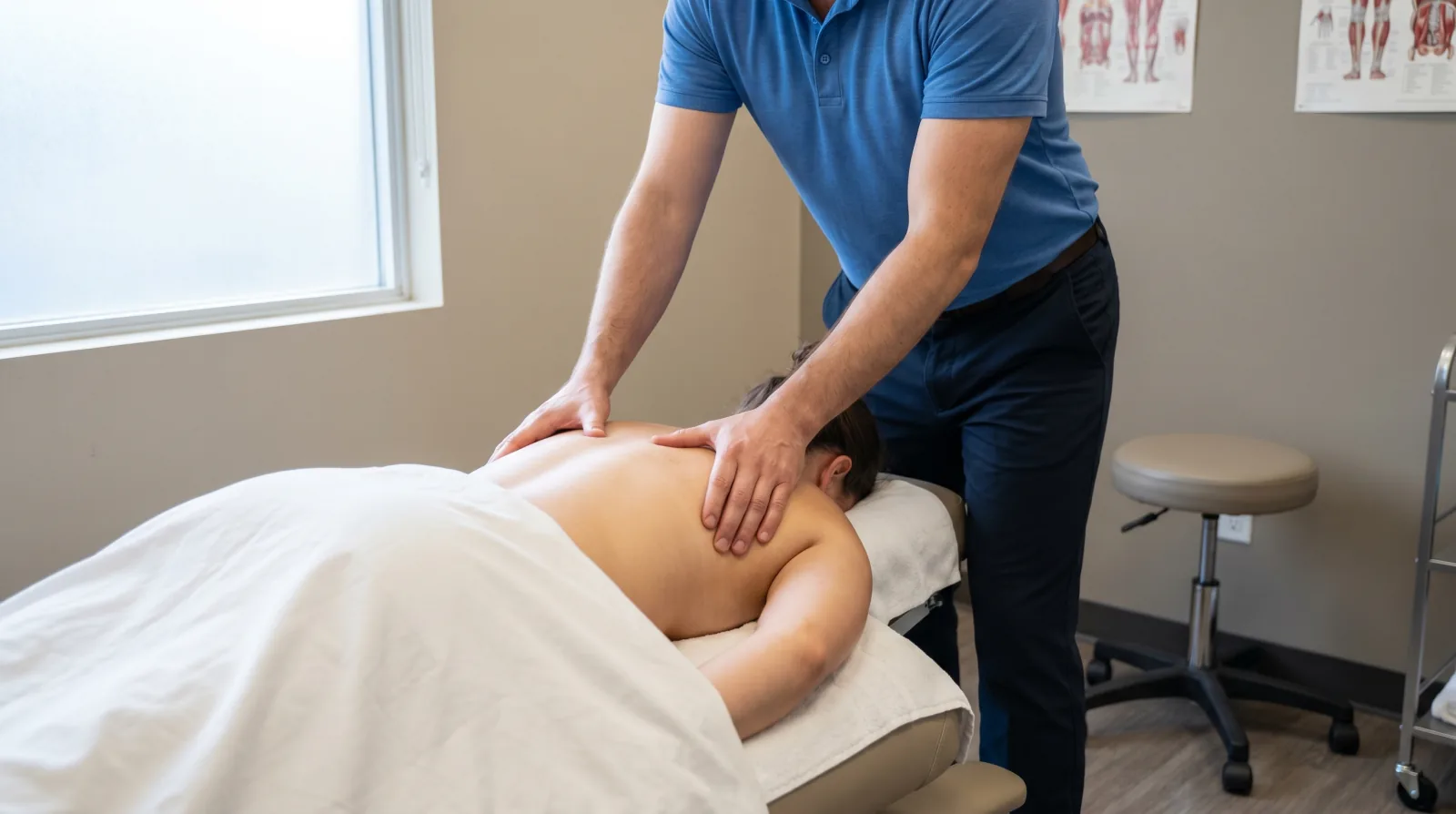
An RMT session begins with a soft-tissue assessment: posture, palpation, and movement screening relevant to the presenting area. The treatment is primarily hands-on: Swedish and deep-tissue techniques, trigger-point therapy, myofascial release, and passive joint range-of-motion work within the RMT's scope. Per CCHPBC's scope standards, RMTs assess and treat the muscular, nervous, and circulatory systems to improve health. Prescribing exercise, diagnosing structural injury, or ordering imaging fall outside RMT scope.
The session is treatment-focused, not relaxation programming — though many patients feel calmer leaving than arriving. An RMT working with an injured patient is assessing tissue quality, identifying areas of restricted motion or elevated tension, and applying manual techniques to address those findings. It is a clinical service.
Where the scopes differ most clearly
The distinction that matters for injury decisions:
The first distinction: assessment and diagnosis. A physiotherapist can assess and diagnose. An RMT cannot provide a clinical diagnosis of a structural injury. If you sprained your ankle badly and need to know whether there is a ligament rupture versus a grade I sprain, that clinical determination belongs with physiotherapy (or a physician). If you know what the injury is and you want manual work to support soft-tissue healing alongside a physiotherapy program, an RMT is the right call.
The second: one profession builds a rehabilitation program, and the other works session-by-session. A physiotherapist sets a loading plan, tracks progression, and adjusts based on how the tissue responds. RMT treatment addresses what is in front of the practitioner that day. That does not make one better than the other — it reflects different roles. For a North Shore trail runner who needs staged return-to-running programming after a hamstring strain, physiotherapy holds the rehabilitation plan and the loading decisions. RMT supports that plan by managing muscle tension and range of motion between physiotherapy visits.
When physiotherapy is the right first booking
Start with physiotherapy when the injury involves a structural question. You rolled your ankle badly, took a blow to the shoulder, or have back pain that started after a fall. A physiotherapist screens for red flags, identifies the tissue, and determines the rehabilitation path. RMT cannot do that clinical triage.
Post-surgical recovery is physiotherapy territory. Surgeons issue physiotherapy referrals for a reason: the progressive exercise protocols and load-sequencing decisions require physiotherapy scope.
Return-to-sport with a specific goal belongs in physiotherapy too. Whether the target is a hockey tryout, a trail race, or a climbing grade, the progressive load planning and return-to-play criteria live with the physiotherapist.
Neurological symptoms change the call entirely. Numbness, tingling, weakness, or bowel and bladder changes alongside musculoskeletal pain are physiotherapy screening territory. That is not RMT scope, and a delayed assessment is a clinical risk.
ICBC and WorkSafeBC claims favour physiotherapy as the first booking. Both professions are covered, but for an acute motor vehicle accident injury, physiotherapy assessment establishes the clinical baseline that supports the claim.
When RMT is the right standalone choice
Muscle tension without structural injury is the clearest case. A neck and shoulder presentation driven by desk posture and accumulated stress, with no neurological symptoms and no acute mechanism — that is RMT territory. No physiotherapy triage is needed; the soft-tissue work is the treatment.
Ongoing maintenance between physiotherapy discharges is another good fit. Many patients find that regular RMT between injury flares keeps tissue quality where it needs to be for their activity load. We see this a lot with North Shore trail runners and hockey players who are discharged from physiotherapy but want to stay ahead of their next presentation.
Post-exercise recovery is a performance use case, not an injury use case. Endurance athletes, climbers, and hockey players using RMT for load management between training blocks are not injured — they are maintaining. RMT handles that well.
A known, documented soft-tissue pattern rounds out the list. A patient who has managed a recurring presentation with RMT for years and knows the approach works does not need to re-enter via physiotherapy each time.
How they work together at Medstar
At Medstar Sport Physio & Health, physiotherapy and registered massage therapy run as complementary services. For acute injuries, the physiotherapist sets the diagnosis and rehabilitation plan. The RMT can run concurrently, handling soft-tissue work that supports healing while the physiotherapist manages load progression. In the later stages of rehab — when the injury is stable and the focus shifts to performance and tissue quality — RMT often becomes the primary ongoing service.
For ICBC claims, this coordination matters practically. ICBC pre-approves both physiotherapy and RMT sessions within defined windows after an accident. Per ICBC's current treatment guidelines, the pre-approved structure for each profession differs — verify current session counts at ICBC directly rather than assuming a fixed number from any clinic's marketing material.
Quick decision guide: which to book first
| Your situation | Start with | Why |
|---|---|---|
| Acute injury with a clear mechanism (fall, collision, sprain) | Physiotherapy | Needs clinical assessment and diagnosis before treatment begins |
| Neurological symptoms (numbness, tingling, weakness) | Physiotherapy | Requires screening that falls outside RMT scope |
| Post-surgical recovery | Physiotherapy | Staged protocols and load decisions require physiotherapy scope |
| ICBC or WorkSafeBC claim | Physiotherapy | Establishes the clinical baseline the claim depends on |
| Return to sport with a specific goal | Physiotherapy | Progressive load programming and return-to-play criteria |
| Muscle tension, desk posture, no acute mechanism | RMT | Soft-tissue work is the treatment; no triage needed |
| Maintenance between physiotherapy discharges | RMT | Tissue quality management for active patients |
| Post-exercise recovery for training load | RMT | Performance use case, not an injury presentation |
| Known recurring soft-tissue pattern, well-managed | RMT | No need to re-enter via physiotherapy assessment |
| Complex presentation with both structural and soft-tissue components | Both concurrently | Physiotherapy sets the plan; RMT supports tissue recovery |
The insurance question
Most Canadian extended health plans list physiotherapy and registered massage therapy as separate benefit categories with separate annual limits. If your plan has a $500 physiotherapy limit and a $500 RMT limit, using RMT sessions does not draw down your physiotherapy coverage. That separation is worth knowing before you start treatment — some patients avoid booking the second profession because they assume it comes out of the same pot.
Direct billing at Medstar covers most major insurers for both services. If you are unsure which benefit applies to a specific treatment, the administrative team can confirm before the appointment. Billing surprises at checkout are avoidable.
Frequently asked questions
Should I book physio or RMT first after a sport injury?
For an acute sport injury — something that happened with a clear mechanism — book physiotherapy first. The physiotherapist will assess, identify the tissue, and determine the rehab plan. RMT can run alongside that plan once the clinical picture is clear.
Can an RMT diagnose my injury?
No. Per CCHPBC's scope standards for registered massage therapists, clinical diagnosis of structural injury falls outside RMT scope. An RMT can assess and treat soft tissue and identify areas of tension, restriction, or dysfunction — but confirming whether you have a partial ligament tear, a rotator cuff injury, or a stress fracture requires physiotherapy or physician assessment.
Is RMT covered by ICBC?
Yes. ICBC pre-approves RMT sessions after a motor vehicle accident. The specific pre-approved session structure and billing process are set by ICBC and subject to change. Verify current rules at icbc.com before assuming a specific visit count.
Can I book both in the same week?
Yes, and many patients do. There is no clinical conflict with concurrent physiotherapy and RMT. Bring both providers up to date so treatments are coordinated rather than working at cross purposes.
Does RMT hurt more than physiotherapy?
Both modalities span a range of pressure and intensity. Some physiotherapy techniques — IMS, joint mobilization, aggressive soft-tissue work — can be more intense than a relaxation-focused RMT session. The reverse is also true. Pressure level and technique are something you communicate with your provider directly.
This article is general information, not personal medical advice. A regulated practitioner can determine which profession and treatment approach fits your specific presentation.
Sources
- College of Physical Therapists of BC (CPTBC): public registry and standards
- College of Complementary Health Professionals of BC (CCHPBC): registered massage therapists
- CCHPBC: scope of practice standard for registered massage therapists (January 2024)
- BC Government: Health Professions and Occupations Act (HPOA)
- ICBC: treatment benefits
- WorkSafeBC: health care provider information
- RMTBC: become a registered massage therapist in BC
Share this post
Copies a ready-to-publish LinkedIn post to your clipboard and opens the LinkedIn share dialog. Paste the text into the composer and publish.

Written by
Amir Ahmadi, PhDDr. Amir Ahmadi — Registered Physiotherapist, Certified IMS Therapist and former Associate Professor. 20+ years of clinical practice in North Vancouver.
This article is for general information only and does not constitute medical advice, diagnosis, or treatment. Individual presentations vary — assessment findings and treatment plans differ from person to person. If you are experiencing severe symptoms, neurological changes (numbness, weakness, bowel or bladder changes), or a significant trauma, contact your physician or emergency services. Care at Medstar Sport Physio & Health is provided by practitioners registered with their respective British Columbia regulatory colleges.
Filed under
- physiotherapy
- rmt
- massage-therapy
- choosing-care
- north-vancouver
- injury-recovery
- icbc