
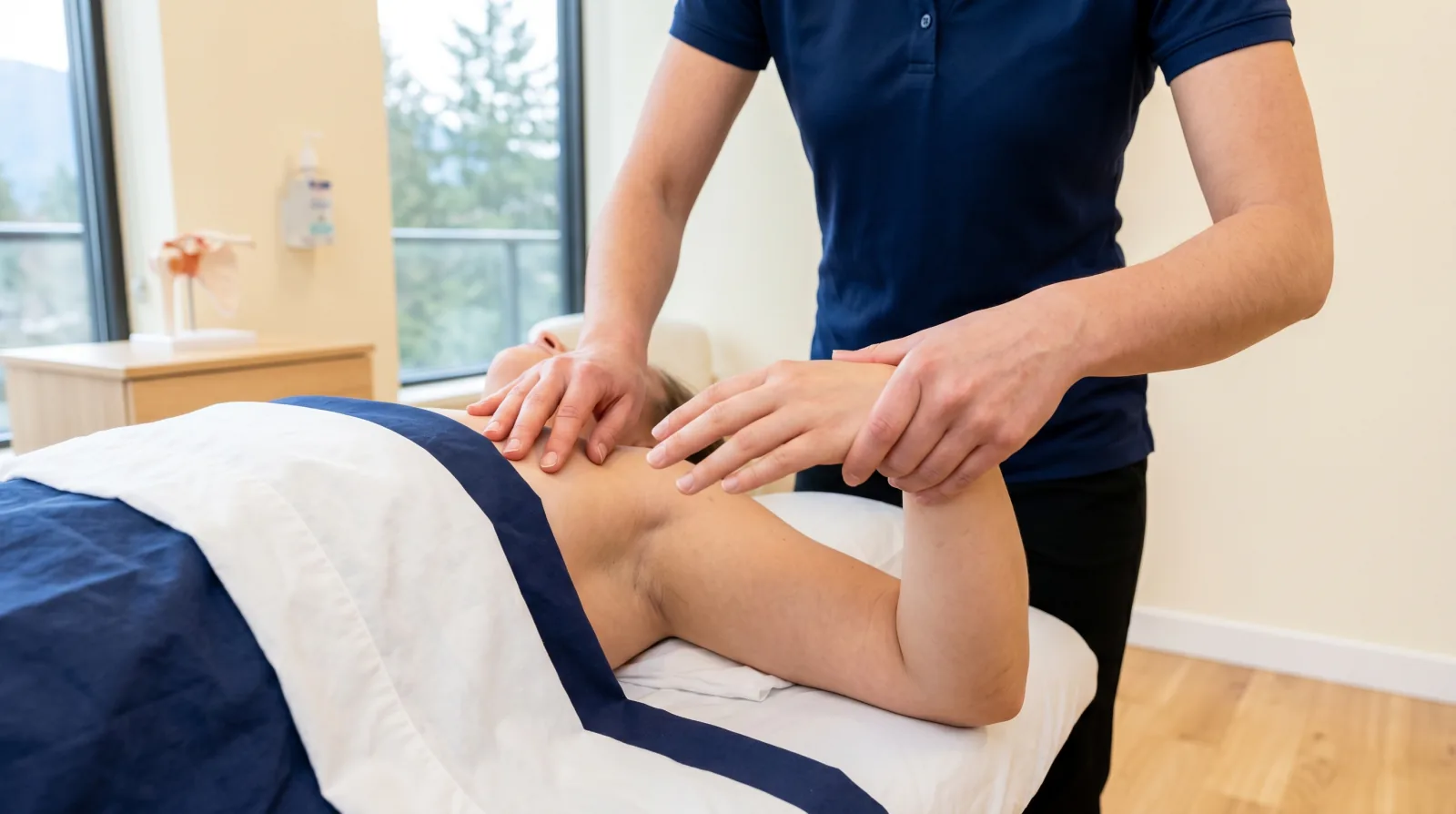
Frozen Shoulder Stages: Why the Right Treatment Changes Each Phase
Frozen shoulder is one of the few conditions where treating it aggressively early makes it worse. Knowing which phase you are in determines whether you should be stretching, moving, or waiting for irritability to settle.
BY SANAZ DAVARIAN, PHD
Frozen shoulder treatment must match the current phase. Aggressive movement in the painful freezing stage often makes things worse by prolonging inflammation, while gentle, pain-controlled movement helps settle it. The frozen stage, when stiffness becomes the main problem, is when manual therapy and progressive end-range work earn their place. The thawing stage focuses on graded loading to recover function. At Medstar Sport Physio in North Vancouver, every plan is matched to where the patient sits in this three-phase process, since using a thawing-phase approach on a freezing-phase shoulder can add months of unnecessary pain. How long each phase lasts varies, and the transition is identified by clinical signs rather than by how many weeks have passed.
If you have unexplained shoulder pain that is now starting to limit your ability to reach behind your back, fasten a seatbelt, or lift overhead, this article describes the framework we use to identify which phase you are in.
What frozen shoulder actually is
Adhesive capsulitis is a contracture of the glenohumeral joint capsule, the connective tissue envelope that surrounds the shoulder joint. The capsule becomes inflamed, then thickens, then fibroses, and progressively restricts the joint. It is distinct from rotator cuff pathology, distinct from bursitis, distinct from osteoarthritis. The hallmark is loss of passive external rotation. Even when the clinician moves the shoulder for the patient, the rotation is limited.
The condition typically presents in adults aged 40 to 65, more often in women, and is more common and more severe in people with diabetes or thyroid disease. Onset is often idiopathic (no clear cause) but can follow shoulder immobilization after a fracture, after a surgery, or after a stroke. The BMJ clinical review on frozen shoulder is a useful starting reference.
The three phases and their treatment implications
The phases overlap rather than sitting behind sharp boundaries, and they direct the clinical plan.
Freezing phase (roughly months 1 to 4 of pain). The capsule is acutely inflamed. The shoulder hurts at night, hurts at rest, and is highly irritable to movement. Range is decreasing but pain is the dominant complaint. The intervention here is pain control and activity modification:
- Sleep position management: pillow under the involved arm, side-lying on the uninvolved side.
- Gentle pendulum-style movement, short-range and pain-controlled.
- Avoidance of provocative end-range positions.
- Anti-inflammatory medication or a corticosteroid injection (via the family physician) if pain is severe enough to disrupt sleep.
- Scapular and proximal shoulder muscle work that does not provoke glenohumeral irritability.
Aggressive end-range stretching at this phase prolongs the inflammation. This is a common mistake. The patient who powers through nightly stretches in the freezing phase often spends an extra 3 to 4 months in pain.
Frozen phase (roughly months 4 to 12). Pain at rest eases. Stiffness is now the dominant complaint. Range remains limited but irritability is lower. This is when active manual therapy and progressive end-range work earn their place:
- Glenohumeral joint mobilization at the new end range.
- Passive range exercises with held end-range stretches.
- Strengthening through the available range.
- Functional retraining: overhead activities, back-of-shoulder reach, dressing patterns.
The Cochrane review on manual therapy and exercise for adhesive capsulitis found benefits for active intervention compared to no treatment, with the largest effects in the frozen and thawing phases.
Thawing phase (roughly months 12 to 24+). Range is gradually returning. Strength deficits become the limiting factor. The plan shifts toward progressive loading through the recovered range:
- Higher-load resistance work.
- Sport-specific or occupation-specific demand training.
- Recovery of overhead capacity for swimmers, throwers, painters, drywallers.
- Maintenance work to limit recurrence, since frozen shoulder can recur in the contralateral shoulder in a subset of patients.
The transition between phases is identified clinically, using pain pattern, sleep disruption, irritability with movement testing, and range measurements over weeks. The calendar plays no part in it.
What we do not do in the freezing phase
A short list of interventions that are commonly prescribed but are usually counterproductive in phase 1:
- Aggressive end-range stretching. Worsens irritability.
- End-range manual therapy (Grade IV+ mobilization). Provokes capsular flare.
- High-load resistance work into pain. Reinforces guarding.
- Push-through-the-pain home programs. The wrong mental model for a phase-1 shoulder.
- Repeated heat-and-stretch routines that increase pain after the session. A useful self-check: if 30 minutes of stretching at home leaves the shoulder worse the next morning, the dose is too high for the phase.
This is one of the few conditions in our practice where the conservative answer in the early phase is to do less. The plan adjusts as the irritability settles.
When imaging and medical workup are useful
The diagnosis is clinical, and passive external rotation loss is the most reliable single finding. Imaging is not routinely required. Plain X-ray can help rule out osteoarthritis or calcific tendinopathy when the clinical picture is mixed. MRI is reserved for cases where rotator cuff pathology is suspected, where the picture is atypical, or where surgical decisions are being made.
The family physician's role is often:
- Pain management: anti-inflammatory medication, occasional corticosteroid injection in severe freezing-phase presentations.
- Screening for the associated conditions, diabetes and thyroid disease.
- Surgical referral if the case has failed conservative management at 9 to 12 months and the patient remains substantially restricted.
Surgical options (manipulation under anaesthesia, arthroscopic capsular release) are effective for the right patient but are reserved for cases that have not responded to a full course of phase-matched conservative care.
How frozen shoulder differs from rotator cuff problems
The two are commonly confused. Patients with a shoulder symptom often arrive saying "rotator cuff" because that is the familiar language. The differential picture:
- Rotator cuff tendinopathy or tear. Active range is more affected than passive range. Resisted strength testing reproduces the symptom. Sleeping on the involved side hurts. Manual therapy and progressive loading are first-line.
- Frozen shoulder. Passive range is reduced, particularly external rotation. Pain is global rather than localized. Night pain often present.
- Glenohumeral osteoarthritis. Both passive and active range affected, often with crepitus. X-ray clarifies.
- Subacromial bursitis. Painful arc on elevation, painful at end-range, but passive range preserved.
A correct framing in week one changes the entire trajectory. Our condition reference for shoulder rotator cuff symptoms and our team of clinicians sees frozen shoulder regularly in the over-50 demographic, often co-existing with mild rotator cuff change.
What a frozen shoulder visit looks like at Medstar
A 60-minute initial assessment with a sport physiotherapist covering:
- A symptom history: onset, sleep disruption, dominant complaint (pain vs stiffness), other medical history (diabetes, thyroid, recent immobilization).
- A structured range examination, active and passive in all planes, comparing sides.
- A strength screen to rule in or out concurrent rotator cuff involvement.
- A phase determination (freezing, frozen, or thawing) and the corresponding plan.
- An honest timeline conversation, because frozen shoulder is rarely a 6-week fix.
- Coordination with the family physician if injection or imaging is being considered.
The strongest outcomes happen when the patient and the clinician agree on the phase, and the plan matches it. A patient who is willing to do less in the freezing phase usually does better in the frozen and thawing phases.
This article is general education about adhesive capsulitis. It is not personal medical advice. A regulated practitioner can confirm the phase and prescribe the corresponding treatment. If shoulder pain is severe at night or progressing rapidly, see your family physician or attend Lions Gate Hospital emergency to rule out non-musculoskeletal causes.
Sources
- Hanchard et al. Diagnosis and management of frozen shoulder, BMJ
- Page et al. Manual therapy and exercise for adhesive capsulitis (frozen shoulder), Cochrane Database of Systematic Reviews
- Kelley et al. Shoulder pain and mobility deficits: adhesive capsulitis clinical practice guidelines, JOSPT
- College of Physical Therapists of BC (CPTBC)
Common questions
Frequently asked questions.
How long does frozen shoulder last?
The natural history is typically 1 to 3 years from onset to substantial resolution, with most cases between 18 and 24 months. Some patients regain near-normal range, others retain a small permanent loss of external rotation. Active management (phase-matched physiotherapy, and occasional corticosteroid injection in the freezing phase if pain is severe) can shorten symptom duration and improve functional outcomes.
Should I push through the pain to keep my shoulder moving?+
Not in the freezing phase. Aggressive stretching during the inflammatory phase prolongs irritability and often makes the pain worse. The freezing-phase intervention is gentle, pain-controlled movement within a tolerable range, with a focus on sleep and activity modification. Aggressive end-range work belongs in the frozen and thawing phases when the capsule has settled.
Is frozen shoulder linked to diabetes?+
Yes. Type 1 and Type 2 diabetes both substantially increase the risk and severity of adhesive capsulitis. Diabetic frozen shoulder tends to be longer-lasting and more resistant to standard interventions. Other associated conditions include thyroid disease and prior shoulder immobilization (post-fracture, post-surgery, post-stroke). The Canadian Diabetes Association's clinical reference materials discuss the shoulder complication patterns.
Will I need a steroid injection or surgery?+
Most patients do not require either. A corticosteroid injection can be useful in the freezing phase if pain is severe enough to interfere with sleep or basic function and is not responding to conservative management. Surgical interventions (manipulation under anaesthesia, capsular release) are reserved for cases that have failed conservative management at 9 to 12 months or beyond. The decision is made together by the patient, the family physician, and an orthopaedic surgeon.
How do I know if I have frozen shoulder or a rotator cuff problem?+
The signature of frozen shoulder is loss of passive external rotation. When the therapist moves your arm with the elbow at your side, it does not rotate outward to the same range as the other side. Rotator cuff problems usually preserve passive range. The two can coexist, and an assessment by a physiotherapist or family physician confirms which is dominant. Imaging is typically not required for frozen shoulder, because the diagnosis is clinical.
Can frozen shoulder come back in the other shoulder?+
It can. Frozen shoulder can recur in the opposite shoulder in a subset of patients, particularly those with diabetes or thyroid disease. It usually does not recur in the same shoulder once it has fully resolved. If your first shoulder went through the freezing, frozen, and thawing phases, it is reasonable to watch the other side and get it assessed early if it starts to stiffen the same way.
Can I tell what phase my frozen shoulder is in myself?+
You can get a rough idea, but a clinician's assessment is more reliable. Pain that is worst at night and at rest, with range still declining, points to the freezing phase. Pain settling while stiffness stays severe points to the frozen phase. Range slowly returning, with weakness now the main limit, points to the thawing phase. A physiotherapist confirms the phase with a structured passive and active range exam rather than by pain alone.
When should frozen shoulder be seen by a doctor right away rather than a physiotherapist?+
See a family physician or attend Lions Gate Hospital emergency if shoulder pain is severe at night, is progressing rapidly, or comes with symptoms that do not fit a typical capsule problem, since these need to be checked for non-musculoskeletal causes. Otherwise, a physiotherapy assessment is a reasonable first step for shoulder stiffness and pain that is building gradually over weeks.
Share this post
Copies a ready-to-publish LinkedIn post to your clipboard and opens the LinkedIn share dialog. Paste the text into the composer and publish.

Written by
Sanaz Davarian, PhDDr. Sanaz Davarian is a Registered Physiotherapist with a PhD and 20+ years of experience. Certified IMS Therapist, former Assistant Professor of Physiotherapy. North Vancouver.
This article is for general information only and does not constitute medical advice, diagnosis, or treatment. Individual presentations vary, and assessment findings and treatment plans differ from person to person. If you are experiencing severe symptoms, neurological changes (numbness, weakness, bowel or bladder changes), or a significant trauma, contact your physician or emergency services. Care at Medstar Sport Physio & Health is provided by practitioners registered with their respective British Columbia regulatory colleges.
Filed under
- frozen-shoulder
- adhesive-capsulitis
- shoulder-pain
- manual-therapy
- north-vancouver