
Graded Exposure for Persistent Pain: Meeting Feared Movements a Little at a Time
When pain sticks around, the movements you fear most often become the ones you avoid most. Graded exposure is the careful way back to them, and it can lower both fear and pain.
BY MEDSTAR SPORT PHYSIO TEAM
When pain sticks around for months, something quiet happens alongside it. The movements that hurt, or that you fear might hurt, slowly become the movements you avoid. Bending, lifting, twisting, running. One by one they drop off your list, and your world gets smaller. Graded exposure is a careful, planned way back to those movements, and it can lower both the fear and, often, the pain itself.
Graded exposure is a way of gradually meeting the movements you have come to fear or avoid because of persistent pain, in small planned steps from least to most worrying. Each step that goes better than expected teaches your nervous system that the movement is safer than it feared, which lowers fear and often pain. It rests on a key idea in modern pain care: pain is produced by the nervous system based on perceived threat, not only by tissue damage, so hurting does not always mean harming. At Medstar Sport Physio in North Vancouver, we pair graded exposure with pacing and clear explanation, after ruling out any serious cause first.
Why persistent pain shrinks your world
In the early days after an injury, avoiding painful movements makes sense. The tissue is healing and needs some protection. The problem is when pain lasts far longer than the healing should take, and the avoidance keeps going anyway.
Over months, a pattern sets in. A movement hurts once, so you avoid it. Avoiding it means you never find out it might be fine now, so the fear stays. The muscles that support that movement get weaker from disuse, which can make the movement feel worse when you finally try it, which confirms the fear. This loop, where fear of a movement leads to avoiding it, which leads to more fear, is called the fear-avoidance pattern, and it is a well-recognised driver of long-term pain and disability. It is not weakness or imagination. It is a normal response that has become unhelpful.
Hurt does not always mean harm
The idea that changes everything for many people is this: pain is not a direct measure of tissue damage. Pain is produced by the nervous system based on how much threat it senses, and that calculation includes far more than the state of the tissue.
In persistent pain, the nervous system can become more sensitive over time, a change sometimes called central sensitisation, where the system amplifies pain signals even when the tissues are healed or were never badly damaged. This is why pain so often does not match a scan, and why two people with the same imaging can have very different pain. It also means that some discomfort during careful movement does not automatically signal harm. A practitioner should confirm this applies to your situation, but for many people with persistent pain, the message that hurting is not the same as damaging is both true and freeing. It is the same reason a scan often explains less than people expect, which we cover in our piece on when an MRI is actually needed for low back pain.
How graded exposure works
Graded exposure takes that understanding and turns it into action. It is not about pushing through pain or gritting your teeth. It is close to the opposite.
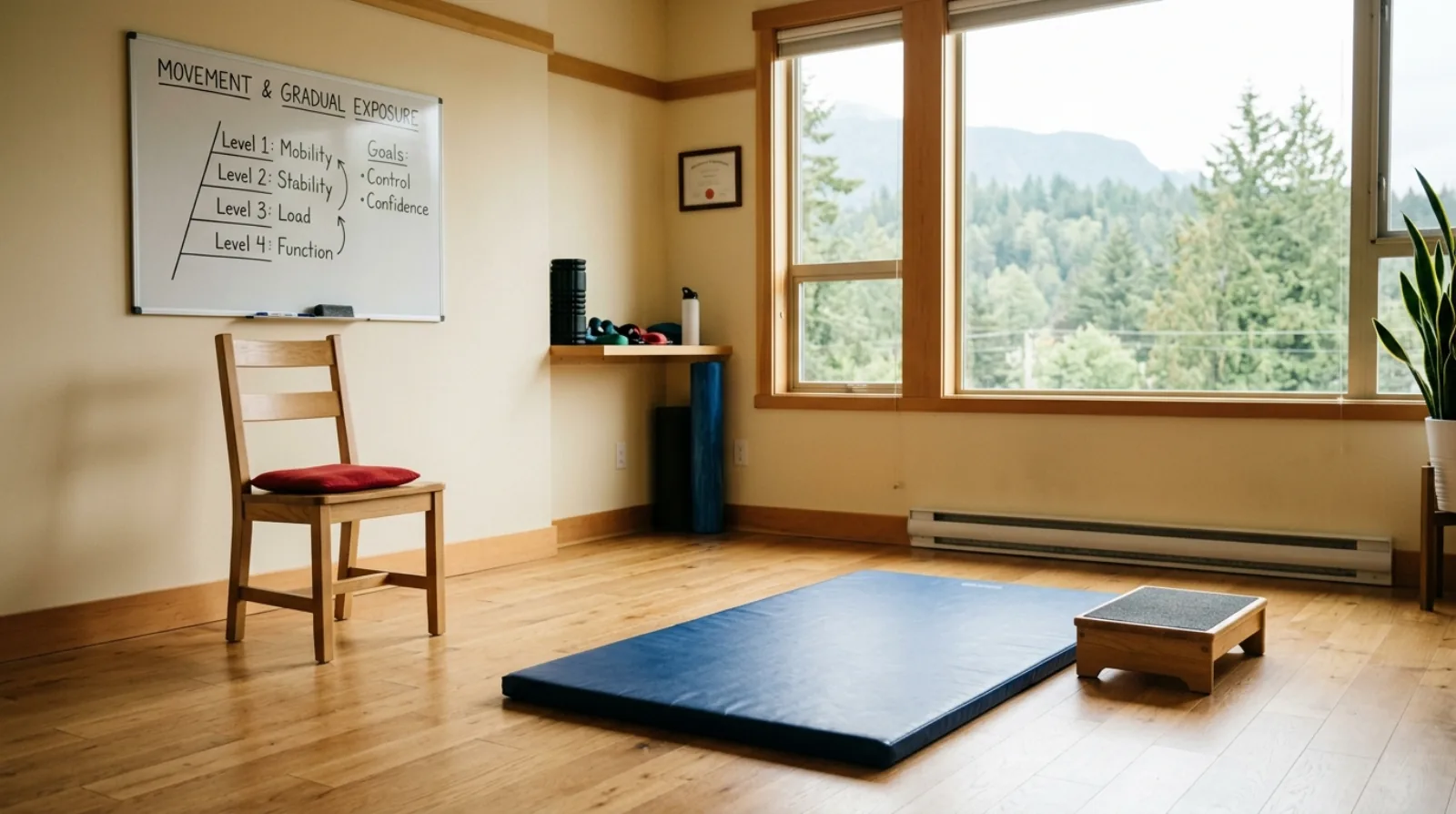
Working with a physiotherapist, you build a list of the movements or activities you fear or avoid, ranked from the least worrying to the most. Then you start near the bottom, with something that feels manageable, and do it in a controlled, planned way. Because the step is small and chosen to be winnable, it usually goes better than your nervous system predicted. That gap between the feared outcome and the actual outcome is the active ingredient. Each success gently teaches your nervous system that the movement is safer than it feared, and you move up the list step by step as confidence and tolerance grow.
What the evidence shows
This approach has been tested, not just proposed. A randomised controlled trial in patients with chronic low back pain found that graded in vivo exposure produced significantly greater improvements in fear of pain and movement, fear-avoidance beliefs, and pain-related anxiety than a wait-list group, and greater improvements than a graded activity group on several of those measures.
Worth being honest about a nuance in that trial: the differences in overall disability were smaller than the differences in fear and anxiety. So graded exposure has its clearest effect on the fear and avoidance that keep people stuck, which for many people is exactly what is holding recovery back. It is a tool for the fear side of persistent pain, used alongside the rest of a rehabilitation plan, not a standalone cure for every symptom.
Where pacing fits
Graded exposure works best alongside pacing, which solves a different problem. Many people with persistent pain fall into a boom-and-bust pattern. On a good day they overdo it, then pay for it with a flare and several bad days of rest, then feel good again and overdo it once more. That swing keeps pain unpredictable and keeps fear alive.
Pacing means spreading activity out into a steady, manageable amount that you can repeat most days, rather than swinging between too much and too little. It builds a stable base. Once that base is steady, graded exposure adds the feared movements on top in small, planned steps. Pacing gives you the consistent platform, and graded exposure gives you the progress. Together they move you forward without the flares that come from doing too much at once.
Rebuilding capacity, not just confidence
The confidence side matters, but so does the physical side. Movements you have avoided for months have usually gotten weaker and stiffer, so part of the plan is rebuilding the actual capacity to do them, not only the willingness. This is where graded exposure blends into strengthening.
A good example is returning to lifting after a long spell of back pain, where fear of bending and loading the spine is common and the fix combines gradual exposure with rebuilding strength. We go through that specific path in our guide to returning to lifting after back pain. The principle is the same across the body: meet the feared movement gradually, and build the tissue's capacity to handle it at the same time.
Being realistic about time
Persistent pain did not appear overnight, and it usually does not resolve overnight either. Progress with graded exposure tends to be a series of small steps with the occasional flare along the way, and a flare after a busy stretch is not a sign the approach has failed. It usually means a step was a little too big, and the plan is adjusted. Knowing that pattern in advance keeps a rough week from turning into giving up, which is the most common reason people abandon an approach that was actually working. We talk more about realistic timelines in our piece on how long physiotherapy takes.
When to get it assessed
If you have had pain for months, if you have stopped doing movements or activities because you are afraid they will hurt, or if scans have not explained your pain and you feel stuck, an assessment can help. We first make sure there is no serious cause that needs different care, then explain what is driving your pain and build a graded plan to get you moving again. Get urgent medical care instead if you have new problems with bladder or bowel control, numbness around the groin, severe unexplained weight loss, or leg weakness that is getting worse, because those need immediate attention.
Book a 30-minute appointment and we will assess your pain, explain what is keeping it going, and build a graded plan that meets the movements you fear a little at a time, at a pace you can actually manage.
This article is general information about persistent pain. It is not personal medical advice. A regulated practitioner can confirm whether the patterns described apply to you.
Sources
- Evaluating the efficacy of graded in vivo exposure for the treatment of fear in patients with chronic back pain: a randomized controlled clinical trial (PubMed)
- Central sensitisation in chronic pain conditions: latest discoveries and their potential for precision medicine (The Lancet Rheumatology)
- College of Physical Therapists of BC (CPTBC)
Common questions
Frequently asked questions.
What is graded exposure for pain?
Graded exposure is a way of gradually meeting the movements or activities you have started to fear or avoid because of pain, in small planned steps. Working with a physiotherapist, you build a list of feared movements from least to most worrying, then approach them one step at a time in a controlled way. Each successful step shows your nervous system that the movement is safer than expected, which over time lowers both the fear and often the pain itself.
Does hurting mean I am causing damage?+
Not always, and this is one of the most important ideas in modern pain care. Pain is produced by the nervous system based on how much threat it senses, not just by how much tissue damage there is. In persistent pain, the nervous system can become more sensitive and produce pain even when tissues have healed or are not damaged. So some discomfort during careful movement is common and does not automatically mean you are harming yourself, though a practitioner should confirm this applies to your situation.
How is graded exposure different from just pushing through pain?+
Pushing through pain usually means ignoring it and forcing activity, which often causes a flare and more fear. Graded exposure is the opposite of forcing. It is planned, gradual, and starts with movements that feel manageable, then builds up only as your confidence and tolerance grow. The aim is a series of small successes that teach your nervous system the movement is safe, not a painful test of willpower that sets you back.
What is pacing in persistent pain?+
Pacing means spreading activity out so you do a steady, manageable amount rather than swinging between overdoing it on good days and resting completely on bad days. That boom-and-bust pattern tends to keep pain unpredictable and reinforce fear. Pacing builds a stable base you can slowly grow from, and it works well alongside graded exposure, where the feared movements are added in small, planned steps rather than all at once.
Can physiotherapy help persistent pain that scans cannot explain?+
Yes. Persistent pain often does not match what shows up on a scan, because pain is influenced by how sensitive the nervous system has become, not only by tissue damage. Physiotherapy for persistent pain focuses on understanding your pain, gradually rebuilding movement and confidence through approaches like graded exposure, and reducing the fear that keeps activity limited. A practitioner should still rule out any serious cause first, then guide this kind of active recovery.
Share this post
Copies a ready-to-publish LinkedIn post to your clipboard and opens the LinkedIn share dialog. Paste the text into the composer and publish.
Written by
Medstar Sport Physio Team
Registered clinician at Medstar Sport Physio & Health, North Vancouver.
This article is for general information only and does not constitute medical advice, diagnosis, or treatment. Individual presentations vary, and assessment findings and treatment plans differ from person to person. If you are experiencing severe symptoms, neurological changes (numbness, weakness, bowel or bladder changes), or a significant trauma, contact your physician or emergency services. Care at Medstar Sport Physio & Health is provided by practitioners registered with their respective British Columbia regulatory colleges.
Filed under
- persistent-pain
- chronic-pain
- graded-exposure
- fear-avoidance
- pain-science
- north-vancouver


