
Leg Pain at the Same Point in Every Run: Exertional Compartment Syndrome
Some running leg pain arrives on a schedule. Same point in every run, gone within minutes of stopping. That predictability is the diagnostic clue.
BY MEDSTAR SPORT PHYSIO TEAM
Most injury pain is unpredictable. It varies with sleep, weather, stress and what you did yesterday. Leg pain that arrives at almost the same minute of every run is doing something different, and that pattern is worth paying attention to.
At Medstar Sport Physio in North Vancouver, leg pain that begins within 15 to 20 minutes of running, arrives predictably at the same point each time, and resolves completely with rest fits the pattern of chronic exertional compartment syndrome. Muscle compartments swell up to 20 percent during exercise, and when the compartment cannot expand, pressure rises high enough to compromise blood flow, which produces pain and sometimes pins and needles or subtle weakness. It is commonly misdiagnosed as shin splints at first. Diagnosis is confirmed by compartment pressure testing. Conservative options including gait retraining are tried first for many people, with surgery considered when they do not work.
Here is the emergency version you must never confuse this with, how the chronic form behaves, and what separates it from shin splints and stress fractures.
Read this first: acute compartment syndrome is an emergency
Two conditions share most of a name and almost nothing else. Getting this wrong is dangerous, so it goes at the top rather than buried in a section near the end.
Acute compartment syndrome is a surgical emergency. It usually follows trauma such as a fracture, a crush injury, or a severe direct blow to the leg. Pressure inside the compartment rises and does not come down, blood supply to the muscle and nerve inside is cut off, and tissue starts to die. Treatment is urgent surgery, and delay causes permanent damage.
Call 911 or go straight to Lions Gate Hospital if you have any of the following after an injury:
- Severe pain that does not let up and keeps getting worse
- Pain that is out of proportion to the injury you had
- A leg compartment that feels tense, hard or swollen
- Numbness or pins and needles in the foot or leg
- Severe pain when someone else gently stretches the muscle
Do not wait for that to settle, do not book a physiotherapy appointment for it, and do not try it out overnight. Everything else in this article is about the chronic exercise-related form, which behaves completely differently: it comes on with exercise, it stops with rest, and it is not an emergency.
What the chronic form actually is
The StatPearls review of exertional compartment syndrome describes the mechanism clearly. Muscle compartments swell up to 20 percent during exercise, because blood flow and fluid volume both increase in a working muscle.
Normally the compartment accommodates that. When it cannot expand further, pressure inside rises. Once that pressure exceeds capillary perfusion pressure, blood flow into the muscle is compromised. Pain follows, and some people also get subtle motor weakness and pins and needles.
That mechanism explains the timing exactly. It takes a while for the swelling to build to the point where pressure becomes a problem, which is why the pain arrives after a set period rather than at the start. It also explains the recovery, since stopping exercise lets the swelling drop and the pressure fall back to normal within minutes.
The review reports that pain typically begins within 15 to 20 minutes of exertional activity, is predictable, and resolves completely with rest. Those three features together are the most useful part of the history.
Who gets it, and where
Peak prevalence is at 20 to 25 years old, and it is more likely in males. Sports associated with it include running, endurance training, soccer, field hockey, lacrosse and skating.
The anterior compartment at the front of the shin is most frequently involved, up to 70 percent of cases in some series. Other reports put the anterior and deep posterior compartments equally common at 25 percent each, with both involved at the same time in 8 to 10 percent of cases.
Bilateral involvement is common, affecting 37 to 82 percent of symptomatic athletes. That is a useful piece of information for a runner who has assumed that pain in both legs must mean it is a training problem rather than a specific condition.
For how often it occurs, the review reports an incidence of 0.49 per 1,000 at-risk person-years in military populations, and a 33 percent incidence among active patients presenting with exercise-induced leg pain. That second figure is the striking one. Among people who turn up specifically with leg pain brought on by exercise, a third of them have this.
Why it gets called shin splints first
The StatPearls review states that this condition is initially misdiagnosed as shin splints or medial tibial stress syndrome. The two overlap in sport, in age group and in the general area of pain, so the confusion is understandable.
The StatPearls review of medial tibial stress syndrome gives the contrast. MTSS pain appears during or after activity along the distal two-thirds of the medial tibial border, and it improves with relative rest. Compartment syndrome is also exercise-induced but may add pins and needles, pallor and cold skin, which are circulation-related signs that MTSS does not produce.
MTSS is common. Reported incidence is 13.6 to 20 percent in runners, 35 to 56 percent in military recruits, and 69.5 percent in recreational marathon runners. Our article on shin splints and load management covers how that condition is managed once identified.
There is one examination finding that does a lot of work in this area. Reproducible tenderness along more than 5 centimetres of the posteromedial tibial border points to MTSS. Point tenderness over less than 5 centimetres suggests a stress fracture instead. That single measurement changes the plan substantially, since stress fractures take 8 to 12 weeks for return to full activity, while MTSS follows a shorter and more flexible progression. We cover that distinction in more detail in our comparison of stress fracture and shin splints, and the broader picture of bone loading in our article on bone stress injuries in runners.
Other conditions that need ruling out include vascular problems, tendon problems and nerve entrapment. This is a diagnosis reached by working through the alternatives carefully.
How it is confirmed
Compartment pressure testing is what settles the question. The Pedowitz criteria are the standard, and any one of three measurements confirms the diagnosis: a resting pressure of 15 mmHg or above, a pressure of 30 mmHg or above at one minute after exercise, or a pressure above 20 mmHg at five minutes after exercise.
The test involves inserting a needle probe into the compartment, so it is performed by a physician rather than a physiotherapist, usually after exercise has been used to provoke the symptoms. It is not the first step for everyone. A careful history and examination come first, and the referral for testing makes most sense when the pattern fits and other explanations have been addressed.
What can be done about it
Conservative management is worth a proper trial before surgery is considered.
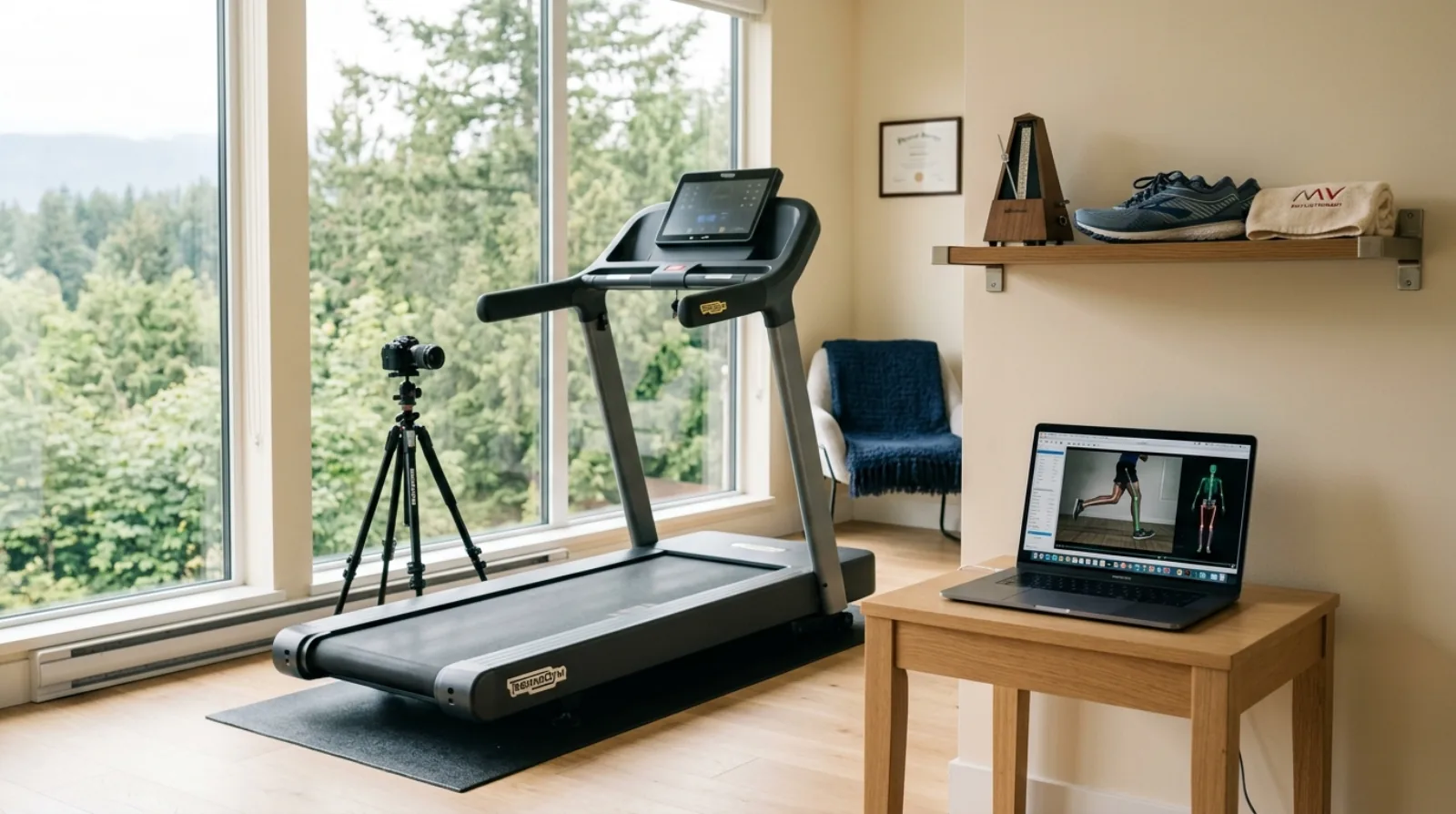
Gait retraining is the option with the most interesting data. The StatPearls review describes a study of 10 participants in which none of the ten required surgery at one year after the intervention. Ten people is a small sample, so this is encouraging rather than conclusive, but it is enough reason to try changing how someone runs before booking an operation. Adjusting how the foot lands and how the leg loads changes which compartment does the work, and our guide to running cadence and injury prevention covers one of the main levers used. A full assessment of the running pattern, described in our article on running gait analysis, is the usual starting point.
Load management runs alongside it. Return-to-activity progressions used for exercise-related leg pain are deliberately slow. The MTSS review describes pain-free walking for 30 minutes before starting progression, a first week of 30-second intervals at 30 to 50 percent of usual pace, gradual increases over the following 4 weeks with rest days included, and distance increases of 10 percent weekly after that. The exact numbers apply to MTSS, though the principle of slow, staged reloading transfers.
If conservative care does not work, surgical release is the option. Reported outcomes are a 66 percent success rate and 84 percent satisfaction at short to mid-term follow-up, with 79.5 percent return to sport in paediatric patients. Results depend on the compartment: anterior compartment results are above 80 percent, compared with roughly 60 percent for the deep posterior compartment. Those numbers are honest rather than discouraging, and they are worth reviewing with a surgeon.
When to get it looked at
Leg pain that appears at a predictable point in every run and stops with rest is worth having assessed, particularly if you have already tried reducing your training without changing anything. So is any leg pain that comes with pins and needles, weakness, or a foot that feels cold or looks pale during exercise.
Get emergency care immediately for the acute signs listed at the top of this article: severe unrelenting pain after an injury, pain out of proportion, a tense swollen compartment, numbness, or severe pain when the muscle is passively stretched. That means calling 911 or going to Lions Gate Hospital, not waiting.
If your legs hurt on a schedule and nobody has explained why, book a 30-minute assessment and we will work through what is actually driving it. You can see what we treat or reach the clinic here.
This article is general information, not personal medical advice. A regulated practitioner can confirm whether the patterns described apply to you.
Sources
- Exertional Compartment Syndrome, StatPearls, NCBI Bookshelf
- Medial Tibial Stress Syndrome, StatPearls, NCBI Bookshelf
- College of Health and Care Professionals of BC public registry
Common questions
Frequently asked questions.
What is chronic exertional compartment syndrome?
It is exercise-induced leg pain caused by rising pressure inside a muscle compartment. Muscle compartments swell up to 20 percent during exercise because of increased blood flow and fluid volume. When the surrounding tissue cannot expand further, pressure rises, and once it passes capillary perfusion pressure the blood supply is compromised. That produces pain, and sometimes subtle weakness and pins and needles.
How do I know if my leg pain is this and not shin splints?+
Timing is the strongest clue. Compartment syndrome pain typically begins within 15 to 20 minutes of exertional activity, is predictable from run to run, and resolves completely with rest. Medial tibial stress syndrome pain appears during or after activity along the distal two-thirds of the medial shin border and improves with relative rest rather than switching off within minutes of stopping.
Which compartment is usually involved?+
The anterior compartment at the front of the shin is most frequently involved, up to 70 percent of cases in some series. Other reports put the anterior and deep posterior compartments equally common at 25 percent each, with both involved at the same time in 8 to 10 percent of cases. Both legs are affected in 37 to 82 percent of symptomatic athletes.
Who tends to get it?+
Peak prevalence is at 20 to 25 years old and it is more likely in males. Sports linked to it include running, endurance training, soccer, field hockey, lacrosse and skating. Incidence has been reported at 0.49 per 1,000 at-risk person-years in military populations, and 33 percent among active patients presenting with exercise-induced leg pain.
How is it diagnosed?+
Compartment pressure testing using the Pedowitz criteria confirms it, and any one of three thresholds is enough: resting pressure of 15 mmHg or above, 30 mmHg or above at one minute after exercise, or above 20 mmHg at five minutes after exercise. Before that, a practitioner works through the history and examination to rule out stress fracture, tendon problems, nerve entrapment and vascular causes.
What is the exam finding that separates shin splints from a stress fracture?+
The length of the tender area. Medial tibial stress syndrome produces reproducible tenderness along more than 5 centimetres of the posteromedial tibial border. Point tenderness under 5 centimetres suggests a stress fracture instead. That distinction changes management substantially, since stress fractures take 8 to 12 weeks to return to full activity.
Can this be treated without surgery?+
Sometimes. Gait retraining has been studied, and in one study of 10 participants, none of the ten required surgery at one year after the intervention. That is a small sample and should be read as encouraging rather than conclusive. A trial of conservative management including gait work is a reasonable first step for many people before surgery is discussed.
How well does surgery work?+
Reported outcomes are a 66 percent success rate and 84 percent satisfaction at short to mid-term follow-up, with 79.5 percent return to sport in paediatric patients. Results differ by compartment: anterior compartment results are above 80 percent, compared with about 60 percent for the deep posterior compartment. Those figures are worth discussing with a surgeon before deciding.
Share this post
Copies a ready-to-publish LinkedIn post to your clipboard and opens the LinkedIn share dialog. Paste the text into the composer and publish.
Written by
Medstar Sport Physio Team
Registered clinician at Medstar Sport Physio & Health, North Vancouver.
This article is for general information only and does not constitute medical advice, diagnosis, or treatment. Individual presentations vary, and assessment findings and treatment plans differ from person to person. If you are experiencing severe symptoms, neurological changes (numbness, weakness, bowel or bladder changes), or a significant trauma, contact your physician or emergency services. Care at Medstar Sport Physio & Health is provided by practitioners registered with their respective British Columbia regulatory colleges.
Filed under
- compartment-syndrome
- running-injury
- shin-pain
- leg-pain
- north-vancouver