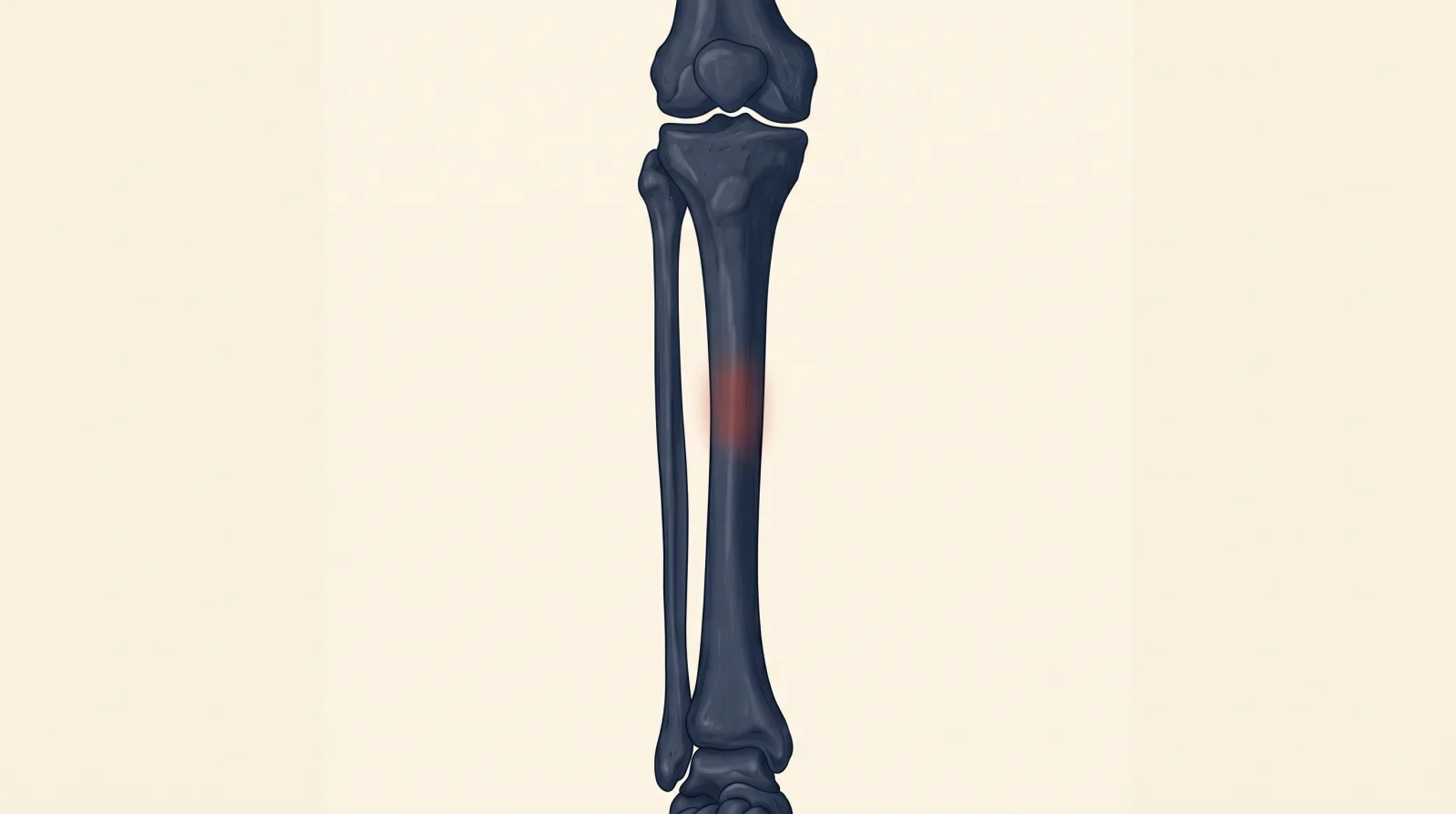

Stress Fracture or Shin Splints? How Runners Can Tell the Difference
Shin splints and a stress fracture can start the same way, but one needs a very different plan. Here is how to tell them apart and the warning signs that mean get it checked.
BY MEDSTAR SPORT PHYSIO TEAM
Shin pain is one of the most common complaints in runners, and two problems get blamed for it: shin splints and a stress fracture. They can start feeling similar, but one is a soft tissue and early bone irritation that you can often keep training around, and the other is a bone injury that gets worse if you run through it. Telling them apart early is what keeps a minor problem from becoming a long layoff.
Shin splints, properly called medial tibial stress syndrome, cause diffuse pain spread along the inner edge of the shin bone. A tibial stress fracture is a bone injury with pain focused on one small spot that worsens through and between runs. They sit on the same spectrum of bone stress, and shin splints that keep getting loaded can progress toward a stress fracture. At Medstar Sport Physio in North Vancouver, we tell them apart by how spread out the pain is and how it behaves, and we send for imaging when the pattern points to a fracture, because a stress fracture needs a very different plan.
Two points on the same spectrum
The most useful thing to understand is that these are not two completely separate problems. They sit on a spectrum of bone stress. Medial tibial stress syndrome represents an early point on the continuum of stress-related bone injury and can advance toward a tibial stress fracture when it keeps getting loaded. Shin splints are the milder, earlier end. A stress fracture is the more advanced end, where the bone itself has developed a small crack or is close to it.
This is exactly why the difference matters so much. If you treat a stress fracture like ordinary shin splints and keep running, you are loading an injury that needs the opposite. The bone needs a controlled reduction in load to heal, not more of the same. The good news is that the pain pattern usually tells you which end of the spectrum you are on, well before a scan is needed.
How the pain patterns differ
The two conditions behave differently, and paying attention to the pattern is the single most useful thing you can do.
Shin splints (medial tibial stress syndrome). The pain is spread out along the inner edge of the shin bone, and it is tender over a wide region rather than one spot. It is often sore at the start of a run, then eases somewhat as you warm up, and it settles with rest between runs. You usually cannot point to a single tender spot.
Tibial stress fracture. The pain is focused on one small spot on the bone that you can often point to with one finger. It tends to follow a crescendo pattern, meaning it gets worse through a single run and worse from one run to the next. As it progresses, it can start to hurt with lower-impact activity like walking, and eventually at rest.
If your shin pain is spread out and eases as you warm up, it leans toward shin splints. If you can put one finger on the sore spot and the pain is climbing week to week, that leans toward a stress fracture and deserves a proper look.
The red flags that mean get it checked
Some features raise the concern for a stress fracture enough that the shin should be assessed promptly rather than run through. These are the ones we take seriously.
Pain that starts earlier in each run than it used to is a warning. If the sore point in your run keeps moving earlier, the injury is likely getting worse, not settling.
Pain that spreads from only bothering you during high-impact activity to bothering you during normal walking is another. When a running injury starts affecting everyday walking, the load tolerance of the bone has dropped.
Pain focused on one small spot on the bone, rather than spread along the shin, points toward bone rather than soft tissue.
Pain that wakes you at night or throbs while you are resting is a concerning sign and needs prompt assessment. Bone injuries that hurt at rest are not something to run through.
If any of these describe your shin, stop running on it and get it assessed before the next run, not after.
When imaging is actually needed
You do not need a scan for every sore shin. Both conditions are diagnosed mainly on a clinical assessment: where the tenderness is, how spread out it is, and how it behaves with load. Imaging is reserved for pain that is worsening, very focused, or not settling with sensible changes to training.
When a stress fracture is suspected, MRI is the preferred scan because it can detect bone stress before a full fracture develops. An important point that catches people out: early X-rays often look normal even when a stress fracture is present, because the change can take time to show on plain film. So a normal X-ray does not rule out a stress fracture, and it is not the first-choice scan for this. This is the same principle we apply to imaging elsewhere in the body, where the scan is chosen to answer a specific question rather than ordered by default.
How each one is managed
The plans diverge because the injuries are at different points on the spectrum.
For shin splints, the core of treatment is load management: reducing the running that provokes the pain, then building back gradually while addressing the factors that overloaded the shin in the first place, such as a sudden jump in training or how the load is distributed through the leg. You can often keep some training going at a level that stays below the flare threshold. Our post on shin splints and load management walks through how we set that up.
For a bone stress injury, the loading has to come down more firmly to let the bone heal, and the return to running is slower and more staged. Running through it is the thing to avoid. Our post on bone stress injuries in runners covers how these are managed and why the recovery is more protected. In both cases we also look at the wider picture, including training load history and, where relevant, factors that affect bone health, because a stress injury is often a sign that load outpaced what the bone was ready for.
What recovery usually looks like
Shin splints often settle over a matter of weeks once the load is managed sensibly, though the exact timeline depends on how long the pain has been present and how much training is involved. A bone stress injury takes longer, usually weeks to a few months, and the pace depends on where the injury is, how advanced it is, and your overall bone health. Trying to rush a bone injury back is how a short setback becomes a long one.
For both, we build the return around symptoms rather than a fixed date. The shin has to tolerate each step of increased load before the next step is added. Some awareness of the shin during a return to running is normal, but pain that climbs, or that starts appearing in daily walking, is a sign to hold or step back rather than push on.
When to get it assessed
If you have shin pain that is worsening, that you can pin to one small spot, that shows up in normal walking, or that wakes you at night, get it assessed promptly. Those patterns point toward a bone stress injury, which needs a different plan from ordinary shin splints. Even for pain that fits the shin splints pattern, an assessment sorts out what overloaded the shin so it does not simply come back when you build training up again.
Book a 30-minute appointment and we will assess your shin, work out where on the spectrum it sits, arrange imaging if the pattern warrants it, and build a load and return-to-running plan matched to what the bone and tissue can handle.
This article is general information about running injuries. It is not personal medical advice. A regulated practitioner can confirm whether the patterns described apply to you.
Sources
- Medial Tibial Stress Syndrome - StatPearls (NCBI)
- Tibial Stress Injury Standard of Care - Brigham and Women's Hospital
- Tibial Stress Syndrome (Shin Splints) - Orthobullets
- College of Physical Therapists of BC (CPTBC)
Common questions
Frequently asked questions.
What is the difference between shin splints and a stress fracture?
Shin splints, properly called medial tibial stress syndrome, cause diffuse pain spread along the inner edge of the shin bone over a wide area. A tibial stress fracture is a bone injury with pain focused on one small spot. They sit on the same spectrum of bone stress, and shin splints that keep getting loaded can progress toward a stress fracture, which is why the difference matters.
How can I tell if I have a stress fracture or just shin splints?+
The main clues are how spread out the pain is and how it behaves. Shin splints are tender over a broad area and often sore at the start of a run then ease slightly. A stress fracture tends to be tender on one small spot, gets worse through a run and from run to run, and can start to hurt with walking or at rest. Pain that wakes you at night is a warning sign. Only imaging can confirm a fracture, so a worsening pattern needs an assessment.
Do I need an MRI for shin pain?+
Not always. Both conditions are diagnosed mainly by a clinical assessment, and imaging is reserved for pain that is worsening, very focused, or not settling with load changes. When a stress fracture is suspected, MRI is the preferred scan because it can detect bone stress before a full fracture shows on an X-ray. X-rays often look normal early on, which is why they are not the first choice for this.
What are the red flags for a tibial stress fracture?+
Warning signs include pain that starts earlier in each run over time, pain that spreads from only high-impact activity to bothering you during normal walking, pain focused on one small spot on the bone, and pain that wakes you at night or throbs at rest. Any of these mean the shin should be assessed promptly rather than run through, because loading a stress fracture can make it worse.
How long does a tibial stress fracture take to heal?+
Bone stress injuries need time and a controlled reduction in loading, and timelines depend on where the injury is, how advanced it is, and your overall bone health. It is usually a matter of weeks to a few months, and it is longer than shin splints. Returning to running is done gradually and guided by symptoms, not rushed by a date.
Can shin splints turn into a stress fracture if I keep running?+
Yes, this is exactly the risk. Shin splints and a tibial stress fracture sit on the same spectrum of bone stress, so continuing to load a shin that is not settling can push it further along that spectrum toward an actual fracture. A pain pattern that is getting worse, not better, over one to two weeks is the signal to stop and get it assessed.
Are certain runners more likely to get a tibial stress fracture?+
Risk is higher with a rapid increase in running volume or intensity, low bone density, inadequate energy intake relative to training load, and a history of a previous stress fracture. Female runners with menstrual irregularities are also at higher risk, since that can signal low energy availability affecting bone health. A physiotherapist can screen for these factors alongside the training history.
Do I need to stop running completely with shin splints, or can I keep training?+
It depends on how irritable the shin is. Milder shin splints can sometimes be managed with reduced volume, cross-training, and load adjustments rather than complete rest, while a suspected stress fracture usually needs a more significant reduction or pause in impact loading. An assessment determines which category you are in and sets the right level of activity.
Share this post
Copies a ready-to-publish LinkedIn post to your clipboard and opens the LinkedIn share dialog. Paste the text into the composer and publish.
Written by
Medstar Sport Physio Team
Registered clinician at Medstar Sport Physio & Health, North Vancouver.
This article is for general information only and does not constitute medical advice, diagnosis, or treatment. Individual presentations vary, and assessment findings and treatment plans differ from person to person. If you are experiencing severe symptoms, neurological changes (numbness, weakness, bowel or bladder changes), or a significant trauma, contact your physician or emergency services. Care at Medstar Sport Physio & Health is provided by practitioners registered with their respective British Columbia regulatory colleges.
Filed under
- stress-fracture
- shin-splints
- mtss
- bone-stress-injury
- running
- north-vancouver