
Separated Shoulder: What an AC Joint Sprain Is and What the Grades Mean
A separated shoulder happens at the small joint on top of the shoulder where the collarbone meets the acromion. It is a different injury from a dislocated shoulder, and the grade decides almost everything.
BY MEDSTAR SPORT PHYSIO TEAM
Someone lands hard on the point of their shoulder, a bump appears at the top of it, and the word "separated" gets used. Here is what that actually describes.
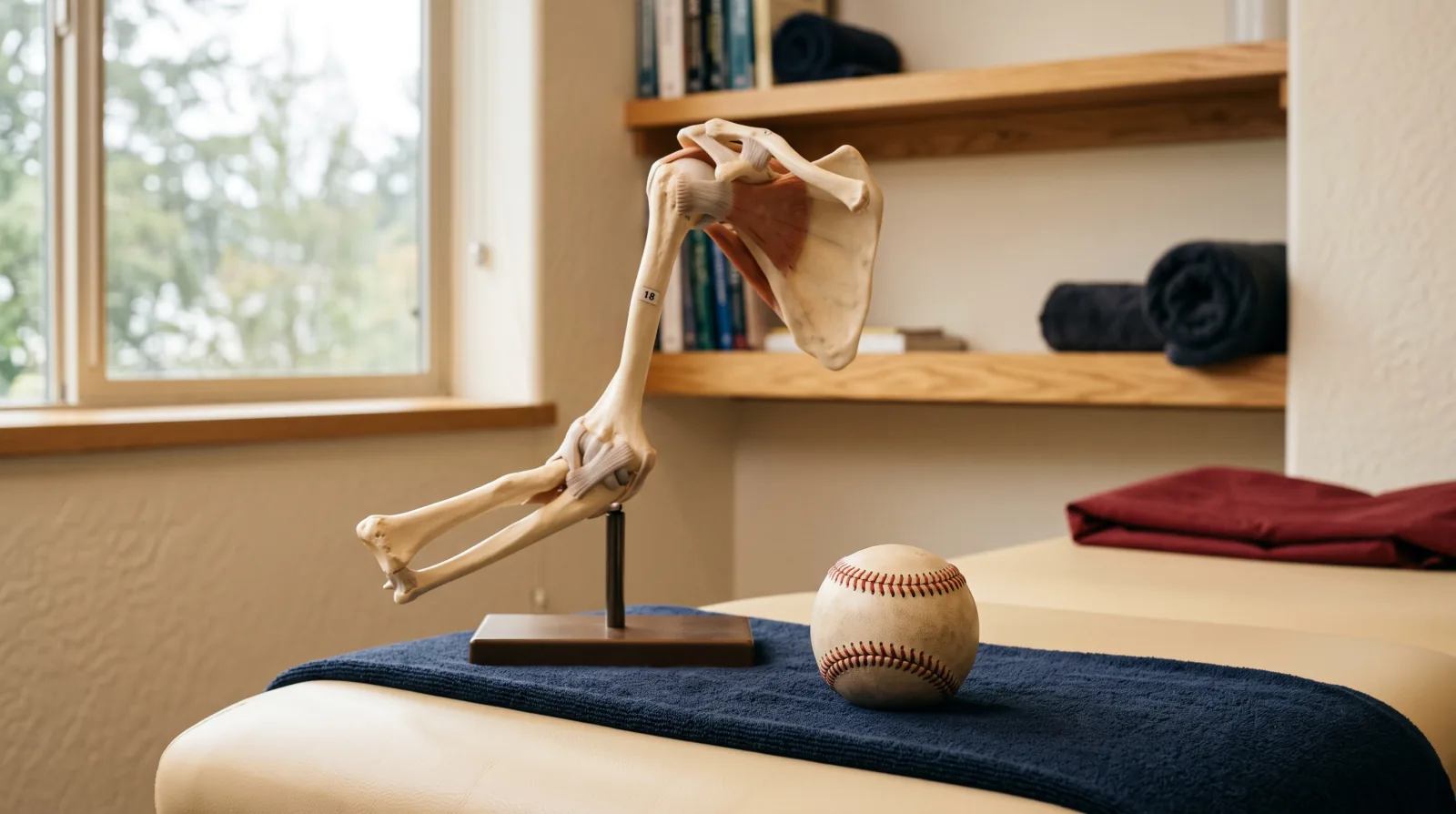
At Medstar Sport Physio in North Vancouver, a separated shoulder is an injury to the acromioclavicular joint at the top of the shoulder, where the outer end of the collarbone meets the acromion of the shoulder blade. A dislocated shoulder is a separate injury at the ball-and-socket joint below it. StatPearls reports that AC joint injuries may account for as much as 40 percent of all shoulder injuries and nearly 10 percent of all injuries in collision sports such as football, lacrosse, and ice hockey. Injuries are graded Rockwood Type I to VI by how far the collarbone has displaced. Types I and II are managed without surgery, with functional motion generally regained by six weeks and return to normal activity by 12 weeks. Standard x-rays are adequate for diagnosis.
Here is the anatomy, what each Rockwood grade means, and how the grade drives the treatment plan.
Two different shoulder injuries with similar names
A separated shoulder is an injury to the acromioclavicular joint, the small joint sitting on top of the shoulder. A dislocated shoulder is an injury to the glenohumeral joint, the ball-and-socket joint below it where the arm bone meets the shoulder blade.
Each one has its own anatomy, its own examination findings, its own grading, and its own rehabilitation plan. A first dislocation of the ball-and-socket joint carries a specific set of concerns around recurrence and stability, which we cover in our guide to first-time shoulder dislocation rehab. An AC joint injury sits higher, on the roof of the shoulder, and the questions are about ligament integrity and how far the collarbone has moved.
The confusion is understandable, because both hurt badly, both follow a fall, and both make it hard to lift the arm. Sorting them out takes an examination and, for the AC joint, an x-ray.
The joint on top of the shoulder
The StatPearls review of acromioclavicular joint injury describes the AC joint as a diarthrodial joint, meaning a joint with a capsule and joint fluid, defined by the lateral process of the clavicle articulating with the acromion process.
Two sets of ligaments hold it together, and they do different jobs.
The acromioclavicular ligament surrounds the joint itself and has anterior, posterior, inferior, and superior components. The superior portion is the most important component of that group. It is the first structure injured when the joint is loaded.
The coracoclavicular ligaments run from the collarbone down to the coracoid process, a hook of bone below it. There are two, the trapezoid and the conoid, and together they provide vertical stability. They are what stops the collarbone riding upward away from the shoulder blade. Their state is what separates a moderate injury from a severe one.
That two-layer design is why the grading works the way it does. Injure the AC ligaments alone and the joint is sore but stays in place. Injure the coracoclavicular ligaments as well and the collarbone starts to move upward, which shows on an x-ray as an increased gap.
Who gets it, and how
AC joint injuries are common in ways most people do not realise. StatPearls reports they may account for as much as 40 percent of all shoulder injuries and nearly 10 percent of all injuries in collision sports such as football, lacrosse, and ice hockey.
The mechanism is consistent. The most common is direct trauma to the lateral aspect of the shoulder or to the acromion process with the arm in adduction, meaning held in close to the body. Being checked into the boards and landing on the point of the shoulder, coming off a bike onto the top of the shoulder, or a heavy tackle that drives the shoulder into the ground all produce the same loading.
The joint can also be injured indirectly, by falling onto an outstretched hand or onto the elbow. The force travels up the arm and into the joint from below.
On the North Shore, the mechanism turns up outside organised sport too. Mountain biking crashes, ski and snowboard falls, and slips on ice all put people onto the point of the shoulder. Other injuries share these mechanisms, which is why an assessment after a fall looks at more than one structure, as covered in snowboard wrist fracture prevention.
The Rockwood grades
The Rockwood classification sorts these injuries into six types based on which ligaments are involved and how far the collarbone has displaced.
Type I is a sprain of the acromioclavicular ligaments only, with no displacement visible on x-ray. The joint is tender and the structure is intact.
Type II involves a torn AC ligament with a sprain of the coracoclavicular ligament, producing less than a 25 percent increase in the coracoclavicular interspace, the gap between the collarbone and the coracoid.
Type III involves both the AC and coracoclavicular ligaments torn, with a 25 percent to 100 percent increased coracoclavicular distance. This is where the visible bump at the top of the shoulder usually appears.
Type IV involves posterior displacement of the distal clavicle into the trapezius muscle behind it.
Type V involves superior displacement of the distal clavicle by more than 100 percent.
Type VI involves inferolateral displacement, with the collarbone ending up in a subacromial or subcoracoid position.
On examination, one finding is worth knowing by name. The piano key sign describes the outer end of the collarbone being pressed down and then springing back up when the pressure is released, moving the way a piano key does. It reflects the loss of the vertical support that normally holds the collarbone in position.
For imaging, the guidance is simple and reassuring: standard x-rays are adequate for diagnosis. The grading depends on the position of the collarbone relative to the acromion, and that is exactly what a plain x-ray shows.
What treatment depends on the grade
The grade drives almost everything about the plan.
Types I and II are managed non-operatively. StatPearls describes rest, protection with a sling, ice, nonsteroidal antiinflammatory medication, and physical therapy. The general timeline given is functional motion regained by six weeks and return to normal activity by 12 weeks. Those are guidance figures, and individual recovery varies with the sport, the demands of the person's work, and how the rehabilitation progresses.
Type III is usually managed non-operatively as well, which surprises people who have seen the bump. Surgery is considered in specific circumstances: displacement greater than 75 percent, in labourers or athletes whose demands are high, or for cosmesis, meaning the appearance of the shoulder.
Types IV, V, and VI are typically managed surgically, because the collarbone has displaced into a position that will not settle on its own.
Where surgery is performed, the general post-operative guidance is immobilisation for six weeks followed by gradual return to full activity at around six months. That is a longer road, and the rehabilitation follows the surgeon's protocol.
Physiotherapy has a role on both pathways. On the non-operative side it restores range, rebuilds the muscles that support the shoulder blade and arm, and progresses loading back toward sport. After surgery it works within the protection period first, then follows the same progression on a longer timeline.
Getting back to contact sport
The point where people run into trouble is the last stretch, between feeling normal and being ready to take contact again.
A shoulder that has stopped hurting is not automatically a shoulder that can absorb another hit on the same spot. The ligaments heal on their own schedule, and the surrounding muscles need to have rebuilt the strength and control that got lost during the protected period. Testing before clearing, rather than clearing on how it feels, is the approach set out in our guide to criteria-based return to sport, and it applies directly here.
Hockey players in particular tend to return to a sport where the same mechanism repeats every shift. The specific demands of that return are covered in returning to hockey after a shoulder injury.
When to get it looked at
Pain at the top of the shoulder after landing on it, especially with a visible bump or a step in the outline of the shoulder, should be assessed. So should shoulder pain after a fall that has not settled within a few days, or any difficulty lifting the arm or carrying weight on that side.
Some situations need medical attention promptly rather than a physiotherapy booking. An obvious deformity, a shoulder that cannot be moved at all, numbness or weakness in the arm or hand, skin that is broken over the injury, or severe pain after a high-energy fall or collision should go to your physician or to Lions Gate Hospital. An x-ray is what establishes the grade, and the grade is what shapes the plan.
If you landed on your shoulder and want to know what you are dealing with, book a 30-minute assessment and we will work out which structures are involved and what the return timeline looks like. You can see what we treat or reach the clinic here.
This article is general information, not personal medical advice. A regulated practitioner can confirm whether the patterns described apply to you.
Sources
- Acromioclavicular Joint Injury, StatPearls, NCBI Bookshelf
- College of Health and Care Professionals of BC public registry
Common questions
Frequently asked questions.
What is a separated shoulder?
A separated shoulder is an injury to the acromioclavicular joint, the small joint at the top of the shoulder where the outer end of the collarbone meets the acromion of the shoulder blade. The ligaments holding those two bones together are sprained or torn. StatPearls reports that AC joint injuries may account for as much as 40 percent of all shoulder injuries.
How is a separated shoulder different from a dislocated shoulder?+
They involve different joints. A separated shoulder happens at the acromioclavicular joint on top of the shoulder, where the collarbone meets the shoulder blade. A dislocated shoulder happens at the glenohumeral joint, where the ball of the arm bone leaves its socket. The assessment, the grading systems, and the rehabilitation plans are separate for each.
How does an AC joint injury happen?+
The most common mechanism is direct trauma to the outer aspect of the shoulder or to the acromion with the arm held in adduction, meaning close to the body. Landing directly on the point of the shoulder in a fall or collision is the classic version. It can also happen from falling onto an outstretched hand or onto the elbow, which transmits force up into the joint.
What do the Rockwood grades mean?+
Rockwood classifies AC injuries into six types by how far the collarbone has displaced. Type I is a sprain of the AC ligaments only with no displacement on x-ray. Type II is a torn AC ligament with a sprained coracoclavicular ligament and under 25 percent increased coracoclavicular interspace. Type III has both torn with 25 to 100 percent increased distance. Types IV to VI involve specific displacement directions.
Which grades need surgery?+
Types I and II are managed non-operatively, with rest, a sling, ice, anti-inflammatory medication, and physical therapy. Type III is usually managed non-operatively as well, with surgery considered when displacement exceeds 75 percent, in labourers or athletes, or for appearance. Types IV, V, and VI are typically managed surgically. That decision belongs to an orthopaedic surgeon, and physiotherapy has a role on either pathway.
How long does recovery take?+
For Types I and II managed without surgery, StatPearls describes functional motion regained by six weeks and return to normal activity by 12 weeks. Where surgery is performed, the general guidance is immobilisation for six weeks and gradual return to full activity at around six months. Individual timelines vary with the grade, the sport, and how rehabilitation progresses.
Do I need an MRI for a separated shoulder?+
Usually not. StatPearls states that standard x-rays are adequate for diagnosis of AC joint injuries. X-rays show the position of the collarbone relative to the acromion, which is what the Rockwood grading is based on. Advanced imaging is reserved for situations where the picture is unclear or another injury is suspected alongside it.
What is the piano key sign?+
It is a finding on physical examination of the AC joint. The outer end of the collarbone can be pressed down and then springs back up when the pressure is released, moving like a piano key. It reflects loss of the ligament support that normally holds the collarbone down against the shoulder blade, and it points toward a higher-grade injury.
Share this post
Copies a ready-to-publish LinkedIn post to your clipboard and opens the LinkedIn share dialog. Paste the text into the composer and publish.
Written by
Medstar Sport Physio Team
Registered clinician at Medstar Sport Physio & Health, North Vancouver.
This article is for general information only and does not constitute medical advice, diagnosis, or treatment. Individual presentations vary, and assessment findings and treatment plans differ from person to person. If you are experiencing severe symptoms, neurological changes (numbness, weakness, bowel or bladder changes), or a significant trauma, contact your physician or emergency services. Care at Medstar Sport Physio & Health is provided by practitioners registered with their respective British Columbia regulatory colleges.
Filed under
- ac-joint
- separated-shoulder
- shoulder-injury
- collision-sport
- north-vancouver