Arthritis at the Base of the Thumb: What Non-Surgical Care Can Do
Pain at the base of the thumb when you open jars, turn keys or pinch may be osteoarthritis of the thumb base joint. Here is what splints, exercises, tools, medicine and injections did in trials, and when to ask about surgery.
BY ALI SHAFIEI, RPT
An ache at the base of the thumb that makes jars, keys and pinching harder is often osteoarthritis of the joint where the thumb meets the wrist. Several non-surgical steps exist, and the research behind them is small and mixed.
Non-surgical care for thumb base arthritis combines joint protection, helpful tools, hand exercises and often a thumb splint, and guidelines support this combination even though each part has only small to moderate proven benefit. At Medstar Sport Physio in North Vancouver, a physiotherapist can assess the thumb, separate it from similar problems and set up this plan, and a hand surgeon is the next step when daily tasks stay limited.
What thumb base arthritis is and who gets it
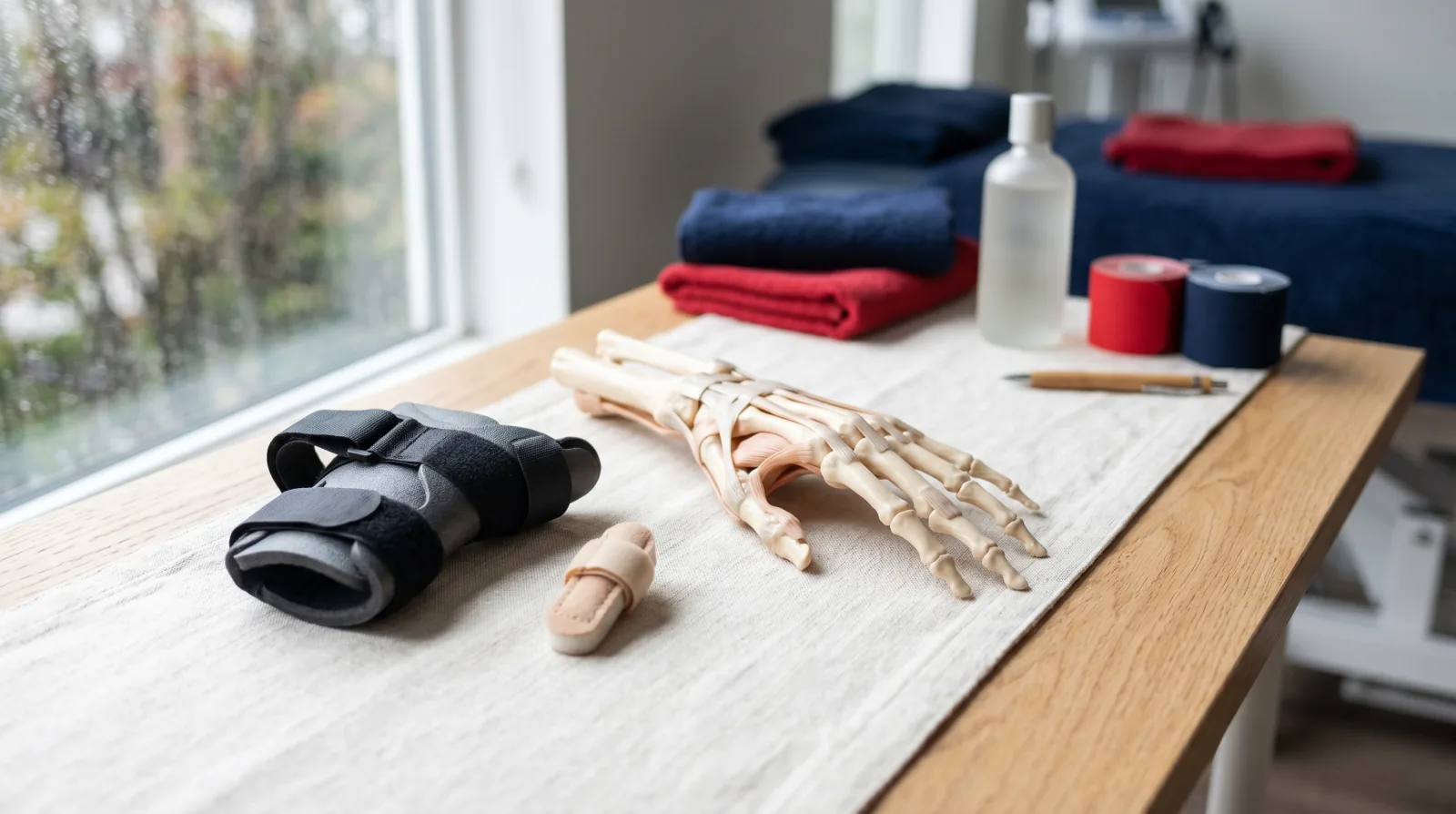
Osteoarthritis is wear in the cartilage that covers the ends of bones in a joint. At the base of the thumb it affects the trapeziometacarpal joint, also called the carpometacarpal or CMC joint. It sits where the long bone behind the thumb (the first metacarpal) meets a small wrist bone (the trapezium). The thumb uses this joint for pinching, gripping and turning, which is why jars, keys and door handles hurt first.
The Framingham Osteoarthritis Study followed adults aged 40 to 84 in the United States and found symptomatic hand osteoarthritis (X-ray changes plus pain, aching or stiffness) in 15.9% of women and 8.2% of men after adjusting for age. That count includes every hand joint. A Cochrane review of exercise for hand osteoarthritis (Cochrane pools the results of many trials) states that no cure is known and that non-drug treatments are recommended as the first care.
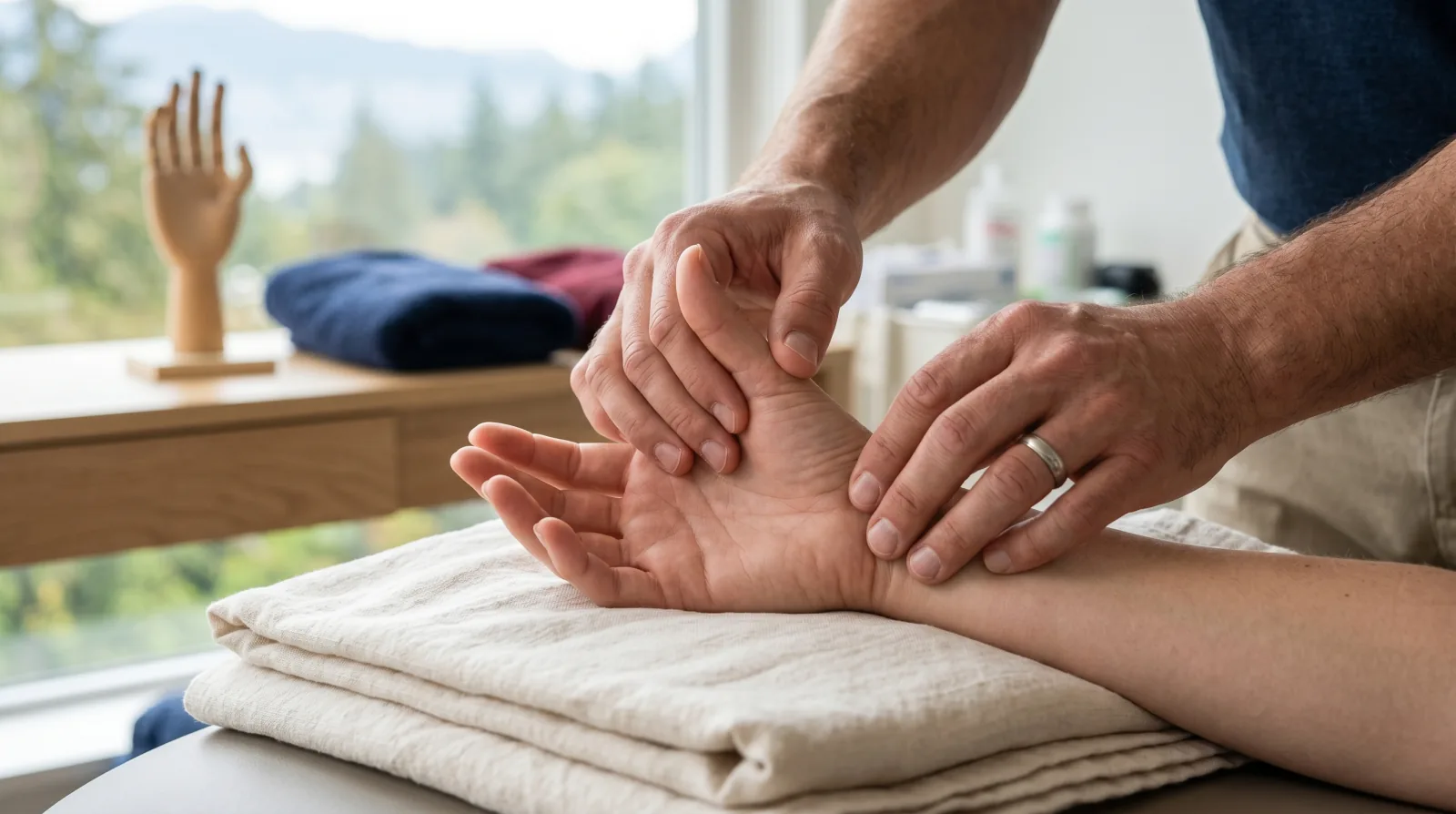
A clinician starts with your history and an examination of the joint. Pressing and turning the thumb at the joint is called the grind test. A 2010 study of 70 thumbs found that it detected arthritis in 42% to 53% of thumbs with X-ray signs, depending on the examiner, so a negative test does not rule arthritis out.
How it differs from De Quervain's, and why an assessment decides
De Quervain's tenosynovitis irritates two tendons that run along the thumb side of the wrist. A review in the journal Hand places the pain around the radial styloid, the bony point on the thumb side of the wrist. The usual check that tries to bring on the pain is the Finkelstein test, where the thumb is folded into a closed fist and the wrist tilts toward the little finger.
Thumb base arthritis hurts in the joint itself, lower down at the base of the thumb. The two areas are close together, and both hurt with gripping and pinching, so the pain alone cannot separate them. Only an assessment can tell them apart, and the treatment differs because one involves tendons and the other involves a joint. Our guides cover De Quervain's in new parents and texting thumb.
Joint protection, helpful tools and exercise come first
The 2018 recommendations from EULAR, the European rheumatology society, begin the treatment list for hand osteoarthritis with education, assistive devices, exercises and orthoses (splints and braces). The 2019 guideline from the American College of Rheumatology (ACR) and the Arthritis Foundation strongly recommends exercise for hand osteoarthritis. The 2019 guideline from the Osteoarthritis Research Society International (OARSI) covers knee, hip and multiple-joint osteoarthritis, and names no recommendation for the thumb base.
Joint protection means changing how you do tasks to reduce strain on the sore joint, such as using your whole hand or both hands instead of a tight pinch. A trial of 257 adults aged 50 and older taught joint protection and hand exercises in four group sessions. At 6 months, 33% of those taught joint protection met an agreed standard for improvement, compared with 21% of those who were not. For hand exercises the figures were 28% and 25%, a gap the study could not tell apart from chance.
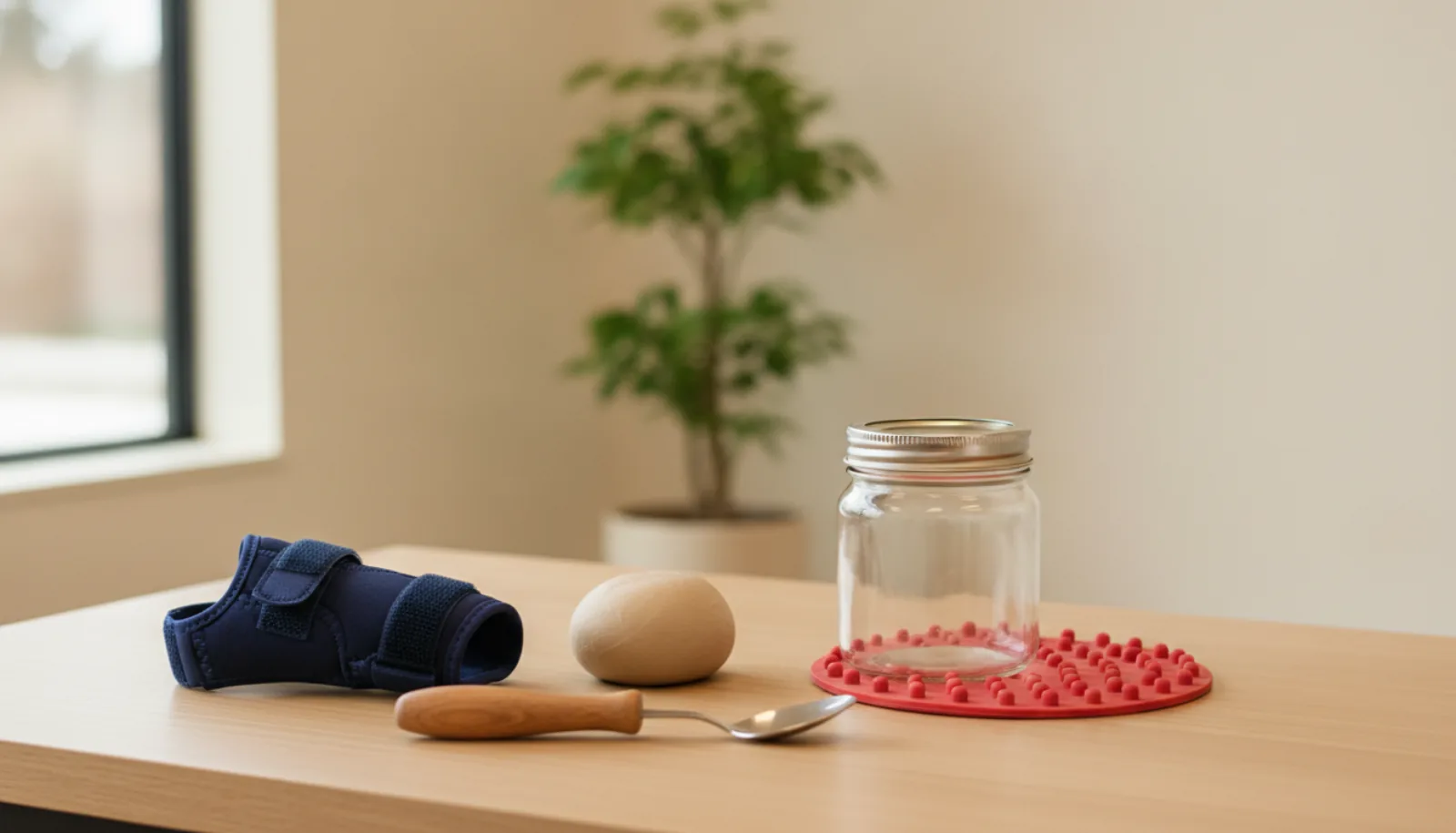
Tools reduce the pinch demand. A 2025 review of trials found moderate-certainty evidence that assistive devices improved hand function over the long term. Examples are a rubber jar-opener pad, thicker handles on cutlery and pens, a key turner, lever taps and voice typing on a phone.
Exercise has weaker support. Pooling five trials, the Cochrane review found low-quality evidence that exercise lowered hand pain by 0.5 points on a 0 to 10 scale (the plausible range was 0.1 to 0.9), and the benefit was gone at 6 and 12 months. In a trial of 190 people with thumb base osteoarthritis, adding a home exercise program to standard care gave no extra benefit, and only 48% of people finished the study. Exercise is low risk and may reduce pain by a small amount. A physiotherapist can choose a set that the joint tolerates. One 2021 trial used thumb opposition, paper tearing, squeezing a ball and picking up objects with chopsticks, three times a week.
Splints help some people, and the trials disagree
A thumb splint holds the base joint in a steadier position. In a French trial of 112 people, a custom-made neoprene splint made no difference to pain at 1 month. At 12 months, pain had fallen by 22.2 mm on a 100 mm scale in the splint group and by 7.9 mm in the usual-care group. The patients and examiners knew who had the splint, which limits how far the result can be trusted.
A larger UK trial of 349 people gave everyone a therapist-led self-management program of 90 minutes over 8 weeks. Some people also received a real splint and some a placebo splint (a look-alike). All groups improved, pain scores at 8 weeks did not differ between them, and the authors concluded that a splint added no benefit to a good self-management program.
An Australian trial of 204 people in 2021 compared education alone with education plus a ready-made neoprene splint, exercises and diclofenac gel. At 6 weeks, hand function improved more with the combination (1.7 points on a 30-point scale) and pain was not clearly different. At 12 weeks, pain was 8.6 mm lower on a 100 mm scale. All 34 minor unwanted effects, mostly skin reactions and pain increases with exercise, were in the combination group.
Guidelines weigh these results differently. The ACR guideline strongly recommends hand splints for osteoarthritis of the first CMC joint. A review of non-surgical treatments found low-to-moderate quality evidence that a custom-made thermoplastic thumb splint beat no treatment. The guideline from the British Society for Surgery of the Hand suggests adding a splint for people who have not responded to self-management alone. In practice, a splint is a trial of a few weeks. Choose it for the tasks that hurt most, check the skin each day, and stop if the skin breaks down.
Heat, gels and tablets can ease pain
The ACR guideline conditionally recommends heat or cold applied to the skin for hand osteoarthritis, and paraffin wax baths as one form of heat. Conditional means the evidence is limited. Check the skin often, and avoid heat on skin with reduced feeling.
The EULAR recommendations prefer treatments on the skin over tablets and name anti-inflammatory gels as the first drug choice. The ACR guideline conditionally recommends them for hand osteoarthritis. The 2025 review found high-certainty evidence for a small short-term gain in hand function from these gels. EULAR advises anti-inflammatory tablets for a limited time only, and the OARSI guideline, written for other joints, recommends against them in people with heart disease and in frail people. A pharmacist or doctor can say whether a gel or tablet suits your health and your other medicines.
Injections have weak evidence
EULAR generally does not recommend steroid injections into hand joints. The ACR guideline conditionally recommends them, and the British hand surgery guideline suggests considering one for people who have not responded to treatment without needles or surgery.
The trial evidence is thin. In a trial of 40 people, a steroid injection into the thumb base joint gave no clinical benefit over a salt-water injection at 24 weeks. A review of 9 trials with 504 patients found that no commonly used injection was clearly better than a placebo or than another injection. The review of non-surgical treatments also found that a salt-water injection performed better than a steroid injection in the trials it covered.
When to see a hand surgeon
Surgery changes the joint, and a surgeon is the next step when pain still limits daily tasks after a steady attempt at non-surgical care. The British hand surgery guideline describes a stepwise plan: first a package of supported self-management, then a splint for people who have not responded, then a steroid injection, and surgery if symptoms fail to resolve. Extra steps such as rebuilding a ligament do not appear to add benefit over removing the trapezium alone.
The 2026 Cochrane review of surgery covered 25 studies with 1,591 participants and compared operations with each other. It found no studies that compared surgery with a placebo or with non-surgical care, and it rated most of the evidence as low or very low certainty. Because no trial compares surgery with non-surgical care, the choice rests on how much the thumb limits your life.
Ask your family doctor about a hand or orthopaedic surgeon if pain wakes you at night or if daily tasks such as dressing or cooking stay limited after several weeks of steady care. Your doctor decides on the referral.
Warning signs, and how to book
Go to the Lions Gate Hospital emergency department or call 911 for any of these:
- a hot, red, swollen joint with fever
- sudden loss of thumb function after a fall
- numbness spreading through the hand
HealthLinkBC describes an infected joint as often red, hot, swollen and tender, and says that early antibiotics are important to prevent permanent damage to the joint. A fall that stops the thumb working needs a check for a fracture or ligament tear, as in our guide to skier's thumb. Spreading numbness points to a nerve problem, and our guide to carpal tunnel syndrome explains one common cause. If the skin breaks down under a splint or strap, stop wearing it and see a doctor or physiotherapist promptly.
For aching at the base of the thumb with no warning signs, a physiotherapist can examine the joint, tell arthritis from tendon pain, and teach joint protection and exercises. You do not need a referral to book physiotherapy in British Columbia. The clinic is at 1325 Marine Drive, North Vancouver, BC V7P 3E5. You can book at medstar.janeapp.com or call (604) 988-5411. Physiotherapists in BC are licensed by the College of Health and Care Professionals of BC, and you can check any name in its public registry.
This article is general information, not personal medical advice, and is not a substitute for assessment by a regulated practitioner. A regulated practitioner can confirm whether the patterns described apply to you.
Sources
- Kloppenburg M, et al. 2018 update of the EULAR recommendations for the management of hand osteoarthritis. Ann Rheum Dis, 2019
- Kolasinski SL, et al. 2019 ACR/Arthritis Foundation Guideline for the Management of Osteoarthritis of the Hand, Hip, and Knee. Arthritis Care Res, 2020
- Gangopadhyay S, et al. Guideline on managing thumb base osteoarthritis: BSSH BEST findings and recommendations. J Hand Surg Eur Vol, 2025
- Bannuru RR, et al. OARSI guidelines for the non-surgical management of knee, hip, and polyarticular osteoarthritis. Osteoarthritis Cartilage, 2019
- Østerås N, et al. Exercise for hand osteoarthritis. Cochrane Database Syst Rev, 2017
- Baljer B, et al. Surgery for thumb (trapeziometacarpal joint) osteoarthritis. Cochrane Database Syst Rev, 2026
- Kjeken I, et al. Efficacy and safety of non-pharmacological, pharmacological and surgical treatments for hand osteoarthritis in 2024: a systematic review. RMD Open, 2025
- Hamasaki T, et al. Efficacy of nonsurgical interventions for trapeziometacarpal (thumb base) osteoarthritis: a systematic review. Arthritis Care Res, 2020
- Rannou F, et al. Splint for base-of-thumb osteoarthritis: a randomized trial. Ann Intern Med, 2009
- Adams J, et al. The clinical and cost effectiveness of splints for thumb base osteoarthritis: a randomized controlled clinical trial. Rheumatology, 2021
- Deveza LA, et al. Efficacy of a combination of conservative therapies vs an education comparator in thumb base osteoarthritis. JAMA Intern Med, 2021
- Dziedzic K, et al. Self-management approaches for osteoarthritis in the hand: a 2x2 factorial randomised trial. Ann Rheum Dis, 2015
- Pisano K, et al. Effect of a stabilization exercise program versus standard treatment for thumb carpometacarpal osteoarthritis. J Hand Ther, 2023
- Meenagh GK, et al. A randomised controlled trial of intra-articular corticosteroid injection of the carpometacarpal joint of the thumb in osteoarthritis. Ann Rheum Dis, 2004
- Riley N, et al. Injection therapy for base of thumb osteoarthritis: a systematic review and meta-analysis. BMJ Open, 2019
- Haugen IK, et al. Prevalence, incidence and progression of hand osteoarthritis in the general population: the Framingham Osteoarthritis Study. Ann Rheum Dis, 2011
- Merritt MM, et al. Diagnostic value of clinical grind test for carpometacarpal osteoarthritis of the thumb. J Hand Ther, 2010
- Goel R, Abzug JM. de Quervain's tenosynovitis: a review of the rehabilitative options. Hand, 2015
- HealthLinkBC: Septic arthritis
- College of Health and Care Professionals of BC: public registry
Common questions
Frequently asked questions.
What is arthritis at the base of the thumb?
It is osteoarthritis of the joint where the long bone behind the thumb meets a small wrist bone called the trapezium. Osteoarthritis is wear in the cartilage that covers the ends of bones. Doctors call this joint the trapeziometacarpal or carpometacarpal (CMC) joint. It hurts most with pinching, gripping and turning, such as opening jars or turning keys.
How can I tell thumb base arthritis from De Quervain's?+
De Quervain's irritates two tendons on the thumb side of the wrist, and the pain sits around the bony point of the wrist. Thumb base arthritis hurts in the joint at the base of the thumb, lower down. Both hurt with gripping and pinching, so only an assessment by a doctor or physiotherapist can tell them apart reliably.
Does a thumb splint help arthritis at the base of the thumb?+
The trials disagree. A French trial of 112 people found less pain and disability at 12 months with a night splint. A 2021 trial of 349 people found no added benefit from a splint on top of a therapist-led self-management program. The American College of Rheumatology guideline strongly recommends hand splints for this joint, so many people try one for a few weeks.
Which exercises help thumb base arthritis?+
The evidence is weak. A Cochrane review of exercise for hand osteoarthritis found low-quality evidence of a small pain reduction of 0.5 points on a 0 to 10 scale, not sustained at 6 and 12 months. One trial used thumb opposition, paper tearing, squeezing a ball and picking up objects with chopsticks, three times a week. A physiotherapist can pick a safe starting set.
Does heat help a painful thumb joint?+
The American College of Rheumatology guideline conditionally recommends heat or cold applied to the skin for hand osteoarthritis, and also paraffin wax baths. Conditional means the evidence is limited and the choice depends on your preference. Heat is low risk for most people. Check the skin often, and avoid heat on skin with reduced feeling.
Are cortisone injections worth trying for thumb base arthritis?+
The evidence is weak. In a trial of 40 people, a steroid injection gave no benefit over a salt-water injection at 24 weeks. A review of 9 trials found no injection clearly better than a placebo or than other injections. The British hand surgery guideline still suggests considering one for people who have not improved with other care.
Can I use an anti-inflammatory gel on my thumb?+
Often yes. The EULAR guideline from Europe names anti-inflammatory gels for the skin as the first drug choice for hand osteoarthritis. A 2025 review rated the evidence for a small short-term gain in hand function as high certainty. A 2021 trial that used diclofenac gel in its combined treatment recorded skin reactions. Ask a pharmacist or doctor whether a gel suits you.
When should I see a hand surgeon for thumb base arthritis?+
The British hand surgery guideline suggests surgery when symptoms persist after self-management, a splint and an injection. Ask your doctor for a referral earlier if pain wakes you at night or stops daily tasks despite a steady trial of non-surgical care. Surgery changes the joint, so the decision is yours after the surgeon explains the options.
What are the warning signs that need urgent care?+
Go to Lions Gate Hospital emergency or call 911 for a hot, red, swollen joint with fever, sudden loss of thumb function after a fall, or numbness spreading through the hand. Skin that breaks down under a splint also needs prompt attention, so stop wearing the splint and see a doctor or physiotherapist. A joint infection needs early antibiotics to prevent permanent damage, according to HealthLinkBC.
Do I need a referral to see a physiotherapist for thumb pain?+
No. In British Columbia you can book physiotherapy without a referral. At Medstar Sport Physio, 1325 Marine Drive in North Vancouver, you can book online at medstar.janeapp.com or call (604) 988-5411. Some extended health plans ask for a referral before they reimburse you, so read your policy first.

Written by
Ali Shafiei, RPTAli Shafiei is a Registered Physiotherapist with 10+ years of clinical experience in musculoskeletal, neurological and sports rehabilitation. North Vancouver.
This article is for general information only and does not constitute medical advice, diagnosis, or treatment. Individual presentations vary, and assessment findings and treatment plans differ from person to person. If you are experiencing severe symptoms, neurological changes (numbness, weakness, bowel or bladder changes), or a significant trauma, contact your physician or emergency services. Care at Medstar Sport Physio & Health is provided by practitioners registered with their respective British Columbia regulatory colleges.
Filed under
- thumb-arthritis
- cmc-osteoarthritis
- thumb-pain
- hand-osteoarthritis
- splinting
- hand-exercises
- north-vancouver