De Quervain's Tenosynovitis: The New-Parent Thumb Pain Nobody Warns You About
A sharp pain on the thumb side of the wrist when you lift your baby has a name, and a reason. De Quervain's tenosynovitis is common, treatable, and not your fault.
BY ALI SHAFIEI, RPT
Among the many surprises of new parenthood is a sharp pain on the thumb side of the wrist that arrives a few weeks in and bites every time you lift the baby. It is common enough to have a nickname, and a clear explanation, and it is treatable. If this is you, the first useful thing to know is that it is not a sign you have done anything wrong.
The sharp pain on the thumb side of the wrist that appears weeks into new parenthood is most often de Quervain's tenosynovitis. It is an irritation of the tendons that run through a snug tunnel near the base of the thumb. Lifting a baby dozens of times a day, with the thumb spread and the wrist bent, loads those tendons repeatedly and can cause this condition. It is not a sign you have done anything wrong. At Medstar Sport Physio in North Vancouver, we treat it with a combination of splinting to rest the tendons, changes to how you lift and carry, and a graded loading program to rebuild tolerance. Most cases settle with conservative care. The timeline depends on how much the aggravating load can be reduced during recovery.
What de Quervain's tenosynovitis is
De Quervain's tenosynovitis is an irritation of the tendons on the thumb side of the wrist. Two tendons that move the thumb run together through a snug tunnel near the base of the thumb. When those tendons and the sheath around them become irritated, moving the thumb and wrist becomes painful, particularly gripping, lifting, and any movement that combines a spread thumb with a bent wrist.
The pain sits over that thumb-side tunnel and can radiate up the forearm or into the thumb. A classic feature is sharp pain when you tuck the thumb into the palm and tilt the wrist toward the little finger, which puts the irritated tendons on stretch.
Why it hits new parents so hard
The reason de Quervain's is so common in new parents comes down to repetition and posture. Lifting a baby dozens of times a day, often with the thumb spread wide and the wrist bent to support the head, repeatedly loads exactly the tendons involved. Add in the all-day carrying, feeding positions, and the general grip demands of caring for an infant, and those tendons are loaded far more than they were used to.
It shows up across all new parents, and it is purely a high-repetition overuse pattern, not a sign of weakness or of doing something incorrectly. Naming it and explaining it tends to come as a genuine relief, because the pain can feel alarming when you do not know what it is.
This is the same overuse logic behind many hand and wrist conditions we treat, including de Quervain's tenosynovitis more broadly and related tendon problems like trigger finger.
How it is treated
The treatment combines several elements that work together.
Reduce the aggravating load. A thumb-and-wrist splint that rests the irritated tendons is often used to settle symptoms, especially early on. By limiting the painful thumb and wrist movements, it gives the tendons a chance to calm down.
Change how you lift. This is the part that makes the difference for new parents. We look at how you pick up, carry, and support your baby and find ways to take load off the thumb-side tendons, often by lifting with a more neutral wrist and using the whole hand rather than spreading the thumb. Small changes, repeated dozens of times a day, add up.
Manual therapy and graded loading. As symptoms settle, hands-on treatment can reduce sensitivity, and a graded loading program rebuilds the tendons' tolerance so they can handle the demands of parenting without flaring.
In stubborn cases that do not respond to conservative care, a corticosteroid injection or, rarely, a minor surgery is considered. But most cases settle without those, which is why we start with load modification, splinting, and loading.
Why a splint alone is not enough
People often hope a splint will simply cure it. A splint helps by resting the tendons and reducing the painful load, and it can settle symptoms while you wear it. But on its own it is not a cure. If the lifting and gripping patterns that overloaded the tendons do not change, and the tendons' tolerance is not rebuilt, symptoms tend to return the moment the splint comes off and normal baby-lifting resumes.
That is why we treat the splint as one part of the plan, not the whole of it. The load changes and the graded loading are what make the improvement last.
A realistic timeline
Many cases settle over several weeks with load modification, splinting, and a graded program. It can take longer for new parents specifically, because the aggravating activity, lifting the baby, cannot be much reduced. You cannot stop picking up your child, so the focus shifts to lifting in less provocative ways and gradually rebuilding the tendons' tolerance. Realistic expectations and practical, sustainable changes to how you lift make a real difference to how the recovery goes.
When to get it assessed
If you have sharp pain on the thumb side of your wrist that flares when you lift and grip, especially as a new parent, an assessment confirms whether it is de Quervain's, fits you with the right support, and gives you practical ways to lift that take the load off. The earlier the load is modified, the faster it tends to settle.
Book a 30-minute appointment and we will assess the wrist, confirm the diagnosis, and build a practical plan that fits the reality of life with a small child.
This article is general information about de Quervain's tenosynovitis. It is not personal medical advice. A regulated practitioner can confirm whether the patterns described apply to you.
Sources
- Goel & Abzug, de Quervain's tenosynovitis: a review of the rehabilitative options, Hand (2015)
- Cavaleri et al., Hand therapy versus corticosteroid injections in the treatment of de Quervain's disease: A systematic review and meta-analysis, Journal of Hand Therapy (2016)
- College of Physical Therapists of BC (CPTBC)
Common questions
Frequently asked questions.
What is de Quervain's tenosynovitis?
It is an irritation of the tendons on the thumb side of the wrist, where they run through a tunnel near the base of the thumb. When those tendons and their sheath become irritated, moving the thumb and wrist, especially gripping and lifting, becomes painful. It is common in new parents because of the repeated lifting and supporting of a baby with the thumb and wrist.
Why do new parents get thumb and wrist pain?+
Lifting a baby dozens of times a day, often with the thumb spread and the wrist deviated to support the head, repeatedly loads exactly the tendons involved in de Quervain's. The sheer repetition, combined with the postpartum period, makes this one of the most common new-parent overuse injuries. It is not a sign you are doing anything wrong, just a high-repetition load.
How is de Quervain's treated?+
Treatment combines reducing the aggravating load, often with a thumb-and-wrist splint to rest the tendons, with activity modification, manual therapy, and a graded loading program as symptoms settle. Adjusting how you lift and support your baby is a key part. In stubborn cases a corticosteroid injection or, rarely, surgery is considered, but most cases settle with conservative care.
Will a splint cure de Quervain's?+
A splint helps by resting the irritated tendons and reducing the painful load, which can settle symptoms, but it is part of the plan rather than a cure on its own. Without changing the lifting and gripping patterns that overloaded the tendons and rebuilding their tolerance, symptoms often return when the splint comes off. We use the splint alongside load changes and loading.
How long does de Quervain's take to get better?+
Many cases settle over several weeks with load modification, splinting, and a graded program, though it can take longer if the aggravating lifting cannot be much reduced, as is often the case for new parents. Realistic expectations and practical changes to how you lift make a real difference to the timeline.
Is de Quervain's the same as carpal tunnel syndrome?+
No. De Quervain's involves the tendons on the thumb side of the wrist, near the base of the thumb, and hurts most with thumb and wrist movement like gripping and lifting. Carpal tunnel syndrome involves a nerve running through the wrist and tends to cause numbness or tingling in the fingers, often at night. Both can affect new parents, but they involve different structures and need different treatment.
What happens at a first physiotherapy visit for de Quervain's?+
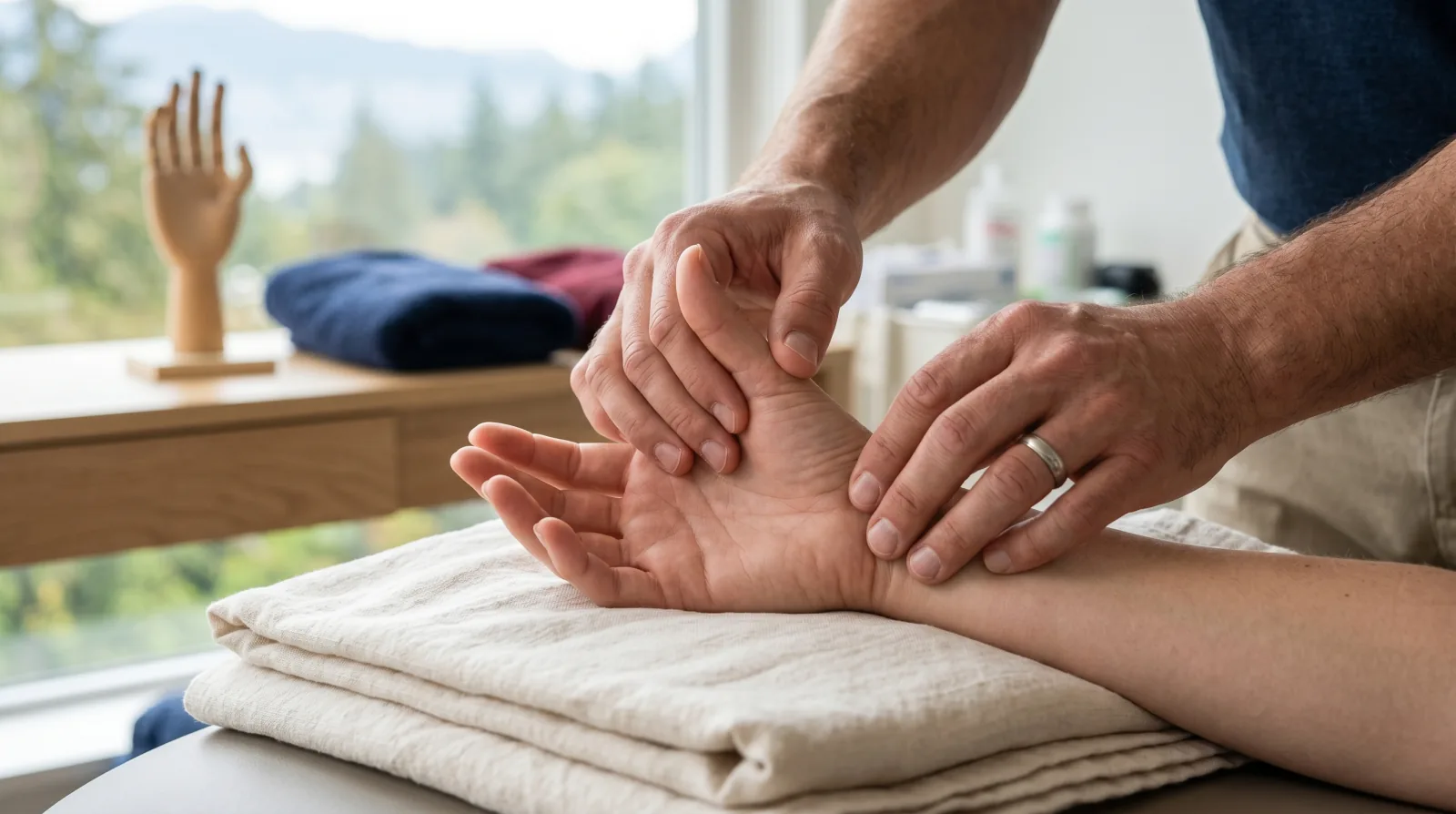
The physiotherapist takes a history of your symptoms and daily lifting demands, examines the wrist and thumb, and confirms the diagnosis with specific tests, including tucking the thumb into the palm and tilting the wrist. From there we discuss splinting options, look at how you lift and carry your baby, and set out a graded loading plan. Most visits also cover practical changes you can start using right away.
When should new-parent wrist pain be seen by a doctor instead of a physiotherapist?+
See a physician if the wrist is visibly swollen, red, or warm, if you have a fever, or if the pain follows a fall or direct injury rather than gradual overuse, since these can point to infection or a fracture rather than de Quervain's. Persistent numbness or tingling in the fingers is also worth a medical opinion. Straightforward, gradually worsening thumb-side wrist pain is well suited to a physiotherapy assessment first.
Share this post
Copies a ready-to-publish LinkedIn post to your clipboard and opens the LinkedIn share dialog. Paste the text into the composer and publish.

Written by
Ali Shafiei, RPTAli Shafiei is a Registered Physiotherapist with 10+ years of clinical experience in musculoskeletal, neurological and sports rehabilitation. North Vancouver.
This article is for general information only and does not constitute medical advice, diagnosis, or treatment. Individual presentations vary, and assessment findings and treatment plans differ from person to person. If you are experiencing severe symptoms, neurological changes (numbness, weakness, bowel or bladder changes), or a significant trauma, contact your physician or emergency services. Care at Medstar Sport Physio & Health is provided by practitioners registered with their respective British Columbia regulatory colleges.
Filed under
- de-quervains
- thumb-pain
- wrist-pain
- postpartum
- north-vancouver