Snowboard Shoulder Injuries: The Pattern Wrist Guards Do Not Cover
Wrist guards get most of the attention in snowboarding, and for good reason, but the shoulder takes a real share of the falls too. Here is the injury wrist guards do not touch.
BY MEDSTAR SPORT PHYSIO TEAM
Snowboarders and the people who treat them talk about wrists constantly, and for good reason. The shoulder gets less airtime despite carrying a real share of the season's falls, through a mechanism no wrist guard touches.
Snowboarding shoulder injuries, including acromioclavicular joint separations and full glenohumeral dislocations, make up 8 to 16 percent of all snowboarding injuries and come from a different fall mechanism than the classic wrist fracture. One study found snowboarding had the highest proportion of shoulder injuries turning out to be an AC joint injury of any sport studied, at 47 percent. At Medstar Sport Physio in North Vancouver, shoulder rehab after a snowboard fall starts by sorting which joint and which structures were injured, since an AC joint separation, a full dislocation, and a soft-tissue wrist injury all need different plans.
The injury wrist guards were never built for
Wrist guards work by supporting the wrist joint during a fall onto an outstretched hand, the classic mechanism behind a snowboard wrist fracture. That mechanism, a rider losing balance with both feet strapped to the board and throwing a hand out to catch the fall, is specific to the wrist.
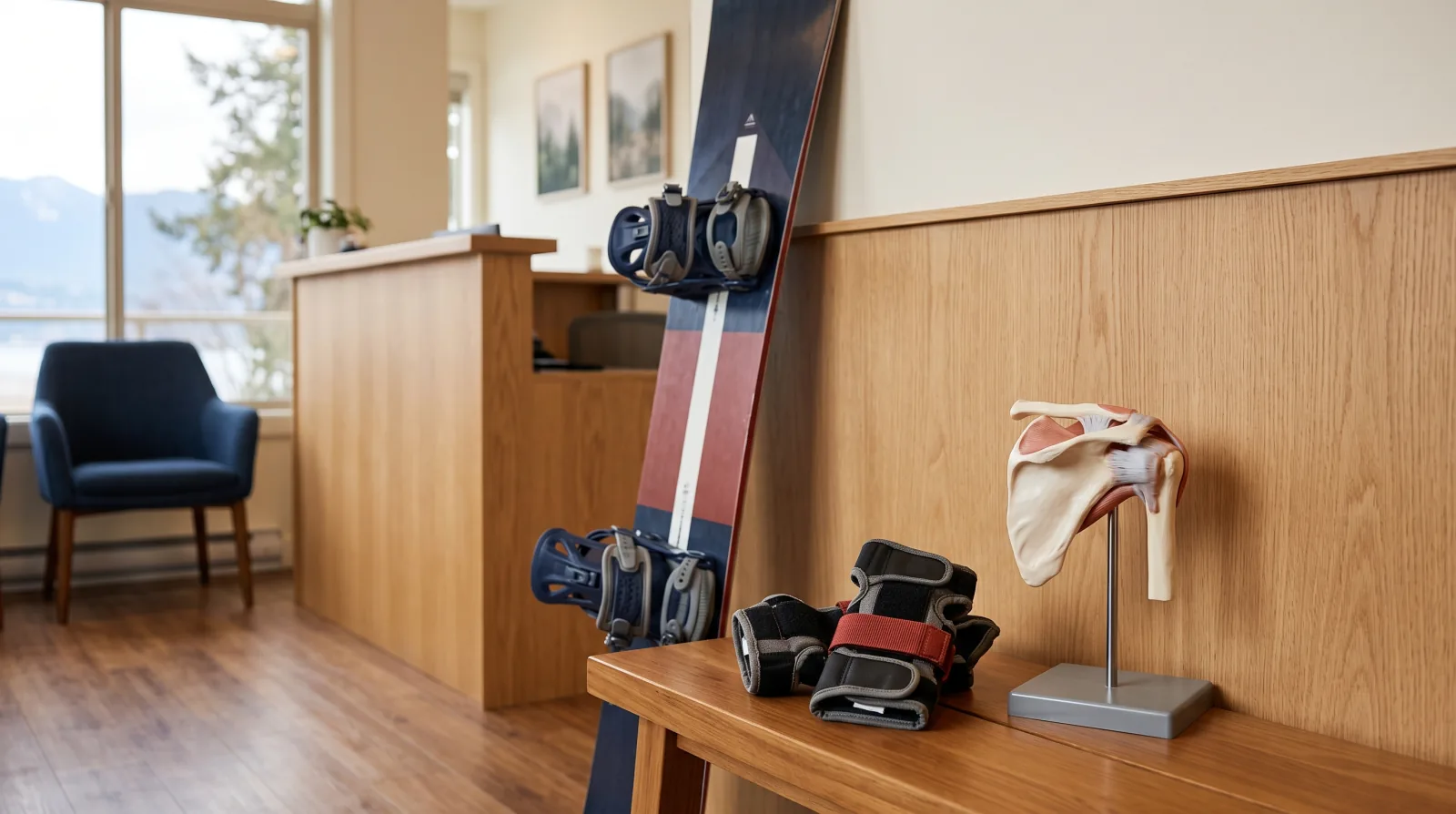
The shoulder gets hurt a different way. An acromioclavicular joint injury, often called a shoulder separation, happens from a direct fall onto the top or side of the shoulder. A full shoulder dislocation, where the arm bone comes out of its socket, usually comes from a fall onto an extended, rotated arm rather than a flat hand. Neither mechanism runs through the wrist, which is exactly why a wrist guard, however effective at its own job, does nothing to reduce either type of shoulder injury.
How common shoulder injuries actually are in snowboarding
Shoulder injuries are not a footnote in this sport. They account for 8 to 16 percent of all snowboarding injuries and 20 to 34 percent of upper-extremity injuries, a meaningful share of everything that sends a rider off the hill.
Within that shoulder injury category, one particular pattern stands out. A prospective cohort study of acromioclavicular joint injuries looked across a range of sports and found that snowboarding had the highest proportion of shoulder injuries turning out to be AC joint injuries specifically, at 47 percent, ahead of martial arts, ice hockey, and football. Young men carried the highest overall risk in the study, consistent with who tends to fill a beginner terrain park.
What an AC joint injury actually is
The acromioclavicular joint, shortened to the AC joint, sits at the top of the shoulder, where the collarbone meets the shoulder blade. A direct fall onto that spot, common when a rider goes down hard on the point of the shoulder rather than the hand, stretches or tears the ligaments holding the joint together.
The result ranges from a mild sprain that settles with rest and a progressive rehab program, to a more significant separation where the collarbone visibly steps up above the shoulder blade. The grade of the injury, assessed clinically and sometimes with imaging, determines whether the plan is a structured rehab program or a surgical opinion.
The other shoulder injury: full dislocation
A separate and more dramatic injury is a full dislocation of the glenohumeral joint, the main ball-and-socket joint of the shoulder, where the arm bone comes fully out of the socket. A study comparing glenohumeral dislocations in snowboarding and skiing over five seasons found the dislocation rate in snowboarders was more than double the rate in skiers, and that dislocations in snowboarders were more common with higher rider age, male gender, wet snow conditions, and falls that engaged the toe-side edge of the board. The overwhelming majority of these dislocations, 95.8 percent in that study, were the anterior type, meaning the arm bone displaces toward the front of the shoulder.
Telling an AC joint injury from a dislocation matters for treatment. An AC joint injury is often managed with rehab alone, while a dislocated shoulder needs to be reduced, meaning put back into place, which is a medical procedure, before any rehab begins. Trying to force a dislocated shoulder back into place without training is not something to attempt on the hill.
The wrist story is not finished at "broken bone" either
Wrist injuries still deserve their reputation. Snowboarders are far more likely to injure the wrist than skiers, and the fracture that results, a break in the distal radius near the wrist, is well documented in our guide to snowboard wrist fracture prevention. What that fracture-focused picture sometimes misses is what happens alongside the broken bone.
Research on distal radius fractures has found the triangular fibrocartilage complex, a cushioning and stabilizing structure on the pinky side of the wrist known as the TFCC, injured in more than half of cases, and some form of intracarpal soft-tissue injury present in the large majority of fracture cases. This matters practically: a fracture that heals on schedule by X-ray does not necessarily mean the wrist is fully recovered, if the soft tissue damaged alongside it has not had its own rehabilitation. A wrist that stays sore, clicks, or feels unstable after a fracture has healed is a reasonable thing to have reassessed rather than assumed normal.
Why this matters for how you protect yourself
None of this is an argument against wrist guards, which remain a sensible, evidence-supported precaution for the injury they target. It is a reminder that the wrist is not the only joint at risk, and that "I'm wearing wrist guards" does not mean the shoulder is covered. Falling technique that keeps the shoulder from taking a direct hit, building shoulder strength and control in the off-season, and simply progressing terrain and jumps gradually as a beginner all reduce shoulder risk in a way no piece of wrist equipment can.
For riders managing a different snow-sport risk, our guide to skier's thumb covers the thumb ligament injury that looks similar across both skiing and snowboarding falls, which is worth knowing alongside the wrist and shoulder patterns specific to snowboarding.
Rehab after a shoulder injury from a snowboard fall
Recovery starts with sorting out which structure was hurt, since an AC joint sprain, a full separation, a dislocation, and a rotator cuff strain all look similar in the first days but need different plans. Once the diagnosis is clear and any necessary reduction or surgical decision has been made, rehab generally follows a staged path: settling pain and protecting the joint early, restoring range of motion, then rebuilding strength and control around the shoulder before returning to the demands of riding, including the load of falling again safely.
When to get it assessed
A shoulder that is visibly deformed at the top, that will not move normally, or that feels like it is out of place after a fall needs prompt medical assessment, sometimes through Lions Gate Hospital's emergency department if the deformity or pain is significant. A wrist that stays sore, swollen, or unstable well after a diagnosed fracture has healed is also worth a follow-up assessment rather than assuming it is simply slow.
Book a 30-minute assessment and we will sort out which structure is injured, coordinate with a physician or surgeon when needed, and build a staged rehab plan to get your shoulder or wrist back to the demands of the mountain. You can see what we treat or reach the clinic here.
This article is general information about snowboarding shoulder and wrist injuries. It is not personal medical advice. A regulated practitioner can confirm whether the patterns described apply to you.
Sources
- Young men in sports are at highest risk of acromioclavicular joint injuries: a prospective cohort study (PMC)
- Glenohumeral dislocations in snowboarding and skiing (PubMed)
- HealthLinkBC - Finger, Hand, and Wrist Injuries
- College of Physical Therapists of BC (CPTBC)
Common questions
Frequently asked questions.
Do snowboarders injure their shoulders as often as their wrists?
Both are common, but for different reasons. Wrist injuries dominate the injury statistics in snowboarding because a fall on an outstretched hand is the instinctive reaction when both feet are strapped to the board. Shoulder injuries are a smaller share overall but still meaningful: shoulder injuries make up 8 to 16 percent of all snowboarding injuries, and one study found snowboarding had the highest proportion of shoulder injuries turning out to be an acromioclavicular joint injury of any sport studied, at 47 percent.
What is an acromioclavicular joint injury?+
The acromioclavicular joint, often shortened to the AC joint, sits at the top of the shoulder where the collarbone meets the shoulder blade. An AC joint injury, sometimes called a shoulder separation, happens when a direct fall onto the top or side of the shoulder stretches or tears the ligaments holding that joint together. It ranges from a mild sprain to a full separation where the collarbone visibly steps up from the shoulder blade.
How is a shoulder separation different from a dislocated shoulder?+
A shoulder separation involves the acromioclavicular joint at the top of the shoulder, usually from a direct fall onto the shoulder. A dislocated shoulder involves the main ball-and-socket joint, the glenohumeral joint, where the arm bone comes out of the socket, and it is most often caused by a fall onto an outstretched or extended arm. Both happen in snowboarding, and both need assessment, but they are different injuries to different joints with different treatment paths.
Why do wrist guards not protect the shoulder?+
Wrist guards work by supporting the wrist joint itself during a fall on an outstretched hand, which is the classic mechanism for a wrist fracture. A shoulder injury usually comes from a different mechanism: a direct fall onto the top of the shoulder for an AC joint injury, or a fall onto an extended, rotated arm for a dislocation. No wrist-level equipment changes the forces reaching the shoulder in either scenario, which is why wrist guards reduce wrist injuries without reducing shoulder injuries.
Can a snowboard wrist injury be more than a broken bone?+
Yes. Distal radius fractures, the classic snowboard wrist fracture, frequently involve soft-tissue damage alongside the broken bone. Studies of these fractures have found the triangular fibrocartilage complex, a cushioning structure on the pinky side of the wrist, injured in more than half of cases, and some form of soft-tissue injury inside the wrist in the large majority of fracture cases. This means recovery is not only about the bone healing; the surrounding soft tissue often needs its own attention during rehab.
How long does a shoulder separation take to heal?+
It depends heavily on the grade of the separation, since mild sprains and more significant separations are managed differently and heal on different timelines. Milder grades often recover with a period of rest, a sling for comfort, and a progressive rehabilitation program without surgery. More severe separations may need a surgical opinion. Your physiotherapist and, if needed, an orthopaedic surgeon determine the grade and the expected path based on your specific injury.
What happens at a physiotherapy assessment after a snowboard shoulder injury?+
The physiotherapist asks how the fall happened, since the mechanism helps distinguish an AC joint injury from a dislocation or a rotator cuff injury, then examines the shoulder's stability, strength, and range of motion. Visible deformity at the top of the shoulder points toward the AC joint, while a sense of the arm coming out of the socket points toward the glenohumeral joint. Imaging may be recommended to confirm the grade of injury before building the rehab plan.
Is physiotherapy for a snowboard shoulder or wrist injury covered by extended health insurance?+
Most BC extended health plans that include a physiotherapy benefit cover assessment and rehabilitation for a snowboarding injury the same as any other sport injury. Direct billing means the clinic bills your insurer directly rather than you paying upfront and claiming it back. If surgery or imaging is needed first, physiotherapy is typically coordinated to start once your surgeon or physician confirms you are cleared to begin rehab.
Share this post
Copies a ready-to-publish LinkedIn post to your clipboard and opens the LinkedIn share dialog. Paste the text into the composer and publish.
Written by
Medstar Sport Physio Team
Registered clinician at Medstar Sport Physio & Health, North Vancouver.
This article is for general information only and does not constitute medical advice, diagnosis, or treatment. Individual presentations vary, and assessment findings and treatment plans differ from person to person. If you are experiencing severe symptoms, neurological changes (numbness, weakness, bowel or bladder changes), or a significant trauma, contact your physician or emergency services. Care at Medstar Sport Physio & Health is provided by practitioners registered with their respective British Columbia regulatory colleges.
Filed under
- snowboarding
- shoulder-injury
- wrist-injury
- acromioclavicular
- shoulder-dislocation
- north-shore