
Breathing and Posture: Why the Diaphragm Is a Spine Muscle Too
The diaphragm is known as a breathing muscle. It is also part of the system that stiffens the spine before you lift, reach, or brace, and that second job gets crowded out when breathing demand goes up.
BY SANAZ DAVARIAN, PHD
The diaphragm gets filed under "breathing muscle" and left there. It has a second job that matters for anyone dealing with back pain or working on trunk control, and the two jobs sometimes compete with each other.
The diaphragm contributes to spine stability by helping build pressure inside the abdomen before a lift or sudden load, working alongside the deep abdominal muscles, the pelvic floor, and the spine muscles. At Medstar Sport Physio in North Vancouver, we look at breathing pattern as one factor in how the trunk manages load, not a stand-alone treatment, because research on the diaphragm's dual role shows its contribution to stability can decline when breathing demand rises. Breathing-focused exercise is used alongside progressive core and movement work, not instead of it.
The diaphragm's second job
Most people think of the diaphragm purely as the dome-shaped muscle that drops down to pull air into the lungs. That description is correct and incomplete. A review of the diaphragm's multifunctional role, published in Advances in Respiratory Medicine, describes the diaphragm as part of a "network" connected to postural control, the vascular and lymphatic systems, and digestive function, in addition to breathing.
The postural piece works like this. When the diaphragm contracts along with the deep abdominal muscles (the transversus abdominis), the pelvic floor, and the small muscles along the spine (the multifidus), the trunk builds pressure inside the abdominal cavity. That pressure acts something like a firm cylinder around the spine, adding stiffness before load arrives, whether that load is a barbell, a box, or a sudden stumble. This is the mechanism behind the coaching cue to "brace" before a lift, which we describe in our deadlift technique guide.
Why the two jobs compete under load
Here is the part that gets missed in a simplified explanation. Breathing and postural support are not two separate tasks the diaphragm juggles without cost. Research on its dual function has found that as the demand for breathing increases, such as during heavier exertion, the diaphragm's contribution to trunk and low back stability can decline, because the same muscle cannot maximally serve both roles at once.
This matters most in situations that combine heavy physical effort with a real breathing demand: a hard set at the end of a workout, a strenuous carry, or any task where someone is out of breath and also trying to control their trunk. It is a reasonable, evidence-grounded explanation for why form can degrade specifically when breathing gets hard, not only when muscles get tired.
What a lifting study actually found
A useful piece of direct evidence comes from a study that used ultrasound to track diaphragm movement during kettlebell lifting, published in PLOS One. Researchers measured diaphragm position with M-mode ultrasound, tracked breathing phase with spirometry, and measured abdominal wall tension, while participants lifted a kettlebell at about 20 percent of body weight under three conditions: holding the breath, breathing naturally, and voluntarily contracting the abdominal muscles harder.
They found that lifting a load shifted the diaphragm's position in a way connected to its postural role, and this shift happened in a pattern that was somewhat independent of the breathing cycle itself. Notably, voluntarily contracting the abdominal muscles harder, which doubled measured abdominal wall tension, did not meaningfully reduce this diaphragm movement compared with natural breathing under the same load. In plain terms, gripping the abdomen tighter did not substitute for the diaphragm doing its own postural job.
Where "postural restoration" fits, and where it overreaches
Postural restoration is the name of a specific branded system of assessment and exercise, built around the idea that breathing mechanics and body asymmetry interact to affect movement and pain. It has a growing set of case reports and small studies behind specific applications, including work on low back pain and shoulder conditions, but it has not been tested in the kind of large, high-quality trials that would establish it as superior to other approaches.
This distinction matters. The underlying biological principle, that the diaphragm plays a genuine role in both breathing and spine stability, is supported by a reasonable body of research. A specific commercial protocol built on top of that principle is a separate claim, and it carries a thinner evidence base. Treat the mechanism as real and useful, and treat any single branded system's superiority claim with more caution: a systematic review of systematic reviews on spine posture and physical exposure found no consensus on causality between specific spine postures and low back pain, with associations reported as inconsistent across the reviewed literature.
What this means for low back pain
A narrative review of diaphragm and core stabilization exercise for low back pain notes that impaired breathing patterns and reduced diaphragm movement are associated with reduced postural control and, in some studies, with pain sensitivity. The review suggests that including diaphragm-focused work alongside standard core exercise may improve outcomes for some people with low back pain, though it frames this as an area still being clarified rather than settled.
In our clinic, this translates to a practical addition rather than a replacement. Someone working through a low back rehab program benefits from the same progressive loading and movement retraining regardless of breathing pattern. Adding attention to how they breathe under load, particularly whether they tend to hold their breath poorly or breathe shallowly into the chest under stress, is a reasonable extra layer, not the foundation of the plan by itself.
Bracing is not the same as holding your breath all day
A brief breath-hold for a single heavy effort, often called bracing, is a normal strategy most healthy adults use without harm for that specific task. The goal in rehab is different from either extreme. It is not permanent breath-holding, and it is not loose, chest-only breathing all day either. It is a trunk that can brace briefly and effectively for a demanding task, then return to relaxed, lower-rib breathing the rest of the time.
Teaching that switch is often more useful than teaching either pattern in isolation, because most daily movement does not require maximal bracing, and constant bracing has its own costs in terms of tension and fatigue.
What breathing-focused exercise looks like in practice
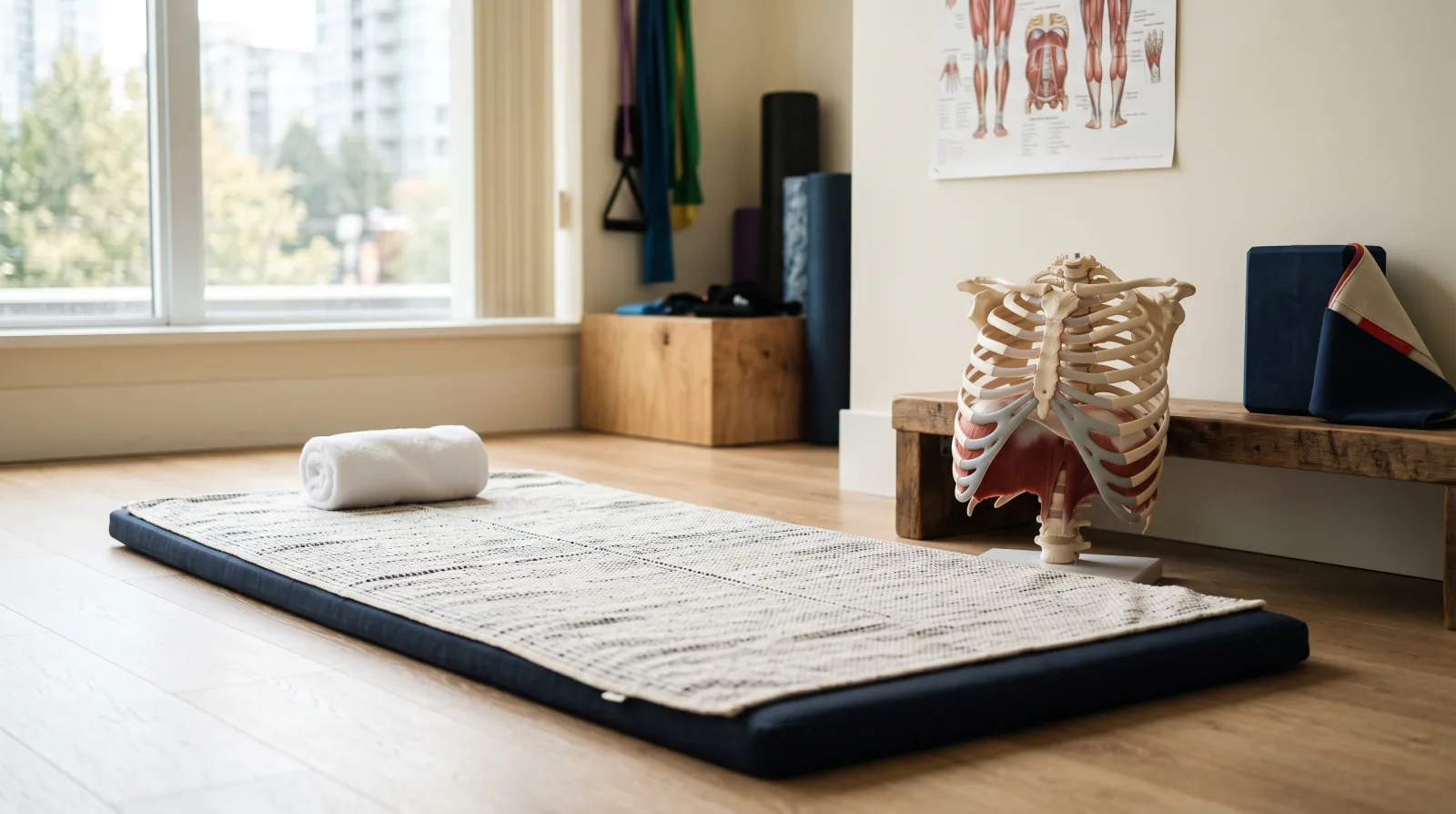
A typical progression starts lying down or seated, where it is easiest to feel the lower ribs and belly expand with a slow inhale rather than the shoulders and chest rising. From there, the same breathing pattern is coordinated with a gentle core activation, then carried into functional movement: a squat, a hip hinge, or a carry, so the pattern holds up under a real task rather than only in a controlled position on a mat.
This is the same principle behind the distinction we draw in core stability versus core strength: the goal is a trunk system, breathing included, that coordinates automatically under the demands of daily movement and sport, not a muscle group trained in isolation and never tested under load.
When to get it assessed
If back pain seems tied to how you breathe under effort, if you notice yourself holding your breath through ordinary tasks rather than just heavy lifts, or if standard core exercise has not moved the needle on a persistent back or trunk problem, an assessment can look at breathing pattern alongside strength, movement, and load tolerance rather than treating it in isolation.
Some back pain needs medical attention before any exercise approach. Numbness, tingling, or weakness down a leg, loss of bladder or bowel control, or pain that is severe and unrelenting are reasons to seek medical care rather than starting a breathing or core program.
The strongest results happen when breathing mechanics are treated as one input into a trunk that is also being loaded, strengthened, and moved through its full range, rather than as a stand-alone fix in its own right.
This article is general information about breathing mechanics and spine stability. It is not personal medical advice. A regulated practitioner can confirm whether the patterns described apply to you.
Sources
- Kocjan J, et al. Network of breathing. Multifunctional role of the diaphragm: a review. Advances in Respiratory Medicine (2017)
- Sembera M, et al. Postural-respiratory function of the diaphragm assessed by M-mode ultrasonography. PLOS ONE (2022)
- Diaphragm and core stabilization exercises in low back pain: A narrative review
- Swain CTV, et al. No consensus on causality of spine postures or physical exposure and low back pain: A systematic review of systematic reviews. Journal of Biomechanics (2020)
- College of Physical Therapists of BC (CPTBC)
Common questions
Frequently asked questions.
What does the diaphragm have to do with posture and spine stability?
The diaphragm sits at the top of the trunk and works with the deep abdominal muscles, the pelvic floor, and the muscles along the spine to build pressure inside the abdomen before you move. That pressure acts like a firm cylinder around the trunk, adding stiffness to the spine before load arrives. This postural role runs alongside, not instead of, the diaphragm's main job of breathing.
Can the diaphragm do its breathing job and its posture job at the same time?+
Usually yes at rest, but research shows the two jobs compete when demand rises. Studies on the diaphragm's dual role have found that when breathing demand goes up, such as during heavy exertion, the diaphragm's contribution to trunk stability can decline, because the same muscle cannot maximally serve both functions at once. This is one reason breathing pattern gets attention in rehab for back pain and trunk control.
Is postural restoration a proven treatment?+
It is a specific branded approach with a growing but limited body of case reports and small studies behind it, not a broadly proven treatment supported by large trials. A body of general research does support the diaphragm's role in trunk stability and breathing mechanics, which is the underlying principle. Whether a specific branded protocol outperforms other breathing- and core-focused exercise has not been established by strong evidence.
Does breathing exercise actually help back pain?+
Some evidence points that way, though the research base is still developing. A narrative review on diaphragm and core stabilization in low back pain notes that impaired breathing patterns are associated with reduced postural control, and that including diaphragm-focused work alongside standard core exercise may improve outcomes. It is reasonable to include as part of a broader active rehab plan, not as a stand-alone fix.
What is intra-abdominal pressure, and why does it matter for lifting?+
Intra-abdominal pressure is the pressure that builds inside the abdominal cavity when the diaphragm, deep abdominal muscles, and pelvic floor contract together, similar to how a firm balloon holds its shape. That pressure helps stiffen the trunk before a lift or a sudden load. A study using ultrasound during kettlebell lifting found the diaphragm shifts position for this postural role in a way that happens somewhat independently of the breathing cycle.
Should I hold my breath when I lift something heavy?+
A brief breath-hold, sometimes called bracing, is a normal and common strategy for a single heavy lift and is not harmful for most healthy people in that context. It is not a breathing pattern to use throughout a workout or throughout the day. The goal in rehab is usually a trunk that can brace briefly for a specific task and still breathe normally the rest of the time, not permanent breath-holding.
How do I know if my breathing pattern is affecting my back pain?+
This needs an assessment rather than a guess, since breathing pattern is one of several factors that can contribute to how the trunk manages load. A physiotherapist can watch how you breathe at rest and under light exertion, check whether you brace before you move, and see whether breathing-focused cues change how your back responds to a movement that normally provokes symptoms.
What does a breathing-focused exercise actually look like in physiotherapy?+
It typically starts with slow, controlled breathing that expands the lower ribs and belly rather than lifting the shoulders and chest, done lying down or seated where it is easiest to feel. From there it progresses to coordinating that breathing pattern with gentle core activation and eventually with functional movement, such as a squat or a lift, so the pattern holds up under real demand rather than only at rest.
Share this post
Copies a ready-to-publish LinkedIn post to your clipboard and opens the LinkedIn share dialog. Paste the text into the composer and publish.

Written by
Sanaz Davarian, PhDDr. Sanaz Davarian is a Registered Physiotherapist with a PhD and 20+ years of experience. Certified IMS Therapist, former Assistant Professor of Physiotherapy. North Vancouver.
This article is for general information only and does not constitute medical advice, diagnosis, or treatment. Individual presentations vary, and assessment findings and treatment plans differ from person to person. If you are experiencing severe symptoms, neurological changes (numbness, weakness, bowel or bladder changes), or a significant trauma, contact your physician or emergency services. Care at Medstar Sport Physio & Health is provided by practitioners registered with their respective British Columbia regulatory colleges.
Filed under
- breathing-mechanics
- diaphragm
- postural-restoration
- core-stability
- north-vancouver


