Os Trigonum Syndrome: The Extra Ankle Bone Behind Posterior Ankle Pain
Some people are born with one extra small bone at the back of the ankle. Most never notice it. In dancers, downhill runners, and kicking-sport athletes, it can become the source of a deep, specific pain that heel-pain advice does not fix.
BY ALI SHAFIEI, RPT
A deep, specific pain at the back of the ankle when you point your foot down does not fit the usual heel-pain advice. It is not the sharp morning ache of plantar fasciitis, and it is not the outer-ankle tenderness of a rolled ankle. For dancers, soccer players, and downhill runners, that pattern is often os trigonum syndrome, caused by an extra bone most people never know they have until one specific movement starts pinching it.
Os trigonum syndrome is pain at the back of the ankle from an accessory bone, present in about 15 to 30 percent of people, that gets compressed between the shinbone and heel bone during forceful downward foot pointing. Medstar Sport Physio treats it with an assessment-first approach on the North Shore, starting with conservative care before any injection or surgical option.
An extra bone that most people never notice
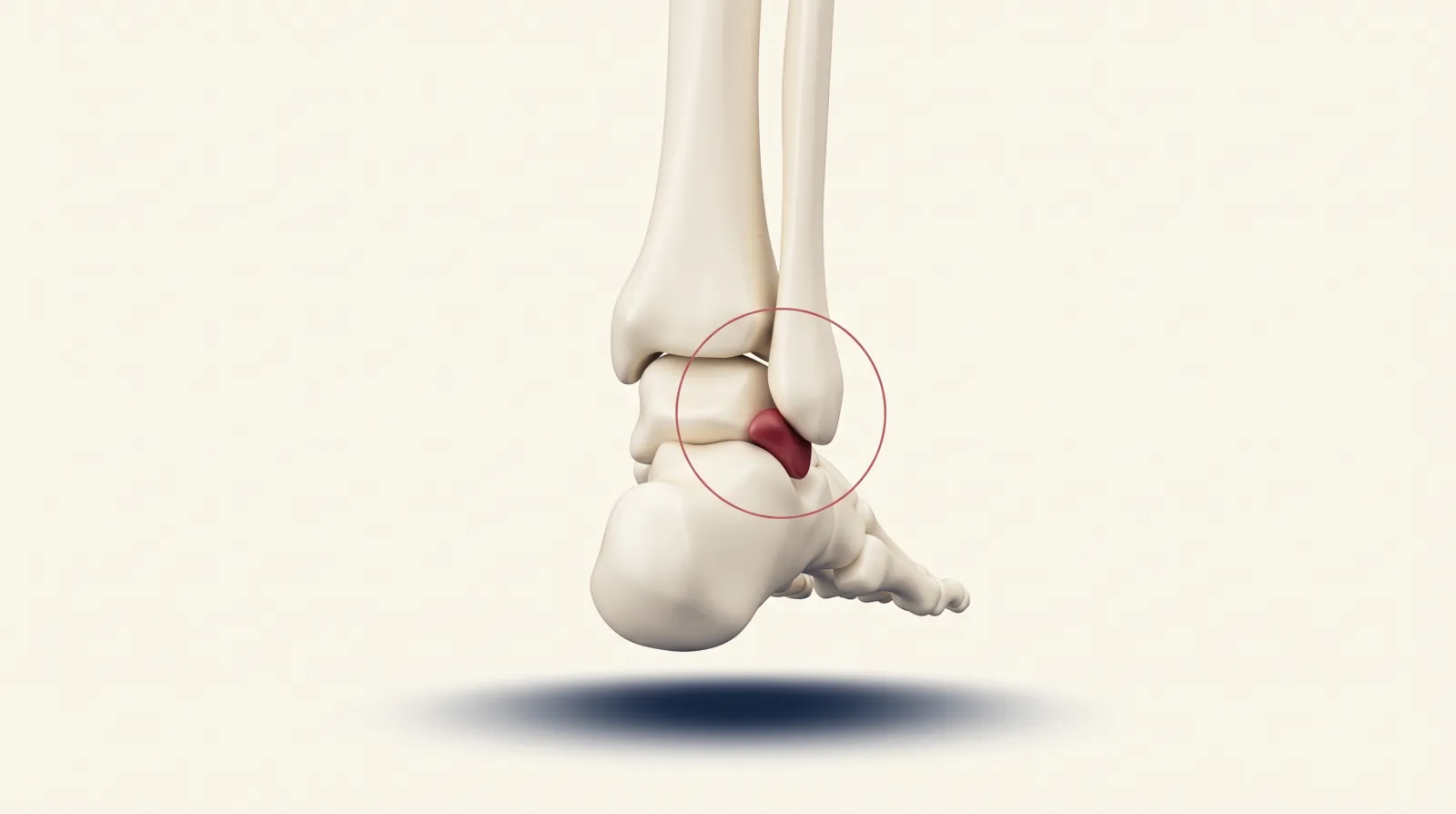
The os trigonum is a small accessory bone that forms behind the talus, the bone that sits between the shinbone and the heel bone at the top of the ankle joint. It develops from a growth centre at the back of the talus that, in some people, never fully fuses to the rest of the bone during childhood. According to the Cleveland Clinic, it is present from birth in roughly 15 to 30 percent of the population.
Having the bone is not the same as having symptoms from it. The os trigonum sits quietly behind the ankle in most people who have it, showing up as an incidental finding if an X-ray is ever taken for an unrelated reason. It only becomes a problem when a specific ankle position, forceful and repeated plantarflexion, pointing the foot down hard, starts compressing the bone and the soft tissue around it between the back of the shinbone and the top of the heel bone. That compression is sometimes called the nutcracker effect, since the mechanism is close to what the name suggests.
Who tends to develop symptoms
The Cleveland Clinic names ballet dancers, athletes in kicking sports like soccer, and people who walk or run downhill frequently as the groups most affected, and the common thread is repeated, forceful plantarflexion. A dancer working en pointe or demi-pointe drives the ankle into an extreme downward position on almost every rehearsal and performance. A soccer player's kicking leg goes through the same forced plantarflexion on every strike of the ball. Downhill running and hiking load the ankle into a similar position with every step, for kilometres at a time.
This is why symptoms usually build gradually rather than start with a single clear injury. A dancer might notice the ache appearing partway through a demanding rehearsal season. A runner training for a downhill race might notice it only after weeks of building mileage on descents. The pattern is overuse against a structure that was fine under normal, everyday ankle movement.
In our clinic, the athletes who describe this pain most clearly are the ones who can point to the exact movement that triggers it: a demi-pointe rise, a full-instep kick, a steep downhill stretch. That specificity is one of the clues that separates os trigonum syndrome from a more generic ankle ache.
What the pain actually feels like
The typical description is a deep ache or a sharp pinching sensation at the back of the ankle, distinct from the outer-ankle pain of a lateral sprain or the under-heel pain of plantar fasciitis. It is worst with the specific movement that compresses the bone: pushing off the big toe, a full kicking motion, or sustained downward pointing of the foot. Swelling, stiffness, and tenderness directly behind the ankle bone often go along with the pain.
Rest from the aggravating movement typically eases the ache, at least at first, which is part of why some people push through a mild version of this for a season before it becomes disruptive enough to seek an assessment. The pain pattern also tends to be reproducible: the same movement brings it on fairly consistently, rather than appearing unpredictably.
Why the bone is rarely the whole story
An X-ray showing an os trigonum is not automatically the full explanation for someone's posterior ankle pain, and treating it as if it were can lead to an incomplete plan. A 2022 review in PMC of posterior ankle impingement surgical cases found that an isolated os trigonum accounted for only 16 percent of the cases studied. Forty-one percent of patients had three or more additional contributing problems, and the flexor hallucis longus tendon, which runs directly behind the ankle joint in close proximity to the os trigonum, was involved in 68 percent of the cases reviewed.
That matters clinically because a plan built entirely around "removing the extra bone" can miss a tendon problem sitting right beside it, or a subtalar joint issue contributing to the same compressed space. An assessment for posterior ankle pain needs to check the tendon, the joint mechanics, and the bone together, not the bone in isolation.
How it gets diagnosed
Diagnosis starts with a detailed history: what movement brings the pain on, how long it has been building, and what sport or activity is involved. The physical exam typically involves forcing the ankle into the same downward position that reproduces the pain, along with checking the flexor hallucis longus tendon and surrounding structures for separate involvement.
A lateral X-ray with the ankle positioned in maximum plantarflexion is the standard first image, since it can show the os trigonum being compressed against the back of the talus and heel bone. If the exam suggests tendon or other soft tissue involvement, an MRI or ultrasound may follow, for the reason covered above: the bone on its own rarely tells the whole story.
Conservative care comes first
For most people, the first step is conservative treatment, not surgery. That typically means resting from the specific aggravating movement while staying active in ways that do not force the ankle into deep plantarflexion, along with a physiotherapy program that addresses ankle mechanics, any tendon involvement identified on assessment, and a graded return to the sport-specific movement once symptoms settle.
Technique modification matters for dancers and kicking-sport athletes in particular. A dancer's demi-pointe mechanics or a soccer player's kicking form can sometimes be adjusted to reduce how hard the ankle drives into the compressed position, without abandoning the movement altogether. This is where working with someone who understands the specific demands of the sport, not just the ankle in isolation, makes a practical difference.
There is no fixed timeline we can promise, since it depends on how long the pain has been building, how much the tendon or other structures are involved, and how consistently the loading changes get followed. What we can say is that conservative care is the standard starting point across the sources reviewed above, and most people get a real trial of it before any other option comes up.
When surgery becomes part of the conversation
Surgical removal of the os trigonum is considered when a genuine trial of conservative treatment has not resolved the pain, when imaging shows an associated problem unlikely to settle without intervention, or when a competitive athlete's schedule cannot accommodate the longer timeline conservative management sometimes needs. It is a second-line option weighed against how the case has actually responded, not an automatic step once the bone shows up on an image.
If surgery does become part of the conversation, that decision and the procedure itself sit with an orthopedic surgeon or sports medicine physician, not with physiotherapy. Our role at that stage shifts to post-surgical rehabilitation once cleared.
Worth a specific assessment, not generic ankle advice
A deep ache at the back of the ankle that gets worse with pointing the foot down, kicking, or downhill movement deserves more than generic heel or ankle advice, especially if the pattern lines up with dancing, a kicking sport, or downhill running or hiking. The bone is rarely acting alone, so the assessment needs to check the tendon and joint mechanics around it, not just confirm the os trigonum is there.
If this pattern sounds familiar, book an assessment. We will test the specific movement that triggers your pain, check the surrounding tendon and joint mechanics, and build a plan around what we actually find.
This article is general information about os trigonum syndrome and posterior ankle impingement, and is not personal medical advice. A regulated practitioner can confirm whether the patterns described apply to you.
Related reading
- High ankle sprain (syndesmosis): why it heals slower
- Tarsal tunnel syndrome: why the bottom of your foot goes numb
- Plantar fasciitis: morning heel pain explained
Sources
- Os Trigonum Syndrome: Symptoms, Causes & Treatment, Cleveland Clinic
- Posterior Ankle Impingement: It is Not All About the Os Trigonum, PMC (2022)
- College of Physical Therapists of BC (CHCPBC): Verify physiotherapist registration
Common questions
Frequently asked questions.
What is os trigonum syndrome?
Os trigonum syndrome is pain at the back of the ankle caused by an accessory bone, the os trigonum, that some people are born with. During forceful downward pointing of the foot, the bone and the surrounding soft tissue get compressed between the shinbone and the heel bone, a pattern often called the nutcracker effect. Not everyone with an os trigonum develops pain from it.
How common is having an os trigonum?+
According to the Cleveland Clinic, an os trigonum is present from birth in about 15 to 30 percent of people. Most of that group never develops symptoms, since the bone only causes pain when repeated or forceful ankle motion compresses it against neighbouring structures. Having the bone on an X-ray is not the same as having os trigonum syndrome.
Who is most likely to develop symptoms from an os trigonum?+
Ballet dancers who work en pointe or in demi-pointe, soccer players and other athletes who kick a ball repeatedly, and downhill runners or hikers are the groups most often affected, according to the Cleveland Clinic. Each activity repeatedly drives the ankle into the same forced downward position that compresses the bone, which is why symptoms tend to build gradually rather than appear after a single incident.
What does os trigonum syndrome feel like?+
The typical pattern is a deep ache or sharp pinch at the back of the ankle, worse when pushing off the big toe or pointing the foot down, such as during a calf raise, a kick, or downhill walking. Swelling, stiffness, and tenderness behind the ankle bone are common alongside the pain, and symptoms usually build with the specific activity rather than appearing at rest.
Is os trigonum syndrome the only cause of pain at the back of the ankle?+
No. A 2022 review in PMC of posterior ankle impingement surgical cases found that an isolated os trigonum accounted for only 16 percent of cases, while 41 percent of patients had three or more contributing problems, most often involving the flexor hallucis longus tendon that runs directly behind the bone. This is why an assessment looks at the whole back of the ankle, not just the bone on an X-ray.
How is os trigonum syndrome diagnosed?+
Diagnosis starts with a history of the aggravating movement and a physical exam that reproduces the pain by forcing the ankle into the same downward position. Imaging, usually an X-ray with the foot positioned in maximum plantarflexion, confirms the bone's position, and an MRI or ultrasound may follow if the exam suggests tendon or soft tissue involvement rather than the bone alone.
What is the first-line treatment for os trigonum syndrome?+
Conservative care is the standard starting point: resting from the specific movement that causes the pinching sensation, physiotherapy to restore ankle mechanics and address any tendon involvement, and activity or technique modification. Most people improve with this approach before any injection or surgical option is considered.
When does os trigonum syndrome need surgery?+
Surgery to remove the accessory bone is considered when a real trial of conservative treatment has not resolved the pain, when imaging shows a clear associated problem that will not settle on its own, or when an athlete's competitive schedule does not allow the longer timeline conservative care can take. It is a second step after conservative care, not the default first option.
Can I keep training or dancing with an os trigonum?+
It depends on whether the bone is currently symptomatic and how much the aggravating position (deep plantarflexion) is unavoidable in your sport. Many people with an asymptomatic os trigonum train without any restriction. Once symptoms start, continuing to load the same movement pattern without addressing it tends to prolong the problem, so an assessment to guide modified training is worthwhile.
Does ICBC or WorkSafeBC cover physiotherapy for os trigonum syndrome?+
Os trigonum syndrome is a developmental and overuse condition, not typically the result of a motor vehicle crash or a discrete workplace injury, so it is usually billed through extended health benefits rather than ICBC or WorkSafeBC. If your symptoms did follow a specific crash or workplace incident, mention that at your assessment so we can check whether either coverage applies.
Share this post
Copies a ready-to-publish LinkedIn post to your clipboard and opens the LinkedIn share dialog. Paste the text into the composer and publish.

Written by
Ali Shafiei, RPTAli Shafiei is a Registered Physiotherapist with 10+ years of clinical experience in musculoskeletal, neurological and sports rehabilitation. North Vancouver.
This article is for general information only and does not constitute medical advice, diagnosis, or treatment. Individual presentations vary, and assessment findings and treatment plans differ from person to person. If you are experiencing severe symptoms, neurological changes (numbness, weakness, bowel or bladder changes), or a significant trauma, contact your physician or emergency services. Care at Medstar Sport Physio & Health is provided by practitioners registered with their respective British Columbia regulatory colleges.
Filed under
- os-trigonum
- posterior-ankle-impingement
- ankle-pain
- dancers
- downhill-running
- north-vancouver