
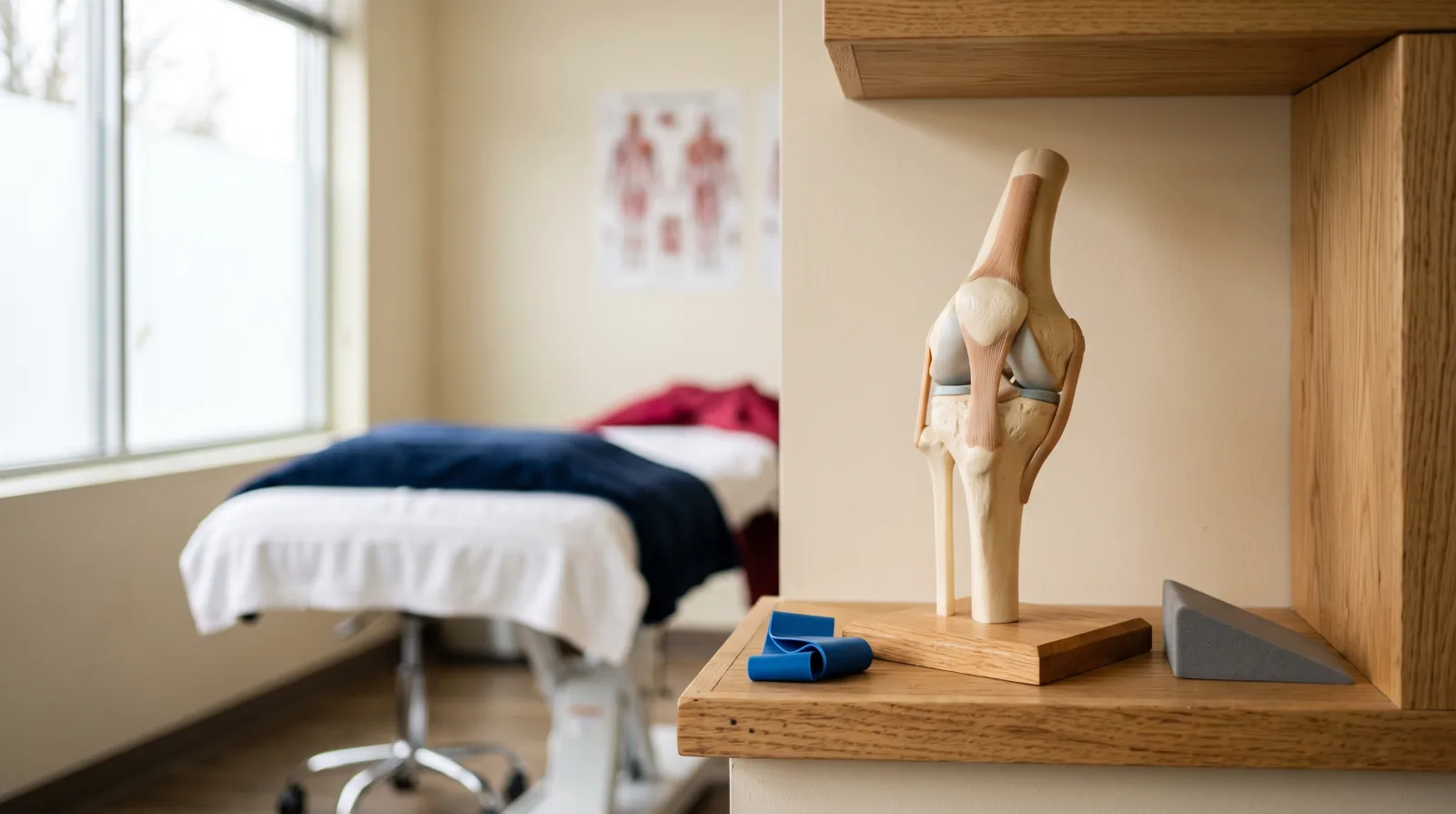
Kneecap Instability and Patellar Dislocation: What Happens After the Kneecap Slips
A dislocated kneecap is a different problem from ordinary kneecap pain. Here is what actually tears, why some knees keep dislocating, and what rehab looks like after.
BY SANAZ DAVARIAN, PHD
A dislocated kneecap is unmistakable when it happens, and confusing afterward. The kneecap slides back into place, the swelling comes and goes, and the question that actually matters, whether it will happen again, is not something you can answer by how the knee feels this week.
At Medstar Sport Physio in North Vancouver, a patellar dislocation means the kneecap has slid out of its groove, almost always toward the outside of the knee, tearing or stretching the medial patellofemoral ligament (MPFL) that normally holds it in place. Reported chances of it happening again after a first episode range from about 15 to 80 percent, depending heavily on individual anatomy, age, and activity level, which is why an assessment after a first-time dislocation focuses on identifying your specific risk factors rather than giving a single number that applies to everyone. Physiotherapy plays a central role whether the path taken is conservative management or surgery.
What actually happens when the kneecap dislocates
The patella, or kneecap, is meant to glide within a groove at the end of the thigh bone (the femur) as the knee bends and straightens. A dislocation means the kneecap has slid completely out of that groove, almost always toward the outside (lateral) side of the knee, usually during a twisting or pivoting movement with the foot planted, sometimes from a direct blow.
The medial patellofemoral ligament (MPFL), a band of tissue running from the inner edge of the kneecap to the thigh bone, is the main structure resisting that sideways slide, providing an estimated 50 to 60 percent of the total restraining force according to a 2024 consensus on managing first-time dislocations. That ligament is injured in nearly every first-time dislocation, whether it is stretched, partially torn, or fully torn. The kneecap frequently slides back into its groove on its own, sometimes as the knee straightens, which is part of why some people are unsure at first whether it actually dislocated or simply "gave way."
Why some knees redislocate and others don't
This is the question that actually shapes treatment. Reported rates of redislocation after a first episode vary from roughly 15 to 80 percent across different studies, a wide range that reflects how much individual anatomy changes the risk rather than inconsistent research.
Several anatomical features are consistently linked to a higher chance of redislocation: trochlear dysplasia (a groove at the end of the thigh bone that is shallower than normal, giving the kneecap less of a channel to track in), patella alta (a kneecap that sits higher than usual relative to the joint), genu valgum (a knock-kneed alignment), and torsional differences in how the thigh or shin bone is rotated. Younger age and higher activity level also increase the risk of a repeat episode, independent of the treatment chosen. An assessment after a first dislocation, often supported by imaging your physician orders, looks specifically for these features to give you a realistic individual estimate rather than a generic number.
Deciding between conservative care and surgery
Older guidance leaned toward treating almost every first-time dislocation the same way with a period of rest, bracing, and rehabilitation. The 2024 formal consensus from ESSKA, a major European sports medicine and arthroscopy society, moved toward individualized decision-making instead, tailoring the recommendation to the patient's specific risk factors and demands rather than applying one default pathway to everyone.
Under that framework, surgery is considered more strongly when there are multiple redislocation risk factors present at once, when an osteochondral fracture has occurred (a chip of bone and cartilage broken loose during the dislocation), when symptoms persist despite a genuine trial of conservative treatment, or in some skeletally immature patients whose growth plates are still open, since redislocation rates in that group can run notably high. Many straightforward first-time dislocations without these features are still managed conservatively, with physiotherapy as an essential part of the plan either way.
Where a brace does and does not help
Bracing after a patellar dislocation is common practice, and it is worth being clear about what the evidence actually supports. The same 2024 consensus found no clear evidence that any particular brace design outperforms no brace at all for preventing a future dislocation over the longer term. A brace with unrestricted motion may still have a place in the acute period after injury, mainly for comfort and confidence while swelling and pain settle, but it is not treated as a proven long-term prevention tool on its own.
This matters because it shifts the emphasis toward the parts of rehab that do have a stronger evidence base: restoring strength, movement control, and the specific muscle function that supports the kneecap during activity, rather than relying on external support to do that job.
How this is different from ordinary kneecap pain
Patellar dislocation is a distinct problem from patellofemoral pain, commonly called runner's knee, even though both involve the same joint. Runner's knee is a gradual ache around or behind the kneecap that builds up from load, without the kneecap ever actually leaving its groove. A dislocation is a specific traumatic event: the kneecap slides fully out, tears or stretches the MPFL, and typically causes immediate swelling, a sense of the knee giving way, and sometimes a visible or felt shift of the kneecap itself.
Telling these apart is usually straightforward from the history and the exam, since a dislocation has a clear mechanism and often a memorable moment where the kneecap moved. Someone with vague, load-related kneecap pain and no dislocation event is managed with a load-management and strengthening approach, not the ligament-focused, risk-factor-driven plan used after an actual dislocation.
What rehab looks like after a dislocation
Rehab generally moves through a similar sequence whether the injury was managed conservatively or surgically, though the specific timeline and restrictions differ. Early on, the focus is reducing swelling and restoring a comfortable range of motion without forcing the knee into positions that stress the healing MPFL. As tolerance improves, the program adds quadriceps and hip strengthening, since strong hip and thigh muscles help control how the kneecap tracks during activity, followed by balance and movement-control work.
Later stages build toward the specific demands of your sport or activity, including pivoting, cutting, and landing mechanics, since these are the movement patterns most associated with the original injury. A 2021 narrative review of first-time patellar dislocation management describes full activity resuming by around three months for straightforward conservative cases, though this is a general pattern rather than a fixed target, and surgical reconstruction typically follows a longer, more staged timeline set by the surgeon.
When to get it looked at
Any first-time kneecap dislocation deserves a proper assessment, even if the kneecap has already slid back into place and the knee feels reasonably normal within a day or two. That assessment identifies whether an osteochondral fracture occurred, screens for the anatomical risk factors that predict redislocation, and sets a rehab plan matched to your specific risk profile rather than a generic knee protocol.
A knee that gives way repeatedly, locks, or has dislocated more than once needs a more thorough workup, often including imaging, to properly weigh conservative management against a surgical opinion. Significant swelling that develops rapidly, an inability to straighten the knee, or a visible deformity after the injury warrants prompt medical assessment rather than waiting for a scheduled appointment.
Book a 30-minute assessment and we will check for the specific instability risk factors, get you moving safely, and build a rehab plan around whatever path, conservative or surgical, fits your knee. You can also read about our return-to-sport approach or see what we treat.
This article is general information about patellar dislocation and kneecap instability. It is not personal medical advice. A regulated practitioner can confirm whether the patterns described apply to you.
Sources
- Management of the First Patellar Dislocation: A Narrative Review (PMC)
- Management of first-time patellar dislocation: The ESSKA 2024 formal consensus, Part 2 (PMC)
- College of Physical Therapists of BC (CPTBC)
Common questions
Frequently asked questions.
What happens when a kneecap dislocates?
The kneecap, or patella, slides out of the groove at the end of the thigh bone where it normally tracks, almost always shifting toward the outside of the knee. This tears or stretches the medial patellofemoral ligament (MPFL), a band of tissue on the inner knee that is the main structure resisting that sideways movement, in nearly every first-time dislocation. The kneecap often slides back into place on its own or with a straightening of the knee, sometimes before arriving at the clinic or emergency department.
Will my kneecap dislocate again after the first time?+
It might, and the chance varies a great deal depending on individual anatomy. Reported redislocation rates after a first episode range from about 15 to 80 percent across studies, with younger age, higher activity level, and specific anatomical features such as a shallow groove for the kneecap to track in, a high-riding kneecap, or knock-kneed alignment all raising the risk. A physician or physiotherapist assessment after a first dislocation looks specifically for these risk factors to estimate your individual chance of it happening again.
Does a dislocated kneecap need surgery?+
Not always. A 2024 formal consensus from a major European sports medicine society recommends individualized decision-making rather than a single rule for everyone. Surgery is considered more strongly when there are multiple risk factors for redislocation, an osteochondral fracture (a chip of bone and cartilage), ongoing symptoms after conservative treatment, or in some skeletally immature patients with a high redislocation risk. Many first-time dislocations without those features are managed conservatively with physiotherapy.
What is the MPFL, and why does it matter?+
The medial patellofemoral ligament is a band of tissue running from the inner kneecap to the thigh bone, and it provides roughly half to 60 percent of the total force resisting the kneecap sliding sideways. It is injured in nearly every first-time patellar dislocation. Whether it heals well on its own, gets repaired, or gets reconstructed with a tendon graft is one of the central decisions in managing a dislocated kneecap, particularly for a knee that keeps redislocating.
Does a knee brace prevent another dislocation?+
The evidence does not support that a brace meaningfully lowers the long-term redislocation rate compared with no brace, according to a 2024 formal consensus. A brace with unrestricted motion may still be used briefly in the acute period after injury for comfort and confidence, but it is not treated as a proven way to prevent a future dislocation on its own.
How is a dislocated kneecap different from runner's knee?+
They are different problems entirely, even though both involve the kneecap. A dislocation is a specific traumatic event where the kneecap fully slides out of its groove, tearing the MPFL and often causing visible swelling and giving-way. Runner's knee, or patellofemoral pain, is a gradual ache around the kneecap from overload, without the kneecap ever leaving its groove. An assessment tells the two apart quickly based on how the injury happened and what the exam finds.
What does rehab look like after a patellar dislocation?+
Rehab typically starts with reducing swelling and restoring a comfortable range of motion, moves into quadriceps and hip strengthening, and progresses through balance, movement control, and sport-specific work as the knee tolerates it. Whether rehab follows conservative management or surgery, this staged progression is similar, though timelines and specific restrictions differ depending on which path you're on.
When can I get back to sport after a kneecap dislocation?+
Recovery timelines depend on the severity of the injury, whether surgery was needed, and how the knee responds to each stage of rehab, so there is no single number that fits everyone. Some reviews describe full activity resuming by around three months for straightforward conservative cases, while surgical reconstruction and more complex injuries typically follow a longer, more staged timeline set by the treating surgeon.
Share this post
Copies a ready-to-publish LinkedIn post to your clipboard and opens the LinkedIn share dialog. Paste the text into the composer and publish.

Written by
Sanaz Davarian, PhDDr. Sanaz Davarian is a Registered Physiotherapist with a PhD and 20+ years of experience. Certified IMS Therapist, former Assistant Professor of Physiotherapy. North Vancouver.
This article is for general information only and does not constitute medical advice, diagnosis, or treatment. Individual presentations vary, and assessment findings and treatment plans differ from person to person. If you are experiencing severe symptoms, neurological changes (numbness, weakness, bowel or bladder changes), or a significant trauma, contact your physician or emergency services. Care at Medstar Sport Physio & Health is provided by practitioners registered with their respective British Columbia regulatory colleges.
Filed under
- patellar-dislocation
- knee-instability
- kneecap
- mpfl
- north-vancouver


