IT Band Syndrome: Why the Outside of Your Knee Hurts When You Run or Ride
Outer-knee pain that arrives at the same point in every run or ride is the classic pattern of IT band syndrome. The fix is rarely more stretching. It is load management and hip strength.
BY MEDSTAR SPORT PHYSIO TEAM
Sharp pain on the outside of the knee that arrives at almost the same distance in every run, then fades with rest, is the signature of iliotibial band syndrome. It is one of the most common overuse problems in runners and cyclists, and the fix is rarely the one most people try first.
IT band syndrome is irritation on the outside of the knee where the iliotibial band passes the outer thigh bone, and in runners and cyclists it usually shows up as pain at a predictable distance that eases with rest. Foam rolling and stretching the band alone tend to disappoint, because the band does not lengthen much. The more reliable path, supported by research in runners, is hip abductor and gluteal strengthening combined with load management. At Medstar Sport Physio in North Vancouver, the plan reduces the trigger, downhills, distance, or a high bike saddle, and rebuilds the hip strength that controls the knee.
What the pain pattern tells you
The iliotibial band is a strong sheet of connective tissue that runs down the outside of the thigh, from the hip to just below the knee. In IT band syndrome, the tissue becomes irritated where it passes the bony bump on the outside of the knee, usually because it has been loaded more than it could tolerate.
The pattern is what makes it recognisable. Many people can run or ride for a set distance before the pain starts, and it often gets worse going downhill or as the pace increases. It sits over the outer knee, not the front of the knee or the joint line, which helps separate it from other common knee problems like patellofemoral or kneecap pain. Rest settles it, then it returns at the same distance, which is the frustrating hallmark of an overuse injury that has not been addressed at the source.
Why foam rolling alone disappoints
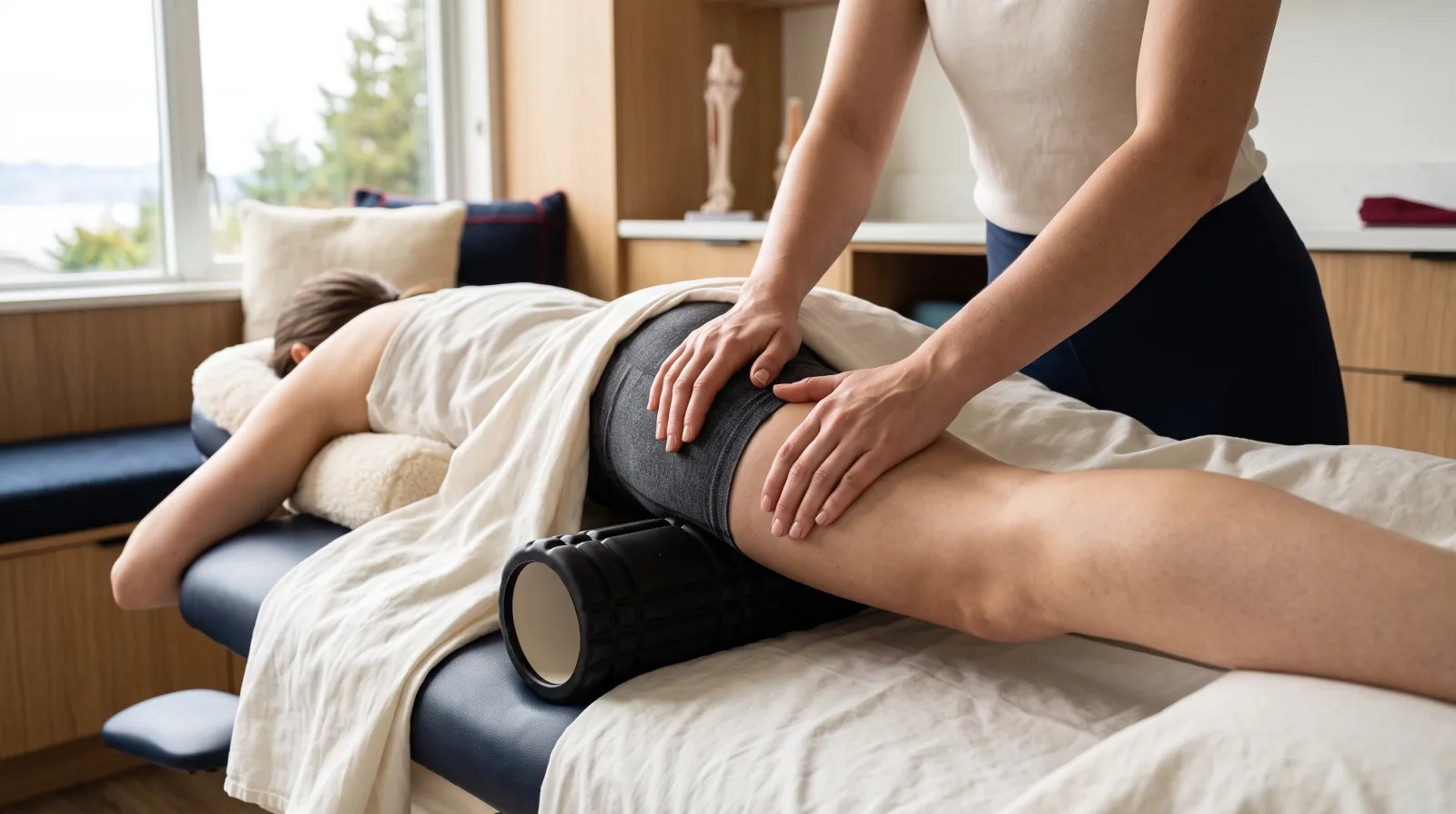
The instinct is to foam roll the outside of the thigh, often aggressively, in the hope of loosening the band. This can ease symptoms for a session, and it is not harmful. But on its own it rarely settles the problem.
The iliotibial band is not a muscle you can stretch to a new length. It is a dense sheet of tissue anchored firmly to bone, and rolling it does not build the capacity of the muscles that control the knee. This mirrors what we see across most overuse problems, where loading and strengthening, not stretching, are the active ingredients. Rolling can earn a small place in the plan for short-term comfort, but treating it as the cure is why so many runners cycle through weeks of rolling with no lasting change.
What the research points to
A systematic review of conservative treatment for IT band syndrome in runners found that hip abductor strengthening was a common thread across effective programs, with pain reductions reported over roughly two to eight weeks. Runners with IT band syndrome also tend to show lower hip abductor strength and greater fatigue in those muscles after running compared with runners who do not have the problem.
The practical read is that the outer knee is where the pain shows up, but the hip is often where the problem lives. When the hip stabilisers, the gluteus medius and the surrounding muscles, cannot control the leg through each stride or pedal stroke, the outer knee absorbs more strain than it can handle. Building the strength and endurance of those muscles is what changes the underlying picture, which is why our plans lean heavily on progressive strengthening rather than passive treatment alone.
The parts of a plan that actually work
A reliable approach to IT band syndrome pulls together a few elements:
Load management. Like most overuse injuries, IT band syndrome usually follows a spike in load, more mileage, more downhill running, more time in the saddle, or a jump in intensity. Reducing the specific trigger, while keeping you moving within a comfortable range, is foundational. Complete rest often settles the pain but sets up its return the moment you go back to the same load.
Hip and gluteal strengthening. Progressive strengthening of the hip abductors and glutes builds the capacity to control the leg, so the outer knee absorbs less strain. This is the part of the plan with the most support in the running research, and it is the part people most often skip.
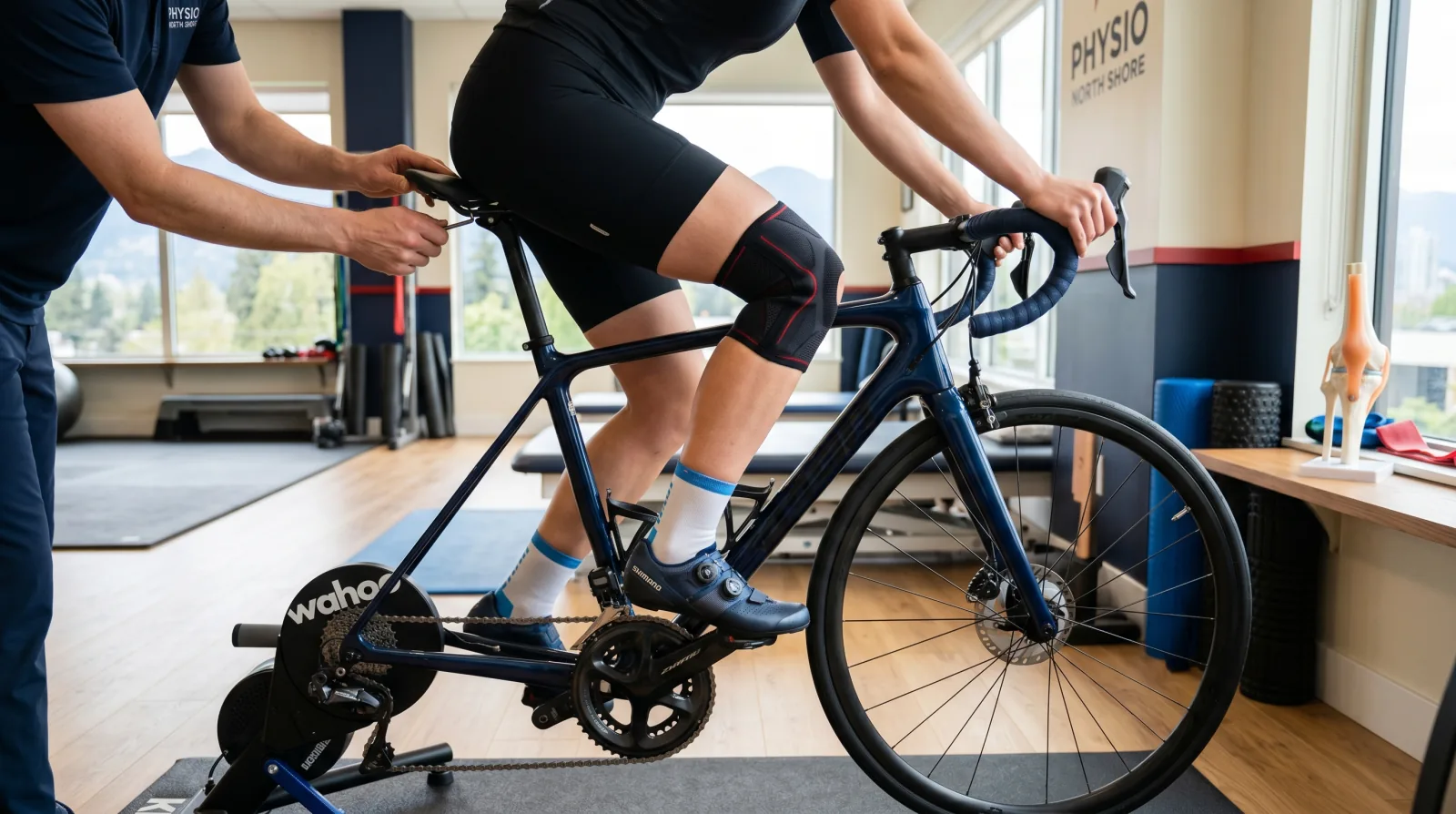
Running or riding adjustments. For runners, gradually reintroducing downhills and distance matters, and a running gait review can identify movement patterns that overload the outer knee. For cyclists, saddle height and cleat position often matter more than anything else, because a saddle set too high or a poorly aligned cleat increases strain on the outer knee through every pedal stroke.
Why cyclists need a bike-fit review
The tissue involved is the same in cyclists as in runners, but the trigger is different. In cycling, the knee moves through a repetitive arc thousands of times per ride, and small errors in the setup add up. A saddle set too high increases the strain on the outside of the knee near the bottom of the pedal stroke, and cleat position that rotates the foot poorly can do the same.
For a cyclist, we usually pair the strengthening work with a review of the bike setup, similar to how we approach cycling knee pain and bike fit. Getting the saddle and cleats right can remove the mechanical driver, so the strengthening has a chance to hold.
A realistic timeline
IT band syndrome often responds to conservative care over a few weeks, with the research in runners reporting meaningful pain reduction across roughly two to eight weeks of strengthening and load management. Cases that have been present for a long time, or that keep getting reaggravated by the same load, can take longer.
We pace the return to running or riding based on how the outer knee responds, progressing distance and downhills as each step is tolerated, and reassessing against function rather than expecting the pain to disappear overnight. Knowing the timeline ahead of time makes it far easier to stick with the plan rather than abandoning it after a rough week.
When to get it assessed
If you have sharp or burning pain on the outside of the knee that shows up at a predictable point in your runs or rides, an assessment confirms IT band syndrome, rules out other causes of outer-knee pain, and builds the strengthening and load plan that actually settles it. Outer-knee pain that comes with locking, giving way, or swelling in the joint is worth assessing sooner to be sure of the diagnosis.
Book a 30-minute appointment and we will assess your hip strength, your running or riding load, and, for cyclists, your bike setup, then build a plan to get you back to training without the burn on the outside of the knee.
This article is general information about iliotibial band syndrome. It is not personal medical advice. A regulated practitioner can confirm whether the patterns described apply to you.
Sources
- Aderem & Louw - Effects of conservative treatment strategies for iliotibial band syndrome on pain and function in runners: a systematic review, Frontiers in Sports and Active Living (2024)
- Balachandar et al. - Iliotibial band syndrome rehabilitation in female runners: a pilot randomized study, Journal of Orthopaedic Surgery and Research (2020)
- College of Physical Therapists of BC (CPTBC)
Common questions
Frequently asked questions.
What does IT band syndrome feel like?
It usually starts as a sharp or burning pain on the outside of the knee that comes on at a fairly predictable point in a run or ride, then eases with rest. Many people can run for a set distance before it starts, and it often gets worse going downhill or when the pace picks up. The pain sits over the outer knee, not the front or the joint line.
Does foam rolling fix IT band syndrome?+
Foam rolling can ease symptoms in the short term, but on its own it rarely settles the problem. The iliotibial band is a strong sheet of tissue that does not lengthen much with rolling. Research on runners points to hip abductor and gluteal strengthening, combined with load management, as the more reliable path. Rolling can be part of the plan, not the whole of it.
How long does IT band syndrome take to settle?+
It varies. Studies of conservative treatment in runners report meaningful pain reduction over roughly two to eight weeks with strengthening and load management, though longstanding cases can take longer. At Medstar we reassess against function, how far you can run or ride pain-free, rather than expecting it to vanish overnight.
Should I stop running or cycling completely?+
Usually not. Complete rest often settles the pain, but it returns as soon as you go back to the same load. The better approach is relative rest: reduce the distance, downhills, or intensity that triggers it, keep moving within a comfortable range, and rebuild capacity through strengthening. We help set that dose based on your symptoms.
Is IT band syndrome the same problem in cyclists as in runners?+
The tissue involved is the same, but the trigger differs. In runners it is often downhill running and hip strength. In cyclists, saddle height and cleat position matter a great deal, because a high saddle or poor cleat alignment increases strain on the outer knee through the pedal stroke. The strengthening side is similar, but a bike-fit review is usually part of a cyclist's plan.
Can I tell IT band syndrome apart from a meniscus or ligament injury myself?+
Not reliably. IT band syndrome sits over the outer knee and follows the predictable distance-then-fades pattern, while meniscus or ligament problems often come with swelling, locking, catching, or a feeling the knee will give way. Because the outer knee has other structures nearby, an assessment is the safer way to confirm which one you are dealing with rather than guessing from the location alone.
Does hip strengthening actually need to be supervised, or can I just do squats?+
General lower-body exercise like squats can help, but the research on IT band syndrome points specifically to targeted hip abductor and gluteal strengthening, not just any leg workout. A physiotherapist checks that you are actually recruiting those muscles and progressing the load, since it is easy to do a hip-strengthening exercise with poor form and get little benefit from it.
Will custom orthotics help IT band syndrome?+
Orthotics are not a first-line treatment for IT band syndrome in most cases. The stronger evidence points to hip and gluteal strengthening plus load management. Foot mechanics can matter for some runners, so it is worth raising with your physiotherapist if strengthening and load changes alone are not enough, but it is not where treatment usually starts.
Share this post
Copies a ready-to-publish LinkedIn post to your clipboard and opens the LinkedIn share dialog. Paste the text into the composer and publish.
Written by
Medstar Sport Physio Team
Registered clinician at Medstar Sport Physio & Health, North Vancouver.
This article is for general information only and does not constitute medical advice, diagnosis, or treatment. Individual presentations vary, and assessment findings and treatment plans differ from person to person. If you are experiencing severe symptoms, neurological changes (numbness, weakness, bowel or bladder changes), or a significant trauma, contact your physician or emergency services. Care at Medstar Sport Physio & Health is provided by practitioners registered with their respective British Columbia regulatory colleges.
Filed under
- it-band-syndrome
- itbs
- knee-pain
- running
- cycling
- north-vancouver