Grouse Grind Injuries: What Goes Wrong and How to Recover
The Grouse Grind is 2.9 km of relentless climbing. Most injuries happen on the way back down, and they are very predictable once you understand why.
BY AMIR AHMADI, PHD
The Grouse Grind is 2.9 km of near-continuous ascent, gaining roughly 850 metres from base to summit. For most North Shore hikers it is a benchmark, something to time and repeat. For the caseload we see at Medstar Sport Physio, it is a consistent source of predictable injuries. Most of them show up after the descent, not the climb.
At Medstar Sport Physio in North Vancouver, the injuries we see most after the Grouse Grind are IT band syndrome and patellofemoral knee pain driven by the descent demands, Achilles and calf problems from the sustained steep climbing, and ankle sprains from the uneven rocky footing. Most respond well to a structured load management and strengthening plan.
Why the descent causes more injuries than the climb
The climb up the Grouse Grind is hard on your lungs and your hip extensors. Your glutes and hamstrings generate the power to move you upward; your calf and Achilles handle the ankle loading; your cardiovascular system works at a high rate for the full duration of the ascent.
Coming down is a different problem. Whether you take the gondola to the base or descend via the trail, your quad muscles now work eccentrically. They lengthen under load to control each step rather than generate power. That places more force through the knee than the upward climb does. And after 40 to 60 minutes of aerobic effort on the ascent, your muscles are already tired when that demand peaks.
The IT band, the thick fascial band running along the outside of the thigh, goes through a repeated flexion-extension cycle at the knee during each downward step. When the hip abductors are fatigued or under-strengthened, the IT band is put under more tension to compensate, and lateral knee pain is the result. Patellofemoral pain (aching behind the kneecap) follows a similar logic: high eccentric quad demand plus fatigue equals increased joint loading.
The IT band: what goes wrong and why loading helps
IT band syndrome after hiking is one of the more common referrals we see from the North Shore trail community. The lateral knee pain typically presents during or after activity, is reproduced by stepping down stairs, and can be sharp during the specific portion of the descent where the knee is flexed around 30 degrees.
Contrary to what many people expect, the fix is strength work rather than rest and stretching. Research over the past decade, including systematic reviews published in the British Journal of Sports Medicine, has increasingly supported hip abductor and external rotator strengthening as the primary intervention. The loading pattern at the hip is what changes the tension going through the ITB, and the band itself does not stretch meaningfully. We cover the mechanics and rehab plan in more depth in IT band syndrome: why the outside of your knee hurts when you run or ride.
In our clinic, we use a graduated hip strengthening program, sometimes combined with short-term load modification (reducing frequency or elevation on trail hikes while building capacity), and manual therapy to address any associated tension patterns in the tensor fascia latae. If irritability is high, a short period of complete rest might precede the strengthening work, but the strength program is the actual treatment.
Knee pain behind the kneecap: patellofemoral presentations
Patellofemoral pain, an ache at the front of the knee that gets worse going down stairs or descending a slope, is extremely common after the Grouse Grind, particularly in people who are new to hiking or who have ramped up frequency quickly.
The patella (kneecap) tracks in a groove on the femur. Under high eccentric quad loading, if the hip abductors or external rotators are not providing adequate stability, the femur can rotate inward relative to the knee, changing the mechanical environment of the patellofemoral joint. This is visible in the way some people's knees move inward (valgus collapse) during a step-down test at assessment.
Treatment targets the hip, not just the knee. Patellofemoral pain rehabilitation has good evidence behind hip-dominant strengthening programs. The 2016 systematic review in the British Journal of Sports Medicine found hip strengthening to be a clinically important addition to knee-focused exercises. We use that evidence base for our North Shore hiking population.
Achilles and calf: what the climb demands
The ascent of the Grouse Grind is a sustained, high-demand stimulus for the calf-Achilles complex. The step height and grade require significant plantarflexion force with each step, and many people are not conditioned for 40 to 60 minutes of continuous uphill walking.
Achilles tendinopathy after the Grind typically presents as morning stiffness that improves with movement, or a sharp ache at the Achilles during or after activity. Calf strains (actual muscle tears) are less common but do occur, particularly when someone pushes the pace late in the ascent when the muscle is already fatigued.
The distinction between a tendinopathy and a calf strain matters because the rehab is different. A tendinopathy responds to progressive loading, specifically heavy slow resistance exercises that load the tendon through a range. A calf strain needs a period of relative rest before loading begins, with the timeline depending on the strain grade.
Ankle sprains and footing
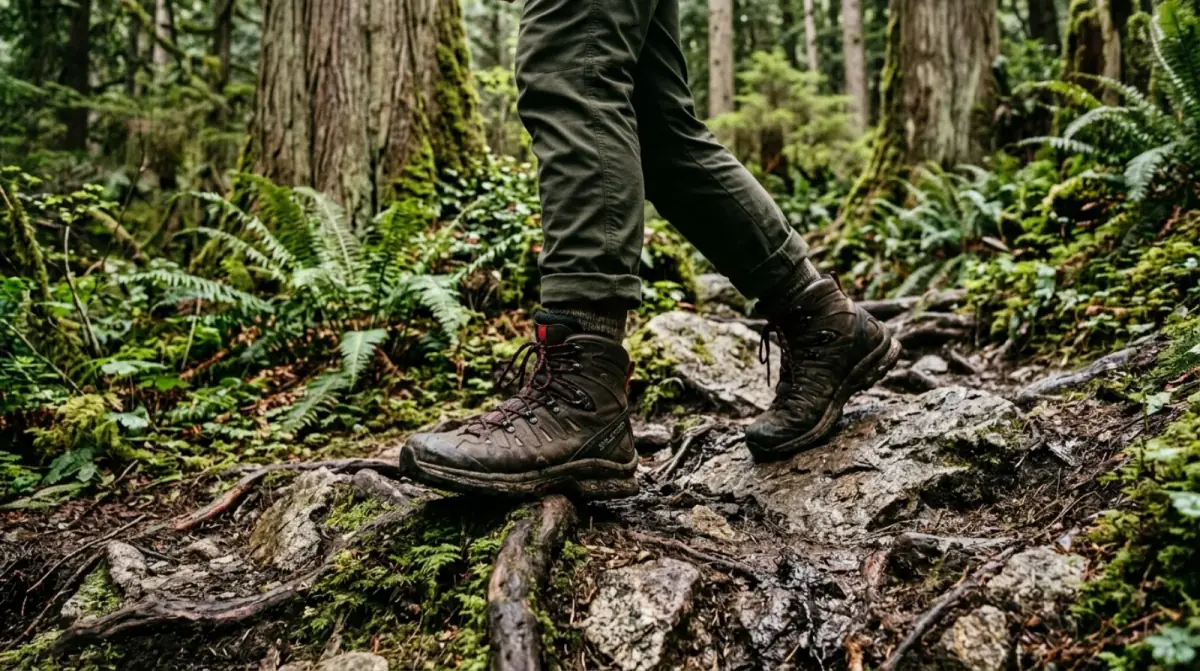
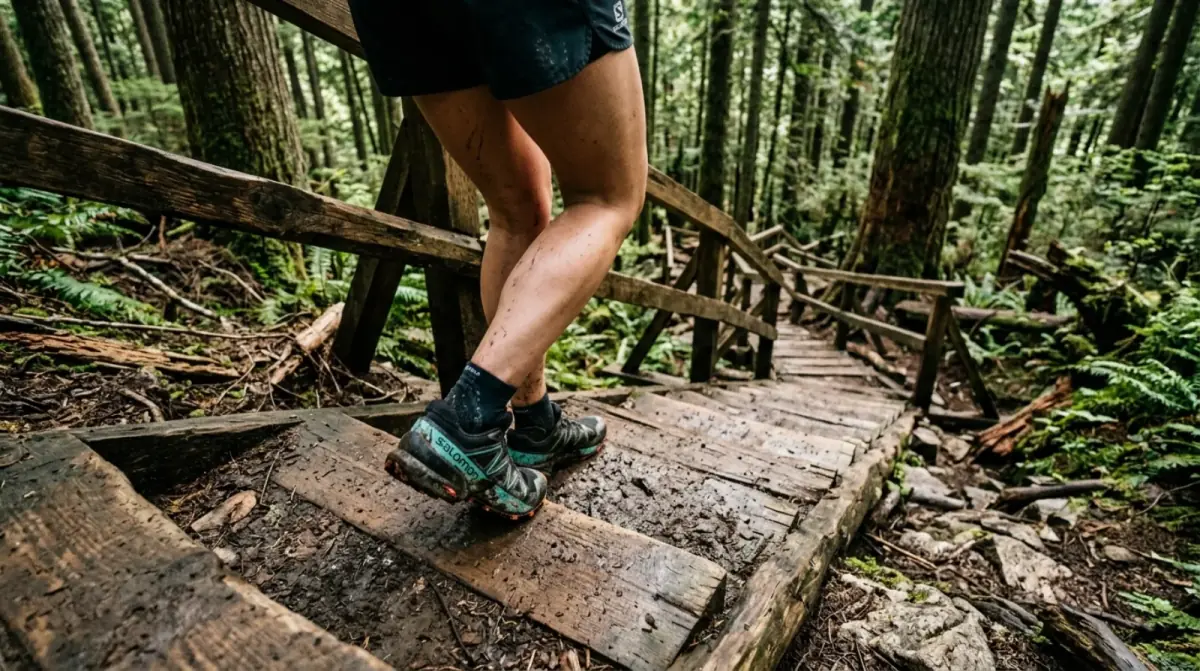
The lower portion of the Grouse Grind is a mix of wooden steps and rocky, uneven trail. Ankle sprains, typically inversion sprains to the lateral ankle, are common, particularly later in the hike when attention and proprioception are reduced by fatigue. Our ankle pain and Achilles injury page covers assessment and rehab for this pattern in full.
Most lateral ankle sprains after the Grind are Grade I or II, meaning partial ligament tears that recover well with a structured balance and proprioception rehabilitation program. Grade III sprains (complete lateral ligament rupture) are less common but require closer management, and any ankle injury in which bone tenderness is present should be assessed for fracture using the Ottawa Ankle Rules framework, which your physiotherapist or an emergency physician will apply at assessment.
The chronic ankle instability that develops in people who have had repeated sprains without proper rehabilitation is more functionally limiting than a first-time sprain, which is why we address balance training and proprioceptive work early in the rehab rather than as an afterthought.
Building a body that handles the Grind repeatedly
The Grouse Grind pulls repeat visitors. Some people do it two or three times a week in season, chasing their best time. That is a lot of load for a body that may not have trained specifically for it.
The gaps we see most often in Grind-related overuse injuries are weak hip abductors and external rotators, not enough eccentric quad strength for downhill control, under-loaded calves and Achilles relative to 50+ minutes of steep climbing, and poor single-leg balance for the rocky footing.
Stretching does not fix any of those. A pre-season program with step-downs, single-leg Romanian deadlifts, Copenhagen adduction work, and progressive calf loading does. None of these are complicated. Most take 20 minutes, two or three times a week.
When to see a physiotherapist after the Grouse Grind
Sore legs in the 24 to 48 hours after the Grind are normal. Delayed onset muscle soreness (DOMS) does not need physiotherapy.
What does warrant a booking: pain that does not settle within a week of modified activity, pain that gets worse hike to hike rather than better, swelling or bruising after a specific incident, a joint that gave way or feels unstable, or any numbness or weakness. An acute ankle roll or knee twist with significant loss of function is a same-day call.
Getting assessed early after those patterns consistently shortens the overall course.
You can book at medstar.janeapp.com or call us at (604) 988-5411. We are at 1325 Marine Drive, North Vancouver, a short drive from the base of Grouse Mountain.
This article is general information about hiking-related overuse injuries and their management. It is not personal medical advice. A regulated practitioner can confirm whether the patterns described apply to you.
Sources
- Grouse Mountain. The Grouse Grind trail statistics
- British Journal of Sports Medicine. Hip strengthening for iliotibial band syndrome
- Rathleff et al. Exercise for patellofemoral pain: a systematic review, British Journal of Sports Medicine (2016)
- College of Physical Therapists of BC (CPTBC)
Common questions
Frequently asked questions.
What are the most common Grouse Grind injuries?
Knee pain, particularly IT band syndrome and patellofemoral pain, is the most common complaint we see after the Grouse Grind, followed by Achilles and calf issues from the steep ascent and ankle sprains on the uneven terrain. Quad and hip flexor soreness is nearly universal for first-timers but typically resolves without treatment.
Why does the Grouse Grind hurt my knees on the way down?+
The descent from the summit (usually via the Skyride gondola or the trail itself) loads your knee joint very differently from the climb. The quad muscles work eccentrically, lengthening under load, to control each downward step, and the IT band is put through a repetitive flex-extend cycle that can irritate the lateral knee. The combination of fatigue from the climb and high eccentric demand on descent is what drives most of the knee pain we see.
How long does IT band syndrome from hiking take to recover?+
Most people with a first episode of IT band syndrome from a single challenging hike settle within a few weeks with load modification and hip strengthening. People who push through the pain and keep hiking at the same volume or intensity tend to have a longer course. Early attention usually keeps the timeline shorter.
Can I keep hiking the Grouse Grind with knee pain?+
It depends on the irritability of the tissue and what is actually causing the pain. Some presentations tolerate gentle continued activity with load modification; others need a short break to let irritability settle before building back. A physiotherapy assessment will clarify which situation applies to you so you can avoid both stopping unnecessarily and making it worse.
Do I need an MRI for my Grouse Grind knee pain?+
Usually not for initial management. Most Grouse Grind knee complaints are load-related overuse patterns that are diagnosed clinically, by the location, behaviour, and timing of pain, rather than by imaging. Your physiotherapist will identify if there are signs that warrant imaging and coordinate that referral if needed.
Is the Grouse Grind safe to do multiple times a week?+
For most people, doing the Grind two or three times per week without a structured strength base or adequate recovery is a significant overuse risk. It is 2.9 km of near-continuous ascent with about 850 metres of elevation gain, which is a significant training stimulus. Injuries in our clinic often come from people ramping up frequency too quickly.
Share this post
Copies a ready-to-publish LinkedIn post to your clipboard and opens the LinkedIn share dialog. Paste the text into the composer and publish.
Written by
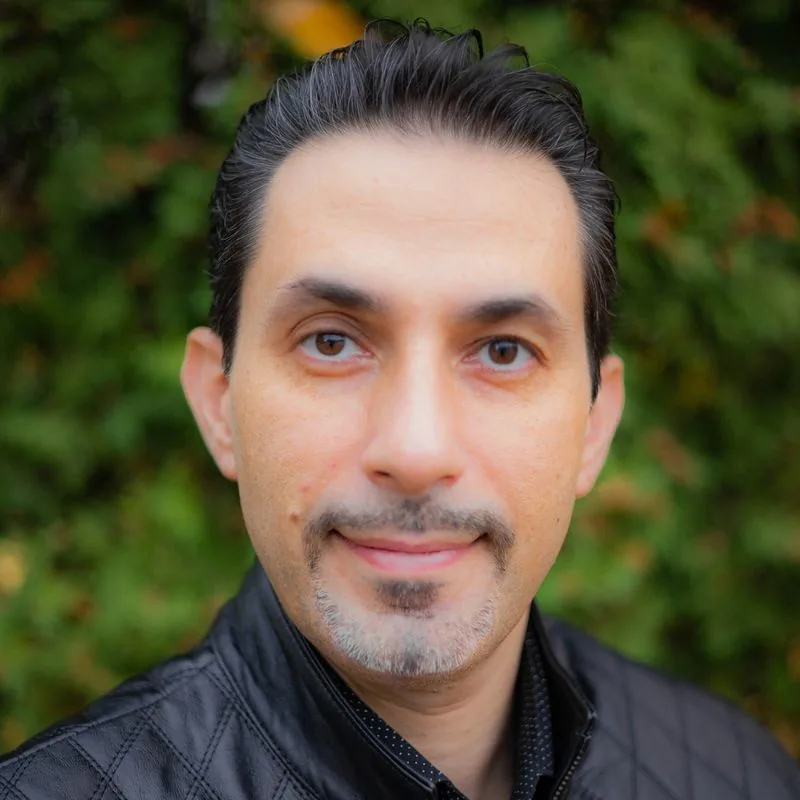
Amir Ahmadi, PhDDr. Amir Ahmadi is a Registered Physiotherapist, Certified IMS Therapist and former Associate Professor. 20+ years of clinical practice in North Vancouver.
This article is for general information only and does not constitute medical advice, diagnosis, or treatment. Individual presentations vary, and assessment findings and treatment plans differ from person to person. If you are experiencing severe symptoms, neurological changes (numbness, weakness, bowel or bladder changes), or a significant trauma, contact your physician or emergency services. Care at Medstar Sport Physio & Health is provided by practitioners registered with their respective British Columbia regulatory colleges.
Filed under
- grouse-grind
- hiking
- trail-running
- knee-pain
- north-vancouver
- achilles
- IT-band