Bunions (Hallux Valgus): What Non-Surgical Care Can and Cannot Do
Non-surgical care can ease bunion pain. Reviews rate the proof that it straightens the big toe as low. Here is what the trials found and when to ask about surgery.
BY ALI SHAFIEI, RPT
A bunion is a bony bump on the inside of the foot at the base of the big toe. Many people ask whether exercises, wider shoes, toe spacers, shoe inserts or tape can make it smaller. The research shows more for pain than for the shape of the bone.
At Medstar Sport Physio in North Vancouver, physiotherapists help people ease bunion pain with footwear advice, foot exercises, supports and taping. Reviews of the trials report low certainty that any of these straightens the big toe, so surgery becomes the question when pain still limits daily life.
A bunion is a change in how the big toe joint lines up
The bump is the bunion. The change in position behind it is called hallux valgus. The American Academy of Orthopaedic Surgeons (AAOS) explains that the long foot bone behind the big toe shifts toward the inside of the foot, the big toe angles toward the second toe, and the joint gets larger and sticks out.
A doctor confirms a bunion with an X-ray taken while you stand. The angle between the big toe and the foot bone, called the hallux valgus angle, is the number most studies use to measure change.
A 2023 review of 45 studies estimated that 19% of people worldwide have hallux valgus, with a likely range of 13% to 25%. The authors warn that the studies differed widely. A 2026 review of 23 observational studies found higher odds of hallux valgus with female sex (odds ratio 2.57), narrow-toed shoes (2.25) and high-heeled shoes (1.65). These links come from groups of people, so they cannot show what caused any one person's bunion.
Other foot problems can feel similar. A stiff joint that will not bend upward fits hallux rigidus. Pain under the ball of the foot can come from Morton's neuroma or metatarsalgia. Pain under the big toe joint after a sport injury may be turf toe or sesamoiditis.
Wide shoes ease pressure, and the proof is limited
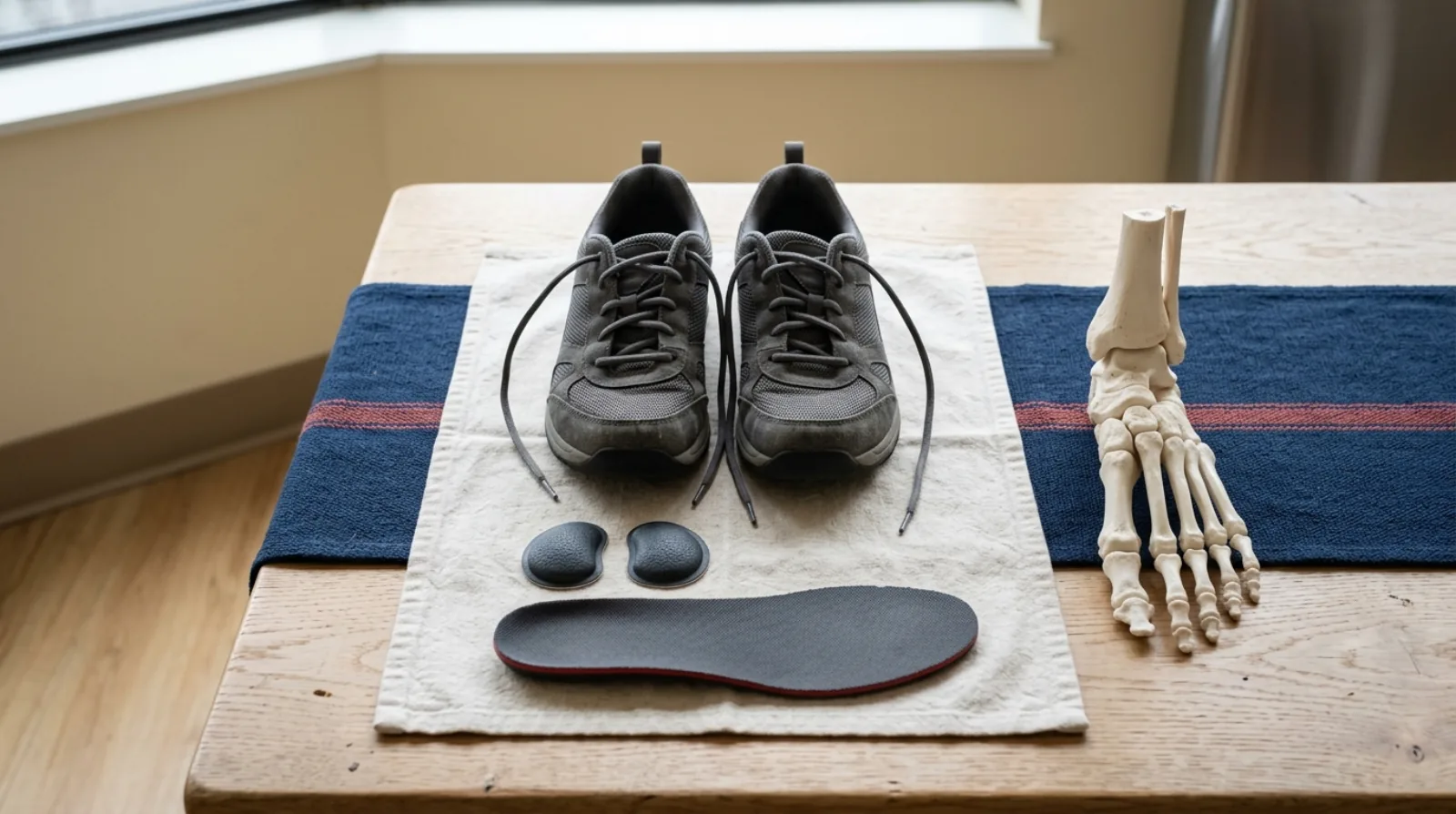
Footwear is the first step in both the NHS and the AAOS guidance. The NHS advises wide shoes with a low heel and a soft sole, and no high heels or tight, pointed shoes. The AAOS adds a fitting routine: fit the larger foot, try shoes on at the end of the day, and leave 3/8 to 1/2 inch between your longest toe and the end of the shoe. Soft pads can cushion the bump, but a thick pad can add pressure, so test one briefly.
The research on footwear is small. A 2025 study of 28 women with moderate or severe hallux valgus found that the match between foot width and toe-box width in their usual shoes did not track the pressure at the inside of the forefoot (all correlations below 0.35). The authors conclude that changing the toe box of usual shoes may not necessarily reduce this pressure. A 2023 pilot trial of footwear, orthoses, exercises and advice in 28 women was judged not feasible for a larger trial, mainly because few people kept using the plan. Choose shoes you will wear and exercises you will do.
Exercise and toe spacers: small trials, mixed results
A 2022 review by Hurn and colleagues included 18 studies of non-surgical care. Most were small, with concerns about bias. Pooled results for foot orthoses, splints, manual therapy and taping added to exercise showed no clear effect on pain or toe angle. Eight single studies did report less pain with treatments such as orthoses, night splints, manual therapy and taping added to exercise. Four reported a clinically important reduction in angle, with night splints, foot exercises, multi-part physiotherapy and botulinum toxin injections. The authors rated the certainty as low and wrote that less pain appears more likely than a better angle.
A 2026 network review pooled 11 trials with 401 people with mild to moderate hallux valgus. A network review compares several treatments at once and ranks them. Exercise lowered the angle by a mean of 3.32 compared with an adjusted placebo (range 2.23 to 4.40). Exercise with taping (6.72) and exercise with orthoses (6.67) ranked highest. The authors state that larger, higher-quality trials are needed.
In Abdalbary's 2018 trial, 56 women with moderate hallux valgus had 36 sessions over 3 months. They had foot joint mobilization, big toe strengthening, toe grip exercises, calf stretching and a toe separator. Compared with a waiting list, they had less pain, better foot scores and smaller angles on X-ray at 3 months and at 1 year. The authors say more research is needed to learn which parts helped.
Toe spacers have trials of their own. In a 2008 trial, 30 women wore an insole with a toe separator or a night splint for 3 months. Pain fell with the insole and toe separator, and the angles changed little in both groups. In a 2018 trial, 90 adults were assigned by chance to a custom silicone toe separator worn 6 hours a night for 12 months, or to a comparison group with foot care advice and proper shoes. Of those, 79 finished. The angle fell by 3.3 degrees in the spacer group and rose by 1.9 degrees in the other group, and pain was lower with the spacer.
Inserts and night splints ease pain more than they change the angle
In a Finnish trial published in 2001, 209 adults with a painful bunion and an angle of 35 degrees or less were assigned by chance to surgery, an orthosis or a 1-year waiting list. At 6 months, walking pain on a 0 to 100 scale had fallen by 14 more points with the orthosis than with waiting (range 6 to 22). At 1 year, 46% in the orthosis group and 24% in the waiting group said they had improved. The authors concluded that orthoses give short-term relief. In the 2-year follow-up, pain was similar in all three groups, and 43 of 69 people in the orthosis group had an operation by then.
A 2024 review of 5 studies found too little good evidence that orthotics slow the progress of the deformity on X-ray. Two studies reported changes, and one of them used toe spacers. The other three found none. Our article on custom and off-the-shelf inserts explains how the insert types differ.
Guides disagree on one point. The AAOS says non-surgical care can help keep a bunion from getting worse. The NHS says you cannot stop a bunion getting worse yourself. The orthoses review found too little evidence to settle it. The AAOS adds that braces and splints have not been shown to permanently fix bunions.
Physiotherapy aims at pain, strength and walking
A physiotherapist examines how the big toe joint moves, how the foot and ankle share load and which shoes you wear. The plan usually includes exercises for the big toe and foot muscles, hands-on joint work, taping, and advice on shoes and padding.
In a 2023 trial of people with mild to moderate hallux valgus, the same exercise program given with a physiotherapist lowered walking pain and toe angle more than the program done at home.
For short-term pain, the NHS suggests an ice pack wrapped in a cloth on the bunion for up to 5 minutes at a time. It also lists paracetamol or ibuprofen, and a pharmacist or doctor can confirm which pain medicine suits you.
The NHS says surgery is the only way to get rid of a bunion. The goals physiotherapy can reach are less pain, better foot strength and easier walking in comfortable shoes. If pain stays after a fair trial of care, the physiotherapist can send you to a podiatrist or your doctor.
Surgery becomes the question when pain limits daily life
The AAOS says a doctor may recommend surgery when pain and trouble walking continue after you have changed footwear and tried other non-surgical care, and only for a painful bunion. The NHS adds that surgery is not done just to improve how feet look.
Surgery does reduce pain. In the 2001 Finnish trial, walking pain at 1 year had fallen by 19 more points with surgery than with waiting (range 10 to 28 points), and 83% in the surgery group said they had improved. The 2003 follow-up concluded that when surgery is not available soon, waiting a year with or without orthoses does not harm the final result.
Recovery is long. The NHS lists no driving for 6 to 8 weeks, 2 to 12 weeks off work and no sport for 3 to 6 months. The toes may be weaker or stiffer afterward, may not be perfectly straight, and may still hurt. A 2021 review of 23 studies with 2,914 people found that 24.86% had the bunion return (range 19.15% to 30.57%), with wide differences between studies.
Podiatrists in British Columbia are registered with the College of Physicians and Surgeons of BC, according to HealthLinkBC. A podiatrist or your doctor can review your X-ray and explain surgical options.
Warning signs, and when to book
Go to the Lions Gate Hospital emergency department or call 911 if the big toe joint is hot, red and swollen and you also have a fever, shivering or feel sick. The NHS gout page says sudden joint pain and swelling with a high temperature could mean infection inside the joint, which needs urgent care. Gout also causes sudden, severe pain with hot, red, swollen skin, usually in the big toe. A review of gout studies pooled 11 of them and estimated that 73% of people with gout have acute arthritis at this joint. A first attack needs a doctor.
See a doctor soon for sudden severe toe pain after an injury, for new numbness or tingling in the toe or foot, and for any break in the skin over the bunion that does not heal. If you have diabetes, contact your doctor early. HealthLinkBC says to call your doctor immediately for a foot sore, and to call if a blister or break in the skin turns red, oozes or has not healed after 4 days. It also says to report blue or black areas.
For a painful bunion without these signs, you can book physiotherapy without a referral in British Columbia. The clinic is at 1325 Marine Drive, North Vancouver, BC V7P 3E5. You can book at medstar.janeapp.com or call (604) 988-5411. Our physiotherapy service page describes an assessment. Physiotherapists in BC are licensed by the College of Health and Care Professionals of BC, and you can check any name in its public registry.
Bring the shoes you wear most and any X-ray report to the first visit.
This article is general information, not personal medical advice, and is not a substitute for assessment by a regulated practitioner. A regulated practitioner can confirm whether the patterns described apply to you.
Sources
- Hurn SE, Matthews BG, Munteanu SE, Menz HB. Effectiveness of Nonsurgical Interventions for Hallux Valgus: A Systematic Review and Meta-Analysis. Arthritis Care Res, 2022
- Zhu Z, et al. Effects of exercise combined with external support on hallux valgus angle and pain: A systematic review and network meta-analysis. Foot Ankle Surg, 2026
- Torkki M, et al. Surgery vs orthosis vs watchful waiting for hallux valgus: a randomized controlled trial. JAMA, 2001
- Torkki M, et al. Hallux valgus: immediate operation versus 1 year of waiting with or without orthoses. Acta Orthop Scand, 2003
- DeHeer PA, et al. Orthoses Effect on Radiographic Measurements of Hallux Abducto Valgus: A Systematic Review. J Am Podiatr Med Assoc, 2024
- Abdalbary SA. Foot Mobilization and Exercise Program Combined with Toe Separator Improves Outcomes in Women with Moderate Hallux Valgus at 1-Year Follow-up. J Am Podiatr Med Assoc, 2018
- Chadchavalpanichaya N, et al. Effectiveness of the custom-mold room temperature vulcanizing silicone toe separator on hallux valgus. Prosthet Orthot Int, 2018
- Tehraninasr A, et al. Effects of insole with toe-separator and night splint on patients with painful hallux valgus. Prosthet Orthot Int, 2008
- Oztarsu MB, Oksuz S. Comparison of the effects of progressive supervised and home program exercise therapy in mild-moderate hallux valgus. J Comp Eff Res, 2023
- Menz HB, et al. Nonsurgical management of hallux valgus: findings of a randomised pilot and feasibility trial. J Foot Ankle Res, 2023
- Bajraszewski KJ, et al. Footwear Toe-Box Shape and Medial Forefoot Pressures in Women With Hallux Valgus. J Foot Ankle Res, 2025
- Cai Y, et al. Global prevalence and incidence of hallux valgus: a systematic review and meta-analysis. J Foot Ankle Res, 2023
- Zhang G, et al. Determinants and associated factors for hallux valgus: a systematic review and meta-analysis. BMC Musculoskelet Disord, 2026
- Ezzatvar Y, et al. Prevalence and Predisposing Factors for Recurrence after Hallux Valgus Surgery: A Systematic Review and Meta-Analysis. J Clin Med, 2021
- Stewart S, et al. The first metatarsophalangeal joint in gout: a systematic review and meta-analysis. BMC Musculoskelet Disord, 2016
- AAOS OrthoInfo: Bunions
- NHS: Bunions (page last reviewed 12 June 2023)
- NHS: Gout
- HealthLinkBC: Diabetes, Checking Your Feet
- HealthLinkBC: College of Physicians and Surgeons of British Columbia
- College of Health and Care Professionals of BC: public registry
Common questions
Frequently asked questions.
Can exercises reverse a bunion?
The evidence is weak. A 2026 review of 11 trials with 401 people found that exercise lowered the toe angle on X-ray by a mean of 3.32, but the authors call for larger, better trials. A 2022 review rated the certainty of the evidence as low. Exercise is more likely to ease pain than to move the bone. The AAOS says non-surgical care cannot reverse a bunion.
Do toe spacers work for bunions?+
Toe spacers have helped with pain in some trials. In a 2008 trial of 30 women, an insole with a toe spacer lowered pain over 3 months. A 2018 trial of 90 adults reported a 3.3 degree smaller toe angle after 12 months of nightly use, against a 1.9 degree larger angle in the comparison group. The trials are small, so treat the results as early findings.
Do night splints straighten a bunion?+
The evidence is mixed. A 2022 review found that pooled results for splints showed no clear effect on pain or toe angle, although some single studies reported less pain or a smaller angle. In a 2008 trial, a night splint had no clear effect on pain or angle. The AAOS states that braces and splints have not been shown to permanently fix bunions. A splint may be worth trying for comfort.
Do orthotics help a bunion?+
Orthotics are shoe inserts. In a Finnish trial of 209 adults, those given an orthosis had less walking pain after 6 months than those who waited, by 14 points on a 0 to 100 scale. A 2024 review found too little good evidence that orthotics slow the change in the toe angle. They are an option for pain relief, and the evidence for straightening the toe is weak.
What kind of shoes are best for a bunion?+
Choose shoes with a wide toe box, a soft sole and a low heel, as the NHS advises. The AAOS adds that you should leave 3/8 to 1/2 inch of space beyond your longest toe, fit the larger foot, and shop at the end of the day. A small 2025 study found that toe-box width did not match the pressure at the inside of the forefoot, so judge a shoe by how it feels on your foot.
Does taping help a bunion?+
Taping has weak support. A 2022 review found that pooled results for taping added to foot exercises showed no clear effect, although one study reported less pain. A 2026 review of 11 small trials ranked exercise with taping first for toe angle and pain. The authors ask for larger studies, so taping is a short-term comfort option to try with a physiotherapist.
When should I ask about bunion surgery?+
Ask when pain and trouble walking continue after you have changed your footwear and tried other non-surgical care. The AAOS says to consider surgery only for a painful bunion. The NHS says surgery is not done just to improve how the foot looks. A podiatrist or your doctor can explain the options and tell you how to reach a foot surgeon.
Do bunions come back after surgery?+
They can. A 2021 review of 23 studies with 2,914 people found that 24.86% of people had the bunion return, and the studies differed widely. The NHS also says bunions sometimes come back. Surgery brought the largest pain reduction at 1 year in the Finnish trial, so ask a surgeon about the chance of recurrence and about the recovery time.
Is a hot, red, swollen big toe joint a bunion?+
It can be a different problem. The NHS lists hot, red, swollen skin over a joint as a sign of gout, and says sudden pain and swelling with a high temperature or shivering could mean infection inside the joint. That needs urgent care. Go to Lions Gate Hospital emergency or call 911 if you also have a fever or feel unwell.
Do I need a referral to see a physiotherapist for a bunion?+
No. In British Columbia you can book physiotherapy without a referral. Medstar Sport Physio is at 1325 Marine Drive in North Vancouver, and you can book online at medstar.janeapp.com or call (604) 988-5411. Some extended health plans ask for a referral before they pay, so read your policy. A physiotherapist can send you on to a podiatrist or doctor if needed.

Written by
Ali Shafiei, RPTAli Shafiei is a Registered Physiotherapist with 10+ years of clinical experience in musculoskeletal, neurological and sports rehabilitation. North Vancouver.
This article is for general information only and does not constitute medical advice, diagnosis, or treatment. Individual presentations vary, and assessment findings and treatment plans differ from person to person. If you are experiencing severe symptoms, neurological changes (numbness, weakness, bowel or bladder changes), or a significant trauma, contact your physician or emergency services. Care at Medstar Sport Physio & Health is provided by practitioners registered with their respective British Columbia regulatory colleges.
Filed under
- bunion
- hallux-valgus
- big-toe
- toe-spacers
- foot-orthoses
- footwear
- foot-exercises
- north-vancouver