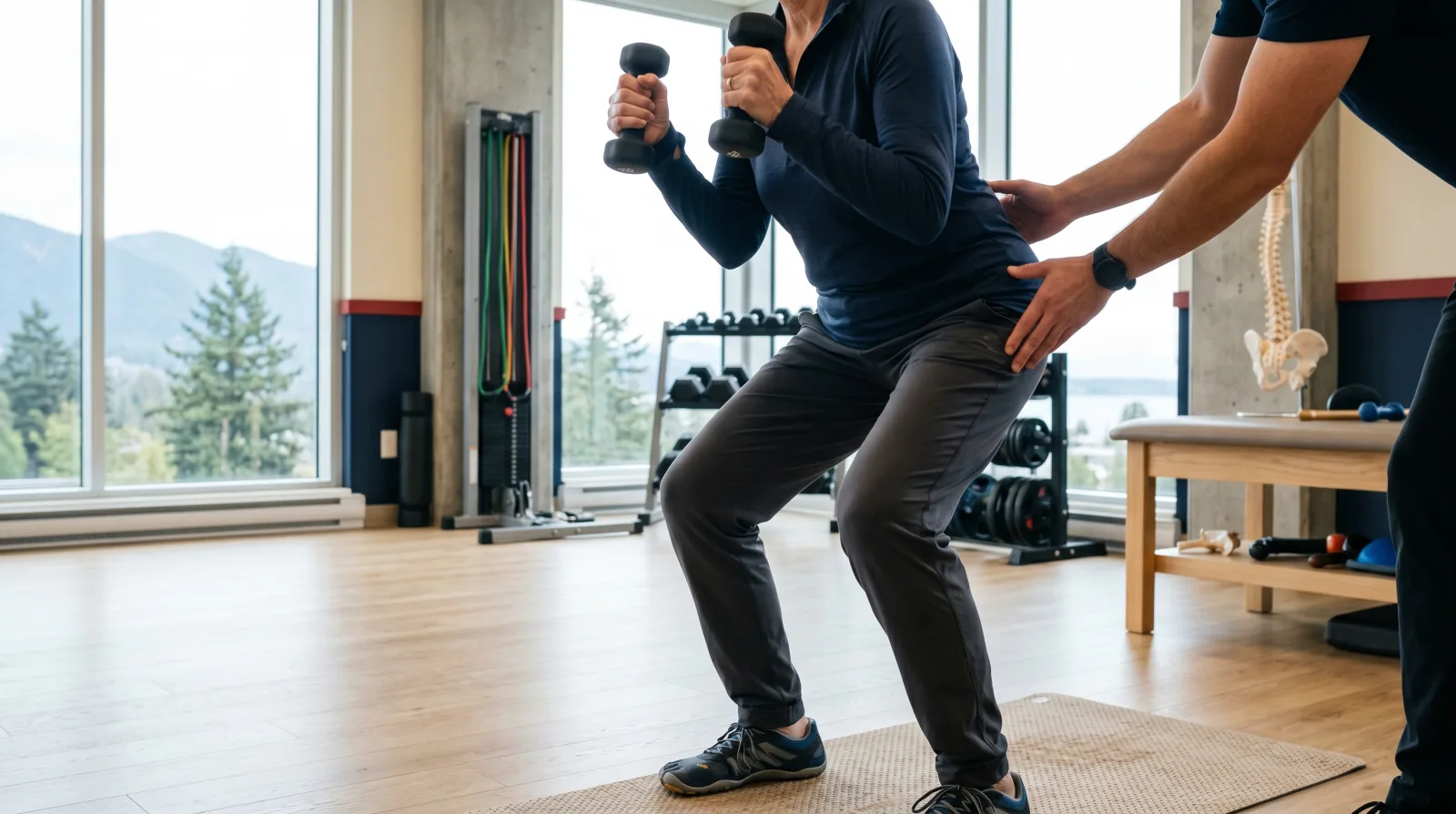

Blood Flow Restriction Training: Building Strength at Low Loads After Injury
After surgery or a bad injury, you often cannot lift heavy yet. Blood flow restriction training is a way to build strength with light weights, and here is how it works and who it suits.
BY MEDSTAR SPORT PHYSIO TEAM
After surgery or a serious injury, there is a frustrating stretch where you need to rebuild muscle but you are not allowed to lift anything heavy yet. Muscle usually grows best under heavy load, so this seems like a trap. Blood flow restriction training is a way out of it, and it lets you build strength with light weights during the exact phase when heavy lifting is off the table.
Blood flow restriction training, or BFR, uses a cuff around the top of an arm or leg to partly limit blood flow while you exercise with light weights. This lets low loads build muscle to a degree closer to heavy lifting, which makes it useful early after surgery or injury when heavy loading is not yet safe. The evidence for building muscle size is reasonably strong, though strength gains are usually smaller than heavy training. At Medstar Sport Physio in North Vancouver, BFR is one tool inside a wider plan, and it always comes after screening your medical history, because it is not suitable for everyone.
What blood flow restriction training is
The idea is simpler than it sounds. A cuff, similar in feel to a blood pressure cuff, is placed around the top of the arm or the leg and inflated to a set pressure. This partly limits the blood flow out of the working muscle while you do light resistance exercise. The muscle ends up working in a lower-oxygen environment, which appears to trigger a stronger training response than the light load alone would produce.
The practical result is that a light weight, which normally would not do much for muscle growth, starts to give a training effect closer to what heavy lifting usually provides. That is the whole point in rehabilitation. It lets someone who cannot yet load heavily still push the muscle enough to grow it.
Why it matters after injury or surgery
Normally, building muscle and strength needs a decent amount of load. Early after knee surgery, after some tendon injuries, or when a joint is too painful or too fragile for heavy weights, that load is not available. Left alone, the muscle around the injury wastes away quickly, and that lost muscle then slows the whole recovery down.
BFR fills this gap. It lets you keep or build muscle during the low-load phase, so you do not lose as much ground while you wait for the tissue to be ready for heavier work. This is especially useful for the quadriceps after knee surgery, which is a common problem area. It fits alongside the kind of preparation we describe in our guide to ACL prehab before surgery, where building strength early changes how the whole recovery goes.
What the evidence actually shows
It is worth separating two things the evidence treats differently: muscle size and strength.
For muscle size, the evidence is reasonably strong. Reviews of studies show that low-load training with BFR builds muscle to a degree comparable to heavy resistance training, and clearly more than light training without a cuff. For strength, the picture is more mixed. Low-load BFR generally produces better strength gains than light training alone, but often smaller strength gains than heavy lifting. So the honest framing is that BFR is a strong tool for keeping and building muscle when you cannot go heavy, and a useful but not complete substitute for heavy strength work once you can do it.
Who it suits
BFR tends to suit people who need to build or keep muscle but cannot yet load heavily. That includes someone in the early weeks after knee surgery, a person with a painful joint that heavy weights aggravate, or an older adult who struggles to tolerate heavy loading. In each case, the shared problem is the same: the muscle needs a stimulus, but the usual heavy stimulus is not available.
It also has a place later in rehabilitation as an add-on, for example to give the quads extra work without adding heavy load to a joint that has already done enough for one session. Where exactly it fits depends on the injury, the stage of recovery, and the person, which is why it is planned rather than applied to everyone the same way.
The safety side, in plain terms
This is the part that gets glossed over in a lot of online promotion, and it matters. BFR is generally well tolerated by suitable people, but it is not for everyone, and screening comes first.
There are real reasons to avoid it. A history of blood clots, clotting disorders, poor circulation, and a number of other medical conditions are all reasons BFR may not be safe for you. Because of this, a proper review of your medical history is done before any cuff goes on. This is also why BFR should be set up and supervised by a trained practitioner using proper equipment and pressures, not improvised at home with a random band pulled tight, which can be genuinely unsafe. For most suitable people the common effects are mild, such as discomfort during the exercise and some muscle soreness afterward, similar to what you would expect from any new strength work.
Where it fits in a rehab plan
BFR is a tool for a specific problem, not the whole plan and not a replacement for normal strength training. Once you can tolerate heavier loads, standard resistance training is usually the main driver of strength, and that is where the plan heads. BFR earns its place in the phase before that, keeping and building muscle so you arrive at the heavy-loading stage in better condition.
The same logic of loading a joint sensibly rather than avoiding load runs through a lot of what we do. For a painful knee that cannot handle much yet, for instance, we still prioritise building capacity, which we cover in our piece on managing knee osteoarthritis with exercise first. BFR is one more way to keep loading useful when the usual heavy approach is temporarily off the table.
When to ask about it
If you are recovering from surgery or an injury and you are struggling to rebuild muscle because you cannot lift heavy yet, it is worth asking whether BFR fits your case. It is also worth asking if you have lost a lot of muscle around a joint and the usual exercises are not producing much because you cannot load them enough. The first step is always a review of your medical history to check it is suitable for you.
Book a 30-minute appointment and we will assess your injury, screen whether BFR is appropriate for you, and decide where it belongs in a plan that still builds toward normal strength work as soon as your body is ready.
This article is general information about rehabilitation. It is not personal medical advice. A regulated practitioner can confirm whether the patterns described apply to you.
Sources
- Effects of Low-Load Blood Flow Restriction Resistance Training on Muscle Strength and Hypertrophy Compared with Traditional Resistance Training in Healthy Adults Older Than 60 Years (PubMed)
- Blood flow restriction training in clinical musculoskeletal rehabilitation: a systematic review and meta-analysis (PubMed)
- Blood Flow Restriction Training (PMC, safety and contraindications)
- College of Physical Therapists of BC (CPTBC)
Common questions
Frequently asked questions.
What is blood flow restriction training?
Blood flow restriction training, often called BFR, uses a cuff placed around the top of an arm or leg to partly limit blood flow while you exercise with light weights. The cuff keeps some blood in the working muscle, which lets low loads produce a training effect closer to what heavy lifting usually gives. It is used in rehabilitation because it lets people build muscle and strength when they cannot yet tolerate heavy loads, such as soon after surgery or a serious injury.
Does blood flow restriction training actually build muscle and strength?+
Yes, and the evidence is reasonably strong for muscle size. Reviews of studies show that low-load training with BFR builds muscle to a degree comparable to heavy resistance training, and more than light training without a cuff. For strength, low-load BFR generally beats light training alone but often produces smaller strength gains than heavy lifting. So it is a useful bridge when heavy loading is not yet safe, not a full replacement for heavy strength work once you can do it.
Is blood flow restriction training safe?+
For suitable people, screened first, it is generally well tolerated, but it is not for everyone. There are important reasons to avoid it, including a history of blood clots, clotting disorders, poor circulation, and some other medical conditions. That is why proper screening of your medical history comes before any BFR, and why it should be set up and supervised by a trained practitioner rather than tried on your own with a random band. Done correctly, common effects are mild, such as discomfort during the exercise and muscle soreness afterward.
Who is a good candidate for BFR training?+
BFR often suits people who need to build or keep muscle but cannot yet load heavily, such as after knee surgery, after some tendon injuries, or when a joint is too painful for heavy weights. It can also help older adults who struggle with heavy loading. It is not suitable for people with certain medical conditions, which is why a screening step comes first. A physiotherapist can tell you whether it fits your situation and where it belongs in your overall plan.
Does BFR replace normal strength exercises?+
No. BFR is a tool for a specific problem, which is building strength and muscle when heavy loading is not yet possible or safe. Once you can tolerate heavier loads, standard resistance training is usually the main driver of strength. Think of BFR as a bridge that keeps or builds muscle during the phase when you cannot lift heavy, so you arrive at the heavy-loading stage in better shape, rather than a permanent substitute for it.
Share this post
Copies a ready-to-publish LinkedIn post to your clipboard and opens the LinkedIn share dialog. Paste the text into the composer and publish.
Written by
Medstar Sport Physio Team
Registered clinician at Medstar Sport Physio & Health, North Vancouver.
This article is for general information only and does not constitute medical advice, diagnosis, or treatment. Individual presentations vary, and assessment findings and treatment plans differ from person to person. If you are experiencing severe symptoms, neurological changes (numbness, weakness, bowel or bladder changes), or a significant trauma, contact your physician or emergency services. Care at Medstar Sport Physio & Health is provided by practitioners registered with their respective British Columbia regulatory colleges.
Filed under
- blood-flow-restriction
- bfr-training
- rehabilitation
- strength-training
- post-surgery
- north-vancouver