The Throwing Shoulder and Elbow: Why Pitchers Get Hurt and What Actually Prevents It
A pitcher's arm absorbs enormous force with every throw. Here is what that load does to the shoulder and elbow, and what the evidence says actually reduces injury.
BY SANAZ DAVARIAN, PHD
A pitcher's arm does something almost no other sporting motion asks of the body: it accelerates a joint through a huge range of motion in a fraction of a second, over and over, at high force. The shoulder and elbow absorb that load together, and when volume or mechanics get ahead of what the tissue can tolerate, one or both start to break down.
At Medstar Sport Physio in North Vancouver, we manage throwing-arm injuries by looking at total pitch volume and rest, shoulder rotation deficits, and elbow support strength together, because the shoulder and elbow load each other during a throw and a problem in one often traces back to a limitation in the other. Pitch count and rest-day guidelines exist because research consistently links total pitching volume and pitching while fatigued to a higher injury rate in adolescent pitchers, and that same principle, respecting total load and recovery, applies to recreational and adult throwers too.
What the throwing motion actually does to the arm
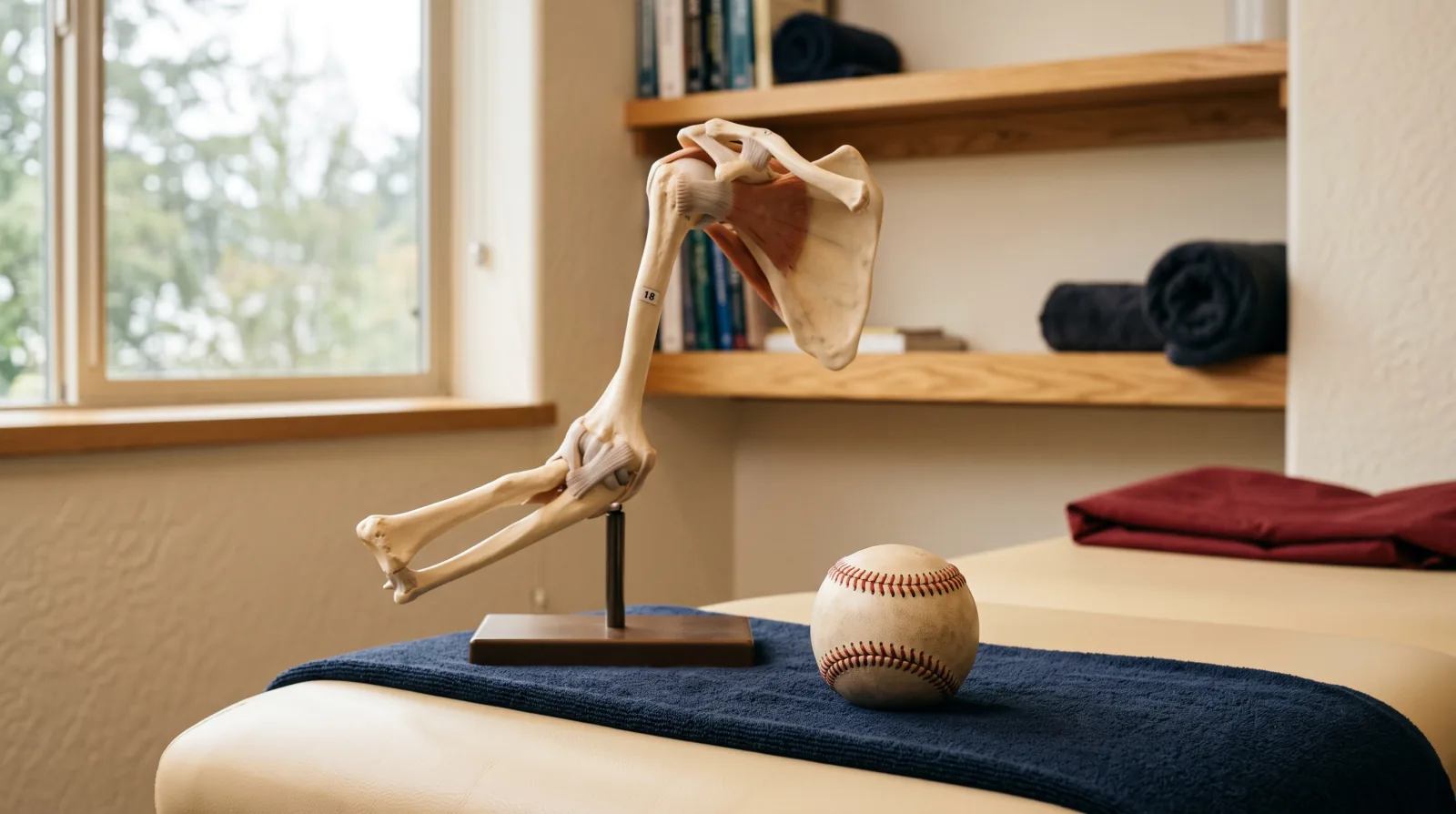
A baseball throw moves through a sequence: wind-up, early and late cocking, acceleration, release, and follow-through, all completed in well under a second. During late cocking, the shoulder reaches maximum external rotation, often past what most other sports ask of the joint, while the elbow is placed under significant valgus stress, a sideways force that pulls the inside of the elbow joint apart. The ulnar collateral ligament (UCL), a band of tissue on the inner elbow, is the primary structure resisting that force, and it is the most commonly injured elbow structure in throwers.
This is not a flaw in the motion. Throwing at pitching velocity requires this range and this force, and a well-conditioned arm tolerates it across a normal competitive workload. The injury risk climbs when the total volume of throwing, the recovery between outings, or the strength and rotation supporting the joints fall out of balance with the demand being placed on them.
Why pitch counts exist, and what they actually measure
Pitch count rules can look arbitrary from the outside, a number picked out of thin air for a specific age group. They are not. Pitch Smart, the joint program from USA Baseball and Major League Baseball, sets age-based daily pitch limits along with required rest days scaled to how many pitches were thrown, built on research into injury risk in youth pitchers.
The research behind these limits is specific about what actually predicts injury. ASMI's position statement on Tommy John injuries in baseball pitchers states that the amount of competitive pitching and pitching while fatigued are strongly linked to injury, alongside playing on multiple teams, playing catcher on days off from pitching, and pitching year-round without an off-season. The same statement notes that between 10 and 20 percent of pitchers do not return to their previous performance level after ulnar collateral ligament reconstruction (Tommy John surgery), which is a meaningful reason to take prevention seriously rather than treating surgery as a routine fix.
Fatigue is the variable that matters most
The throwing motion depends on precise timing and sequencing through the kinetic chain, the coordinated sequence running from the legs through the trunk to the arm. When the muscles supporting that sequence fatigue, the timing degrades, and the arm ends up compensating for what the rest of the body should be providing. A tired pitcher often relies more on the arm itself to generate velocity, which increases the load specifically at the shoulder and elbow rather than spreading it through the whole kinetic chain the way a fresh, well-sequenced throw does.
This is why "pitching through it" is a genuine risk rather than a toughness question. A pitcher who finishes an inning on adrenaline while clearly fatigued is often the same pitcher who shows up with shoulder or elbow pain a few starts later. Recognizing fatigue signs, a drop in velocity, a change in arm slot, or reported arm heaviness, and pulling a pitcher before those signs become an injury is one of the more actionable pieces of prevention available to a coach or parent.
The shoulder-elbow connection: GIRD
One shoulder finding shows up often enough in throwers that it is worth explaining directly: glenohumeral internal rotation deficit, or GIRD, a loss of internal rotation range in the throwing shoulder compared with the non-throwing side. Repeated throwing can tighten the back of the shoulder capsule over time, shifting the joint's rotational range toward more external rotation and less internal rotation than the other arm has.
GIRD is not just a shoulder finding in isolation. Changes in shoulder rotation and the shoulder's overall position during the throwing motion have been connected to increased stress at the elbow, since a shoulder that cannot rotate through its normal arc changes how the rest of the arm has to move to deliver the pitch. This is why a proper throwing-arm assessment measures both shoulders side by side rather than examining only the joint where the pain currently is. A shoulder that is not moving well often explains an elbow that keeps getting hurt, a pattern that shows up in other overhead and rotational sports as well as pitching specifically.
Coordinating load across multiple teams
A risk factor that is easy to overlook is exposure that no single coach can see. A young pitcher playing for a school team and a club team simultaneously can accumulate a safe pitch count on each roster individually while still exceeding a safe weekly total once both are combined. Nobody watching either team in isolation has the full picture.
Coordinating total throwing volume, across school ball, club ball, showcases, and any additional bullpen or practice throwing, is one of the more practical prevention steps a family can take, and it is also one of the more commonly skipped ones. Keeping a simple log of total pitches and throws across every context a young athlete plays in makes this visible in a way that relying on any one team's pitch count sheet does not. Our article on growth plate injuries in young athletes covers a related principle: a young, still-developing skeleton needs different load management than an adult one, and the elbow's growth plates are a specific concern in pitchers who have not finished growing.
What a throwing-arm assessment covers in the clinic
When a pitcher, youth or adult, comes in with shoulder or elbow symptoms, or wants a preventive check before a season, we compare internal and external rotation and total rotational range between the throwing and non-throwing shoulders, screen scapular control and rotator cuff strength, and check elbow stability along with the strength of the flexor-pronator muscle group, the forearm muscles that help support the UCL during the throwing motion.
We also ask about the practical side: recent pitch volume, days of rest between outings, whether the athlete plays on more than one team, and whether this is a new pattern of symptoms or something that has recurred across seasons. That context shapes whether the plan is acute injury management, a return-to-throwing progression after time off, or a preventive strength and mobility program going into a new season.
What a return-to-throwing plan actually looks like
Rehab for a throwing-arm injury is staged and based on meeting specific criteria at each step, not a fixed calendar. A typical progression starts with restoring pain-free range and basic strength, moves to flat-ground throwing at short distance with careful volume limits, gradually increases throwing distance and intensity, and only progresses to mound work and full-velocity throwing once each prior stage has been tolerated without a setback.
Trying to compress this timeline, especially returning to mound throwing before flat-ground volume has been well tolerated, is a common way a resolving injury becomes a recurring one. The arm rebuilds tolerance the same way it lost it: gradually, with load added in a sequence the tissue can actually adapt to.
When to get it looked at
Shoulder or elbow pain during or after throwing that lingers beyond a day or two, a drop in velocity or control that the athlete cannot explain, or pain that changes how the arm moves warrants an assessment before returning to the mound. Sudden sharp elbow pain during a single pitch, especially with a popping sensation, needs prompt medical evaluation rather than a wait-and-see approach, since that pattern can indicate an acute UCL injury.
Book a 30-minute assessment and we will check shoulder rotation, elbow stability, and strength, talk through actual pitch volume and rest patterns, and build a plan whether the goal is recovering from an injury or heading into a season with a healthier arm. You can also read about our return-to-sport approach or see what we treat.
This article is general information about throwing-arm injuries in baseball. It is not personal medical advice. A regulated practitioner can confirm whether the patterns described apply to you.
Sources
- Pitch Smart pitching guidelines, ages 9-12, USA Baseball and Major League Baseball
- Position Statement for Tommy John Injuries in Baseball Pitchers, American Sports Medicine Institute (ASMI)
- Example limits for number of pitches thrown in games, American Sports Medicine Institute (ASMI)
- College of Physical Therapists of BC (CPTBC)
Common questions
Frequently asked questions.
Why do baseball pitchers get shoulder and elbow injuries so often?
Throwing a baseball at pitching velocity puts the shoulder through an extreme range of motion at high speed and loads the elbow with significant valgus force, a sideways stress that pulls the inside of the joint apart during the late cocking and acceleration phases. The motion repeats hundreds of times per outing and thousands of times per season, so both joints accumulate load quickly, especially when volume, rest, and mechanics are not managed.
What is pitch count actually protecting against?+
Pitch counts exist because research consistently links the total amount of competitive pitching, and pitching while fatigued, to a higher risk of shoulder and elbow injury in adolescent pitchers. A tired arm loses the mechanical efficiency that spreads load properly, so the same pitch thrown fatigued places more stress on the same tissues. Pitch Smart guidelines from USA Baseball and Major League Baseball set age-based pitch limits and required rest days based on this research.
What is GIRD, and why does it matter for pitchers?+
GIRD stands for glenohumeral internal rotation deficit, a loss of internal rotation range in the throwing shoulder relative to the other side, usually from repeated capsular tightening on the back of the joint. It matters because GIRD has been linked to changes in shoulder mechanics that increase stress at the elbow during the throwing motion, connecting a shoulder finding to elbow injury risk. Physiotherapists screen for it directly by comparing internal and external rotation between arms.
Does throwing curveballs at a young age cause elbow injuries?+
The relationship is debated and not fully settled by strong evidence, but pitching while fatigued and total pitching volume are more consistently linked to injury than pitch type alone in the research to date. Breaking pitches thrown with poor mechanics or excessive volume likely add risk, but singling out one pitch type as the cause oversimplifies a picture where fatigue and total load matter more.
Can physiotherapy prevent a UCL tear in a pitcher's elbow?+
Physiotherapy cannot guarantee prevention, since throwing injuries have multiple contributing factors including genetics, mechanics, and total exposure. What a physiotherapist can do is address modifiable risk factors: shoulder rotation deficits, weakness in the muscles that support the elbow during the throwing motion, and a structured return-to-throwing progression after time off, all of which are part of a comprehensive arm-care approach.
What does a shoulder and elbow assessment look like for a pitcher?+
The physiotherapist compares internal and external rotation, and total rotational range, between the throwing and non-throwing shoulders, checks scapular control and rotator cuff strength, and assesses elbow stability and the flexor-pronator muscle group that supports the ulnar collateral ligament. We also ask about pitch volume, rest between outings, and whether multiple teams or year-round play are part of the picture, since those are documented risk factors.
Should a young pitcher play on more than one team at once?+
Playing on multiple teams at the same time is a documented risk factor for overuse injury in adolescent pitchers, mainly because it makes total pitch volume and rest days harder to track and enforce. A pitcher on two teams can easily exceed a safe weekly pitch count without either coach realizing it. Coordinating total throwing volume across every team a young athlete plays for is a practical, if often overlooked, injury-prevention step.
How long does rehab take after a shoulder or elbow throwing injury?+
Recovery timelines depend on the specific structure involved, the severity, and whether surgery was needed. A return-to-throwing progression is staged and criteria-based rather than calendar-based, moving through flat-ground throwing, distance, and eventually mound work as strength, rotation, and pain-free function are confirmed at each stage. Your physiotherapist and, where relevant, your surgeon set the specific timeline for your injury.
Share this post
Copies a ready-to-publish LinkedIn post to your clipboard and opens the LinkedIn share dialog. Paste the text into the composer and publish.

Written by
Sanaz Davarian, PhDDr. Sanaz Davarian is a Registered Physiotherapist with a PhD and 20+ years of experience. Certified IMS Therapist, former Assistant Professor of Physiotherapy. North Vancouver.
This article is for general information only and does not constitute medical advice, diagnosis, or treatment. Individual presentations vary, and assessment findings and treatment plans differ from person to person. If you are experiencing severe symptoms, neurological changes (numbness, weakness, bowel or bladder changes), or a significant trauma, contact your physician or emergency services. Care at Medstar Sport Physio & Health is provided by practitioners registered with their respective British Columbia regulatory colleges.
Filed under
- baseball
- pitching
- shoulder-injury
- elbow-injury
- youth-sport
- north-vancouver