
Sprained Ankle: When You Actually Need an X-ray (The Ottawa Ankle Rules)
You rolled your ankle and it hurts. Do you need an X-ray? A well-tested set of rules can tell you when a fracture is possible and when imaging can wait.
BY MEDSTAR SPORT PHYSIO TEAM
You rolled your ankle on a trail, a curb, or a court, it swelled up, and now you are staring at it wondering if you should head to the emergency room for an X-ray. Most sprained ankles are not broken, and there is a well-tested way to judge whether a fracture is likely enough to image. It is called the Ottawa Ankle Rules.
Most ankle sprains do not need an X-ray. The Ottawa Ankle Rules are a tested checklist that suggests an X-ray only when a fracture is realistically possible: pain near the ankle bones plus bone tenderness at the tip or back edge of either ankle bone, or an inability to take four steps on the injured foot both right after the injury and when examined. For the midfoot, the checkpoints are tenderness at the navicular bone or the base of the fifth metatarsal. At Medstar Sport Physio in North Vancouver, we use this same logic to decide who needs imaging first and who can start rehab. These rules are for adults and older children, so a young child or an unclear case should be assessed by a doctor.
Why not just X-ray every sprained ankle?
Before these rules existed, almost everyone with an ankle injury got an X-ray, even though only a small share turned out to have a fracture. That meant a lot of waiting, cost, and radiation for injuries that were sprains. A group of clinicians in Ottawa built a simple checklist to sort out who actually needed imaging, and it worked well enough that it spread worldwide.
The Ottawa Ankle Rules are now among the most tested clinical rules in medicine, checked in dozens of studies across many countries. The goal is not to avoid X-rays at all costs. It is to X-ray the injuries that might be fractures and to spare the ones that almost certainly are not.
What the rules actually say
The checklist splits the injury into two areas: the ankle itself and the midfoot. You look for pain in the area, then check specific bony points and whether the person can walk.
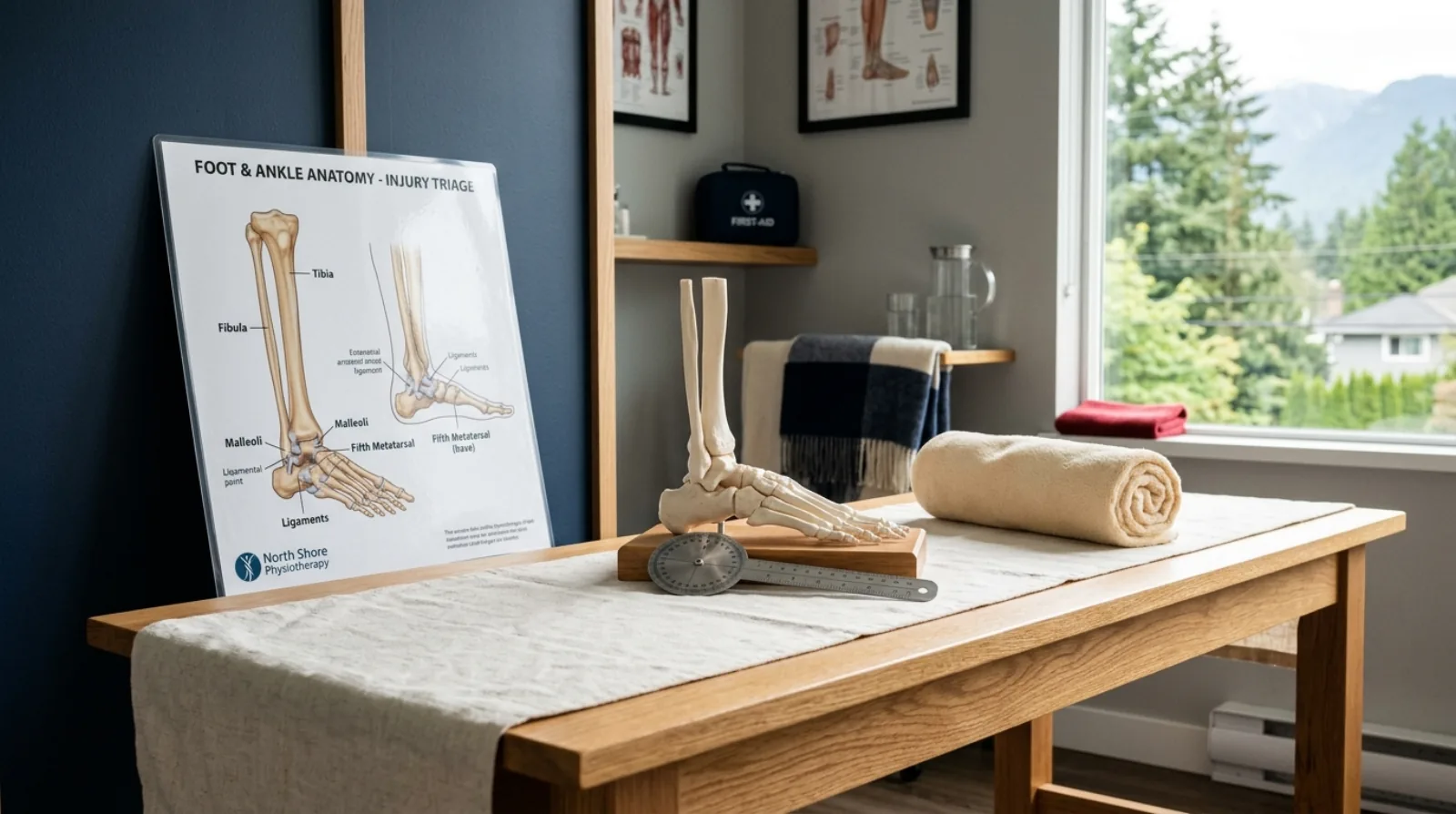
For an ankle X-ray, imaging is suggested if there is pain in the ankle bone area (the malleolar zone) AND any one of these:
- Bone tenderness along the back edge or tip of the lateral malleolus, the bump on the outside of the ankle, including the lower 6 cm of the fibula.
- Bone tenderness along the back edge or tip of the medial malleolus, the bump on the inside of the ankle, including the lower 6 cm of the tibia.
- Being unable to take four steps on the injured foot, both immediately after the injury and when examined.
For a foot X-ray, imaging is suggested if there is pain in the midfoot AND any one of these:
- Bone tenderness at the navicular bone, on the top inner part of the midfoot.
- Bone tenderness at the base of the fifth metatarsal, the bony bump on the outer edge of the foot.
- The same inability to take four steps, right after the injury and when examined.
If none of the checkpoints in a zone are positive, a fracture in that zone is very unlikely, and an X-ray is often not needed.
The four-steps test, explained
The weight-bearing part confuses people, so it is worth being clear. The question is whether you can take four steps on the injured foot, and limping counts. You do not have to walk normally or without pain. If you can hobble four steps, even painfully, that is bearing weight, and it is a reassuring sign.
The test matters at two moments: right after the injury and again when a clinician examines you. Being unable to take those four steps at both points is one of the triggers for an X-ray. Being able to limp along is one of the signs that points away from a fracture.
How good are the rules?
This is where the rules earn their trust. Reviews report that the Ottawa Ankle Rules have a sensitivity of roughly 96 to 100%, which means they very rarely miss a true fracture. That high sensitivity is exactly what you want in a rule whose job is to make it safe to skip an X-ray.
The trade-off is that they are not very specific. A positive result does not confirm a fracture, it simply means an X-ray is worth doing to check. That is the right balance for a screening tool. Studies show that using the rules cuts unnecessary X-rays by about 30 to 40% without missing more fractures. So they save time and radiation while keeping the catch rate high.
Who the rules are not for
The rules are not a fit for every situation, and this is important. They were developed and best tested in adults. Research supports their use in children older than about 6 years, but they are less established in younger children, whose growing bones behave differently, so a young child with an ankle or foot injury should be assessed by a doctor rather than sorted by this checklist alone.
The rules also depend on a person being able to reliably tell where it hurts. They are not applied when someone cannot do that, for example with intoxication, a distracting injury elsewhere, or major swelling that makes it impossible to press on the bone accurately. In those cases the safe move is a medical assessment. If your pain is in the wrist rather than the ankle, the same idea of checking for a hidden fracture applies, which we cover in telling a wrist sprain from a scaphoid fracture.
What happens after you rule out a fracture
Say the checkpoints are negative and a fracture is unlikely. You still have a sprained ankle, and a sprain is a real injury that needs proper care to heal well. The old advice was to rest it completely, but current care favours protected early movement, gradual loading, and rebuilding the ankle's balance and strength so it does not become a repeat problem.
This is where rehab does the real work. Restoring movement, then strength, then balance, lowers the chance of the ankle giving way again in the future. We walk through this in detail in our guide to ankle sprain rehab and balance retraining. Skipping rehab is one of the most common reasons a simple sprain turns into an ankle that keeps rolling.
When to get it assessed
Use the checkpoints above as a guide, not as a final diagnosis. See a doctor or go to urgent care for an X-ray if you have bone tenderness right on the tip or back edge of either ankle bone, tenderness at the navicular or the base of the fifth metatarsal, or you cannot take four steps on the foot. Also seek care if the ankle looks deformed, is numb or cold or pale, or the pain is severe and out of keeping with a simple sprain.
If a fracture has been ruled out, or once a fracture has healed, that is the point to start rehab. Book a 30-minute appointment at our physiotherapy clinic in North Vancouver and we will assess the ankle, confirm it is safe to load, and build a movement, strength, and balance plan so the sprain heals properly and is less likely to happen again. Patients coming from up the mountain can read how we handle Lynn Valley physio appointments, and if the ankle was hurt in a car crash, ICBC-approved physiotherapy covers 25 sessions with no upfront cost.
This article is general information about ankle injuries. It is not personal medical advice. The Ottawa Ankle Rules are a clinical decision aid, not a diagnosis, and a regulated practitioner can confirm whether the patterns described apply to you.
Sources
- Ottawa Ankle Rule - MDCalc
- Wang et al. - Clinical Value of the Ottawa Ankle Rules for Diagnosis of Fractures in Acute Ankle Injuries, PMC (2013)
- Ottawa Ankle Rules in Children and Adolescents, PMC (2025)
- College of Physical Therapists of BC (CPTBC)
Common questions
Frequently asked questions.
Do I need an X-ray for a sprained ankle?
Most ankle sprains do not need an X-ray. Doctors use the Ottawa Ankle Rules, a well-tested checklist, to decide when a fracture is possible enough to image. An X-ray is suggested if you have pain near the ankle bones plus tenderness right on the bony tip or back edge of the ankle bones, or if you cannot take four steps on the injured foot both right after the injury and when examined. If none of those apply, a fracture is very unlikely and an X-ray is often not needed.
What are the Ottawa Ankle Rules?+
The Ottawa Ankle Rules are a clinical checklist created to help decide who needs an X-ray after an ankle or foot injury. An ankle X-ray is suggested if there is pain in the ankle area plus bone tenderness at the back edge or tip of either ankle bone, or an inability to bear weight for four steps. A foot X-ray is suggested if there is midfoot pain plus tenderness at the navicular bone or the base of the fifth metatarsal, or the same weight-bearing problem. They are among the most tested rules in medicine.
How accurate are the Ottawa Ankle Rules?+
Very good at ruling out fractures. Reviews report a sensitivity of around 96 to 100%, which means they rarely miss a real fracture. They are less specific, so a positive result does not confirm a fracture, it just means an X-ray is worth doing. Using the rules has been shown to cut unnecessary X-rays by about 30 to 40% without missing more fractures.
Can I walk on a sprained ankle if it is not broken?+
Being able to take a few steps, even painfully, is actually part of the Ottawa Ankle Rules and is a reassuring sign that a fracture is less likely. Limping still counts as bearing weight. That said, walking on a fresh sprain should be gentle and within comfort, and a painful, swollen ankle still needs proper rehab to recover fully, even when nothing is broken.
Do the Ottawa Ankle Rules work for children?+
The rules were developed and best tested in adults. Research supports their use in children older than about 6 years, but they are not established for younger children, and they are not applied when someone cannot reliably report tenderness, such as with intoxication, distracting injuries, or major swelling. For young children, or when there is any doubt, a medical assessment decides on imaging.
Do the Ottawa Ankle Rules also apply to the foot, not just the ankle?+
Yes, the checklist has a separate foot zone alongside the ankle zone. A foot X-ray is suggested when there is midfoot pain plus bone tenderness at the navicular bone on the top inner part of the midfoot, or at the base of the fifth metatarsal on the outer edge of the foot, or the same inability to take four steps both right after the injury and when examined. The ankle and foot checkpoints are checked separately, since either zone can be injured on its own.
What should I do if the checkpoints are negative and I don't need an X-ray?+
A negative result means a fracture in that zone is unlikely, but you still have a real ankle sprain that needs proper care to heal well. Current care favours protected early movement and gradual loading rather than complete rest, followed by rebuilding strength and balance so the ankle is less likely to give way again. Skipping this rehab step is one of the most common reasons a simple sprain turns into an ankle that keeps rolling.
What are the warning signs that mean I should still get checked even if I can walk on it?+
The four-steps test is a guide, not a final diagnosis. Get assessed even if you can walk if you have bone tenderness right on the tip or back edge of either ankle bone, tenderness at the navicular bone or the base of the fifth metatarsal, or if the ankle looks deformed, is numb, cold, or pale, or the pain feels out of proportion to a simple sprain.
Share this post
Copies a ready-to-publish LinkedIn post to your clipboard and opens the LinkedIn share dialog. Paste the text into the composer and publish.
Written by
Medstar Sport Physio Team
Registered clinician at Medstar Sport Physio & Health, North Vancouver.
This article is for general information only and does not constitute medical advice, diagnosis, or treatment. Individual presentations vary, and assessment findings and treatment plans differ from person to person. If you are experiencing severe symptoms, neurological changes (numbness, weakness, bowel or bladder changes), or a significant trauma, contact your physician or emergency services. Care at Medstar Sport Physio & Health is provided by practitioners registered with their respective British Columbia regulatory colleges.
Filed under
- ankle-sprain
- ottawa-ankle-rules
- x-ray
- ankle-fracture
- injury-triage
- north-vancouver