Ankle Sprain Rehab Beyond RICE: Balance Retraining and Why Reinjury Is the Real Risk
Most ankle sprains get a tensor bandage, a few days of rest, and a return to activity once the swelling settles. The reinjury rate tells us that pathway is leaving most patients functionally underprepared. Here is what we add.
BY AMIR AHMADI, PHD
An ankle sprain is not self-healing once the pain settles. When a lateral ligament is damaged, the joint also loses some of its ability to sense and respond quickly to unexpected movements. That deficit does not resolve on its own, which is why reinjury rates after a first sprain are high. A structured balance and strengthening program, typically six weeks or longer, rebuilds that joint control. The program often includes single-leg balance work, controlled perturbation drills, and graduated return to impact activities. At Medstar Sport Physio in North Vancouver, we follow this approach after every significant ankle sprain and use criteria-based progressions before clearing return to trail or sport. How long the program takes depends on injury grade and the demands of your activities.
If you twisted an ankle on a descent or on a soccer field and are now wondering whether you are ready to return to your usual training, this article describes the program we use.
Why "RICE and a tensor" undersells the rehab
The classical pathway for an acute ankle sprain (rest, ice, compression, elevation, with a tensor bandage) addresses the early swelling and pain phase. It does nothing for the second-stage problem: proprioception and joint stability.
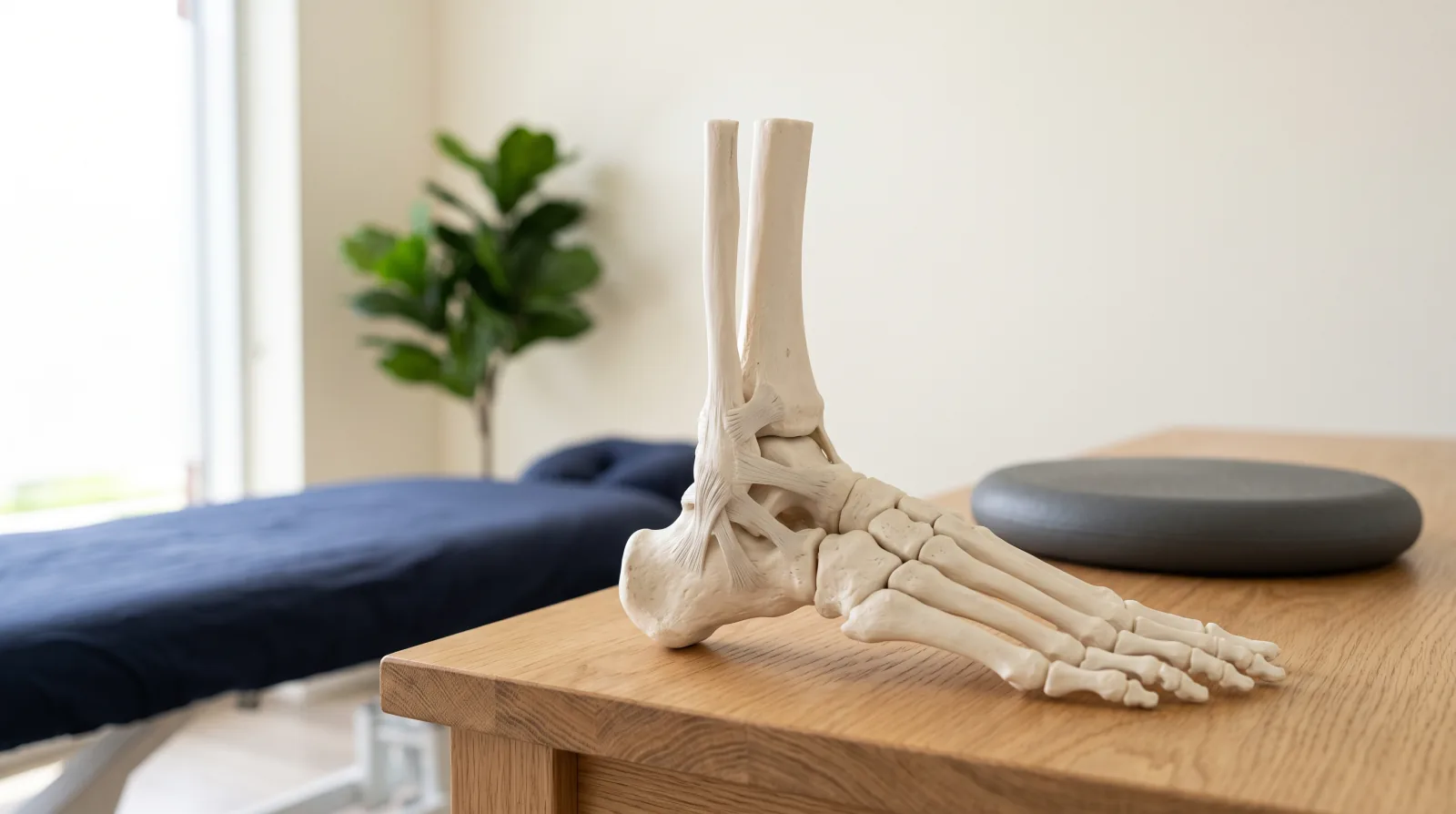
When a lateral ligament is partially or completely disrupted, the mechanoreceptors in and around the joint capsule are also damaged. The brain loses some of the moment-to-moment information it uses to know where the foot is in space. Reaction times to a perturbation (an uneven landing, a misstep on a root, a step into a hole) slow measurably. Peroneal muscles fail to fire fast enough to protect the joint. The joint becomes mechanically less stable and neurologically less informed at the same time.
This is the mechanism behind chronic ankle instability, the diagnostic label for an ankle that repeatedly rolls or feels unstable months or years after the original sprain. The International Ankle Consortium consensus on chronic ankle instability frames the problem and the rehab implications.
The Ottawa Ankle Rules: when imaging matters
Before rehab planning, the question is whether the injury is a fracture, not a sprain. The Ottawa Ankle Rules are a validated, widely used screening tool:
- An ankle X-ray is required if the patient has pain in the malleolar zone AND any of: bony tenderness at the posterior edge or tip of the lateral malleolus, bony tenderness at the posterior edge or tip of the medial malleolus, or inability to bear weight for four steps both immediately and at exam.
- A foot X-ray is required if the patient has pain in the midfoot zone AND any of: bony tenderness at the base of the 5th metatarsal, bony tenderness at the navicular, or inability to bear weight for four steps both immediately and at exam.
If all rules are negative, the probability of a fracture is very low and rehab can begin directly. If any rule is positive, attend Lions Gate Hospital emergency or your family physician for imaging.
The first two weeks: acute phase done well
The early-phase principles align with the PEACE and LOVE framework we use across acute soft-tissue injuries:
- Protection from further load in the first 1 to 3 days.
- Elevation, optimal loading (early controlled weight-bearing as tolerated), avoidance of anti-inflammatory medication early when possible.
- Compression to manage swelling.
- Education on what the injury is, what to expect, and the rehab pathway.
- Active progression after the first 3 to 5 days: pain-controlled movement, isometric calf and peroneal work, gentle walking.
A tensor bandage or lace-up brace is reasonable for the first 7 to 10 days for symptom management. Beyond that, ongoing reliance on the brace delays the proprioceptive reconditioning the joint needs.
The balance retraining program: the active ingredient
This is the part of the rehab the standard pathway commonly skips. A structured 6-to-12-week proprioceptive program changes reinjury rates substantially in published trials. The 2018 BMJ systematic review by Doherty et al. found a meaningful reduction in recurrent ankle sprain rates with balance training, with the strongest effects when the program ran for at least 6 weeks.
The progression we use:
- Phase 1 (weeks 1 to 2): static single-leg balance. 30 seconds on a stable surface, eyes open. Progress to 60 seconds, then to eyes closed.
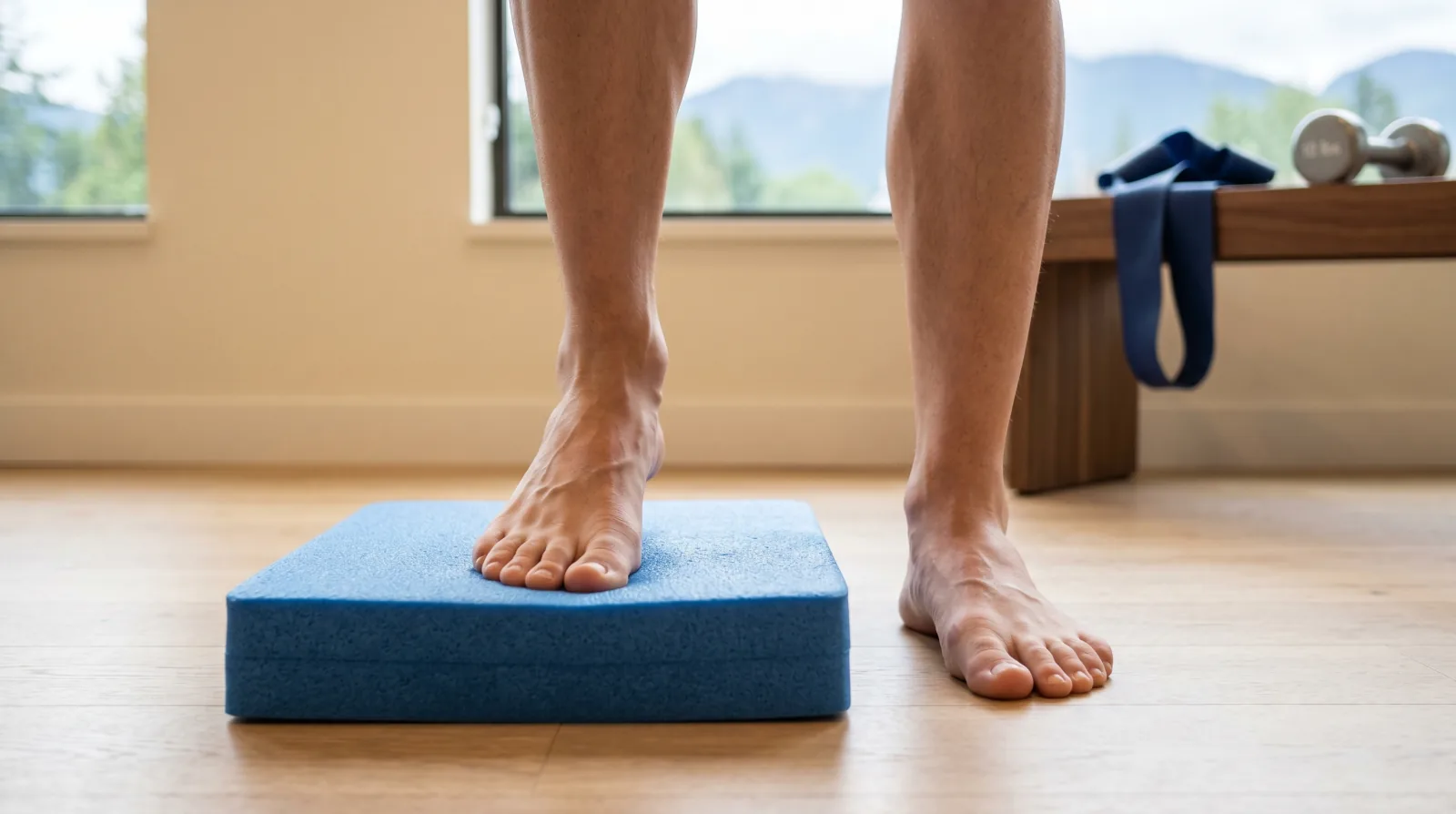
- Phase 2 (weeks 2 to 4): unstable-surface balance. Foam pad or balance disc. Progress through 30-second holds, then add upper-limb movement to create a dual-task challenge.
- Phase 3 (weeks 4 to 6): perturbation training. Balance under controlled disturbance: head turns, ball tossing, light external pushes, dual-task cognitive load.
- Phase 4 (weeks 6 to 8): dynamic landing. Single-leg hop to a stable landing, then to an unstable surface, then with rotation and direction change.
- Phase 5 (weeks 8 to 12): sport-specific terrain. Trail surface, uneven gravel, lateral cuts, jumps with planned and reactive directional changes.
The dose is roughly 10 to 15 minutes daily. The exercise selection is progressive. Patients who plateau at phase 2 and stop the program early are the patients who reinjure on the next descent.
Strengthening the peroneals: the active ankle stabilizers
The peroneal muscles (peroneus longus and brevis) are the primary active resistance against the inversion mechanism that produces most lateral ankle sprains. After a sprain, peroneal strength and reaction time are typically reduced. The strengthening progression:
- Resistance band eversion against a controlled load, 3 sets of 12 to 15 reps daily.
- Single-leg calf raises emphasizing eversion at the top.
- Lateral hop drills with controlled landing.
- Reactive lateral movements at sport-specific velocities.
Peroneal strengthening is the load-and-strength counterpart to the balance work. Both are needed, and skipping either component undersells the protective effect.
Returning to North Shore trail terrain
A graduated return-to-running progression after an ankle sprain in a trail-running patient:
- Walking outdoors for 30 minutes pain-free.
- Treadmill jogging for 20 minutes pain-free.
- Pavement jogging for 30 minutes pain-free.
- Easy gravel-path running on the Lower Seymour Conservation Reserve gravel routes.
- Smooth singletrack at conservative pace.
- Technical singletrack such as the BCMC and the Mount Fromme descents, at a planned reduced pace, gradually progressing.
Skipping a step is the common trap. A runner who returns directly to the Knee Knacker training schedule three weeks after a sprain has not given the proprioceptive system the staged exposure it needs. Our running gait analysis post discusses descent-specific eccentric demands that compound the ankle question on technical terrain.
When chronic ankle instability is the diagnosis
If you are reading this with a third or fourth ankle sprain on the same side, that pattern is chronic ankle instability rather than bad luck. The presentation:
- A history of multiple ankle sprains, often increasing in frequency.
- A sense of the ankle "giving way" on uneven surfaces.
- Persistent difficulty with single-leg balance.
- Often a measurable deficit in peroneal strength and proprioceptive testing.
The rehab is the same balance retraining and peroneal strength program described above, run more rigorously and for longer (12 weeks rather than 6). A small minority of cases do not respond to conservative care and warrant orthopaedic opinion for surgical stabilization, which is uncommon once a full course of structured rehab has been completed.
What a first ankle visit at Medstar looks like
A 60-minute initial assessment with a sport physiotherapist covering:
- Application of the Ottawa Ankle Rules and a referral to imaging if positive.
- A clinical grading of the sprain (I, II, III).
- A functional baseline: single-leg balance, peroneal strength, range of motion.
- An acute-phase plan for weeks 1 to 2.
- A specific balance retraining program with the right starting phase for the patient's baseline.
- A criteria-based progression to running, sport, and trail terrain. See the criteria-based return-to-sport post for the framework.
The strongest outcomes happen when the patient sticks with the balance program past the point where the ankle "feels fine." The proprioceptive deficits persist longer than the pain and swelling. Closing the gap between feeling fine and being functionally ready is the rehab work that prevents the next sprain.
This article is general education about ankle sprain rehabilitation. It is not personal medical advice. A regulated practitioner can grade the injury, apply the Ottawa Rules, and tailor the program to your sport, your tissue, and your history.
Sources
- Doherty et al. Treatment and prevention of acute and recurrent ankle sprain: an overview of systematic reviews with meta-analysis, BJSM
- Gribble et al. Selection criteria for patients with chronic ankle instability in controlled research: a position statement of the International Ankle Consortium, Journal of Athletic Training
- Stiell et al. Implementation of the Ottawa ankle rules, JAMA / NCBI StatPearls reference
- Vuurberg et al. Diagnosis, treatment and prevention of ankle sprains: update of an evidence-based clinical guideline, BJSM
- College of Physical Therapists of BC (CPTBC)
Common questions
Frequently asked questions.
How long does an ankle sprain take to heal?
Depends on grade. A grade I (mild ligament stretch) often clears in 1 to 2 weeks. A grade II (partial tear) often takes 3 to 6 weeks. A grade III (complete tear) can take 8 to 12 weeks. Functional recovery of the joint runs on a longer schedule than ligament healing. Proprioceptive deficits commonly persist for months after symptoms resolve, which is why reinjury is so common.
Should I see a doctor or get an X-ray after spraining my ankle?+
The Ottawa Ankle Rules are the standard screening tool for whether an X-ray is needed. The rules check for bony tenderness at specific points on the malleoli or in the midfoot, and the ability to weight-bear immediately and at exam. If any rule is positive, imaging is indicated to rule out fracture. If all are negative, the injury is almost certainly a soft-tissue sprain and rehab can begin directly.
Is a tensor bandage actually useful?+
For the first few days, an elastic compression wrap or brace can manage swelling and provide a sense of stability. After about a week, ongoing reliance on a brace or tensor often delays the proprioceptive reconditioning the joint needs. A short transition phase with a brace during return to sport can be useful, particularly on uneven terrain. The long-term goal is functional stability without external support.
Why do my ankles keep rolling on the trail?+
Chronic ankle instability, the residual proprioceptive and strength deficit after one or more prior sprains, is the most likely driver. The fix is a structured balance and proprioception program (6 to 12 weeks), often combined with peroneal strengthening and sport-specific terrain reintroduction. Many patients see a substantial change in reinjury frequency once the program is consistent.
When can I run on trails again after an ankle sprain?+
After completing a graduated return-to-running progression on stable terrain and demonstrating tolerance of progressively more challenging surfaces. A typical sequence: pain-free walking, jogging on the treadmill, jogging on smooth pavement, jogging on uneven gravel paths, then trail running on technical singletrack. Objective criteria drive the timeline rather than the calendar.
What happens if an ankle sprain is never properly rehabbed?+
The proprioceptive deficit left by the sprain tends to persist, and the ankle stays more likely to roll again on uneven ground. Repeated sprains on the same ankle are the pattern behind chronic ankle instability, not bad luck. Skipping the balance program because the ankle already feels fine is the most common reason this deficit is left unaddressed.
Do I need a brace for trail running after an ankle sprain?+
Not necessarily long term. A brace or tensor bandage can be useful during the return-to-sport transition, particularly on uneven terrain, but relying on it past the first week or two can delay the proprioceptive reconditioning the joint needs. The goal of the balance retraining program is functional stability without external support, with a brace used as a short bridge rather than a permanent fix.
How is a high ankle sprain different from the lateral sprains covered here?+
The program described here targets the lateral ligaments, the ones affected by the inversion mechanism behind most ankle sprains and the presentation covered by the Ottawa Ankle Rules. A high ankle sprain involves different ligaments higher up the joint and often needs a longer, more cautious loading progression. A physiotherapist can identify which structures are involved at assessment before applying either pathway.
Share this post
Copies a ready-to-publish LinkedIn post to your clipboard and opens the LinkedIn share dialog. Paste the text into the composer and publish.

Written by
Amir Ahmadi, PhDDr. Amir Ahmadi is a Registered Physiotherapist, Certified IMS Therapist and former Associate Professor. 20+ years of clinical practice in North Vancouver.
This article is for general information only and does not constitute medical advice, diagnosis, or treatment. Individual presentations vary, and assessment findings and treatment plans differ from person to person. If you are experiencing severe symptoms, neurological changes (numbness, weakness, bowel or bladder changes), or a significant trauma, contact your physician or emergency services. Care at Medstar Sport Physio & Health is provided by practitioners registered with their respective British Columbia regulatory colleges.
Filed under
- ankle-sprain
- balance-training
- chronic-ankle-instability
- trail-running
- north-vancouver