PEACE & LOVE: Why Sport Physiotherapy Replaced the RICE Protocol
Rest, Ice, Compression, Elevation was the standard for decades. Current sports-medicine consensus has moved on. Here's what replaced it, and why the change matters for your recovery.
BY SANAZ DAVARIAN, PHD
The RICE protocol has been replaced in current sports medicine by the PEACE and LOVE framework, published in the British Journal of Sports Medicine in 2019. The shift is based on how tissue heals: inflammation after a soft-tissue injury is a normal repair signal, not a malfunction. Suppressing it early with ice or anti-inflammatories may interfere with that process. The framework moves away from prolonged rest and ice as healing strategies, and toward protection in the first day or two followed by gradual, controlled loading. Ice may still be useful as a short-term pain tool. At Medstar Sport Physio in North Vancouver, this is the framework applied in the acute phase of soft-tissue injuries. How quickly the loading phase begins depends on the tissue involved and how the injury presents.
The RICE protocol (Rest, Ice, Compression, Elevation) was first described by Dr. Gabe Mirkin in 1978. It became the default advice for sport injuries for forty years. In 2014, Dr. Mirkin himself revised his position, writing that ice and complete rest "may delay healing rather than help."
The clinical literature followed. The framework that replaced RICE recognises a basic fact about tissue: it heals through controlled inflammation and progressive loading, not through suppression and rest. The current model is PEACE & LOVE, and the way it changes the first week of rehab is worth understanding before your next injury.
What does PEACE & LOVE stand for?
PEACE covers the first one to three days. LOVE covers the days after that, typically the subacute phase, when the work shifts from protecting the area to reloading it.
The PEACE phase
- P (Protect). Limit activities and movements that increase pain in the first day or two. Avoid prolonged rest. Full immobilisation is the exception, not the rule.
- E (Elevate). Raise the injured limb above the heart to help with fluid drainage.
- A (Avoid anti-inflammatories). Pharmacological anti-inflammatories and ice may interfere with the normal inflammatory response that healing depends on. Use them sparingly, for pain control only, not as the treatment.
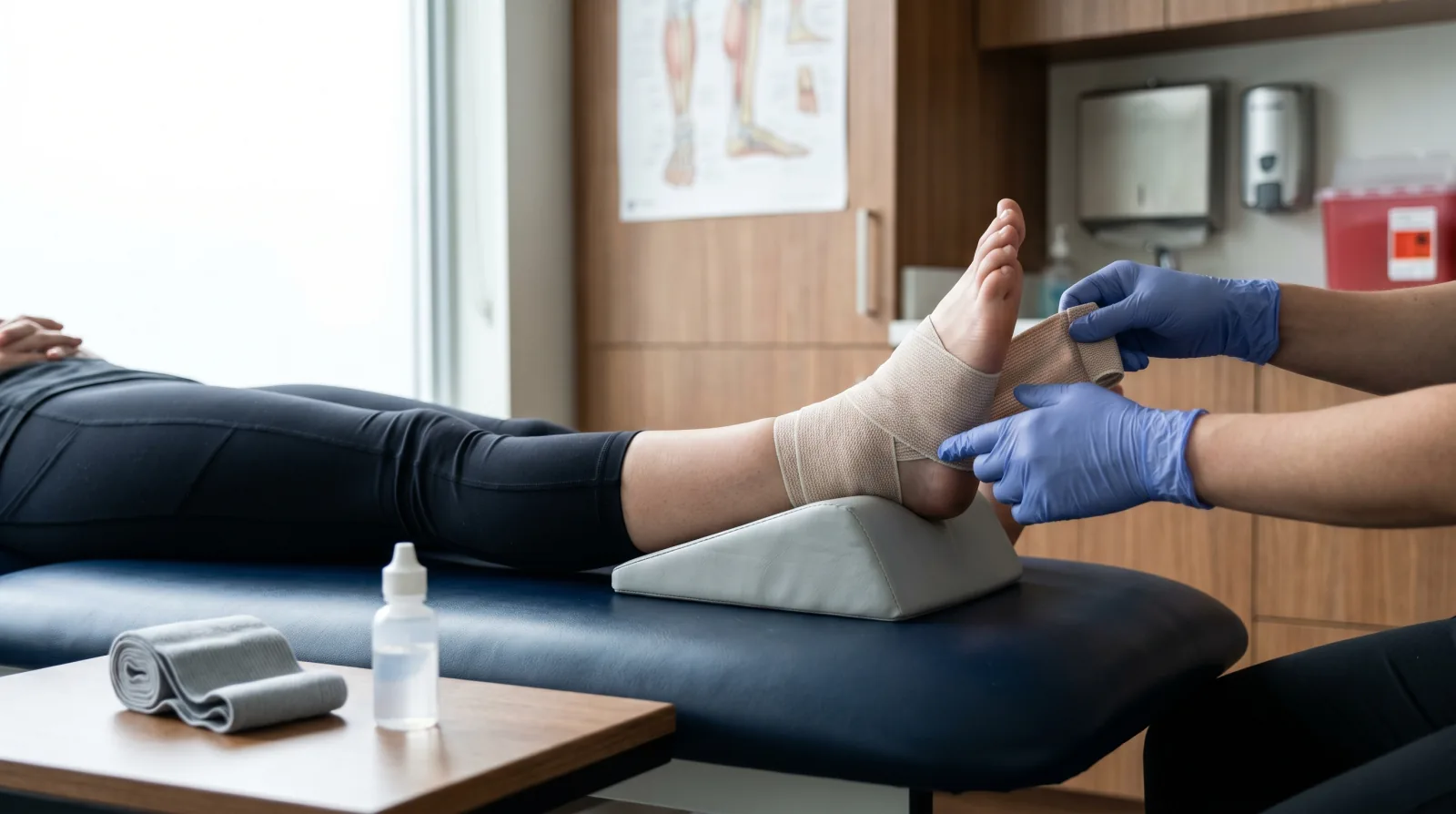
- C (Compress). Use elastic compression or taping to manage swelling and improve comfort.
- E (Educate). Patients who understand the recovery process do better. Set expectations early. Talk about timelines, about what flares mean, about what the active rehab phase will look like.
The LOVE phase
- L (Load). Mechanical stress is the signal that drives tissue adaptation. As soon as symptoms allow, introduce protected loading.
- O (Optimism). Beliefs about recovery influence recovery. Fear-avoidance behaviours and catastrophising are real predictors of poor outcome and are addressed deliberately, not dismissed.
- V (Vascularisation). Pain-free aerobic activity (walking, cycling, swimming) increases blood flow to the injured area and supports healing. It is not "doing nothing while you wait".
- E (Exercise). Active rehab restores mobility, strength, and proprioception, and reduces the risk of reinjury.
The mnemonic is friendly. The shift it represents is substantial.
Why was ice removed?
This is the part patients ask about most often. Ice has been a staple of sport injury care for so long that removing it from the recommended list feels strange.
The reasoning is mechanistic. Inflammation after an injury is not a malfunction. It is the cleanup and signalling phase that recruits the cells responsible for tissue repair. A 2021 review in the Journal of Athletic Training found that while ice reduces pain and swelling in the short term, the evidence that it improves recovery outcomes is weak, and some animal models suggest it may delay muscle regeneration.
The practical takeaway is not "ice is harmful". It is "ice is a pain-control tool, not a healing tool". Short bouts for symptom relief are reasonable. Prolonged or repeated icing as a way to speed recovery is no longer supported.
How PEACE & LOVE compares to RICE, PRICE, and POLICE
Four acronyms have governed acute soft-tissue care over the past fifty years. Here is what each adds and where each falls short, as of 2026.
| Framework | Era | Key shift | What it misses |
|---|---|---|---|
| RICE (Rest, Ice, Compression, Elevation) | 1978 to 2010s | Defined structured first aid | Promotes rest and ice; both now questioned |
| PRICE (Protection + RICE) | 1990s to 2010s | Added Protection as a first step | Same ice and rest problems as RICE |
| POLICE (Protect, Optimal Loading, Ice, Compression, Elevation) | 2012 | Replaced Rest with Optimal Loading, a significant step | Kept Ice; no psychological or vascularisation component |
| PEACE & LOVE | 2019 to present | Removes ice from the recommended approach; adds Avoid anti-inflammatories, Educate, Optimism, Vascularisation | Requires more clinical judgement than a simple 4-letter rule |
The progression is not cosmetic. POLICE was the first framework to replace Rest with active loading, which was a meaningful clinical shift. PEACE & LOVE went further: it removed ice, added the psychological dimension (Optimism), and brought patient education into the acute phase as a first-class component. The 2019 BMJ paper by Dubois and Esculier that introduced PEACE & LOVE explicitly positions it as a response to the limitations of all four predecessors.
The practical implication: if you learned RICE in a first-aid course more than five years ago, the framework has moved on. PEACE & LOVE is the current consensus in sports medicine and physiotherapy.
Where the framework still leaves room for judgement
PEACE & LOVE is a general framework. It is not a recipe. Three places in particular need clinical judgement.
The role of anti-inflammatory medication. For a patient with a moderate soft-tissue injury and no other complicating factors, the framework suggests minimising NSAIDs in the first few days. For a patient with a chronic inflammatory condition, severe pain, or post-surgical recovery, the decision is different and belongs to the prescriber.
The timing of load. "As soon as symptoms allow" is the working principle. The exact threshold differs between a recreational ankle sprain and a post-operative ACL repair. Your physiotherapist will set the threshold based on the assessment, not on a protocol.
Imaging. PEACE & LOVE assumes the injury has been screened and the diagnosis is reasonable. Red flags (significant trauma, suspected fracture, neurological symptoms, joint locking) still mean imaging and a clinician visit before any rehab plan starts.
How we apply it at Medstar
Most patients arriving at our North Vancouver clinic in the acute phase are still working from the old RICE script. The conversation in the first session usually covers three things.
First, what protected movement looks like for their specific injury. Not "rest", and not "go for a run", but the small windows of pain-tolerant motion that keep the joint informed.
Second, why the swelling does not need to be aggressively suppressed. Compression helps. Elevation helps. Ice for pain control is fine. Rolling around with frozen peas every two hours for five days is not the plan.
Third, when active rehab starts. For most uncomplicated soft-tissue injuries, that is within the first week, sometimes the same week as the injury, depending on the tissue. The phased model we walk through in the Return to Sport guide describes what comes next.
Quick reference: what to do in the first 48 hours (current guidance, 2026)
This is not a substitute for assessment. It is the first-aid-level translation of PEACE for a soft-tissue injury in an otherwise healthy adult with no red flags.
| Action | Do | Avoid |
|---|---|---|
| Movement | Gentle, pain-free range: small ranges, not full sport load | Prolonged immobilisation; complete rest |
| Ice | Short bouts if it helps pain control | Icing every 2 hours as a "healing" strategy |
| Anti-inflammatories | Use sparingly if pain is limiting; short course only | NSAIDs as a first-line treatment in the first 72 hours |
| Compression | Elastic bandage or sleeve to manage swelling | None. Compression is still supported |
| Elevation | Limb above heart where possible | None. Elevation is still supported |
| Activity | Walk, cycle, swim at pain-free intensity | Returning to full training before load tolerance is confirmed |
Red flags that change this picture entirely: significant trauma (high-energy mechanism), suspected fracture, neurological symptoms (numbness, weakness, tingling), joint locking, rapidly worsening swelling. Any of these → assessment first, not self-managed first aid.
What this means for your next soft-tissue injury
PEACE & LOVE is not a slogan. It is the clinical position taken by current sports-medicine literature on how acute injuries actually recover. The framework moves the work of the first few days away from suppression and toward early, protected, intelligent loading. That is the shift worth taking from this post into your next injury.
If you have a fresh injury and are not sure what stage you are in, the first assessment ends with a plan, not a rebook for another assessment. We treat patients through the full arc at our North Vancouver physiotherapy clinic, from acute injury through supervised active rehab and kinesiology to criteria-based return to sport. This article is not a substitute for assessment by a regulated practitioner.
This article is general information about acute injury management. It is not personal medical advice. A regulated practitioner can confirm whether the patterns described apply to you.
Sources
- Dubois & Esculier, Soft-tissue injuries simply need PEACE and LOVE, British Journal of Sports Medicine (2020)
- Mirkin, Why Ice Delays Recovery, DrMirkin.com (2015)
- Malanga et al., Mechanisms and efficacy of heat and cold therapies for musculoskeletal injury, Postgraduate Medicine (2015)
- Journal of Athletic Training, Topical Cooling (Cryotherapy) for Acute Soft-Tissue Injury (2021)
- College of Physical Therapists of BC (CPTBC)
Common questions
Frequently asked questions.
Is PEACE & LOVE actually better than RICE?
The clinical consensus has moved that way. RICE was formalised in 1978 by Dr. Gabe Mirkin, who later revised his own position in 2014. The evidence behind ice as a healing tool is weak. It reduces pain, but animal and human studies suggest it may interfere with the inflammatory signalling phase that tissue repair depends on. PEACE & LOVE retains what worked (compression, elevation, protection) and removes what the evidence stopped supporting (ice as a healing strategy, prolonged rest). It also adds a psychological dimension (Optimism) which has independent evidence for recovery outcomes.
How long does the PEACE phase last?+
Typically the first 24 to 72 hours after the injury. The exact window depends on the tissue involved and how the injury presents. A mild ankle sprain might move out of the PEACE phase within 24 hours. A moderate muscle tear or a post-surgical acute phase can last longer. Your physiotherapist will reassess and indicate when the work shifts into the LOVE phase, generally when pain is settling and the joint tolerates early loading.
Should I still use ice after an injury in 2026?+
Ice is still reasonable as a short-term pain control tool. The position has changed on using it as a healing or recovery strategy. Using it briefly to manage acute pain is still fine. If icing for 10 to 15 minutes helps you tolerate movement or sleep, that is appropriate. Using a bag of frozen peas every two hours for five days as a way to speed tissue repair is not supported by current evidence.
Does PEACE & LOVE apply to all soft-tissue injuries?+
It applies well to uncomplicated soft-tissue injuries in otherwise healthy adults: ankle sprains, muscle strains, ligament sprains, and similar presentations. Red flags change the picture entirely. Fractures, significant trauma, neurological symptoms (numbness, weakness, tingling), joint locking, or rapidly worsening swelling require clinical assessment before any self-managed approach. PEACE & LOVE is also not a surgical rehab protocol; post-operative recovery follows a different clinical pathway.
When does active rehab start under PEACE & LOVE?+
Under the LOVE framework, active rehab starts as soon as the acute phase allows. For most uncomplicated injuries, that is within the first week, sometimes sooner. 'Optimal loading' means introducing movement and gentle load before pain is fully gone, rather than waiting until the injury feels normal. At Medstar, the first assessment ends with a specific plan for when loading starts and what it looks like for that particular injury.
What does the 'Optimism' part of LOVE actually mean in practice?+
It means your beliefs and expectations about recovery genuinely influence how you recover. Fear-avoidance behaviours and catastrophising about an injury are real, documented predictors of a poorer outcome, so a physiotherapist addresses them deliberately as part of the plan by setting clear expectations, explaining what a flare-up means, and describing what the rehab phase will involve.
Should I stay completely inactive while a soft-tissue injury heals?+
No. The 'Vascularisation' letter in LOVE specifically calls for pain-free aerobic activity like walking, cycling, or swimming, which increases blood flow to the injured area and supports healing. Staying completely inactive is not the goal at any stage. Even the early PEACE phase favours limiting only the specific movements that increase pain, with full immobilisation reserved for the exceptional case rather than the default.
Is full immobilisation ever the right call after a soft-tissue injury?+
It can be, but it is the exception rather than the rule. The PEACE framework's 'Protect' step calls for limiting activities and movements that increase pain in the first day or two, and avoiding prolonged rest. Full immobilisation is reserved for specific cases your physiotherapist or physician identifies, rather than applied by default to every sprain or strain.
Share this post
Copies a ready-to-publish LinkedIn post to your clipboard and opens the LinkedIn share dialog. Paste the text into the composer and publish.

Written by
Sanaz Davarian, PhDDr. Sanaz Davarian is a Registered Physiotherapist with a PhD and 20+ years of experience. Certified IMS Therapist, former Assistant Professor of Physiotherapy. North Vancouver.
This article is for general information only and does not constitute medical advice, diagnosis, or treatment. Individual presentations vary, and assessment findings and treatment plans differ from person to person. If you are experiencing severe symptoms, neurological changes (numbness, weakness, bowel or bladder changes), or a significant trauma, contact your physician or emergency services. Care at Medstar Sport Physio & Health is provided by practitioners registered with their respective British Columbia regulatory colleges.
Filed under
- acute-injury
- peace-and-love
- rice-protocol
- sport-rehab
- return-to-sport
- north-vancouver