
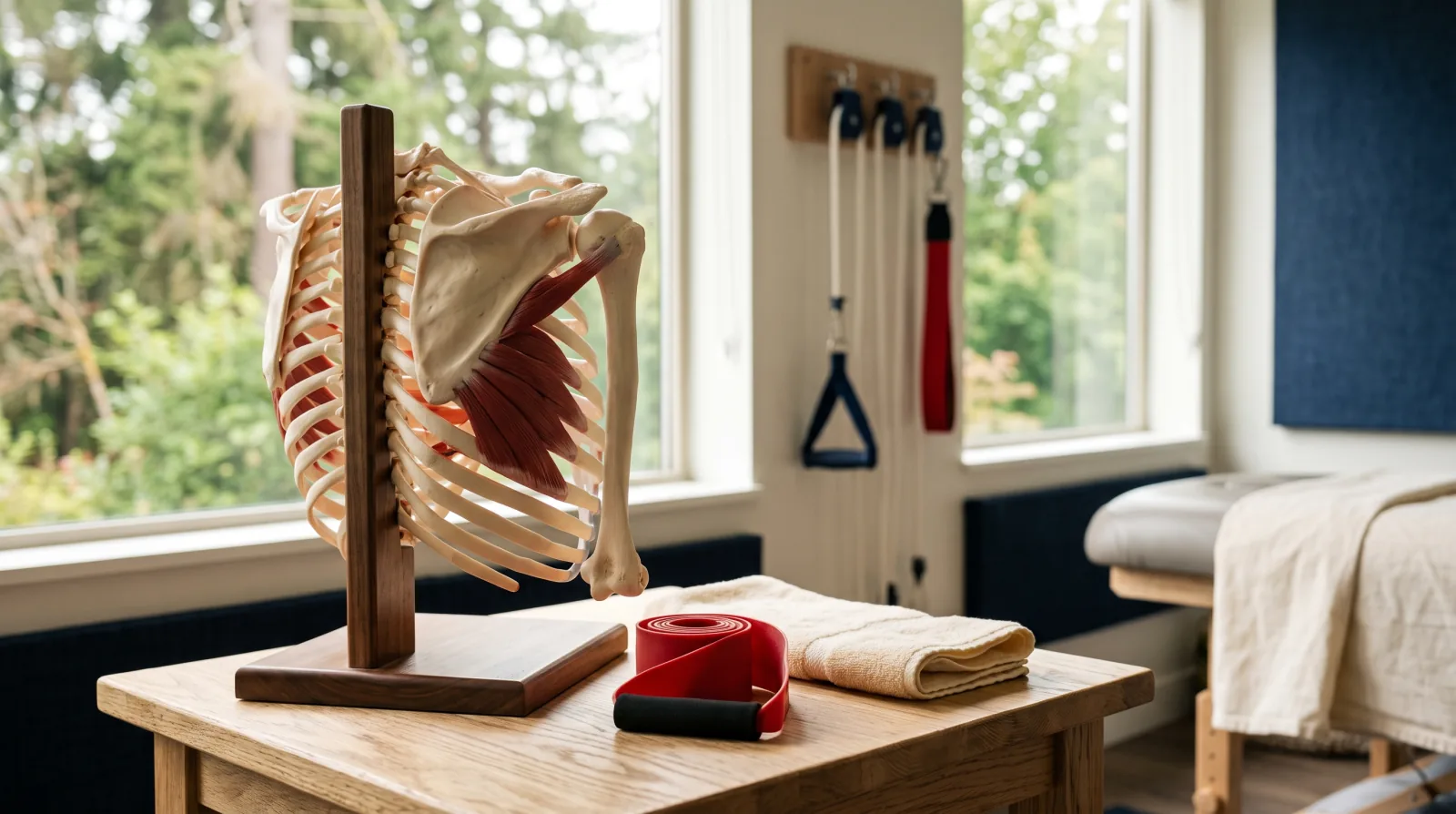
Shoulder Blade Winging: Why It Happens and How Scapular Stability Rehab Works
A shoulder blade that visibly lifts off the ribcage, rather than simply moving oddly, is a specific presentation with its own name and its own set of likely causes. Here is what winging actually is and how rehab addresses it.
BY ALI SHAFIEI, RPT
Someone does a push-up in front of a mirror and notices a shoulder blade lifting off their back like a small wing. That specific, visible sign has a name, a set of likely causes, and a rehab approach built around identifying which one applies.
At Medstar Sport Physio in North Vancouver, scapular winging describes a shoulder blade that visibly lifts or juts away from the ribcage, most often from injury to one of two nerves. Long thoracic nerve injury weakens the serratus anterior muscle and produces medial winging, where the inner edge of the blade lifts, while spinal accessory nerve injury weakens the trapezius and produces lateral winging, where the outer edge lifts. Many cases are a neuropraxia, a temporary nerve conduction problem that frequently resolves within six to nine months with physiotherapy support, and surgery is reserved for cases that do not improve after an extended period of conservative care.
Winging is a specific sign, not a general finding
It is worth separating winging from the broader idea of a shoulder blade moving oddly. Altered scapular movement quality in general, known as scapular dyskinesis, is common and shows up even in athletes with completely healthy, pain-free shoulders, as we cover in our post on scapular dyskinesis. Dyskinesis is a description of movement quality during arm motion, and on its own it does not point to a specific structural cause.
Winging is different. It is a visible, physical prominence of the shoulder blade lifting away from the ribcage, most obvious with a specific test such as pushing against a wall with both arms extended. Where dyskinesis is common and often incidental, winging more reliably points toward a genuine nerve or significant muscle problem behind it. Both findings live in the same general territory of shoulder blade mechanics, but they warrant different levels of concern and different next steps.
The two directions winging shows up in
Winging is classified by which edge of the shoulder blade lifts, and that detail is a direct clue to which nerve and muscle are involved.
Medial winging is the more common presentation. The inner edge of the shoulder blade, closest to the spine, lifts away from the ribcage. This happens from long thoracic nerve injury, which weakens the serratus anterior muscle. The serratus anterior normally holds the shoulder blade flat against the ribcage and rotates it upward during overhead arm movement, so when the nerve supplying it is compromised, the blade loses that anchor and lifts, particularly noticeable when pushing forward against resistance.
Lateral winging is less common and involves the outer edge of the shoulder blade lifting instead. This comes from spinal accessory nerve injury, which weakens the trapezius muscle. The trapezius helps elevate and rotate the shoulder blade, and losing its function changes how the blade sits and moves in a different pattern from serratus anterior weakness.
What actually damages these nerves
The long thoracic nerve has a long, exposed path along the side of the chest wall, which makes it more vulnerable to both sudden and gradual injury than many other nerves in the shoulder region. Causes include traction or stretch injuries, a direct blow to the shoulder, prolonged pressure such as from a poorly fitted heavy backpack, and certain surgical procedures in the chest or shoulder region. Neuropraxia, a temporary disruption of the nerve's ability to conduct signals without the nerve fibre itself being physically severed, is described as the most common underlying mechanism.
The spinal accessory nerve is injured through a different and more frequently iatrogenic route. It runs close to the surface in the neck, which puts it at risk during surgical procedures in that area. Injury during a lymph node biopsy or removal in the neck is described as the most common cause of spinal accessory nerve palsy, making lateral winging more often linked to a specific surgical history than medial winging is.
How the diagnosis gets confirmed
The physical examination for winging usually starts with the wall push-up test, watching the shoulder blades while the patient pushes against a wall with both arms extended, since this position specifically loads the serratus anterior and reveals medial winging that might not be obvious during resting posture. Serratus anterior weakness itself often shows up as difficulty raising the arm forward beyond a certain point, since the muscle plays an important role in the later phase of overhead shoulder flexion.
Beyond the physical exam, electromyography and nerve conduction studies are the tools used to confirm which specific nerve is involved and to characterize the severity of the injury, distinguishing a milder neuropraxia from more significant nerve damage. Imaging is used selectively, mainly to rule out other structural causes or to investigate a suspected compressive lesion along the nerve's path. Getting this diagnostic step right matters, because the winging pattern points toward the nerve involved, but confirming it changes how confidently a treatment timeline can be set.
What rehab for winging actually targets
Conservative physiotherapy is the standard first approach for most winging cases, and it centres on scapular stabilization work. Unlike a generic shoulder program built around the assumption of normal scapular control, rehab for winging has to account for the fact that a specific muscle is not currently doing its job at full strength, which changes what exercises are safe and useful early on.
Early work typically emphasizes range of motion and gentle activation of the muscles that remain functional, avoiding load patterns, such as heavy pushing or overhead pressing, that ask the compromised muscle to do more than it currently can. As nerve function returns, if it is going to, exercises progress to rebuild strength and control in the previously weak muscle specifically, alongside the surrounding shoulder blade muscles that have often been compensating. This matches the same order-of-operations logic used broadly in shoulder blade rehab: mobility and motor control before heavier strength work, a principle also central to managing swimmer's shoulder, where the shoulder blade's positioning directly affects how much load the rotator cuff has to absorb during repetitive overhead movement.
The timeline, and when surgery enters the conversation
When the cause is a neuropraxia, the outlook is generally good. This type of nerve injury frequently resolves within six to nine months, and physiotherapy during that window supports the shoulder while nerve function is recovering, rather than being the thing that fixes the nerve itself. Clinicians typically continue watching a case for up to two years before surgical options are seriously considered, since spontaneous recovery can continue over that longer window even when early progress feels slow.
Surgery, including nerve decompression procedures or muscle transfer operations that use a different muscle to replace the lost function, is reserved for cases that do not show adequate improvement after this extended period of conservative management. For most people with a straightforward neuropraxia, that surgical conversation never becomes necessary, which is part of why an accurate early diagnosis, rather than assuming the worst from a visibly winging shoulder blade, matters so much.
When to get it looked at
A shoulder blade that visibly lifts during a specific movement, especially alongside new weakness raising the arm, difficulty with overhead tasks, or a history of a recent neck or chest surgery, biopsy, or a significant blow to the shoulder, is worth having assessed properly rather than working around with generic shoulder exercises. Sudden severe weakness, numbness spreading down the arm, or winging that follows a major trauma should be seen by a physician promptly to rule out a more significant nerve or structural injury.
If you have noticed a shoulder blade that does not sit flat against your back, book a 30-minute assessment and we will test which pattern is present, build a stabilization program matched to the muscle actually involved, and track how it is progressing over the following months. You can also read about what we treat or reach the clinic here.
This article is general information, not personal medical advice. A regulated practitioner can confirm whether the patterns described apply to you.
Sources
- Winging of the Scapula, StatPearls, NCBI Bookshelf
- Winged Scapula: A Comprehensive Review of Surgical Treatment, PMC
- Sciascia A, Kibler WB. Current Views of Scapular Dyskinesis and its Possible Clinical Relevance, International Journal of Sports Physical Therapy (2022)
- College of Physical Therapists of BC (CPTBC)
Common questions
Frequently asked questions.
What is scapular winging exactly?
Winging is when a shoulder blade visibly lifts or juts away from the ribcage instead of lying flat against it, most obvious when pushing against a wall or during arm movement. It is distinct from the broader and more common finding of scapular dyskinesis, which describes altered movement quality without necessarily involving a visible prominence of the shoulder blade off the ribcage. Winging is a specific physical sign, usually pointing to a nerve or muscle problem rather than a general movement pattern issue.
What causes a winged scapula?+
The two most common causes are long thoracic nerve injury, which weakens the serratus anterior muscle and causes the inner edge of the shoulder blade to lift, known as medial winging, and spinal accessory nerve injury, which weakens the trapezius muscle and causes the outer edge to lift, known as lateral winging. Long thoracic nerve injury is often a stretch or compression injury, sometimes from a blow to the shoulder, heavy backpack straps, or certain surgical procedures, while spinal accessory nerve injury is frequently iatrogenic, most often following a lymph node biopsy or neck surgery.
Does a winged scapula go away on its own?+
Often, yes, when the cause is a neuropraxia, a temporary nerve conduction problem rather than a structural break in the nerve fibre. This type of injury frequently resolves within six to nine months with physiotherapy support, and clinicians typically observe for up to two years before considering surgery. Winging from a different cause, such as a muscle or tendon problem, follows a different path, which is why an accurate diagnosis at the start matters.
Is scapular winging the same as scapular dyskinesis?+
No, though they overlap. Scapular dyskinesis is a broader term for altered shoulder blade movement quality that is common even in pain-free athletes, covered in our post on [scapular dyskinesis](/journal/scapular-dyskinesis-shoulder-mechanics). Winging is a specific, visible sign, a shoulder blade physically lifting off the ribcage, and it more often points toward a nerve or significant muscle weakness rather than the subtler motor control issue that dyskinesis usually describes.
What does treatment for a winged scapula involve?+
Conservative physiotherapy is the first approach for most cases, particularly when the cause is a neuropraxia. This includes scapular stabilization exercises, range-of-motion work, and monitoring nerve recovery over time. Surgery, including nerve decompression or muscle transfer procedures, is reserved for cases that do not improve after an extended period of conservative management, generally after roughly two years without adequate recovery.
How long does scapular winging rehab take?+
It depends heavily on the underlying cause and whether the nerve injury is a temporary conduction block or more significant damage. Many neuropraxia cases show meaningful improvement within six to nine months, though full strength can take longer to return. Rehab continues in parallel with nerve recovery, since keeping the muscle and joint working well supports whatever return of nerve function occurs and prevents secondary stiffness or weakness.
Can exercise make a winged scapula worse?+
The wrong exercise, particularly loaded overhead pressing or heavy pushing before the shoulder blade can control its position, can aggravate symptoms or reinforce a poor movement pattern. This is why assessment before starting a program matters, so the exercises match the specific muscle or nerve involved rather than following a generic shoulder routine that assumes normal scapular control to begin with.
Should I be worried if my shoulder blade sticks out a little?+
A small, symptom-free prominence noticed only on close inspection is a different situation from an obvious wing that appears with a specific movement, such as pushing against a wall, or one that comes with pain, weakness, or difficulty raising the arm. The second pattern is worth having assessed properly, since it points toward a nerve or muscle cause that benefits from an early, accurate diagnosis rather than watching and waiting indefinitely.
Share this post
Copies a ready-to-publish LinkedIn post to your clipboard and opens the LinkedIn share dialog. Paste the text into the composer and publish.
Written by
Ali Shafiei, RPTAli Shafiei is a Registered Physiotherapist with 10+ years of clinical experience in musculoskeletal, neurological and sports rehabilitation. North Vancouver.
This article is for general information only and does not constitute medical advice, diagnosis, or treatment. Individual presentations vary, and assessment findings and treatment plans differ from person to person. If you are experiencing severe symptoms, neurological changes (numbness, weakness, bowel or bladder changes), or a significant trauma, contact your physician or emergency services. Care at Medstar Sport Physio & Health is provided by practitioners registered with their respective British Columbia regulatory colleges.
Filed under
- scapular-winging
- shoulder-blade
- serratus-anterior
- long-thoracic-nerve
- shoulder-stability
- north-vancouver


